Building Your AI-Powered GTM Engine: The Future Tech Stack | INBOUND 2025
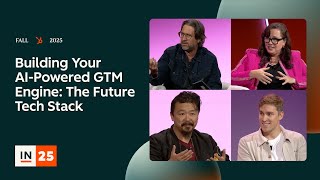
Stevie Case from Vanta, Matti from 11 Labs, and others show how AI is reshaping sales and marketing. They cover AI BDRs, voice agents, automated CRM updates, and real-time coaching, all built on centralized customer data. The focus: AI amplifies humans, not replaces them.
Chapters
Thank you, everyone. Great to be here. All right. Yes. We have another panel on AI. All right, I'm sorry, it's on Go to Market AI but it is not about what is going to happen. It is about where we are today. We have three awesome panelists that are running groundbreaking companies and we're going to talk about how they're leveraging AI within their go to market stack and wrestle with all these questions. I'm psyched to have a front row view and learn from them on this. So let me introduce them and help me out and welcome them. So we got three great panelists. Stevie from Vanta, Siki at Runway and Matty at 11 Labs. Welcome to the stage.
All right, guys.
All right, so I'm sure a lot of folks have heard of your companies, but let's just like set the playing field. Stevie, if you want to kick us off, intro on you, the company, and then a little bit on like how you're using AI and go to market.
Okay, you got it. So Stevie Case, chief revenue officer at Vanta. Vanta is a trust management platform. So what that means day to day is that we help companies build trust, earn trust, prove trust for founders. We help them get compliant for the first time and then upstream. When we're selling into enterprise, we're typically selling into the office of the CISO and we're helping them build their security compliance programs with a single pane of glass. So we are a 100% direct field sales organization. So today Vanta is about 1,000 employees. I've got about 150 quota carriers and about 100 SDRs globally. And we've got AI sort of everywhere in the tech stack. So we focused most heavily initially on how we can supercharge the work that our team does both in building pipeline and in closing deals. So our stack today is that we've got at the core, you know, all of that data, all of that information flowing through HubSpot. We are then personalizing with tools like Clay to create like a very custom one like data enriched current Personas. So we're identifying the perfect Persona we're setting up to sell to them. We're then taking everything we know about the right value prop for those Personas. We, we're creating custom messaging for our team and we've got people picking up the phone. It's a little counterintuitive. I'm actually making a big bet on humans. Despite being very bullish on AI picking up the phone and using those scripts with value based messaging that we've Created bespoke to each person. So we've got AI everywhere in that stack. But it's really about supercharging the humans, not replacing them.
Okay, different approach. Ziki, you're not as human driven, not as big of a team, but talk to us about how it's going at Runway.
So what Runway is we are a next generation finance platform. So we make the business and the financials of this business in particular understandable to both finance and the rest of the company. So our customers include Lambda Labs, AG1, AngelList, Superhuman. And our go to market approach is a little different in that we launched about three years ago and we had a very small team with this website. And so this is before you can buy a lot of great off the shelf GTM tools. And so when we launched this website it went pretty viral and we were getting multiple leads a minute and so we had to build our enroll our own tools to qualify. And so since then we've of course started consolidating all of our customer data onto HubSpot. So not just lead data and opportunity data, but also we got rid of our customer success tool and have all of that data on HubSpot as well. And we piped that through a combination of default and a bunch of tools that we built in house. And most Today close to 100% of our AR comes inbound. We're looking to change that. But we too, we now have SDRs, we're doing more outbounding. And my contrarian view on this is that in this world where more and more is being automated, proof of human becomes more valuable. So we have real people, we try to do very creative marketing events. Whether that's. So like our locked jacket we put like this, we emailed a bunch of bags with a timer lock and they all unlock at the same time. And you get a jacket like this. We have a hot sauce dropping next week, which you'll probably hear about, but that's kind of our philosophy.
Amazing. Can you talk about that? You know the decision to move everything into one, into HubSpot and like take us back to that moment. Why was it just because like the data centricity was key to enabling these tools?
Yeah. So if you think about some of the things you want to know about your customer and a question you might want to ask, Right. It's not just closing a deal. You want to know which marketing channels it came from. You want to know if they onboarded, if they're successful, what is the nature of their business, who is in their business. Who is the model owner? And so the life cycle of a customer goes from someone seeing the ad all the way to onboarding and being successful and referring other people in order to make useful decisions like who should we target more of and where do we find them? Having it in one place is really useful. And so we bring that hotspot data and connect it to Runway, connect it with all of our marketing data and our operational data down to individual account executives and we're able to make decisions about where we should optimize and how we should invest our marketing dollars.
Okay, so yeah, Matti, I mean you're in the thick of it. Everyone has some AI in their product. I mean you guys are almost as native as it comes in the voice space. Tell us about you and 11 labs and then how you all use go to market architecture.
Thank you and thanks for having me here. Great to see so many people. At 11 labs we combine voice, AR research and product deployments. We are on a mission to be the voice of the technology, help people make interactive experiences where voice is that future interface, whether it's call centers, customer support, personal agents. And then second, help people make things available in audio, whether that's in a spoken world or in any language out there. And the way we do it, we combine those two parts. So we have a research division which helps us deploy frontier models from text to speech to speech to text to bringing those models together to really make an orchestration and a end to end experience work. And on top we have two key offerings. One is our creative platform offering where people can create narrations, voiceovers, dubs to bring it to other language. And then a gentic platform offering where people can add voice to an existing agent or deploy an entire experience to their customers, combining that with the business logic. And of course being from the beginning kind of at the research frontier, AI was a big part of the flow. We started with insights of trying to generate as much as possible in terms of what's actually happening in their customer conversations and how they are using the product and bring that to the field. That was also where high HubSpot came into play, where we are doing a lot of enterprise marketing. We want to understand what messaging works, what doesn't, and then use that to refine partly the messaging, but also partly what we might need to bring into the product. Second, of course the big bucket is productivity. How we can think about using AI to make ourselves smarter, quicker, understand how our reps are performing through tools like Gong, and then elevate that further and maybe the last one, and I think this one is the most interesting bucket for me is we try to dog food a lot of the technology ourselves. And maybe one example was trying to use our voice agent in part of the qualification flow. So we have a lot of inbound coming to 11 labs and of course if we detect this is the person or company we want to speak with, that goes through the usual flow. But we also have a lot of inbound where we are not sure. And that happens internationally, happens sometimes in us. So we deployed effectively just for that sub segment, an AI BDR where you can jump on a call and accelerate the process of getting to the team. So we disclosed that you will be speaking with AI voice agents and you.
Built it on your platform.
We built it on our platform. You can then give a little bit more detail about the use case, talk through, which actually helped us close the deals we might not get to for weeks or months or never get to, which was great. And an interesting piece from that was that actually people were more keen to speak to the voice agent and sometimes leave the details that they would. So that was a great, amazing.
I do want to come back to you on internationalization. Has anyone gone international? Have you been a leader in taking your company international? It is such a pain. It's gotten like 20 years ago you had to rewrite everything, rewrite the website, all the different languages, you know, the whole localization thing. We did pretty good I think in the last 10 years of making that process easy. But you have to remember like someone still needs. I remember at HubSpot, I think like someone came inbound and signed up and from like they were only spoke Portuguese and they called the support line and we didn't know yet. And the support rep literally stood up, was like, does anyone speak Portuguese to like the whole office? Like it's. It's so difficult to be able to get ready for. And you already do business as a pretty young company in like 32 countries. So can you talk to us a little bit like, how is internalization and localization going to evolve in this AI era?
And it's funny you mentioned this example. We see this all the time across our customers where it's like we have customer support across all types of clients. How can we have our rep in English? But then if we want a person from Portugal or any other country, how do we switch this out automatically to be able to. To speak this other language? Of course there's like two parts to it. There's the voice agent part to it, but also Just the marketing materials, like how do you bring the same messaging in any of the markets? So the way we approach this from very early days that a, we need to localize a lot of the work we do in any language. So if you are watching a video, if you are reading about our work, you can access that in other languages. And beyond it being available in that content, it actually carries the same emotion, the same intonation in that voice too. So that's one big piece. Second is the product itself. So actually internalization, the product experience. People will go for the first element of the flow. If the product is in there, you will have a big drop off rate. And especially in Japan or Korea where we do a good amount of business too, that's definitely the most felt and then free which is more specific to the go to market side. And as a company that tries to cater to 30 plus languages, we use of course a lot of AI, but we also have reps that speak a lot of those languages too. And especially it helps with the first elements of the flow. But then we can continue through the flow with someone that speaks the language, is the expert of actually using the technology, which really helped. So now we have people everywhere and very timely today I think we opened Brazil.
So perfect. Back in the morning. Know that. And that example was spot on. All right, so Stevie, back to you. You've kind of coined this really cool strategy on go to market architecture. Going from system centric of function centric to system centric.
Yes.
What does that mean? And can you like bring it to life with a very specific use case so we can conceptualize it?
Absolutely. So I've got a very large go to market team. We sell to humans who are in the field of security. As you can imagine they are.
It's weird that you have to clarify that.
Well, it's funny because they are, they are the least amenable to AI first technology. AI BDR does not work trying to sell to a chief information security officer. So our business is built on trust. Therefore we like to put humans at the front. And look, I grew up in a very capacity model centered on quota carriers world and I am building a human first go to market machine. But we've turned it on its head and we think of it now systems first. And because we are putting the systems first, those systems are about supercharging our humans, making them more effective. So I don't want them updating CRM. I don't want them like writing notes. I don't want them having to think what I want them to think about is having a high quality conversation with a customer. So you know, we use GONG to record a call. We're not just taking that transcript, we're actually taking the insights. We're piping those into CRM. We're then using that to create automated follow up notes that are highlighting the follow up action items, key points in the value journey. And it's very specific to the demographics, the firmographics of that buyer and the conversation they just had. So we're then making our sales team look better and sound smarter. So we're able to center the conversation on value. And it's not apparent to the buyer that there's AI anywhere in that flow because all they're experiencing is a human. As we've done that, one of the interesting transformations is, is that the functions do start to blend together. So when you create an organization that systems first, you have to build that around the customer journey. And this whole notion of a salesperson in a silo and a customer success person in a silo or a support person, it's not really how it works anymore. You have to have people on your team that can think across the entire customer journey about not just like value delivery and how we talk about the value prop of our solution, but how we deliver it at different points during that journey. So we need to hire people who are much more creative, much more growth mindset. We are expecting our humans to build their own workflows. We're using an agent builder platform called Dust and everybody can build their own agents. So that is the kind of person we now want to employ. And we're thinking beyond just I've got 20 years in this function and all I know is this function, that person probably isn't the right fit.
Okay, so two takeaways I find there that I'm definitely seeing across the industry is there's this game of abstraction that's going on of how far we're being abstracted from where the human work is happening today. And I think the first level abstraction gets us away from doing anything but the actual point of our job in this example. So selling. And I don't know how you think about this number Stevie, but like usually people call like selling time which represents like if you look at the, you know, 40 hours in a reps week, what percent is actually customer facing versus other stuff? And I think, I don't know if you measure that, but I think the best in class these days is like 30 to 40%. Do you measure it?
We do measure it. And in fact, one of the biggest metrics we're focused on right now, it's increasing selling time and decreasing admin time.
Yes.
You know, we, we don't want our sellers having to do account research or think about how our, how they should pitch the platform. Like we need them to have a deep understanding of that. But then we want to serve up to them on a platter the perfect customized set of messages that they can share with that buyer. We want them to be able to think about. Objection. Handling and discovery and the things that are like creative human endeavors, not matching data together or writing things down. So we have automated so much of that work that we really just want them in that creative space. And I think it really does just transform the type of work that our quota carriers do. And my hope would be to get that well over 50%. You know, I think that.
What are you at now?
There's, there's no, we're, we're, it's hard to measure. We're like, yeah, we're hovering right below 50%. But we are active. We just did a big time study and we set a goal to knock off hours every week of every task.
It's amazing. Think about that for your team as founders, CEOs, whatever. Just like CROs. Just that selling time is a great metric to motivate folks around AI adoption within go to market. Last one, that's off script. I'm sorry to do this to you, Stevie, but like you just mentioned how, you know, the, the, the handoffs, the functions.
Right.
And we had this moment 20 years ago, probably Aaron Ross's work in predictable revenue invented the specialization of SDRs and then reps and eventually CSMs. Are we going to go away and go back because like with the agents.
Help, yes, certainly people will have areas of specialization and things that they do better than others. But I think that the people who will be successful within revenue organizations in even the near future are going to be the ones that understand how to use AI as a thought partner and not just a way to automate tasks, but it's a way to get smarter, much faster. AI is just completely democratized learning. So the idea that you need to be in a specific field or a specific role and do that for a dozen years to be good at it, that has to go away. And I think that means that like the real players are going to be the ones that are across the whole spectrum. Like I would way rather hire somebody that's worked in all of those functions rather than specialized.
Okay, so Sikhi, the breakout for chat GPT that made a mainstream was like November 2022. You were playing with it in 2020 when we were trying to find masks and Covid tests.
Right.
So go back to that moment, what made you dig in? And I'm sure there was a bunch of fast failure experimentation that led to breakthroughs. Can you talk us through that?
Yeah. So we started the company around mid 2020 and that's when GPT3 first came out. I think that's the first breakout moment. We're like, oh, this is really serious. We're there in the sci fi world. And the trigger was as I mentioned when we had this website and it was just blowing up, we couldn't handle it and we needed to hire more people or I needed to go and build a tool and I noticed a few things. One is the tools are so much easier to build now you can just hook up a ChatGPT call, call Clearbit and say vaguely, this is our ICP and if it's qualified, put in this slack channel. It does not qualify. Put in this slack channel and describe why you made this decision. And if it is qualified, by the way, I want you to go to our rep's Gmail inbox and write based on all of this context a outbound a response to it, put it in drafts, customize this person, make it really clever, don't make it obsequious. It's like a two page long script and our reps wake up in the morning and they see a bunch of drafts and just press send. And now there's amazing tools that you can use off the shelf for this. That wasn't the case three years ago. And so often there is a question of like do I build or do I buy? And my philosophy is you should build to learn what to buy.
I love that. And for me sometimes like simple example like just managing something through a Google sheet or something just to figure out what you want it to do and then look if a product can match it but you're taking it to a whole new level where you're building on the basic LLM and then you decide if the tool can match that.
And the capabilities have gotten so much better and so much more accessible over time. And so to the point about the roles are merging, we're definitely seeing that. So our expectations for an AE is that they should be able to now understand SQL and explain financials to a pretty sophisticated buyer and that that blends the line between our our solutions architect.
And a because of what you're selling Right. And does like a lot of folks are like, I want to do this, but like I'm struggling with my talent. You know, I've got, I don't know if this is Rev Ops or whatever, but like they're like my Rev Ops person's really good at the HubSpot CRM. They're really good at like, you know, the dashboards and like. But they don't know, they don't have experience with LLMs. Like is there a different, is this.
Does this sit in.
Rev Ops is a different type of person.
So I think it starts from the top down. You really have to role model it. So, you know, I've built the number one like Education GPT in a ChatGPT store. We do a lot of infrastructure investment. So you know, if you go on Twitter, my Twitter is Blader, like follow, subscribe. But there is a screenshot of a real Slack thread from our team and this happens almost every day. And it's a CXM just got off a call saying this customer encountered this issue. And the CXM tags Cursor in Slack and that's the coding agent. Cursor will then write the test, develop the feature, push a pull request. Of course the engineer will review it and it's literally between feedback and production with about 12 minutes. And so that's the blurring of lines. You can have CX people do product and do engineering.
Crazy. All right, Matti, so you sell to some big companies. Maybe if you could give us an example. And some folks do it. You run medic, you run account based selling, you're multi threaded, you start the deal at 100,000, it can grow to 10 million. How does go to market AI change that type of emotion? Maybe you could give us a specific logo you can talk about and what you all do.
Yeah, I think few good examples is companies like Cisco, Deutsche Telekom, Epic Games, which are of course presence everywhere and across all. I think first in general, as you think about selling in general, I highly agree with what Stevie mentioned where we tried to use of AI tooling to focus less on admin and more on understanding the customer, understanding them deeply.
Is there a single person that owns that account or is there a team that owns that account?
For all accounts there's one specific person as a key owner and of course that comes with a bigger team.
So for Cisco there's one person that's.
Like a support team and then of course we have people that will own different parts of that work. I think the other interesting piece that is mentioned and we've seen that across those accounts too is I think twofold. One, a lot of AI now allows us to get a bigger understanding of the customer. What works across the different sub teams across that customer, how we can bring that to what they are telling are their priorities and then actually act on that too. And then there's a second piece where across our go to market team, people take more hats, as you both said. But in our case this also means they become a little bit more technical, more closer to like showing what the value is. And that's across all those customers internationally, where the delta from the use case to the prototype to then bring your production is much, much, much smaller. And in many ways I'm proud of the team where a lot of people are actually showing back to the rest of us across our go to market on like, what can you do? And of course now with vibe coding as an example, you can actually create a use case of how this will be mocked up in the customer before you even start a deployment. Which helps so much as you speak with the different teams and as you kind of clear that first element in making this a bit more real. I think hiring is very big part of bringing those reps in the first place. We try to hire for passion for the space and the agency to actually go through that step. But then when you do have those people in any of those accounts, then it's us deeply understanding the customer, bringing AI to understand what's actually working, what's not, and then using that to prototype quicker than you would in the past.
Okay, great. So I'll do a quick one for each of you. When we look ahead, we'll do a little look ahead now, not what they're doing. Like you all are pushing the edge on the frontier on how this stuff works. As we look ahead to 20, 26, what is going to be that AI driven go to market use case that blows everything open that you think is coming. And maybe Stevie, do you have a take on that?
Yeah, I'm very passionate about this. I think it's actually enablement because I believe very deeply in humans leading the process, getting humans up to speed, teaching them everything they need to know and then helping them iterate, helping them understand what they didn't do well, what they did do well. And then improve.
Improve.
Like with agents.
Yes.
So taking away the human trainer, the exact pressure on the salesman, maybe the sales manager to rep ratio goes from like, you know, the rep to is like 8 to 1 to 20 to 1.
Yes.
Because that Coaching pressure's off.
That's exactly right. I think the ratios change. I think enablement moves away from this. We're going to run a live session and teach you to. Every call you do is scored in a way that's specific to your business and value prop and the way you want them selling. So. So you build your methodology in. They get a score in real time feedback. Not even after the call, but during the call. They get live coaching and then you get a summary every week. You're moving them in the right direction and then you get feedback about how those folks are performing in real time.
And what's cool about it is it's low risk, high impact because it's not customer facing.
That's right.
Siki, what's yours?
I got one in half. One is the continued democratization of the ability to build. We have a sales rep who ship dark mode. Right. And this is the cutting edge. But this is coming. Everyone is going to be able to build more sophisticated software a lot faster and so you can experiment and learn a lot more than you otherwise could have. The other one is a little bit contrarian. I think we're still struggling to make AI useful in upmarket for outbounding. It's not really a thing. But in that regime for outbound. For outbound marketing, upmarket. Right. The creativity, the human relationship, the proof of human is still really important. So I think in that world what is even more valuable is brand and creativity. And I think I'm looking forward to the resurgence of the importance of those things. In a world where the baseline is AI. AI everyone.
Matty.
I'm learning from you guys what will happen. I do think AI is you have.
A new favor now.
100%. I think the enablement will happen in 2025. We are already seeing that in some of our work is such a big problem.
You build it yourself.
We build it ourselves, of course, with help of work a few companies as well to help them build it. But even our reps now will actually have an agent that they speak with how to sell. Recently we deployed a hiring agent that you can prep for an interview before you start interviews. I'm a big believer in the enablement piece too. I think maybe the other part is in 2026 is going to be optimizing and we've seen this a case recently in a client where for voice when you interact, you'll be able to optimize the experience to the specific customer that's calling in which will actually improve the experience altogether. We work with A healthcare client where they have a very older population calling in, but also a very much young set of folks and they want a voice depending on who calls and the style. It's an older population, calmer, slower, very different delivery of information. And the younger one, of course, much more snappy, quick and emotional. And I think what will happen is that with that combination of voice agents and being able to understand who is calling in for parts of the flow, and I agree it was not going to be a whole flow in 2026, more of the experiences will be delivered entirely through voice agents.
So we probably have time for maybe one more topic and I think this one's pretty critical and related to architecture. There's a lot of thought leaders that talk about the importance of an interoperable architecture and agile architecture. And what that means is this stuff is changing so fast that if some vendor has a breakthrough, you wanna be able to take advantage of it as soon as possible and that's gonna be able to create an edge for you. Probably the best example I see, which is a consumer one, was like perplexity back in February when Deepseek broke out. I think in 48 hours they had that put into the engine and that just like that's how we have to sort of think. And I don't know Stevie, if you've thought about your go to market architecture to be agile in that way.
Yeah, we definitely have. And it's a different paradigm than in the past. You think of rebops and systems of the past, it was individual SaaS, products sitting in silos, sometimes integrated lightly. The paradigm has to be different now and you have to start from the base up. And that foundation is data. So you have to start with not just high quality clean data, but a system that is really cleaning, optimizing and constantly updating your data layer in a way that is unique to your business. So once you lay that foundation, I'm a big believer in build as well. So we only buy solutions now when we are confident in the use case, we know exactly where we're going. We start with build and that has to come tops down from a build mindset. Like when rise of cursor, I downloaded cursor, I started Vibe coding apps like as a revenue leader. You have to do that now because if you're going to build, you've got to have a point of view and that point of view has to be authentic and rooted in this kind of foundation.
And build mindset, Sikhi, anything on your side.
Yeah, well this is why we're here and working with HubSpot, they have some announcements coming up that I don't want to spoil with them. But HubSpot for some context is outside of the general ledger, like a QuickBooks or Netsuite, the number one integration of our customers. And it makes sense because if you think about what makes any model as capable as possible, it is access to as much context as possible of the business. Right. If you know only to surface things about a job title and not about the specifics of the role and what their job is and what the product strategy is and your position, it is not going to be as effective in writing that outbound or inbound email. And so in order for us to quickly evaluate all of these new tools that are coming out 10 times a week, you have to have a data architecture where it is very easy to provide that context to new products. And consolidating things in HubSpot and making sure your data is very, very accessible and clean is extremely important for that.
Okay, we get our TV moment right now. Matti, look at the clock, look at the pressure. We're about to go to a commercial break, but this is a key question is like adoption by the front line. And I want to ask you, because you're selling to these people, I've heard that we've switched from like the security and IT blocker to now the frontline users are skeptical that they're putting themselves out of a job by adopting this AI. Have you seen that in maybe some of your customers? And how have you gotten through it?
So two quick thanks with 11 seconds left. The first one is across the company, across the customers. We think it's like an entire everyone's responsibility to be at the front and know what the tools are, know the engineering. And as we work with the customer, it needs to penetrate across the company. As we think about ourselves at 11 labs, you just need to know what's happening. Second thing to your, to your last question. We think that people adopting AI will be the people that will replace people that don't adopt AI, rather than AI replacing each of those.
And I think Sam Altman's been pushing that too. I can reflect back to the early days of HubSpot. I wasn't patient enough with content marketing, and it just took time. And I think we kind of have that moment with AI right now. There are people that leaned in and they had breakout moments because of content marketing back then. And now with AI, it's like if you just try this thing and you're not more efficient within an hour. You can't give up. You gotta, like, create the space for yourself and your. Your team to be, like, 20, 30% less productive temporarily, to get that gain on the other side. Well, I've really enjoyed learning from you all. Let's do it one more time for our panel. Thank you so much for joining us today.









