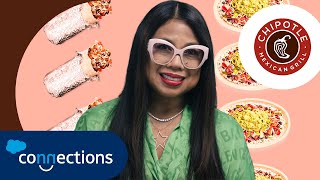
Marisa Andrada, Chipotle's Chief Diversity, Inclusion and People Officer, explains how the brand lives through its workforce. After the 2015 food-safety crisis, Chipotle crowdsourced values across its 100,000 employees, about 70% of whom are diverse. The company launched an education benefit in 2019 covering five universities and 75 programs, now expanded to nine universities.
Questions this video answers
January 25, 2022.
100,000.
70%.
2015.
2019.
Chapters
The brand's not authentic unless the people inside the company really believe it.
Hey, I'm Sarah Franklin and welcome to Connections, where we hear from some of the most innovative leaders in marketing in today's world. Everyone is a marketer, whether it's in your title or not. And that is certainly true for Marisa Andrada, the chief diversity, inclusion and People officer@Chipotle. 100,000 Chipotle employees interact with customers every day. And Marisa knows you can't grow the company unless you grow the people. And I'm here with her in Washington D.C. to hear how she does it.
I love saying I am a first generation American. My dad came here first from the Philippines to be a student, and then like 10 years later, my mom came here to be a nurse and they decided why not, you know, live in the US and raise a family here. I look back on my life and say, wow, I'm really fortunate with every opportunity, all the jobs that I've had and people that I've met. So it's been pretty amazing.
So what drew you to hr?
You know, we talked about this American dream and growing up like my, my mom speaks excellent English and my dad to this day, I mean, he's been here since 1963 and he has a really thick accent. And in the grocery store he would be checking out and back then he'd write checks to check out. And I remember the checkers would say really loudly and slowly, you know, how much the tab would cost. And I would look at them and go, and as a nine year old, you know, my dad understands you. You don't need to yell at him. And so when I think about the role of human resources, it's just, I think my entire life I've just been observing people. And so I guess not a surprise that I gravitated towards human resources.
And so in hr, it's not just about the people. You also believe it's important to bringing the brand to life. Yes, tell me about that.
The brand's not authentic unless the people inside the company really believe it. I've always said that you can bring a brand to life through people. And, you know, it's just authentic in that way. I mean, it's human beings at the center of the company. And, and you know, I've seen companies grow because we've invested in developing people. The basics of HR is, hey, look, a company can accomplish its short or long term goals as long as the people inside them are not only motivated and inspired about what is it they're doing, but they're actually confident and skilled. When you invest in people and develop them, I think it just pays the whole company forward because they're the ones delivering for the business.
And so do you think that happy employees lead to happy customers?
I'm such a big believer. I mean, at Chipotle, we call our people Chipotle people, our chapeeps.
So you call them what chapeeps? Chapes. Like Chipotle.
People together are cheapes. And so I think about the foundation of our guest experience is really about the employees. Chipotle is known for having this highly personalized, customized bowl of safely prepared, sustainably raised food. And it's these happy employees who are fired up about helping you and getting customers through the line. If employees aren't happy in doing what they're doing, I don't think guests would stand in line and, you know, get the food which they crave.
And so you also talked about sustainability and quality and freshness. How much is all that in your products represented as your brand?
Our brand is all around this purpose of cultivating a better world. And it normally has been through. Through food with integrity, and now we say through people with integrity.
You have grown, not just customers. You've built a community.
How.
How have you done that?
I'm part of an amazing leadership team, and I think it goes back to really understanding who we are as a company. I joined right after our CEO Brian Nicol, joined. So about a month after, you know, we had a big responsibility to get this company through a transformation. A lot of people know this, that there was a huge food safety crisis 2015 with our company. The company was going in a certain direction. You know, people on the outside, including me, I'm a big Chipotle fan, were like, gosh, are they going to be on their own? But the fact that a new CEO had joined and knew that this company had to turn around, and it wasn't just about, hey, how do we market it differently? How do we bring in digital? It was about creating a culture. And so when I hear you ask me about community, I. I think, again, people at the center of the company are the ones that have to believe in this culture. I brought in a facilitator. We created nine values. And then my small but mighty team at the time took it out to the restaurants, and we literally crowdsourced our ideas. I think our employees were like, you want my opinion on what our values should be? And it's not like it was new language. It was all based on artifacts, on the company's history. So everything we do is about that amazing real food every day. And it's that experience for our people around that line, whether it's for our employees, our chapeeps or our guests. And I think that creates community when you're living that.
You're hr, you have your counterparts in marketing, but you think we're all marketers. Explain that to me.
You know, marketing is all about if people can connect emotionally to what it is that you have to say or give. And you can tell a story through that in which people can say, oh, I can relate to that. I think that's marketing.
And speaking of being relatable, there's multiple channels these days. But a lot of your employees are younger generation.
That's right.
Where do you reach them?
Oh, my goodness. Well, first of all, I think, where.
Do you reach the chapeeps?
Like our chapeeps, Anyone who loves Chipotle, they will come and work at Chipotle. And so we've got five generations working in our restaurants. The majority are millennial and Gen Z. It is about reaching out to them because they experience the brand. But then we tried some really creative things. So the fact that a lot of our customers are fans of Chipotle, they're on TikTok. You know, they're creating their own Chipotle videos. We got Chipotle today. I got me a chicken burrito. We also tried something on Discord. We obviously have a great social following, so why not let our guests know in that vehicle, right? Or that modality through TikTok and through Discord. Hey, come and apply at Chipotle. Here are the opportunities. And so we have been trying things like that too, to get to that next generation. It's not about pay, it's not about benefits. What it is about is people will gravitate and they will stay if it's a purpose that they believe in. I think the future is really about people being part of something bigger, not only just a job.
And so speaking of being part of something bigger, you talked about the American dream, but you also believe in giving back and helping bring others along. Tell us about your commitment to education.
Our vision for people is all around cultivating an environment where all of our employees can thrive, pursue their passion, and become lifelong leaders. And, you know, we have a highly diverse workforce. 100,000 employees, primarily part time and 70% diverse. A lot of underrepresented, you know, BIPOC community. I spend a lot of time in restaurants and a lot of employees will literally tell me their life story and Say, Chipotle has changed my life. And I look back at my own family and say, wow, you know, I think a great equalizer in society is to provide access to education. I feel like I was really fortunate. My parents always said, go get your education. And once I got there, I'm like, well, now how am I going to afford this? And had to figure out like partial scholarships, you know, work all the time, some loans so I can get through school. And so our commitment to this whole vision for people is around opportunity. As a part time employee, you can be working for four months and after four months get access to an education, whether it's a two or four year degree. And at the time we introduced, it was five universities, 75 programs which they have debt free access to. And so we introduced that back in 2019 and then this year we added four more universities. Because here's the deal, like, I hope our employees stay with us and pursue their passion in that way. And if they don't, that's okay. We appreciate all the time that they've spent with us and I hope they go somewhere in our value chain. I see so much of my family and my personal experience in our employees. And so it's just giving them access to create their own opportunity.
With Salesforce, we talk about business as the greatest platform for change. And you shared how you've lived the American dream. What's it like to now be able to give that dream to other people.
It's very humbling that I've have the chance to work in a large organization where you can focus on a culture that is centered around people. It's humbling for me in that I see a lot of my past or my family's history in the organization today. And so it means a lot.
And what is there for us to learn from that?
I think if anything, the takeaway is don't forget that there are human beings at the center of organizations. And if you don't see them, hear them, listen to them, then the organization won't be able to move forward. And so I think that's really important for companies today to pay attention to that.
Thanks for tuning in. Never miss an episode by subscribing and turning on your notifications. We'll see you next time.