COVID-19 Latest Updates with Larry Brilliant from August 31st, 2020 | B-Well Together | Salesforce
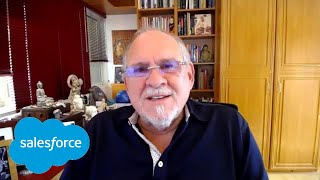
Epidemic expert Larry Brilliant predicts a Labor Day spike in COVID cases and deaths rising to 1,000 per day by late fall, with US deaths reaching 200,000-250,000. He warns against rushing vaccines, calls for 3.5-5 million daily tests instead of the current 600,000-700,000, and criticizes political interference in public health agencies.
Questions this video answers
33,000 cases in the last 24 hours (speaker also referenced a prior peak of 70,000).
He cited averaging about 1,000 deaths per day and a cumulative ~180,000 US deaths at the time of the talk (projecting to exceed 200,000–250,000 by late fall/winter).
About 3.6 million cases (likely undercounted) and approximately 64,000 deaths; he also cited ~78,000 new cases in India on that day.
He estimated ~600,000–700,000 tests per day in the US and said the US should be doing roughly 3.5–5 million tests per day (Harvard Global Health Institute estimate ~5 million).
A large increase in cases about three weeks after Labor Day and deaths rising about six weeks after Labor Day.
Chapters
Hello, Happy Monday, and welcome back to another edition of Be well Together. I hope you were really able to unplug and relax a little bit this weekend. We are kicking this week off with one of my favorite guests, who is an incredibly important voice during this whole COVID 19 pandemic, and that is, of course, the brilliant Dr. Larry Brilliant. For those of you who are unfamiliar with his work, he is a leading expert on epidemics. He focused his work with the World Health Organization and actually helped eradicate smallpox. He's the CEO of the PAN Defense Advisory and chair of the advisory board of the NGO Ending Pandemics. He's written for everybody. You've seen him in the Wall Street Journal, you've seen him in Forbes, you've seen him in the Guardian. He's written a couple of books. One's called Sometimes Brilliant and the other the Management of Smallpox Eradication. So today, Larry is obviously going to be here talking to us about the latest with COVID 19. And if you have questions and you are an employee, then I would encourage you to go ahead and post those up in the camp Be well chatter group. And with that doctor Brilliant. Thank you so much for joining us again today. I have really been looking forward to this.
Jodi, it's always nice to see you. Thank you for having me.
So I'm eager to just jump into this because I personally have a lot of questions. I'm sure others do, too. So why don't you maybe start by just giving us the kind of current state of the state and where your head is at these days.
Yeah. I'd like to just briefly touch on three things. What's gonna happen the next four months? I think that's what I get asked the most. Then I wanna talk a little bit about the Global south, the rest of the world that we don't talk about very much. And then some of the dangers that are facing the Trump administration and the temptations that we have to choose policies and maybe explain what some of the downside risks are of things that seem rather innocent on the surface. So, first of all, the next four months. We are currently experiencing, thankfully, a dip in cases in the United states. About a 10%, 15% drop. We had reached a peak of 70,000 cases today. We have 33,000 cases in the last 24 hours. I hope that that will last. Of course, I always hope that that will last, but I don't think it will. The reason for the humps in our curve in the past, it takes a very big event to change the course of A disease that's in every county in the United States. And such a big country we are. And the biggest things that we've seen affect us up until now are the reopening or the closing. The reopening and then Memorial Day, fourth of July. And of course now we're going to have Labor Day four day weekend. And Labor Day weekend will itself bring about all sorts of virus producing increased case count behavior. So I expect to see a large increase in cases three weeks after Labor Day. And unfortunately that means hospitalizations, perhaps ICU and inevitably some deaths. So, so I expect to see the deaths go back up probably about six weeks after Labor Day weekend. We have been averaging 1,000 deaths a day, even though today's death count is less than half of that average. That's a huge amount. And maybe we should take a step back and say 180,000 of our fellow Americans of all colors, ages, races, everything have died from this disease. 180,000 that every week we have the number of deaths of two 9, 11s. So let's think about that. So as we go into the fall, we'll get the trough right now until we see the effect of Labor Day, then increasing cases, then deaths. Unfortunately, we're also going into the flu season and this is extremely dangerous. I actually believe the flu season will be muted this year because of all the face mask wearing that we'll have in the United States. But the combination of flus and colds and other respiratory diseases and Covid will mean there'll be misdiagnoses and chaos and too many demands on tests. That will also increase the number of cases, as will the reason that we have flu season, which is the reopening of schools historically and the fact that the weather starts to get cooler and we spend more of our time crowded inside, even in our homes, in small gatherings. All of that will increase cases and ultimately increasing deaths. And I do think that by the time we get to the end of October, we'll, we will be back at 1,000 deaths a day and have well exceeded 200,000 deaths, be on our way to a quarter of a million total deaths. And that's a huge number of deaths, many of which of course were completely avoidable had we acted sooner and had acted with more global health kind of policies in place. Speaking about the globe, let me mention the global south because early on we heard things like why doesn't India have more cases? Why doesn't Africa have more cases? There was some suspicion that the younger age group in those regions would mean fewer cases, some suspicion that they had used bcg, a vaccine against tuberculosis, and that had mysteriously dropped the case count. There was some suspicion, as they're always in India, about turmeric. I say this as someone who loves India and lived in India for 10 years. Sadly, India is now at the top of our list, and I'm afraid it will continue. As of today, India has had 3.6 million cases, and I'm certain that's an undercount by at least 50%. And this week, actually today, 78,000 cases. India is about to, if it hasn't already, set the world's record for the number of cases in a country in a day. And the deaths in India are now 64,000. India had the highest number of deaths of any country in the world today, almost a thousand deaths. And India, Brazil, Colombia, Peru, Argentina, Russia, Mexico, Iraq, Philippines, Indonesia, South Africa, Bangladesh are all in the top number of cases and cases per million population. So, unfortunately, when we think of a pandemic, we think of a worldwide campaign. I envision if we get a good vaccine that fits, a eradication program, such a vaccine would require one dose. It will be droplets or nasal sprays instead of an injection. It will not require a booster shot, will not require a cold chain and be inexpensive and readily available. If we get a vaccine like that, I do believe we will have a global campaign, if not to eradicate, but to control. Covid, that means tens of thousands of Jeeps, hundreds of thousands of Jeeps, and millions and millions of vaccinators. But we need to get that vaccine first. But until then, I'm afraid that we're going to be seeing the global south and its economies shattered by this virus going forward. And it breaks my heart, but I think that is the reality we'll face. Lastly, I just want to talk about four things that the Trump administration has been talking about or experimenting with and why they caused so much distraught in the epidemiological community. Community. Let's talk first about the obvious one, rushing a vaccine. Rushing a vaccine and cutting corners is a understandable desire that we all have. In fact, well over 30,000 people have volunteered to take the vaccine right now, irrespective of risk. But bear in mind, 40% to 50% of Americans say they'll never take the vaccine because of the anti vax concerns.
So is it really that high? It's 50%, yes.
In surveys, as many as 50% of Americans say, no, I'm not going to take the vaccine. Now, that may change if we get good news about the vaccine. And particularly if we have trust and confidence in it. And how can you erode trust? Well, you can cut corners and then you can have accidents. You can have early on people who take the vaccine and have side effects. And here's the problem with vaccines. You don't really see a one in a million side effect until you've done a million vaccinations. You don't see a 1 in 100,000 side effect till you've done 100,000 vaccines. And I guarantee you that the focus of the media will be on those side effects and all of us will be worried about those side effects. Because just like the mirror that you have, it says things are larger than they appear in your rearview mirror. It's actually they're smaller than they appear in your rearview mirror. But we don't look about that. We don't think that way when we're dealing with side effects. The second thing I want to mention is rushing convalescent plasma, cutting corners and bringing it to the market fast. We are all eager to see convalescent plasma. The idea that people who've had the disease donate blood at the Red Cross or wherever they donated. It's spun down, the cells are removed, and that plasma as rich with antibodies is then used to treat and save the life very often of people who have Covid. We want that to be there. But when you rush it right now, you not only bear the risk of not knowing, will it work in different age groups, demographic groups? Because we haven't tested it. In fact, this may shock you when you think that the FDA has given it an emergency use authorization. There has not been a single proper case control test or placebo control test of convalescent plasma. That's one of the bad things. The second bad thing is that once you say it's great, like Trump said about oleander and he said about hydroxychloroquine, and he said about bleach. But with hydroxychloroquine, there was a rush on the market and people who legitimately needed it for lupus and malaria couldn't get it. And it's useless for coronavirus. And that mythology spreads, so we have to be really careful. Also, we need convalescent plasma as a get out of jail free card if it works, so that if we're doing large vaccine trials, we can use it in case there's a bad reaction to redeem the life of someone who's been in that trial. The last thing I want to mention is there is now, if you read the new York Times. A push from a new member of the Coronavirus Task Force to adopt the Swedish model, which is essentially a rush towards herd immunity. I just want to remind Everybody, we have 180,000 going on 200,000 deaths. That is with only a grand total of 6 million cases. If you rush towards herd immunity, you're saying we're going to rush towards 60 million or 100 million or 200 million cases very quickly before there's a vaccine to prevent it. If you do that, you're talking about millions of deaths in the United States. Bear in mind they rush towards herd immunity. Sweden has the highest death rate of all of its peer countries, sometimes by 2 or 3x. A rush towards herd immunity is reckless. The only herd immunity that I want to rush to is the herd immunity you get from vaccinating everybody with a good vaccine, properly tested and safe. And those are my introductory remarks.
Amen to that. Okay, my head's spinning in a couple of ways. Let's start with. So you talk about how you're gonna. You expect to see a spike six weeks after Labor Day, which puts us right around the time of Halloween, which puts, you know, kids and parents trying to have some sort of a normal and being out. And then that puts us a couple weeks into Thanksgiving, and that puts us a couple weeks into Christmas. And so I guess I'm kind of curious to hear from you about. I know that we're working on a vaccine, and I know we don't want to rush either, but when do you think, like, ballpark figure, that we would be in a position to start safely administering a vaccine? Is it next summer? Is it next winter? Is it January? Like, what? From where you sit, what does it look like to you?
Well, of course, I don't know. But to extrapolate what we do know, I'm 100% sure we will see the President standing in front of warehouses full of boxes of vaccines, and we will see them soon. We just won't know if what's inside those boxes is a vaccine that is safe and competent. And the reason I say that is we've placed orders for 100 million doses vaccine from each of five or six different manufacturers. We will get those doses made before we know if it's a good vaccine or not. I think that's a really good strategy. I'm not saying anything. I like that strategy. I'd rather waste money and speculate on vaccines and have that portfolio theory that some of those vaccines will have been adjudicated as being competent and safe. The Problem that we will have is that those vaccines, when we have them, we will get them before we know are these safe in elderly people, Are there ethnic groups that they are not safe for? How many doses do you really need to get in order to have them? I think those answers will not come with reasonable scientific scrutiny, peer review to give us the confidence to not increase the anti vax movement by bad anecdotes. I don't think we'll get that till the first quarter, but I think it'll be pretty early January, February. But you're right, we will have gone through Thanksgiving, we'll have gone through Halloween, we'll have gone through Christmas and New Year's before we have vaccine. That is, I think that's gone through any kind of reasonable process of peer review and the kind of placebo controlled study, case control study, natural experiment that we're doing right now. And that's a problem that's problematic.
So when you are on like a real layman side of this, okay, and you're seeing, you know, the vaccines are out there and they're all widespread and you know, how do you kind of. What would you advise us to look for? To know that there's a level of certainty that proper testing has been done, that we have had those one in a million opportunities to discover and to tweak the formula. How do you know when it's safe? Not just you want to rush and get it, but when it's truly safe to take you and your family and go down this path.
Oh, Jody, this is going to be a hard answer. Normally I would say you look at what the FDA has said. I, you know, the FDA approval is still a gold standard, but the FDA is not approving anything. It's giving these emergency use authorizations. And I have to say in many cases they're not worth the paper they're printed on. An FDA approval means it's gone through a rigorous case control study. Scientists have looked at it, it's peer reviewed and that that has been the process has been signed off on by the fda. An FDA emergency use authorization means you've submitted a couple of page application and there's a little paragraph at the boxes. I want you to know that I have tested my product myself and it's good. That's the thinnest of misleading things that you can possibly have. I would look at a committee of the National Academy of Sciences that is co chaired by Helene Gale who was the head of CARE and, and Bill Foege, who was the head of cdc. This Committee is called the Ethical Use of Vaccine Committee. And we will be hearing from them shortly on how they think the vaccine should be distributed, who should get it first. Would it be first responders or the elderly, or using it in a kind of ring vaccination approach where there are cases? And I'm certain that in between the lines there will be some comments about what is an effective and a safe vaccine. I think we'll be hearing that a lot. I would pay attention to the epidemiologists and the public health professionals who are not in the administration as much as those in the administration. And that doesn't matter what administration it is. I'm not talking to the election.
Yeah, okay. All right, let's swap. Let's change a little bit of our focus from vaccines to, to. I'm kind of curious about people who are getting Covid and you know, we've all learned, you know, you gotta wash your hands, you gotta wear your masks, gotta do all those things. And we know that those are good protective measures that we can take for ourselves. But I'm also seeing things about how things like what can we do to better prepare our bodies if we are to get it right? There's narratives around general inflammation and like and things that like, tend to make it seem worse in some people because there's many people who get it and survive it or didn't even know that they had it. And I guess like if there was advice that you could give from a here's what you should be doing for your overall general health so that if you get it, you have a better propensity to survive it.
Yeah, I mean, we know that there are pre existing conditions that increase your risk of having a bad outcome, but there are also pre existing conditions that decrease your risk of having a bad outcome. And certainly general health is really important. Getting your exercise, eating a good diet. But even more than that, it's obviously avoid those pre existing conditions and they are obesity, they are diabetes, they are hypertension. There are many of these that you can avoid. There are some that you can't avoid. If you have cancer and you're being treated with chemotherapy that knocks down your immune system or if you have an autoimmune system. Those are not things you cannot avoid, but you can treat them. You can keep your blood sugar under control, you can keep your weight under control, all the things that we know. If you've heard that something is a pre existing condition, ask yourself how you could avoid it. There is another pre existing condition that does seem to give some Immunity, Cross immunity. It's speculative. Right now. Remember the coronavirus that we call coronavirus. This COVID 19, is one of a family of seven different viruses that have already hit us as people over the past many years. Two of those MERS and sars, don't go out and go get those for sure. Sure. You can't get them. They're not around right now. MERS is percolating a little bit, but there are four other coronaviruses that are colds, and you may get them this season. There may be some cross immunogenicity from people who have had one of those colds recently. That may be why children appear to have a lower, have an easier way of dealing with this COVID 19 because they may have more recently had another coronavirus. Likewise, I think people who've been recently immunized against anything seem to have an easier time of dealing with coronavirus. This is speculative. That's also one of the reasons that's been offered to think about. Why do kids get off a little bit easier? Well, they've more recently had this battery of vaccinations. These are all speculative. I wouldn't go to the bank on any of them, but that's what we're looking at. So make yourself as healthy as you can. Get exercise, wear your mask. Wear your mask. Wear your mask. Wear the right mask. Don't go out there and wear a mask. That's one ply. Get a mask. That's five ply. If you can get a KN95 mask. That's not the one that competes with first responders, but it gives you as good protection as a N95, especially if you're in a smoky area.
Okay. Along those lines, I'm curious to try to understand. I'm hearing about people who have had this and then they seem to have, you know, these really terrible ailments that stay with them long after, you know, the heart of the disease has passed. And I'm curious to know what we know about some of these things. And are these kind of. Do you have a lifelong sentence of asthma or other things that are preventing serious. That I don't feel like gets as much attention and, you know, just kind of, what can you tell us about, like, what are some of the potential things that maybe you survive it, but now you, you know, you have these other issues to deal with?
Well, let me, let me first disabuse us all about the most recent fear that's going around, which is that you can get it a second time. We now have four or Five case reports of people who've had Covid a second time. You know, does that mean that, you know you're going to get Covid a second time? No, of course not. There have been 25 million cases and we have four humans out of 25 million who've had it a second time. I had an experience when I was running the smallpox program in India where I had a wonderful young vaccinator who I was very fond of and I had trained him. He was vaccinated dozens of times and he died of smallpox. The only case in history where the smallpox vaccine failed to protect somebody. He had multiple cases of smallpox because he had congenital absence of immunoglobulin IgM. He didn't have any. He would have died from measles or a cold if he had gotten that. So of four people who are getting the disease a second time, I believe that's probably true. But what the virus can do is different than what the virus does do. And it sure does lead to these long haul kind of cases. People who continue to get effects that are different than a respiratory disease. We've seen autopsy reports that as many as half or more of people have some cardiomyopathy if they've had Covid, even if they've died from something differently long after they've had it. We should be worried about the rare but very dangerous autoimmune diseases that follow. We should be looking at kidney diseases that follow. You're right about the asthma again. Asthma is a pre existing condition. One thing you can do to keep yourself safer is keep your asthma under control. But this is a terrible disease in many ways. It's like smallpox again. Smallpox was worse. It killed one out of three. It sped through the population with twice the r naught of COVID But smallpox was a total system disease. And Covid is also nose to toes. Calling it a respiratory disease is misleading. It is a route of infection, the respiration route. But this disease affects pretty much every cell in the body. And I wouldn't fall prey to thinking about it as a mild disease because it is mild for a small number of people.
Larry, in the beginning of when we were all first going, starting to find our way, our footing here, you were very outspoken about the need for more testing in the United States. And I know that there's been a lot of progress here. You know, where do you think we're at now? Do you think we're. We've hit that. We have we hit the satisfactory mark or are we still.
No, we're nowhere near the satisfactory mark. In fact, if I could. I won't do it, but if I could show the graph of testing, it's actually gone down. In the United States, I think we're something around 600,000 cases. 600,000 tests a day. We should be at 3,5 million tests a day. If you think about it, if we had these rapid tests and they were $5 and you could get a result in five minutes, which many of the new tests offer as a promise, we'll see. If indeed they come through like that and we could all be tested every day, then clearly we'd be able to find anyone who had a case and isolate them very quickly. And we could end the disease pretty abruptly even without a vaccine, or we want a vaccine adjunctively with rapid testing for everybody. Harvard's Global health institute estimates 5 million tests a day is what it will really take. We're nowhere near that at 700,000. And I know you hear that we've done the most tests in the world per capita. Even that's not true. We're so far behind. And because we lost two months with almost no testing, you can't get those two months back. But what we can do is we can test in the right places. If you're gonna go to a party in the hamptons and there's 200 people there and they're all gonna be tested twice before they can get in the door, that's 400 tests that are not being done in our nursing homes. That's 400 tests. I mean, I don't actually know if, of course, wealthy people paying $300 for a test depletes or increases the total number of tests that are made. It could go either way. But we're not testing in the right places. And even looking at this formula of the percent of tests that are positive is problematic because we should be looking at what number of tests are given, where are they given, are they given in the right places? And I would argue the most important place is the diagnosis of a disease in the high risk communities. And, and then specifically in contact tracing, we should be finding every case, testing every case, and then doing contact tracing and finding 100% of the contacts. We're only finding about 10%. Vietnam, which went until two weeks ago without having a single death, did so because they traced 100% of all contacts. We are so far away from the optimal disease response with contact tracing. That's where our testing should be located. If we did that, we would not be seeing these huge numbers that we see in the United States today.
And so what is preventing us from really getting our arms more around contact tracing? What do you think that we could do as individuals or as businesses to try to help promote that?
Talk to your congressman, your congresswoman, talk to your state representatives. We have. We have a. We have probably the most incompetent response to any disease that I've ever seen in my entire lifetime, which is saying something I can't. Yeah, because I'm old.
I was going more for your brilliance, but we can go with that. You go wherever you need to go.
Come on now. We're 4% of the population of the world, and we're 20 to 25% of all the deaths. I mean, America's always been historically the leader. CDC is the gold standard. The FDA is looked up to and admired. Every country that could has followed CDC and FDA and built one of their own. The Chinese version of the CDC is called China cdc. The India version of the CDC is called India cdc. The African version is called Africa. And we've messed it up terribly because of incompetent leadership, political interference, and demoralization of the agencies. Can you imagine how it feels to work at the FDA and to have made a decision about convalescent plasma or have made a decision about hydroxychloroquine and have that overruled by the President of the United States? I don't want this to be a political statement. I'm just talking about a management statement. What if the CEO of your company came down to an area that you're working on, and you're the world's expert, and said to you, nope, I don't like it that way. I want it green. You say it should be blue. Nope. I mean, those are the things that Management 101 tells you. Do not disavow, do not distract, do not deceive, and do not depress the workers upon whom you depend. And we're in a rough situation right now. The core scientists at cdc, where I trained and at fda, are. They're the world's greatest. We need to support them as we support first responders, honor them. But understand they're under incredible political pressure right now, and those agencies are suspect.
Larry, I want you to know from the depths of my soul how incredibly grateful I am for all of the work you're doing. I know you do it because it's what's right, and I know you do it because you're passionate about it. But I just feel like all of us are very lucky beneficiaries. To have someone like you out there, you know, fighting the good fight. And I really want to thank you for that. And I'm very, very grateful that you always make time for us here on be well together. So thank you for coming back. I really appreciate it.
Anytime. I love salesforce. I am part of the ohana. You couldn't get me. I'm delighted to be here. Thank you so much for having me.
Absolutely. Absolutely. So, everyone, thank you. I know we're all sending our thanks to Dr. Larry. Brilliant. Please be safe, please be smart, and please be well. And we will see you back here later this week. Bye. Bye, Sam.









