Creating New Categories In a Cloud-First World at The Cloud 100 2020
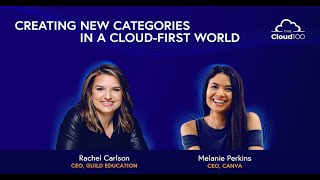
Talia Goldberg, Rachel Carlson, and Melanie Perkins discuss how Guild Education and Canva created new categories in the cloud industry. They cover growth strategies, democratizing education and design, and the challenges these companies faced building in a cloud-first world.
Chapters
Hi, I'm Talia Goldberg, partner at Bessemer Venture Partners. The platforms and software that the Cloud 100 honorees are building are changing the way that we work and how businesses operate. Today we're talking about category creation and the path that two really amazing founders have taken to secure market leadership and reimagine their industries.
Hi, I'm Rachel Carlson. I'm CEO and co founder of Guild Education. Melanie.
I'm Melanie Perkins, CEO and co founder of Canva. It's exciting for us to be here together. We're going to be discussing why we started our businesses and the opportunities and challenges we face building them and growing our companies in today's world.
So let's dive in. One of the common threads that is linking some of the great Internet and software businesses is how they democratize access. You have Google with Information Stream, Stripe with Payments, Shopify with commerce, and WhatsApp with communications. The list really goes on. And here you two both have created categories by democratizing access. But you've gone about it in two very different ways. On the one hand, Canva, it's a freemium platform that's used by over 35 million people each month that really democratizes design and empowers everyone from individuals to small businesses and beyond to easily create content of all types. On the other hand, you have Guild, which is enabling the tens of millions of Americans that need upskilling or reskilling to compete in the modern workforce. And you're really democratizing access to adult education. You do this by partnering with employers and providing education as a benefit. You have two very different go to market approaches. On the one hand, we have Canva with a very bottoms up approach and, and Guild's enterprise oriented top down approach. So Rachel, fairly early into Guild's life, you landed one of the biggest companies in the world and literally the biggest employer in America, Walmart. Please explain to us how does a startup at the time, just a couple years old, land such a massive whale of an early customer?
On one level it was full of luck, but on another level it was really an instructive moment for us that helped us figure out how to go forward with our go to market strategy. Because Walmart was emblematic of so many other companies at the time. And you know, for Gil, what we wanted to figure out was how to incentivize employers to invest in their employees education. And we knew if we did that we would transform the business model of higher ed because we'd reduce the crazy customer acquisition costs that are incurred in B2C higher education with Google and Facebook taking large cuts of the ad revenue that really cut into students tuition costs and that employers would also know a lot more about what modern working adults should be learning when they go back to school, since they were also their current employees but their future employer as well. And so with Walmart we spent a bunch of time with them, we built relationships and we got to know their problem set. And their problem set spanned everything from the cashier job in the rural Walmart store all the way up through E commerce challenges with Walmart's work towards becoming a really iconic E commerce company. And so we were able to understand really the entire American workforce challenges by drilling into this one company that happens to employ 1.5 million Americans.
How do you go about satisfying a giant like Walmart, which may have some particular needs without then blowing up though your entire product roadmap and support structure?
That is a great question and one we spent the last two years really addressing. We definitely made some mistakes along the way, but largely what we tried to do was onboard other large companies at the same time as Walmart, which really just felt hard at the time but meant we were calibrating the things they were asking for alongside companies like Disney and Lowe's and Discover Financial at the same time. What it didn't allow us to do is to have multiple strategies at the same time. So when we went long with Walmart, we really went long with enterprise as you mentioned and had to commit to that as our distribution strategy and our tops down model as you mentioned. And so that was the right choice, but one that we absolutely had to make so that we could prioritize within our roadmap. And we've done a lot of work that has essentially solidified our view that we should be working with the Fortune 1000 for now and at a later chapter in Guild's life, probably moving into more mid market and SMB. Awesome.
So Melanie, in the span of just 18 months, Canva grew to 1 million users at one point and you now have many tens of millions of users that are engaging with the product each month. Can you help us to understand and just dive into what drives your product development roadmap and how do you prioritize features and functionality when you have such a diverse set of users and so many different use cases? How do you pick what to prioritize and what to do first or put off for later?
I think one of the incredible things that we've seen is just how common there's so many common needs across so many different industries. So we have an incredibly widespread number of people using canva. We're in 190 countries. We have the small 7 year old at school using Canva to create school assignments. And then we have Fortune 1000 companies using Canva, you know, solidify their design across their entire companies. But the commonality is actually really surprising that everyone's trying to communicate their ideas visually. Everyone has struggled previously with design. Design programs are really complicated and we wanted to make that simple. So it's surprising the number of things that are common between the seven year old to the Fortune 1000 company. One of the things that we found right from the early days was it's absolutely critical to solve a problem that affects a lot of people. And one of those things is that design programs are really hard. Another is that the world is becoming increasingly visual as the years have gone on. Social media has certainly helped to accelerate that. But the way people are creating pitch decks and presentations and social media graphics and videos, they all have a lot of commonalities that our goal was to make really simple and accessible to everyone.
And so in the early years, can you give us a sense of what drove some of your adoption and growth? And then as you've scaled and now are touching so many tens of millions of users, has anything meaningfully changed in your go to market strategy? How has it evolved?
Yeah, so years ago I was at university, I was teaching design programs and saw a lot of students struggling, learning the very basics. And so that sort of basic problem that things are really complicated, people are having to go to all sorts of things from stock photography libraries and video libraries and layout libraries to create the most basic of designs. And you know, this standard person was left with clipart and ugly fonts and ugly templates. That problem was sort of the universal piece that started that kick started Canva's life. Solving a problem that affected a lot of people was really critical at the start. And then what we did was we ensured that we had a really valuable free product that then help to accelerate Canva's growth. So we've had hundreds of thousands of blogs written about Canva, social media posts, tweets where our community is really helping to tell other people about it and it's helping to spread through word of mouth. So organic distribution has been really critical for Canva right from the early days. And as we've grown that's just continued to accelerate. We've continued to expand into now we're in the enterprise and so we are starting to build out a team that's helping our customers to be successful as well. But I think that that acceleration right from the early days was built from solving a problem that affected a lot of people, making it free and really valuable for people to be able to adopt it easily and spread through word of mouth. And then critically, we've really had a strong focus on internationalization. So we're now in 100 languages. We tackled some really hard languages like right to left for Arabic and Hebrew and Urdu. And then we've also ensured that we launched in Canva in China, amongst other more tricky markets to get into. But that has meant that Canva's adoption has been really, really quite global from, from the early days.
That's impressive. So this next question is for Rachel. So Rachel Gilt has many different stakeholders. There's employers, there's schools, there's employees. And sometimes one of the tricky dynamics is that those that are paying the bills or cashing the checks aren't always the ones that are touching the end product. You have so many different stakeholders. And so as you think about that and this kind of triangle, what have been your key areas of focus and how has that changed over time?
Sure, it's a great question and really defines kind of our four years of growth as well as our business model and our B Corp charter is really all in how do you manage multiple stakeholders? So said simply, our business model was oriented around this idea that we could help reduce what working adults and low and middle income Americans pay if we could get employers to pick up some of the bill and we could help universities better connect into the ecosystem and also pick up some of the bill for the technology and the services that the working adult needs. And so that's how we've gone out about the business is having employers pay tuition, having universities pay for gilts technology and services and trying to drive the cost down to zero as much as possible and whenever possible for the student. And we pulled that off, but we've done it by effectively, I think the same challenges that most marketplaces work through, which is in any given quarter or year, you're balancing the supply demand challenges. And so as I think about it, you know, effectively the early years of the first year of the business was generating the supply side, getting universities to want to join our marketplace. The second year was going to market for the first time to employers and students and figuring out if they wanted what we had on our shelves. Then we had to flip back and do effectively a rebuilding expansion year on our supply side and add many more universities because we didn't have enough. And then this year heading back into thinking about expansion with the next batch of employers and go to market there. So it's been a balancing act at every turn. And that's a really important conversation we're constantly having within the company as we think about quarterly and annual prioritization and helping everyone understand why at one time, even though we have teams that represent all of the stakeholders at any one time, it does feel like one stakeholder group is getting an extra dose of attention from the product roadmap and from.
Our services and across these three different types of end customers or users that you have. How do you go about measuring success for schools, for employers, for employees? Are there different metrics or different KPIs that you're monitoring for each of those categories?
Yes, but we also felt like we needed to find the commonalities, so I'll probably start there. What we realized was that the win, win, win to make this whole ecosystem work would be increasing the retention of working adult learners both at school and at work. And when you do that well, you obviously do right by the student. You're helping them have access to a free education because they're staying at work and work's paying. And you're helping them increase their graduation rates at school because the average working adult learner is has a 50% graduation rate outside of Guild. And we've been able to bring that up into the annual rates in the 90s. And so that felt like the core KPI to start with. And then we align that with what the universities want. They care a lot about retention at school. And so really building our services and products focused on that KPI for them. And then the employer cares about retaining the worker in their job. Now that doesn't mean forever. In fact, they're very supportive of the worker moving on after three or five years. But retaining them past the six month or the one year mark is actually incredibly hard. In frontline jobs where they have, you know, an average 40 to 60% retention rate just for those first six to 12 months. And so we really oriented around that as KPI number one that creates the win, win, win. And then obviously we have additional things we care about. For employers, it's helping them increase their retention rates beyond and then their recruitment rates. Sorry, I kind of bumble that. But helping them increase their, their recruitment rates as well as their upskilling opportunities and promotion rates for workers and then for our students, we ultimately care about creating economic opportunity. So education is a means, but the end is how do we Help them move up within their company or move up beyond their company into higher paying jobs and middle class opportunities.
That's awesome and really interesting. It sounds like you really have found this almost like a North Star that does unify each of these different constituents. Melanie, do you have any kind of North Star or kind of key measure of success that you look at with.
Canva going extremely macro? We have a two step plan. So step one is to build one of the world's most valuable companies and step two is to do the most good we can do. And we're still very, very early stages on both of those steps, but it feels like we're making a few little mini steps in step one and step two. Something that I think inspires a lot of our team is really like we've got 50,000 nonprofits in our nonprofit program where we give our paid product away for free. We're in 50,000 schools now. But really helping each of that small businesses and students and teachers to be achieving their goals is sort of what really drives and motivates our team. So, you know, there's many, many metrics under the sun that we're continuously looking at. UserTesting.com is something that we use very frequently within our product teams to watch videos of people using the product. We've had a million pieces of user feedback. So trying to ensure that we're satisfying the demands of our community and also continuing to pay forward towards our mission of empowering the whole world to design has really helped to provide a lot of our roadmap. So we want to empower everyone across every single industry to design anything. So we've launched presentations and social media graphics and marketing materials and videos. But we have a long roadmap there as well in every language I mentioned, we're in 100 languages now on every device. So I guess those sort of key pillars continue sort of what we we continuously invest in and we'll continuously be investing in those forevermore, but hopefully making some progress towards our two step plan over the years to come.
Absolutely. Well, you both have had tremendous success and canva now worth $6 billion and guild over a billion dollars in just a short period of time. Really. It's remarkable to see all the people and communities that both of your businesses have impacted and touch for the positive. But I'm sure it hasn't been without the trials and tribulations. As you know, there are speed bumps in all of journeys. And I'm curious if you could go back in time and tell your current self one thing that you know today, but that you wish you had known a few years ago when you were just getting started, what would it be?
I guess it's somewhat trite, but it really is the truism for me. I've grown up on political campaigns and that was where my early, I think first six jobs and political campaigns are definitely definitionally sprints and startups can take on the sprint mentality, but election day isn't, you know, six to nine months in the, in the horizon. You know, what we want to do with Guild hopefully is in perpetuity well beyond my lifetime since we know 88 million Americans need what we do. And so training for the marathon and then sustaining the marathon has probably been the biggest lesson for me over time. And then I think additionally, just really orienting at all times back to taking the pauses when you need them to think about, you know, are we orienting around all the various stakeholders that we need to be paying attention to? Are we pausing to reflect on what we've learned? Really just building those mechanisms in was something I had to learn at each chapter.
Melanie, what about you?
I think an important lesson that we've learned along the way is it's hard for everyone. I remember when we started out and we were seeing other companies getting funding or other companies getting millions of users, and I was like, oh my gosh, they must be handed to them on the silver platter. It's working for them and it's so damn hard for us. I think knowing that it's hard for absolutely everyone and everyone's just kind of figuring it out as they go and having to learn on the fly, I think would have been helpful knowledge in those early days. Because I think the concept that I quite like is just in time learning. And it feels like every moment you're learning something just in time, just ahead of knowing it, or in some cases, just after you would have liked to have known it. And I think just continuously knowing that you're going to have to learn, it's hard for everyone. Everyone's strugg and figuring out things as they go I think is quite important.
That's a great point. And to that end, what are some of the big mistakes or obstacles that your team has had to overcome? I don't know if there's a specific story or more general obstacles or challenges that have come your way that you'd be willing to share with others to give them the same sense of, hey, no matter what comes and no matter what comes at you, you can get through it and end up in positions similar to the two of you.
I think, to Rachel's point, every day brings new challenges and ones that you may never have tackled before. So in the earliest of days, it was, how do we find investors? How do we build a tech team? And that was rejections for years to get to those two milestones. Now the big challenge is we've got a thousand people and we have more than 500 people in our product Org. How do we ensure that we're building a product that maintains the simplicity but is catering to the 20 different industries that we need to cater towards? Because essentially canva is building 20 companies would kind of be easy comparatively to building 20 companies that have unified UX and a really cohesive experience across all of those. So that's sort of the things that we're working on right now, is our product process and ensuring that it is cohesive and streamlined and still delivers an amazing experience for someone that's just joined Canva and is using Canva within the first 30 seconds. Still has that simplicity that was so critical to our core. There's been so many different interesting learnings around raising funding over the years. It's not signed until it's in the bank. It's not done until it's in the bank. I think was an interesting learning because I think that in our early days, an investor would be like, I'm going to invest. And we're like, oh, yes, it's done, it's done. And like, it is not done. And then when we're trying to get our tech team together, it was so hard and frustrating for years trying to find the right people that could build our tech, because it's a very complex beast. But I think that that challenge and that extended period of time of not being able to land our tech team actually was really helpful because it meant that we ended up with a really incredible tech team that was at the technical bar that we needed to be able to build our product. And likewise, the very frustrating time of being rejected by investors for years actually meant that we ended up with a really refined pitch deck and strategy because we were getting so many rejections. And every time we were rejected, we'd go and refine and define again and pitch deck to ensure that that really, really spoke to exactly what we wanted to build. And it has meant that we still are executing on the decks from 2011. There's still things in there that we're continuing to execute upon. So I guess the takeaway is, even though things are frustrating at the time and sometimes you feel like you've had to learn the lesson a very hard way that took years. I think that those things help to build our character as a company, to refine our pitch deck, and to become really solid in our strategy going forward.
Your question made me think of advice. You get a lot when you first have kids, which people tell you like little kids, little problems, big kids, bigger problems. And they don't often say you have to work through those little problems in order to be equipped as a parent or as a leader. And I'll apply it to gild in a second to tackle the bigger challenges. So the mistakes or the learnings are constant and there's no lower volume of them later on than in the early days. But it's different in the early days, they were problems that crop up in the morning and you try and solve them. By the end of the day, you're kind of in firefighting mode. You're figuring out all these various component parts and then those LEGO building blocks build you to a place where now you're solving much larger challenges. And in Guild's perspective, the early days, what gave us a competitive advantage and let us be successful is that we were willing to take on the complexities of multiple stakes groups and the employers and the universities and the students. Today, what we have to make sure is we don't let that complexity get in our own way. We're at 700 employees, we've got big teams overseeing those three stakeholder groups and making sure that we can optimize for all of them while keeping in mind the needs of our fourth stakeholder group, which are our employees, and really thinking about how are we making sure that their jobs are getting simpler, that their ability to work with their colleagues maintains that cross functional nature that's really been in the bones of Guild since day one. And that they have career paths and really successful experiences as employees of ours is something we're spending a lot of our time on right now. And it's in large part because of the complexities we took on early days, which we're grateful for, but means you have to keep iterating and building and thinking about how to address those new bigger challenges.
Absolutely. So on that note, let's transition and chat a little bit about teams and team building. This is a really quick question, but recruiting, retaining and managing talent is always a top priority of CEOs so quickly and first, Melanie, what percentage of your time do you spend recruiting in any given month?
I am really fortunate to have built up a really incredible team around Us. And so I don't. For example, we had an intern and grad program. We had 14,000 applicants to apply to our intern and grad program. So I'm not having to spend a hell of a lot of time during that process at the moment. But at the same time, we meet with every single onboarding class. We go through our vision deck of Canva's vision. So it's really critical that right from the very start, people are joining Canva and they're understanding what we're trying to build together. I think that having a shared mission and a shared vision of the future that we're trying to build is utterly critical. I think it's really important. Like, I spend a lot of time on, I'd say, internal comms and like every week we do something that we call a sit down. It was a stand up when it was back in the real world where we all were meeting in person. And now we do a sit down on Zoom. And I spend a lot of my time making sure that the messages that are going throughout the company are really consistent, that we are all working towards the same thing, that everyone has that context and information to make great decisions. And I'd say that is kind of a long way of saying. I think that that actually helps with the recruitment function as well. Because if 1,000 people in the company can speak to the mission and vision as well as I could, and knows sort of the values in our culture and the sort of people that would make a really great contribution to Canva and where we're trying to go, I think that is kind of like a little bit of a quasi way of doing, of helping with our recruitment. Because, you know, we have a lot of people who are working in recruitment now, a lot of people who are trying to decide, is this person going to be a fit for Canva? And so while I might not be in every single one of those interviews, we need to ensure that that culture is spread very, very consistently across the company and that people are knowing what to expect from Canva and who should be able to join Canva and the sort of environment that they should be able to create.
I think there's a saying that, you know, whoever you hire, they may be responsible for the next, you know, 100 hires. So it's, how do you kind of keep that alignment to get the right culture and talent into the company and then support them? So one of the reasons that at Bessemer we were so excited to invest in both Canva and in Guild is because of the really amazing and purposeful cultures that you both built. Can you speak a little bit to the cultures that you have built and how that has evolved as you went from an early stage, a very small startup, to a much larger company now really operating at scale with hundreds of employees.
I think that right from the early days, I always wanted to create a company that I wanted to work at and that has sort of influenced every single decision that we've made. And from the way we have lunch together, when we had, when we were eating in person, to the way we have defined our company's values. So in the early days, it wasn't necessary to define our company values because you're kind of involved in every decision and every conversation. Now we have a thousand people. It's really critical that we define really clearly what is expected of our team. And so our values such as be a good human, be a force for good, pursue excellence, set crazy big goals and make them happy. These are really critical that we got down on paper and now literally have on stickers and T shirts and are continuously talking about with the company because there's so many decisions that are being made every single day that we might not be part of. And it's critical that people know that we have their back. So for example, if a decision is going to lose us some money, but be a force for good, that's critical that we pursue the be a force for good route. And I think that defining the values help for our team to know that we have their back when they are making those decisions. I think it's really critical as well that we ensure that we are continuously finding ways to connect as a company. So I mentioned before, we do sit downs every week. We have often 20 to 30 of our leaders and people across the entire company speaking about different values or different goals and initiatives that we're working on. There's sort of three sections. We do goals, launches and community stories every week. And I think that what's really critical about that is it sort of helps to build and reinforce our culture. Every single time we meet, we're saying what we prize as a company, what we respect, what we really want everyone to be striving towards. And it helps to build that shared context and culture as well. So I think that those are some pretty critical parts of it is setting our values, ensuring that we're finding opportunities to reinforce and propagate and develop our culture as well in that shared context.
Yeah, for us, you know, our mission really is the heartbeat of our culture. And it's interesting because when we first started Guild, we actually entertained. Should we start as a nonprofit? Should we start as a venture backed company? And then we had a kind of creative acquisition opportunity to join another organization and bring Guild to fruition. And so that origin story and the fact that we really tried to say, okay, the reason we chose this path to be a venture backed organization to identify as a tech enabled service is because we want to scale. And the other two paths weren't going to give us that opportunity to scale. And but we're still doing it for all the same reasons that a nonprofit might or that another organization might, which is to deliver economic opportunity to our students and our workers. And so that mission and really the goal of starting there is what pulses through every part of the field. That's why people join, it's why people stay. But we really have to think about how to make sure and evolve that. And I think an interesting thing that all mission driven organizations have to grapple with is you can't let the mission be a crux of for culture. And that's something we thought long and hard about, probably more than ever during COVID And we also had just done our first acquisition that we really have to invest in the values and the other component parts that live beyond our mission. And maybe someone's working at Gilt just because they love the technology problem we're solving or because it's the best job for them to achieve their career growth opportunities, or because of other things we stand for or work we do in other parts of our business. And so we've been having that conversation internally. And really I think that gets to your question about how does it evolve as you scale is you really have to continue refining and evaluating how do we make sure we're accomplishing what we want for our customers, for our employees, for our investors, for the various stakeholder groups, and reevaluating and readdressing that conversation on a pretty regular basis because it is a heartbeat, it's a living, breathing thing. And you have to keep thinking about it on regular cadence and not letting it be a static identity.
Before we get to the final question, I want to make sure to give both of you an opportunity to ask each other questions.
So I read a quote the other day. It said, happiness is giving the world what you yearn for most. And I thought that was a really insightful quote and one that was particularly true. If you could create the world in any which way that you'd like. If your Guild could be taken to the absolute full extreme, what would it look like.
Oh, I love that question. I'm a believer of that maxim that in today's world, talent is equally distributed around the world and opportunity is not. And so if guild could be a mechanism by which opportunity becomes equally distributed and that's a high bar, so maybe I'll give it one * which is like more equitably distributed but at its, you know, its maximum complete equal distribution of opportunity, not of outcomes. Right. Everyone has to achieve their own outcomes. But if that opportunity, which we believe starts with education and then moves into career opportunity, that would be the dream. Melanie, I've been so amazed by your leadership starting a company outside of Silicon Valley by many, many clicks. I get asked this all the time in Denver, but gosh, you've done it at a, at an X factor that really rivals what we do since we can take a day trip. What are the things that you think you've done that follow maybe traditional Silicon Valley expectations of starting a company? And where's one or two places where you've completely veered off the norm and it's been really rewarding to you in Canva?
That's a really good question. I think I thought the norm when we were pitching our company at the start, I thought the norm was that you had to be pitching a multi billion dollar company. I thought that was the rule of what you had to do. So I was like, my pitch deck has to be damn amazing. It has to be like literally the feature of everything. And so I kind of, I think that what I considered the norm was probably potentially a higher bar than maybe what was getting funded in some regards. So I guess my perception of the norm was probably what ended up with such a powerful pitch deck. In many ways. I think that there's a lot of things that we've done that haven't been the status quo. My enemy for a long period of time was the lean startup. So when we were initially pitching for funding the lean start up with all the rage and we were the exact opposite of that. So rather than. And people would be like, have you put up a Google Ad and seen if people have clicked on it and were like, that just doesn't make any sense. This is the future of everything. How is the future of design and publishing? It's so obvious that the world is moving in this direction. I think that has been a really critical piece of Canva is that we have always had a mission, we've always had a vision that we're trying to drive towards and then we've Just taken little goals towards that. And every step of the way we've been doing it for a number of years now. And I think that that's quite different from what was the sort of status quo of the lean start, minimum viable product iterating as you go. That's probably being one of the key, the key pieces is sort of that, that just very different, different way of approaching building a company. I think there's a lot of physical ones like we're in Australia, we have another office in the Philippines. We have been international from day one. I think these things are becoming more the norm. So while it's been typical that we got rejected many times by investors, that said, I have to be able to ride my bicycle, I have to be. You have to be based in Silicon Valley or I'm not going to be best. We actually have a ton of rejection emails for that very specific reason. But I think that it's, I think the world is becoming more global now. I think that the, to your point, the distribution of talent is very much global and I think that companies that are able to tap into that more certainly seeing huge benefits. So I think that, yeah, there's been a host of things in that regard. Like I don't tick many of the Silicon Valley boxes of the typical vis see boxes of like typically it's like a male who's graduated from a certain university, who has, is living in Silicon Valley, who maybe had a CS degree. So I don't tick a lot of those boxes, but I think that it does give you a certain vantage point where you can see the world from a potentially a different perspective. I think that one of the things that we've done well is just really double down on our mission. Like empowering the world to design really means you have to be in every language, you have to be really localized across the entire globe. You have to be global from day one. I think there are a couple of the ways we've broken the mold there.
Love that.
I love that too. You have to think outside the box and be a bit of an outsider to push the boundaries and really recreate these industries and opportunities that you both have. So it's really inspiring. All right, our last question. What do you hope to see from the cloud industry over the next 10 years? And how do you think that's going to change the way that people work? Think big, this could be anything. But what are the big changes that you would really hope to see in this ecosystem and Amongst the cloud? 100 honorees.
For me, your opening Remarks were so resonant in what I hope the cloud can do for the world. And I think the next initiative years is a great timeframe given how much has been accomplished in the most recent 10, which is doing things that transform the way people live, the way people work, the way they experience life and you know, access, how you framed it is really like comes to mind because I think that's so pertinent which is how can the Internet and cloud transform these day to day experiences that have really been inaccessible to people or at the very least unproductive or not particularly functional for the vast majority of the world? And how can it transform people's lives? And I think there's so many organizations doing that right now and I hope that over the next 10 years we continue to see a total transformation to a more digital way that people can have a more self actualized and more robust life.
I certainly think and hope and desperately want to see a more equitable world where everyone is able to, if they've got a creative idea, if they've got an amazing concept or if they, you know, whatever it is that their goal is, that they can put in the effort and they can get there and they can achieve that. And I think that at this point in time we don't appreciate the power of VCs, the power of companies, the power of what's produced in Hollywood, the power of all these different entities, the government, to affect change and to build a better world. And I think that VCs I think we under appreciate the power that they have to determine what products are going to be in our world, what world is going to actually have the funding to actually become actualized. I think that realizing that, you know, when a VC is making a decision if they are going to fund company X or company Y, that is actually creating the reality of what the world will be in the years to come. In so many ways. I think that I would love every single, every single vc, every single company, every single entrepreneur to have a little tick box at the end of their checklist and it says does this make the world a better place? And I think that ideally when a VC is making a decision between company X and Y, that is actually a factor that's taken into account. Is this making the world a more equitable place? Is this making the world a place that I want my kids in? And I think I would love to see that happen. I think it's happening more and more, but I would love to see that accelerated over the years to come. Both Rachel and I. Part of the 1% pledge? I think that it is such an easy way to really make a considerable difference and to. So the 1% pledge is you pledge 1% of equity, 1% of your company's time, 1% of your products, 1% of your. What's the last one, Rachel?
Profit.
Profit.
We're actually. Yeah. To ensure that the world is becoming a better place.
I can't think of a better note to close on than that, to be honest. That was really beautifully said and well said. And I think really speaks to the reason that we're also so proud to be backing such incredible companies, but really such incredible founders like yourselves, whose companies, whose missions, whose business practices can totally embody that idea. And so thank you both for joining us.









