Darren Walker's Mission to End Inequality | Ep. 18 | The Inflection Point
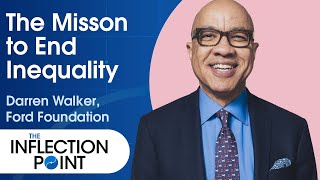
A recorded interview (The Inflection Point, Feb 16, 2022) in which Monica Langley speaks with Darren Walker, president of the Ford Foundation, about his personal journey from Head Start and Pell Grants to law, Wall Street and ultimately leading the Ford Foundation. Walker explains the Foundation’s refocused mission—addressing inequality and supporting democracy—distinguishes generosity from justice, and describes program priorities (e.g., future-of-workers, large annual grantmaking). He also reflects on capitalism, social mobility, and the Ford family’s historical relationship with the Foundation.
Chapters
The Ford foundation is one of the largest philanthropic organizations in the world.
What we invest in at Ford are people's dreams, their hopes, their aspirations.
Are you afraid that the American Dream doesn't exist or is no longer viable?
If you want the American Dream today, Monica, move to Canada.
Welcome to the Inflection Point. I'm Monica Langley. Hi, Darren. Thank you for joining us on the Inflection Point today.
Thank you very much, Monica. Welcome to the Ford Foundation.
When was that moment in your life when you realized this is the person you are going to be?
Well, I was very lucky because in the early 1960s, I lived in a small town in East Texas, and a woman appeared at our door to enroll me in a new government program called Head Start.
That opened up your world by getting to go to Head Start, right?
Absolutely, it did. And in many ways, I always felt that my country was cheering me on, that America wanted me to succeed. Growing up in a town that was where there was absolutely racism, where there was absolutely homophobia, where there was no doubt that I was a different boy, if you will. I always felt affirmed, and I was lucky. I was successful at school. I was in the student council and all those sorts of student leadership things.
And then you went to college and law school at the University of Texas with the help of Pell Grants, and lo and behold, those were ideas of the Ford Foundation. Right?
These were all ideas that the Ford foundation invested in early. It's one of the things we do. We invest in what I call the three I's ideas. We invest in institutions and in individuals, and it really manifests over decades into a tremendous body of work and impact.
You obviously had no clue that the Ford foundation was vital in your life.
Though I didn't know what the Ford.
Foundation was even better.
Never heard of it, and I never heard of it.
Now, when you left Texas, I read that you said growing up poor, you never wanted to be poor again.
Oh, it's absolutely true. And if you grow up poor, you know exactly what I'm talking about. I mean, when you grow up and you're waiting for your mother to pick you up at school after student council, and you wait until it's dark, and then you find out that the reason she couldn't pick you up is because her car was repossessed, these kinds of things have an indelible effect. And so, yeah, I never wanted to be poor. I never wanted to worry about whether I could pay the rent or the mortgage or whether my car would be repossessed. The kinds of things that Today, far too many Americans worry about.
Right. So when you came here, you went straight to a top law firm?
Absolutely. I mean, I knew I wasn't going to work for, you know, a nonprofit or a public interest law firm, like many people.
You want to make the money?
Absolutely. I was. I was unapologetic about that.
And then you went even more toward the money working for ubs, a Wall street firm.
Well, I was very lucky because when you have a client, say, come work for us, you're too much fun to be a lawyer.
Well, I understand. I only practice law a couple years.
Myself, so that's what I did. And UBS was a great run. I was there for eight years, and I think I felt at the end of that time, I was ready to make that transition.
Okay, so then, though, you end up here at the Ford Foundation. What is the Ford Foundation?
The Ford foundation was founded in 1936 by Edsel Ford, the son of Henry Ford and his father, Henry.
But it is not affiliated with the Ford Motor Company.
We have not been affiliated since the 1960s. We divested our stock in 1976. Henry Ford II left our board, and there was not a Ford family member involved until three years ago with the.
In fact, the Ford family got ticked off at you guys at the Ford foundation long before you were here because they thought you all were too darn liberal, Right?
Well, indeed, Henry Ford II did not appreciate the foundation's work on women's rights. The civil rights movement work was problematic because the Ford Motor Company was receiving boycotts from southern whites who would not buy Ford automobiles because they saw the profits going to the Ford Foundation. Our foundational work on creating the public interest law, the environmental law field.
Wow.
Because they, of course, sued the Ford Motor Company for environmental.
Oh, my gosh.
Problems.
I guess I didn't even know that little tidbit.
It's a big tidbit.
Oh, my gosh. But now look at Bill Ford. The chairman of the board is. Of Ford Motor today, is a huge environmentalist. Has been for a really long time. And you, as the president, are the one who orchestrated a reconciliation with the Ford family.
Well, that was very important because, as you know, in 2013, the. The city of Detroit went into bankruptcy. I was called by the bankruptcy judge to help broker a commitment from the foundations in Detroit and others. Through that process, Bill Ford, his sister, Sheila Hamp, and his mother, the great matriarch of the Ford family, Martha Firestone Ford really became my friend.
And I think it had a lot to do, though, with your personality. And the way you were able to bridge this longstanding feud, in a way, don't you?
Well, it was very important that we put that era behind us.
Exactly, I believe. And you stepped in for Detroit.
Absolutely. I mean, the money was made in Detroit. Where do we think this came from? I mean, things just fall from the sky. I mean, we owe a huge debt to that city and to the Ford family.
When you got here, though, you really shook up the Ford Foundation. Let's be clear. You stated you wanted to have a new mission. What is the mission now?
Under your leadership, we have a single focus, and that is addressing inequality in the world in all of its forms. That's a broad mission, but it connects to Henry Ford's directive that we strengthen and support democracy. The reason inequality is so important is because as inequality grows, democracy atrophies. There is a direct inverse correlation. A strong, vibrant democracy is a nation where opportunity does indeed exist for all those who work hard and where those who work hard can expect to live with dignity. The oxygen of a democracy is hope. Inequality asphyxiates hope. And so I believe we've got to build more hope in this country. And if that's to happen, we've got to address inequality.
I have heard you say you are in the business of hope.
Indeed, we're in the business of hope. Philanthropy has the ability to invest in ideas, in people, in ways that give them hope for the future, in ways that allow them to imagine what is possible in, indeed to dream. What we invest in at Ford are people's dreams, their hopes, their aspirations for their country, their community, their families.
I notice when I walk in your front door underneath the Ford foundation, it says a social justice organization. What does it say? And is that your handiwork?
Well, it says that we're a social justice philanthropy. And that that comes out of the words of Dr. King. When he wrote about philanthropy in 1968, he said the following. Philanthropy is commendable, but it should not allow the philanthropist to overlook the economic injustice which makes philanthropy necessary. And what Dr. King was saying was something different beyond what Rockefeller and Carnegie said about philanthropy. He said philanthropy must be more than just charity must be more than just generosity. Philanthropy must have as its objective dignity and justice. And that is different. That requires a different lens, it requires a different inquiry, and it requires a level of self awareness by the philanthropist.
Exactly. This is a point that you put in my brain as I was researching you about the difference between generosity and justice.
Well, generosity is critical. It's important. It's the imperative to want, to give, to help, to give back, to ameliorate some terrible condition. Justice requires something else. So, you know, I love at the holidays, you know, when we can drop money in the Salvation army bucket in front of Bloomingdale's.
I feel so good when I'm dropping that red bucket.
Don't we feel good about that?
And what's wrong with that?
There is nothing wrong with feeling good, but we need more. So when you drop that money in, it's not enough to say, I feel good. I'm addressing homelessness. It's to say, why is there so much homelessness? Why are all these homeless people on the streets of San Francisco, of New York, of our country? What's the core issue here? What is the root cause of so much homelessness? So that's the inquiry that justice brings you to. It doesn't let you off the hook. Generosity sometimes.
So I can't just feel good. I've done my part. I dropped a few bills in that, and that's great.
Good for you, Monica. We need that. But it's not enough.
But I'm implicated because I'm not helping.
Well, you're implicated because some of the systems and structures that produce our privilege also disadvantages others. And we have to inquire, what about those systems that make it so easier for me?
Which is an interesting point with you, because you are an unavowed capitalist.
Absolutely.
Indeed.
There is no better way to organize an economy. But I am concerned that the kind of capitalism we have today is not producing shared prosperity. It's not producing a landscape of opportunity. It's not producing the social mobility. I mean, if you want the American dream today, Monica, move to Canada because the Canadians are outperforming us on every metric of social mobility. America has owned the mobility narrative, and now we are losing it to the Canadians. Even some of the Europeans, honey, are out for Florida.
You're also, though, on three corporate boards. I am indeed. Big ones, good ones.
I am indeed.
Which ones are you on?
I'm on the board of Square, Ralph Lauren and PepsiCo.
All, like, big names. And are you in there trying to shake them up, too? Because you're saying some radical statements move to Canada.
Well, I'm saying that if you need.
To change, we need to make some.
Big changes to make changes. And we capitalists need to understand that there are too many people who no longer see capitalism as the best way to organize an economic system. And this isn't a political statement. All of the data, the Pew surveys, the Gallup surveys, Show this. So we should be concerned. If we want to preserve our ideas of free enterprise, of the kind of entrepreneurial culture that we have in this country, we've got to make capitalism work for more people.
Are you afraid that the American dream doesn't exist or is no longer viable? Is that the bottom line?
Absolutely, I'm afraid. In fact, the data tell us that the American dream, for many, the mobility escalator that I got on has stopped for far too many. It slowed down for far too many. And so we've got work to do to get that mobility escalator moving again.
What you're doing at the Ford foundation is you're giving like three quarters of a billion. Billion with a B dollars a year, like some 1800 grants or so. What are you doing? Where is your focus right now?
Well, we're working, for example, on what we call the future of workers. How do we ensure that people who work 40, 50 hours a week don't have to get a government check to make ends meet, that they don't have to use an EBT card at the Kroger because they don't have enough money to pay for their basic food staples? I mean, this is what is happening in our country. And people like us who live comfortable lives sometimes forget or are insulated from that reality.
What would happen to Darren Walker but for the Head Start and the Pell Grants, which really is. But for the Ford foundation, would we see Darren Walker today as this person you are in front of me?
Well, probably not. There's no doubt that my. The investments in my potential, the belief in my capacity and the public policy, private philanthropy, community support, together made it possible for me to be here with you today. I believe that we in this country have to do all that we can to put the pathways for success in front of. Of young people, especially young, poor people, poor people in rural America, people in urban America that we have a responsibility to serve. And we forget that word. It's among the most valiant, important things we can do as citizens. We've got to ask ourselves, what are we doing to serve, to serve the public good, the public interest, indeed, to serve our country.
Thank you so much for sharing your vision and your views today with us.
Thank you, Monica. Great to be with you.









