Davos 2020: Leadership in the Fourth Industrial Revolution | Salesforce
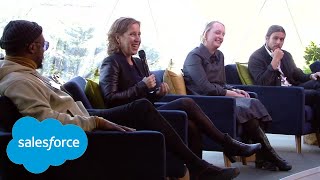
Panel discussion at Davos 2020 (World Economic Forum) on leadership in the Fourth Industrial Revolution, with a strong emphasis on environmental action (notably the Trillion Tree Vision), youth climate activism, and the role of technology, corporations and governments in enabling large-scale solutions. Speakers include Mark (moderator), Felix (Plant-for-the-Planet), Will.i.am, Jane Goodall, Alexandra Villasenor (Earth Uprising), Julie Sweet (Accenture), Susan (YouTube), and others. The conversation highlights cross-sector collaboration, concrete claims about tree numbers/carbon sequestration, reskilling and stakeholder capitalism, and platform responsibility for harmful content.
Questions this video answers
13 billion trees.
About 3 trillion trees exist globally, with space for roughly 1 trillion more.
More than 200 gigatons of carbon.
About 40,000 gigatons of carbon.
Approximately $300 billion.
Chapters
All right, good afternoon. How is everybody doing? Well, we have so many exciting and amazing things going on and we have an incredible, an incredible panel. But I'll tell you that one of the things that we've been really excited about at the World Economic Forum over the last several days is the announcement of1t.org which is our trillion tree vision. How many of you have already heard about the trillion tree vision? Raise your hand. All right, very good. So there's a lot of stories to be told about exactly about how it happened and a lot of the connections around that are here. And I just want to kind of fill in a couple of things before we start. But number one, you know, we had a climate conference in San Francisco a couple of years ago and we had the incredible pleasure of having Jane Goodall with us. How many of you know Jane Goodall? Raise your hand. So amazing. And we had the opportunity to talk to her about the work that we're doing with the oceans and in fact, some of the things that we were talking about here at the World Economic Forum. And I was so excited to tell her about all the ocean work led by Doug McCauley at UCSB, who's sitting right here, incredible young scientist. And she said, well, Mark, that's all very nice, but what are you doing for the forests? And usually I'm not at a loss for words, but I didn't know what to say and I said I'm going to have to think about that. I think you opened a door for me and it was very powerful what had happened. And it was in my mind it was going around and around and around. And we were at the, we were at the World Economic Forum trustee meeting in August of this year. And we have some trustees here and we just stand up, Peter, and we have some people here who are also trustees and so forth. And I'm coming back to get them actually, but because there's some people here have done some amazing work for the World Economic Forum, but he's hiding back here. But anyway, here, will you give Peter a hand? He's right here. Incredible. From Geneva and has been the driving force behind the World Economic Forum for many years. So thank you. And Al Gore took me aside and he goes, well, did you see the work of Tom Crowther? And I said, well, I don't know who Tom Crowther is. And he said, he's an amazing young scientist, 30 years old. He's in, is in Zurich. And he took artificial intelligence and he took this amazing low hanging satellites and the thing that Was really cool is he said, now we can actually map out that if we planted 1 trillion trees exactly here where these satellites say that we're going to do it, well, we could take more than 200 gigatons of carbon right out of the atmosphere. And I went, that's amazing. What's a gigaton? He said, it's a lot of carbon. He said, actually, since the first industrial revolution, we've only put a little bit more than that actually into the atmosphere. So you're taking maybe what could be more than two thirds of all pollution out of the atmosphere by planting a trillion trees. I said, that's amazing vision. And I don't know anything about trees. I don't know that much about carbon. You know, I'm like, I don't even understand, you know, are we creating more carbon? Somebody had to take me aside and say, well, Mark, you know, we don't actually create carbon. Carbon is a constant in the universe. It's one of the four most popular elements, the letter C. And I was looking at it and go, carbon's a constant. Yeah. It's just that human beings are very good at moving the carbon around. You know, when we burn the trees, carbon goes from the trees into the atmosphere. Maybe then it gets into the ocean. The ocean is sequestering carbon. I said, doug, how much carbon is in the ocean? He said, about 40,000 gigatons. Well, how much is in the trees? About 200 gigatons of carbon. And then Doug said to me, yeah, did you see the work of Tom Crowther? And I said, who's Tom Crowther? I just heard that from Al Gore. And he goes, oh, it's an amazing 30 year old scientist in Zurich. So then it was so cool because I'm like, well, maybe that's a huge idea. And I was using this amazing app on the app store called Plant the Planet and I downloaded the app and I'm like, this app is so cool. And it said, yeah, we've ignited young people all over the world to plant trees. In fact, We've already planted 13 billion trees through this app. And I said, well, if you get to 13 billion, I guess you could get to 100 billion. And if you get to 100 billion, you could get to a trillion. Well, that app was started by somebody who was right here, Felix. So stand up, Felix. And. Felix, just tell us a little bit about your story. We'll just take two minutes and so inspiring to me.
Thank you. So about 13 years ago, I was nine years old and I was supposed to Give a little talk in my class about the climate crisis. And when I prepared this, I heard about this fantastic woman from Kenya called Vangari Maathai, who had planted 30 million trees across 30 years with lots of women across Kenya and some other African countries. So I told my classmates that we should plant 1 million trees in each country of the world. And my classmates loved the idea. So a few weeks later, we planted our first tree. But we had no real plan of what we would do after that. But we were incredibly lucky because two local journalists reported about this tree. And so some other schools heard about it and planted some trees as well. And a slightly older student created a very simple website for us, which was essentially just a ranking among local schools of who had planted the most trees. And lots of schools then wanted to out compete one another. And this is essentially how Plant for the planet spread. After one year, we had 50,000 trees. After three years, a million. And children all across the world started joining us. And we started achieving our goal of the million trees in some countries. So that's when we then started asking ourselves, what's the next step? Right. Where do we go from here? And we really had two big questions there. First one was, how many trees even exist in the world? And the second one was, how many additional trees could we plant? And this is, of course, when we met Tom Crowther. He made two wonderful research papers about this, came up with these ANSWERS. We have 3 trillion trees globally in space for 1 trillion more. And since then, for the last nine years, we've been calling on the world to plant a trillion trees. It wasn't going so well for most of those nine years. People didn't really care. But then you came about and you convinced some other people. So we're incredibly excited about this. We've been working for the past two years on building this app that makes it incredibly easy for anyone to plant trees by just donating directly to the best tree planting projects all around the world. And now we've gotten some wonderful support from your team in the last months to actually massively improve it. So I'm very excited about it going forward. And thank you so much for taking up this vision and convincing the world.
So Felix is here. It's an amazing story. And what happened was, is as I started to get excited about this, this was only. We were only at this trustee meeting, Peter and I, in August in Geneva, and then in September that I'm talking to Doug and I'm sending Doug back to UCSB to do the math and to Check and say, who's Tom Crowther? And then we find Felix. And Felix came to Dreamforce, and we're like, all right, this is actually sounding very cool. And then I sit down with a friend of mine, Ray Dalio. And Ray Dalio and I are having lunch, and he's come to San Francisco, and I tell him this, and he's like, well, what's this going to cost? And I said, well, $300 billion. That's what the scientists say. Well, you're not going to be able to do that through a lot of private philanthropy. You're going to need governments. What are you doing about governments? And I went, I don't know. I don't know what to do. And then I kind of thought to myself, well, I guess I'll go find out. So I got in my car and I drove to the White House, and I knocked on the door, and I was very lucky. I walked in to see Jared Kushner, and I said, have you heard about the trillion tree vision? And he said, no, I haven't. I said, have you heard about Felix? Have you heard about Tom? No. And we sat there for maybe an hour, two hours, and we looked at all of the research. We looked at the Scientific American articles and the article in Science and all the things that talked about the criticality of sequestration. See, we had kind of come to the conclusion that sequestration was important in some ways through Doug's research, because one of the key things of ocean research is the ocean is getting a lot hotter. And the reason the ocean is getting hotter is because it is sequestering carbon. And if the ocean keeps getting hotter, it's not going to be good for all of us, for the corals, for the fish. And so that's where we got more motivated around the trees. And as we were explaining all of that to Jared, Jared said, you know what? I think we're in. I said, what? What was that? Maybe when we go to Davos, we will say we're going to support the trillion tree vision. In fact, I think we can plant 100 billion trees just in the United States alone, and also work with our diplomats and our foreign aid to help motivate the rest of the world as well. I was like, I'm sorry, what was that? And in fact, on Tuesday, for those of you who attended Donald Trump's speech, he said that he is now supporting also the Trillion tree vision, along with you, Felix. Amazing. Probably kind of unbelievable. How about that? How about a hand for our U.S. government? Very optimistic. And I'll tell you that the Chinese government also said that they're going to support it. European governments. The President of Colombia, President Duquet also attended our press conference yesterday and made specific commitments to the trees in his country. We spoke to the Latin American leaders last night and I'm speaking to all of you because everyone here has to be on board. So would you raise your hand if you're going to be part of the trillion tree vision? Thank you. So important, if you're attending this conference, it's something that we want you to know about. And you can go to1t.org not low t1t. That's a joke for men over 50. But1t.org and I'll tell you, we're very fortunate. I just noticed sitting right here is one of my heroes, Sylvia Earle. Would you just stand up, Sylvia, for just one second? Thank you for being here. Sylvia Earle, the foremost scientist in the world for the oceans and the former chief scientist of NOAA and so many, so many things. And plant trees. Can you just say a couple words on behalf of the oceans before we begin?
Oh, what an opportunity. I think all of you should dive in. That's what here in the mountains, we all are still dependent on the existence of the ocean. And we have a chance as never before right now to make decisions about the high seas, about the deep seas, about the old growth ocean that needs to be protected and restored. Thrilled to be able to champion what we're hearing about the trees. We need to think what we can also do to repopulate the ocean. Thank you. Thank you for weighing in. Dive in. Go for it.
Thank you. Thank you, Sylvia, for your tremendous leadership. And we also have the UN High Capitol Commissioner for the oceans here, Peter Thompson. Peter, where are you? Oh, he left. Anyway, goodbye, Peter. But he was here. I saw him. We also have Alexandria here. So Alexandria, would you stand up for a second? Would you just before we get going, would you just tell us a little bit about your story and your vision about what's happening on climate and also give us a, a taste of why you're, what you've been doing here in Davos.
Yeah.
So thank you. Hi everyone, my name is Alexandra Villasenor. I am a 14 year old climate activist from New York City. I've been on strike every Friday in front of the United nations headquarters for the past 49 weeks as of tomorrow in solidarity with Greta and the Fridays for Future move. And then I am also the founder of a nonprofit that focuses on climate education. It's called Earth Uprising. And so really what got me involved in climate activism in the first place was I'm originally from Northern California, and so you can usually tell I'm not a true New Yorker because I talk too slow or smile too much. And so I was visiting family back in Northern California when the Paradise Fire broke out. And so my hometown is very close to paradise, so we ended up receiving a lot of the smoke. At one point, it was the worst air quality in the world. And so since I have asthma and it was making me very sick, my family had to send me back to New York City from that trip early. And at that point, I was super upset because California is always on fire. And so that made me start to research about it, and I started to see the connection between climate and wildfires. That made me want to take some sort of action. And that's why after seeing Greta Thunberg at COP24, I knew what I could do to be involved. And this is exactly what I'm starting to see, is that young people are being affected by the climate crisis all over the world because we're already seeing the effects of it. And once young people see the impacts that climate has on their community, it makes them want to get more involved. And so that's why I think education is also such an important key, because when young people see why it's happening to their community, it makes them want to get involved. And so I hope that all of you will come out and support the youth movement, support us, that our actions help amplify our message, because we need everyone to be an activist. Thank you.
Very good.
Thank you, Alexandria. Well, I could spend the whole day going around the room. We have so many important messages. Paul Pullman is right here. Who's getting all the CEOs behind these messages. We have so many Incredible ministers here, CEOs here, NGO leaders here. But we really need everybody involved. And I'd love to now begin this panel and talk about it. We have some of the most wonderful people on the panel. And first of all, of course, we have my hero, Myshiro. Jane. Good also. Jane, welcome. Thank you for coming back and being part of our panel. And we are. And would you like to come on up here? Very good. Thank you. And we also have a good friend of mine who is. And we pick somebody every year, as you know, to really represent the youth and youth activists and people who are making a difference. And for those of you who know the incredible Willie Nelson and have appreciated his artistry for so many years, you probably Know my good friend who has supported us in so much of our.
Work all over the world.
I'm so happy to have him back to Davos for the third time this year as a full conference participant. Participant as a gift of Klaus Schwab. So please welcome Lucas Nelson. Well done. And we're also very fortunate to have an incredible chief executive officer of the largest systems, information systems and consulting company in the world, Julie Sweet. So please welcome Julie, The CEO of Accenture. And we have another very good friend of mine who is also an amazing CEO of a company that we all use their products every day. She was also one of the very first four founders of Google. She is now the CEO of YouTube. Please welcome Susan. And I should also say Susan is also on my board. So she's doing double duty today. And every panel that we have ever had in Davos, we know that we need to have one person who has the clearest thought into the future. And if you go back and watch the videos, which I do from all the panels, you will see that he is somehow able to tell us exactly what is going to happen in five years and in 10 years. And we are very fortunate to have back a tremendous prophet and visionary and leader of many industries, including music, philanthropy, technology. Well, I am. Welcome back. All right, well, we're going to start out our panel, and every year we think about what is happening in the future in the next five years. And usually our question is very simple. You know, we're usually looking at technology, innovation. For the past five to 10 years, we've been talking about the fourth industrial revolution. But I'd like to just slightly shift this year. And I'd like to ask this question. That is, what is it that you deeply care about for the next five years? What are you hearing inside yourself? What do you deeply trust is the message that you have for the world for the next five years? What is it? That is the crystal clear voice inside you in terms of how it's guiding the world and your role in it and what you want all of us to do to help you make that happen. So, Will, would you start us out? Oh, wow, great. He's got a microphone came with it.
So music is an amazing idea, a way to communicate heavily, centered around math, crosses, you know, borders and cultures. It truly is like a universal language. And we take it for granted just how magical music is. And to have real music, you have to, like, complement one another. If somebody's playing in the key of E, you have to figure out how to. If you don't want to play in E. You have to come up with some type of complementary, you know, progression.
That.
Vibes right in the key of E. If you're playing a shuffle, you have to figure out a way to, you know, to have counter rhythms. Because if you don't, it's not music. And politicians don't act that way. Companies don't act that way. So for our musicians, it has to sound good for people. But that's not how companies and politicians are. If politicians were, there was a sound that was associated with how they vibed and collaborated, it would sound like noise. It would be a dis ease. There would be no harmony. It wouldn't be a symphony. And, you know, musicians, we don't call fans users. We call them fans or family or fanatic. Not fanatics, fans or family or like friends, especially the ones that come real close. And we need to start looking at people as people and making products for people. You remember that one time where they were like, oh, asbestos. We got to take it all out of our ceilings. And it was like this huge effort to take asbestos out of our ceilings. But for some reason, we have, like, similar products that are deployed into the world, and we. We really don't care about as long as we make a profit, like, that can't continue. I was in an interview today. Someone asked, like, you know, we're talking about the environment up here. What do you do to help the environment? I was like, you know what? I really don't do anything because I'm not really given. I'm not given true options. They're all just like, options. They're not real options. Even traveling here, anybody that came to Davos and talking about I care about the environment are the biggest hypocrites. Because it's not like we're given options on travel that are, you know, kind to the planet. Carbon points should not just be the solution. There's technology that we should be, you know, working on to even advance how we travel that doesn't pollute our environment. These are the things that we should really be focused on. So what I my next five years, be better collaborators, collaborate. Create a symphony of company, government and society to where people like how it sounds. Can you say you really like the way the aisles in your supermarket sound or the things that you want to put in your body? Do you really like the freaking lies that told you? Like, fat free really truly means fat free, but then they pump with a whole bunch of sugar and then we have diabetes and obesity problems in the world. It doesn't really sound right. There's a bunch of freaking lies. We can't sustain that.
Very good. Thank you. Thank you. All right, Susan, you have an incredible influence on the whole world. Every person here is using your product to entertain themselves, to learn, to motivate, to inspire themselves, to understand things. And our kids are also on your platform as well. Give us your vision of what's happening right now. What is the voices inside you, what are you hearing? And where are you going over the next five years in terms of your life?
So I'd say one of the most inspiring parts of running YouTube has been for me, hearing the stories of YouTubers who have voices that otherwise never would have been gotten out there with stories that they're sharing with the world and changing the way that the world sees so many different types of individuals. And those messages couldn't be told. So this is actually an important year for YouTube because it's the first year that we have YouTube creators that were officially invited by WEF. We actually have seven here that were given the white badge, and they've been able to report and talk about what's happening here in Davos and make it relevant for the next generation. That's a big milestone for us. And let me tell you just the story of two or three of these creators, and you'll have an understanding of what I'm talking about.
About.
So I'll start with the first one. Natalia Akori, who's from Brazil. She has 5 million subscribers on her channel. She started out as a TV correspondent, but created this channel because she realized that women in Brazil a lot of times were staying in abusive relationships because they didn't have personal finance or have knowledge about how to manage their own money. She created this channel. Everyone told her, this is not going to succeed. She was turned away by all the major news networks, and she said, I'm really passionate about this. I'm going to create a YouTube channel. And today she has 5 million viewers and incredible stories of how she's changed people's lives. We have another YouTuber who's here, Molly Burke. She became blind when she was a teenager. She talked about how difficult that was, but she was able to have a channel on YouTube, which is a lifestyle channel, where she talks about fashion and beauty. She has built a business, an incredible career talking about beauty, and also giving exposure and raising sensitivities of what it means to live with a disability. And so these are just two stories of YouTube creators. And we have here in Europe 26 million creators who have over 100,000 subscribers. So that means that's 26 million subscribers. Small companies, each of which has a story like that and that's sharing it with the world. And so what for me inspires me and there've been a lot of hard issues to get through, but what inspires me is these positive stories of how people are getting their stories out there that otherwise never would have been told. Building business each of these creators has a team behind them. They have, a lot of times they have product, they have makeup line, book tours and a team that works for them. And I would say so that's what inspires me. And my goal is to continue that and build out those stories and enable those creators and enable those small businesses to be successful. And all of the activists here, a lot of them are getting their word across by talking about YouTube and using YouTube as their mechanism to connect with other young people. I've also been, I'd say my second big priority has been, my second and last has been to focus on responsibility. And there's been a lot of questions in the last couple years about the role of social media, the role of media, the role of new media and how to make sure that as more voices are on the platform that it's managed in a responsible way. And that has been my primary focus for the last three years, making sure that we are taking every step we can to handle, update our policies. We made 50 policy changes in the last two years, some of which have been really hard, really, really hard for us. We've hired thousands of people to enforce them with machines learning. And I will continue to make this my top priority to make sure we're doing the right, right things. So, and Mark has given me a lot of good questions. Every single time there's some question about it in the news, I get a text from Mark. And so I feel very, for many reasons, for many reasons, this is something that is fairly important to me because I know that this is an unusual time. This is a time of transition. There's a reason we're calling it the fourth Industrial Revolution. And I know that there are going to be books written about how this time was perceived and about who was on the right side of history, about who made the decisions, who was forward thinking and who thought about what is going to be best for society. And I want to make sure that my legacy is one that is on the right side of history. And so that's why I care so deeply about it. And that's why it's been my top priority.
Well, I think you're right. It's a historic time. I think everyone in this room and at this conference would agree at many, many levels and many dimensions, it's a historic time. Taking that into your heart. You mentioned several times, Rosa, there's been extreme, some extremely hard decisions that you have had to personally make and gone to the depths inside yourself to make. Can you illuminate one of those for us? Something that was extremely hard?
Yeah, I mean, I'd say one. You know, we started on this journey three years ago, and the first big issue that we tackled was violent extremism. And like, I'll just say I grew up in a university environment. I thought, I'll work in tech. Like, I never in my life, like, like, if you had told me never in my wildest dreams would I think I needed to work and deal with violent extremism and actually be in the business and hiring people who are experts of this to take that content down. So that was, you know, that was sort of the beginning that turned out it was actually relatively easy to. Easier to solve because it's well established, there's specific groups, there's FTO organizations. And I think one of the hardest decisions and the hardest area for me was the work that we did on hate. And I'm actually really proud of what we did because we made some really, really high standards of how we were going to raise the bar and make sure that we were not going to allow Hate on YouTube. So we have, I think we have about 12 or 13 protected group characteristics, whether it's religion, race, gender, sexual orientation, immigration status, caste. India is a big market for us and make sure that none of those characteristics can be used to justify discrimination, separation, violence, anything that could be harmful to that individual for that group. And the reason it was so hard is because Europe actually has some pretty good hate laws, but the U.S. for example, really, really doesn't. And so it was a tough moment for us. And it was tough because we really had to go above and beyond and make sure that again, we were being fair and understood. But I think at the end, after we made that decision, everybody felt that we had done the right thing and that YouTube was going to be a much better place for it. So we actually announced that we took down over 100,000 videos in that quarter just as results. And while we want to be enabling free speech, we also want to be doing in a responsible way. And that was a very significant moment for us and scary too, a lot of times. Again, these are, you know, this was a scary place to be in the middle of. I never in my life thought I was going to be in the middle of doing this type of work. So I'm proud that we were able to do it and that we're working really hard. And we will continue to make sure that YouTube is a responsible place and we know we have work to do, but we've come a long way and we will continue to go further.
Well, I want to commend you on the incredible changes that you have made to the product and the platform. And I know that you never expected to find yourself in this situation, but there is no finish line in the pursuit of the truth. And you are fighting that fight. And I know every day because I see the text messages from others as well that are heading in your direction, that it's a tough fight that every, that you're fighting and you're at the very tip of the spear. So thank you for everything that you are doing.
Thank you.
Julie, I want to congratulate you on now becoming the Chief Executive officer of one of the largest and most important companies in the world, Accenture. We are, We're grateful to have you specifically in that role. And I'm especially grateful to have another incredible female CEO, because our CEO conferences sometimes can be a little bit too male. And we need more great women like you and Susan leading these important companies going forward. It just makes everything better. Let me ask you now you're the CEO of this company. What is the most important thing to you over the next five years?
So we've, first of all, I want to thank you. I have lots of things to thank you about, but one of the things, as a mother of two daughters, 11 and 13, who's now traveling even more, I'm on the eternal quest of trying to explain to my children that I do something meaningful and it matters. And so I was trying to explain why I'm gone for a week in Davos and nothing got through. And the judge is always, do they get on social media right? Do they tell their friends on snap? Until I said I was going to be on a panel with Dr. Jane Goodall. And then I'm not kidding. True story. Immediately, my 13 year old immediately got her phone at and was telling her friends. And as I listened to Felix and Alexandra, like, it's just, I think the young people really have it. It's so exciting that of all the different things, including everyone on here, and by the way, they've learned all about how to put makeup on on YouTube. So that would have been but it was really, it was Dr. Good On. I think that's a great hope for the future. So thank you for being such an inspiration to the next generation. And I got my selfie, so I'm really cool now. So, you know, one of the things that we've really been trying to think about, we're 500,000 people, 80% millennial and Gen Z, and we spent a lot of time at this conference, and Klaus really led it. And you've been a leader yourself personally in Salesforce on what's now being called stakeholder capitalism.
Right.
And the business Roundtable this year was big, big news, you know, and actually in the US, in my home country, 180 companies said the purpose is for all stakeholders. But I will tell you that that's not a very inspiring message.
Right.
With 500,000 people who we are saying this is what we need to do. And so we believe that just as we talk about, you know, we've just started the decade to deliver on the potential of technology and digital. This needs to be the decade of shared success. So last week we announced to the firm, like, this is how we're going to define ourselves. And, you know, Brian Moynihan, sitting here, did some amazing work in the International Business Council that said that it's going to take $6 trillion to achieve the SDG goals of the UN that's only going to happen with all of us taking that mindset of shared success. And that is not about a particular country or brand, but all of us coming together. And so that's really what we've defined for our next five years, is how do we help be about shared success, not the Accenture brand, but about what we're doing every day and how we're contributing.
When you think about shared success and you think about what's happened in the ibc, one of the things that Brian has said Is he's said two important things. He said, this is to the 200 largest companies here and their chief executives. Many of them are in this room. Number one, each of you are going to go net zero. I know it's going to be hard, but if you're not net zero already, you're to going, going to go net zero. And I want a date of when you're going to be net zero by. That was not easy. And two, he said, and I have spoken now to the CEOs of the four major accounting firms. They are going to audit. They're going to look at each of these ESGs, come into your companies, and in a matrix of 80 fields, they're going to tell us the level of transformation you have gone through to achieve the SDGs. So, one, you're going net zero, and two, you're going to adopt the SDGs and those 200 cos saluted. So thank you, Brian. That was very powerful leadership. When you look at Accenture and its transformation and to adopt all of the SDGs, what is the complexity for you? What will be the challenge?
I think for us, the challenge is to continue the skilling. So we've trained over 300,000 people. We're trying to 3 million in our communities, but at Accenture over the last three years, and the thing about it is, you can't train and then you're done. Right? We automated 40,000 jobs. We said we're going to invest 60% of the savings so that we upskill everyone. Right. But the point is, it's now continuous training and that's, I think, a challenge for all of us. And it's very worrisome. Like, we just did some research that said spending on artificial intelligence three times over the last three years, that's how much it's increased. Only 18% of the same companies invested in Skilling, and we face that challenge ourselves. So When I became CEO, my first video to our 500,000 people, I said, let me tell you, I set a quarterly learning agenda and you're going to be seeing it transparently. And we have something called a learning board. And in six weeks, we actually had 100,000 activities on my own learning board, Shivas, which a little competitive internally. So that was good. But I think that's the challenge for Accenture and for all of us, is that this reskilling, not only are we behind when you look at the numbers compared to what we're embracing, but it's an ongoing challenge. And I think, again, that's something where the WEF has started this new platform around reskilling, and I think that's where we will have to together solve that challenge.
Luke. Lucas, this is your Third World Economic Forum. I know that, you know, as I've gotten to know you now over several years, you've talked to me about. You grew up on the road, which means. And I was on your bus. So I can see that you've had an incredible life. You've seen the whole. You've seen the world, you've met amazing people. You know, you are 31 now, 30 years old. 31. 31. When you first came here, you were 28. So where, where, where is all this going over the next five years for you, what's it going to look like?
It's an interesting question because I've asked myself the same question. When turning 30, I had my own sort of aha moment, if you will, my 2020s. Listening to that speech by President Duquet of Colombia last night, he mentioned the 2000s being the decade of vision, clear vision, 2020 vision. And I found that to be a very appropriate and hopeful analogy because I've started this decade myself with hope for the first time in a long time. I believe that with the initiatives that you mark and these companies here.
Have.
Committed to, we as younger generations, and Felix and Alexandra of the true young generations, are finally able to see that the older generation realizes the importance of connecting what is the most important issue of our time from old to new generations. I find that when I was young, I went on a field trip in San Francisco and then I went up to the redwoods and I listened to Jimi Hendrix for the first time. It was a religious experience, if you will. And one of my favorite quotes of Hendrix is, when the power of love overcomes the love of power, the world will know peace. And that if we here, who have power, can take that to heart and choose love over power, we can change the world. We have that ability here. I like to look at nature as the greatest teacher we have. Nature can teach us in metaphorical ways if we just sit and listen. And the way I liken all of us human beings, we're like the bloodstream of the planet. Everything is natural here, even plastic. Like you were saying, carbon can't be destroyed or created. Everything is elemental. The planet had created us. This is the natural evolution. My hope is that we are in the stage of our human evolution, that is adolescence, and we're actually now maturing into our true human potential and what humanity can be in terms of a harmonious organism on planet Earth. And we are the red blood cells. We are the blood cells. Some of us are red blood cells. And some of us who are more greedy can be cancer. When a blood cell becomes too greedy, it becomes cancer. And some of us can choose to be white blood cells. Some of us can choose to fight that cancer. We all have that choice. We can make that choice, Mark, with the Trillion Trees Initiative, you're allowing people and giving people a vision of what they can truly do in order to become a white blood cell on this planet. I think that the problem with me with understanding what we were going to be able to do in the future, nobody had A vision. Nobody knew what the solution was with all this new technology, AI everything. None of us in our generation were able to overcome our apathy or our lack of faith in the older generation because we see all these new things being created, but we don't see the application in actually making the world a better place yet. And now we have a clear vision with reskilling the workplace. If Exxon Mobil, for example, I use that because it has had previously a negative image. And I think that if Exxon committed to taking half of its workforce over the next 15 years and retraining them to be renewable to renewable jobs, then Exxon Mobil will be a white blood cell force in this world. And it doesn't matter what they were before. And so we can learn from nature. We can see how nature operates in a way where it takes and gives back. And if you take too much and you accumulate too much, you become cancerous. And that applies to so many different things. So what I've been able to do in my own limited way and perspective is when I'm on the road, I've decided to try and connect people to their local farmers. My dad started Farm Aid and Farm Aid is dedicated to supporting family farms, sustainable agriculture and regenerative farming. There's so many amazing things. I went to a few lectures, one on vertical farming, which is a very promising new field. And I think that. So what I'm doing on the road is trying to connect people just by being out there playing music and saying, hey, bring your coolers and we'll have a pop up farmers market and you can connect with your local farmers in the area and you can get your food directly from these really innovative farmers that are doing it the right way and taking care of our planet and you know, keep it in your cooler and take it home. You don't have to go to Walmart the next day, no offense to Walmart, because Walmart is, I've heard that they've made pledges to use local ingredients too in some places. And I think that if we can work together, we can de. Demonize anyone who chooses the right. I think that we have to work together and we can't afford to demonize anyone in this world, especially if they, if they make steps towards doing the right thing. We have to believe in people's potential. We have to believe in our own potential. So I've started this new decade with hope. And I think that's where I remain. And I hope we all can do the same and find it in ourselves.
I Was listening to one of your songs. I don't know if it's on. I think it's on your current album. And I'm like, this is actually somewhat prophetic for what I'm working on. And you said in the song, well, everyone, it's time to turn off the news and plant a garden. Yeah.
Turn off the news and build a garden. Yeah.
Turn off the news and build a garden.
Yeah.
Where. Where does that come from?
Well, it came from my parents both having the news cycle on 24 hours a day. And when I, you know, I got home and, you know, I. I just can't handle it. After a while. I start to go crazy with too much of this. Too many pundits and analysts. No offense to the news folks out there. I understand the importance. In fact, I think the press is extremely important. And in fact, I think that it's the most important job you can have right now, especially with issues like the Trillion Tree Initiative. If you're in the news and you're a journalist, choose to run stories that make the world a better place. Stop choosing to run stories that increase shareholder return. Be a stakeholder capitalist in the news cycle as well. If you run a magazine and you see, I mean, Donald Trump and Ivanka Trump both committed to this Trillion Trees Initiative, this Trillion Trees Initiative has the potential to change the world. Run with that. Print that news story. Make that the headline. Stop. Stop dividing us. We don't need to be divided anymore. That's the most important thing we need to do right now, is to work together in order to make this world a better place and to focus on the positive things that people are doing, not let them get away with the negative. We can't let that happen. We can't let people. I mean, our immigration issues are very important. There's a lot of things that really need to be paid attention to, but people need positivity in order to survive, and we can't live on hopelessness alone. And so we need to make that choice, I think, in order to. So when I say turn off the news and build a garden, what I'm saying is we need to connect with each other more. Stop sitting on the. I mean, for us. For us, it was literally sitting on the couch watching the news all day and not doing anything about anything. You know, people sit there and they become so scared and frozen and paralyzed with the fear of what's happening in the world that they're not actually almost. They're almost physically unable to do anything about it because they feel hopeless. And so I turn off the news and build a garden is teach your children how to be good people. Show them how they can make a difference. Sign up to the Trillion Tree Initiative, encourage companies to reskill their workforce and towards renewable energies. And I think that we can. I have hope it's still there.
Well, Jane, you've been a huge inspiration to me and motivation and spiritual influence, and maybe you could help us understand where all of that is coming from, but also where we're all going and how you see all of this coming together.
Well, where did the spiritual, whatever you said, the spiritual influence come from? Partly the way I was grown up, I was brought up. I can't really start any talk like this without giving a huge acknowledgement to my mother because she supported the crazy notion of this little girl of 10 with no money who dreamed of going to Africa, living with wild animals and writing books about them. Ha, ha, ha. Everybody laughed at me. But my mother said, if you really want something like this, you're going to have to work really hard. Take advantage of opportunity, but don't give up. That's the message I take around the world, particularly to young people in disadvantaged communities. And I wish Mum was alive to know how many people have said, jane, I want to thank you because you've taught me that because you did it, I can do it too. Well, I went, was lucky enough to go and live with the beings most like us, the chimpanzees in the rainforest in Tanzania. And it was the hours and hours that I spent in the rainforest where I felt this real strong spiritual connection to the natural world. And in the rainforest, I learned how everything is interconnected, how every species, no matter how small and insignificant it may seem, if it becomes extinct, that can lead to a chain that can end in ecosystem destruction because that seemingly insignificant little creature, or plant maybe, was the main food source of another. And so the chain reaction goes. And this has actually happened several times that I know of. It was, you know, why did I leave the rainforest? The best days of my life? Because I realized in 86 that across Africa, rainforests were disappearing, chimpanzee numbers were dropping. And going there to learn more about what was happening, I also came to understand the terrible problems faced by so many of the Africans living in and around chimpanzee habitat. The crippling poverty, the lack of good health and education, and the degradation of the land as human populations grew. And it came to a head, Little Gombe national park, where I did my research, was once part of the equatorial forest belt When I flew over in 1990, 30 years later, it was a tiny island of forest surrounded by completely bare hills where there were so many people that the land couldn't support them and they were too poor to buy food from elsewhere. This is when it hit me. If we don't do something to help these people find ways of living without destroying the environment, we can't even try to save the chimpanzees. And sometimes people are blamed in poor areas for destroying the environment. Don't you understand you're destroying your own future. If you are starving, you're going to cut down the trees on the steep slopes. You may know this causes terrible soil erosion. You may know that you can't go plant crops there for much longer. But you've got to feed your children. You don't have a choice. Everyone in this room, we all have a choice as to what we eat, what we buy, what we wear. How was it made? Did it harm the environment? Did it result in cruelty to animals? Is it cheap because of child slave labor? Somewhere we can make that choice. The poor people can't. If they're in an urban area, they have to buy the cheapest junk food in order to survive. And so all of us here are privileged. We're all fortunate. We're really lucky to be here. Thank you, Mark. Thank you to the World Economic Forum. But think of all the people who aren't here. Think of all the people who don't get a proper education. Think of all the people who grow up being taught lies by restricted, restrictive regimes. And so when I realized that we needed to help these people, and we do have a program which is very, very successful now in seven African countries. But, you know, costing money and traveling around the world and realizing what we have been doing to the planet and hearing people say, we haven't inherited this planet from our parents, we borrowed it from our children. We haven't been borrowing our children's future. We've been stealing it, and we're still stealing it today. And as I'm traveling around, and this is going back now to 19, 1919, the end of the 80s, I'm meeting so many young people who seem to have lost hope. And they were depressed, they were angry, mostly just apathetic, not seeming to care. And so I began talking to them. Why do you feel this way? And basically, in all continents, it was the same. You've compromised our future, and there's nothing we can do about it. We have compromised the future. We older generations going back for quite a long way. We have gradually been stealing the natural resources of this planet upon which our children rely. And if it's not there, they will suffer. And already, in some parts of the world, we've used natural resources more quickly than Mother Nature can replenish them. But when the young people said, there's nothing that can be done about it, that's where I disagreed. And that's why I began our youth program, Roots in Shoots, which began in Tanzania with 12 high school students. It's now in about 60 countries, about 150,000 groups, kindergarten, university, everything in between. And the main message of Roots and Shoots, which is for all of us, is that every single individual matters. And I'm including the animals in this, and probably the trees, too. But every single one of us has a role to play, even if we haven't yet discovered it. And I think everyone in this room has discovered your role. You may perhaps get some ideas that you want to slightly change your role, but you have a role. Some people don't know what that role is going to be. But most important of all, every day, every one of us lives, we make some impact on the planet. And again, I come back to we have a choice as to what kind of impact we make. And so the Roots and Shoots, because of what I learned in the rainforest, is basically young people choosing three projects to make the world a better place. One to help people, one to help other animals, because we are animals, whether we like it or not, and one to help the environment. But running through it is a theme that I think it was you who touched on it. I can't remember which of you now. But anyway, when we bring young people together, we try and do it physically, but that's expensive, and it uses a lot of air, miles and things. But we can do it virtually, but particularly when we can bring young people from different countries face to face, they come to understand something that's really important, that more important than the country you come from, the language you speak, the clothes you wear, your culture, your religion. More important than that is that underneath all of it, we all are human beings. If we fall and cut ourselves, our blood is the same. Scientifically proven, by the way. If we weep, our tears are the same. If we laugh. There may be slightly different senses of humor in different cultures, but if we laugh at something that strikes us as funny, we get this wonderful therapeutic feeling of a good laugh. And I know a group of monks who are told every Friday they have to climb a mountain and spend 30 minutes belly laughing. I think it's Somewhere in India, I'm not sure, maybe Nepal. At any rate, this Roots and Shoots program grows, I think, because young people can choose what to do. And so they're passionate about it and they roll up their sleeves, they talk about what they want to do and they go out and take action. One of the first projects that has happened in many countries is tree planting. Right from the beginning, we've planted trees right from the beginning. When I learned that the forests were going, I've been increasingly passionate. And the Trillion Tree project, as you know, Mark, I've always been pushing, we must also protect our existing rainforest because that's got all this amazing biodiversity and we depend on these rainforests planting trees. It's going to take a while for them to grow big enough to sequester all this CO2 that we're talking about. We need to plant them now, quickly, today, tomorrow everybody can plant a tree. So we've got to protect those forests that we have, and we're losing them so, so, so fast. And it hurts me. It hurts me in a very spiritual way. But the hope is that, as you said, there is a change, there's a sea change. Companies are changing. And because so many individuals understand what's going on in the world and they're told, think globally, act locally. It's the wrong way around. Because really, if you think globally, you do get depressed. You can't help it. And, you know, even if you only look at the news, occasionally, you always hear bad stuff. And so, so it's, you know, it's really, really important that we, as you said, think about the positive things that are going on. And I've got a. I don't think it's a blog or something like that. It's done for me, but I gave it a name. Jane Goodalls. All good news.
We have the Good News Garden is what we do.
Let's join.
We could join Teams.
Suni for the next five years. What do I hope? I hope that this Roots and Shoots program can grow, because it can't grow unless we get funding. In the different countries. There's Jane Goodall institutes in some 30 countries. But I want to go out into the places where it's really difficult to get the funding to grow the program, the places where children aren't getting the proper education. I want to go into the Native American reservations. I think that's terribly important. We began because I wanted to know how it would work in the US in South Central and the Bronx. Did it work? You bet it did. Those young people who hadn't had such an opportunity before, who hadn't been listened to. They were so excited. I went to a group of untouchables in Nepal, and of course, I was translated. And the children began to cry. They were working in the salt mines or something like that. And I said, why are they crying? Because nobody has ever before told them they matter. And so I want this program to grow, and I want it to grow because I've seen the change it makes in young people's lives when they can be listened to, when they can roll up their sleeves and take action. And so also, I know that it's helping us to achieve peace. That's why I was made a UN messenger. Peace because of roots and shoots. And so that's what I'm hoping. We can grow this program, spread peace, work together, collaborate, form cooperative arrangements, work with businesses. As you say, we work with people who are changing. And I was told when I sat down with people in the research laboratories where chimpanzees were imprisoned, the animal rights people refused to speak to me because I sat down with the scientists working there. I said, but if you don't sit and talk to people, how can you expect change? So let me grow roots and shoots over the next five years, and I can promise you the world will be a better place.
Very good. Well, thank you. Thank you, Jane, for speaking to our hearts and for your love and your spiritual vision. As we close the panel, I want to turn to another prophet of love who's in the audience. So, Lenny, for now, so many decades, you've been giving us a vision of love. Can you just stand up and help us close this and tell us, you know, what is your vision for the future?
The vision is. And good afternoon, and thank you for having me again, my brother. It's wonderful to see everybody. There's so many inspiring, amazing people here who have been blessed. I don't know what everybody believes. Everybody might have their own different beliefs. I believe that we were created by a creator, a supreme intelligence, and we have all been given beautiful gifts. We all have our own gifts. I believe we are all born with something unique, every human being. In some cases, we acknowledge that gift. We nurture the gift, and we use the gift for the betterment of ourselves, each other, and our planets. In some cases, we don't identify with our gifts. We might be looking at our neighbor, the person over there. We might want what they have. And I've seen that happen in so many cases where people do not use the gift that they were given. Because they're trying to do something that they see over there. But we all have our place and our purpose. And whether it be the next five years, the next five minutes, we take each moment as it comes. But I hope that we all do realize that we are all one. We have beautiful differences that make this life interesting for us. We all have so much to learn from each other. But I hope that we truly embrace that we are one human race, as everybody has been saying, and that we will use our gifts to take.
This.
Planet back to where it needs to be. This planet is a gift to us all. We were given everything that we need. I believe we were given everything that we need so all of us could thrive. Not just the people at the top. All of us should be able to have the basic needs covered. So beginning right now, moving forward into these 2000s, I would hope that all of us. But do the one simple thing and let love rule. Thank you.
Thank you. Thank you, Lenny. And will you please thank our wonderful panel as well, and thank you to all of our speakers and all of you for coming. We're so grateful to have you here at Davos. Thank you.
And I want you here to do it with me. Mark. At the end of the groups in Tanzania, our roots and shoots gathering, I found that the young people were ending up by saying, together we can, meaning we can save the planet. And I said, yes, we can, but will we? So now they say, together we can. Together we will. Could all of us please join and say, together we can. Together we will. Thank you.
Very good. Thank you. Yes, we can. Very good.









