Designing Your Career with Salesforce Trailblazers, Cheryl Feldman and Aaron McGriff | #BossTalks
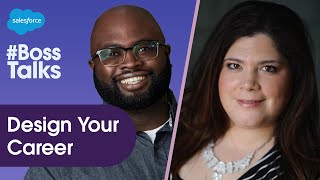
This is a Salesforce+ Boss Talks episode (December 9, 2021) hosted by Ebony featuring two Salesforce community members: Cheryl Feldman (Director of Product Management, Salesforce) and Erin McGriff (Senior Consultant, Slalom). Both guests tell origin stories (non‑traditional starts — hairdresser and retail worker), describe pivots into Salesforce roles, and give practical advice on choosing new career paths, making actionable plans (intentional skill-building, mentorship, measurable goals), overcoming fear and naysayers, leveraging community/user groups, and networking. The episode closes with audience Q&A and a Trailblazer CTA.
Chapters
I gotta feel like you gotta feeling.
That this is gonna be good.
Hello, everyone, and welcome to Boss Talk, a series featuring candid career conversations with people who are changing the game in their respective industries. For today's episode, we're going to do things just a little bit differently. We share a lot of tips and tricks on Boss Talks for how to build your career, but I thought it would be helpful to hear from folks who are actively putting these tools into practice. Not everyone starts out in their dream job, but everyone starts somewhere. So today is about honoring where you are in your journey and helping you identify your next best step to designing a career that you absolutely love. So without further ado, I am so excited to introduce my first guest director of product management at Salesforce, Cheryl Feldman. Cheryl, welcome to Boss Talks.
Thank you so much, Ebony, for having having me. I'm really excited to be here.
I couldn't be happier to be chatting with you. So Cheryl, before we dive in, I want to give everyone an opportunity to get to know you just a little bit better because I still remember the first time I heard your story and I remember just being so inspired. So will you share a bit about your background?
Sure. So currently I am a Director of Product Management here at Salesforce. However, most people don't believe this when I tell them this, that I do not have a background in technology at all. I actually started my career as a hairdresser but I was always super into technology. I was always really interested in it and I was always interested in the next big thing from being a hairdresser. I then went on to being a secretary and I picked up very quickly when somebody left the organization how to do analytics and how to combine all sorts of data. I wanted to be a Salesforce admin so badly. And so I walked into a startup that I found they had a posting on Craigslist and I could tell that they were kind of debating and I flat out asked them, what is your biggest problem in Salesforce? I bet I can solve it. And I worked for free the next day and figured out their issues with Salesforce and proved that I could do this job just as well as anybody with a master's in computer science.
And I just want to point out for everyone again, just double clicking on this, that you did all of this without a degree. And I think that so many people think that a four year degree is the only way to achieve success, but you are living proof that there are so many different pathways and I just really admire the grit and determination you've brought to your career. Now, sometimes people know their current job isn't working for them, but they don't know exactly what they want to pursue. So what tips do you have for people who want to pursue a different career path?
So my tips for choosing a different career path would be, if you're not exactly sure what you want to do, think about what you're passionate about. Think about what you could do around your passions. And if there's a specific career that you're passionate about, find somebody who's doing that type of career. Now, you can search for things like this on LinkedIn or just do a Google search and reach out to somebody. And a lot of times, I would say 99% of those time, folks are willing to have conversations with people who are interested in doing careers just like them.
That's absolutely right. I wouldn't change a thing about what you said. Great advice. Now I want to switch gears and talk about making an actionable plan. So once you decide you're ready to move on and you figured out where you want to go, what's your advice for how to take that next step?
So, first step is be intentional. Be intentional about everything that you want to do. I actually decided back in 2007 that I wanted to be a product manager at Salesforce. However, I didn't have the exact right skills skills to get there yet. So I asked people doing that type of role, what skills do I need? And I started finding roles in different organizations that I could take on that would get me the skills to get where I wanted to go. Step two would be mentorship and find somebody to mentor you and somebody who's going to help you and hold you accountable. That is the most important thing a mentor will do. And they also can help you work together, work on skills. And then the third tip I would give is to keep on checking in with both yourself and your mentor and make sure that you still want to be on the same path. Because I also changed paths a little bit. At one point, I was trying to be a developer, and I was thinking that may be where I wanted to go. And then I really started thinking about it, and really product management was really, well, I really wanted to go. But constantly have those conversations with yourself.
That's great. And you know, sometimes, Cheryl, the hardest move can be the first move, because the fear can be really real. I remember personally when I was switching from it to a new role in philanthropy, I was terrified. I thought I was making a huge mistake. So what is the scariest part of it for You. And how did you overcome that fear?
I think the scariest part for anyone taking on anything new, whether it's a new job, moving to a new city, is the unknown. And I think being able to reduce the unknown and I think also owning your fear sometimes and owning what is making you scared and then listing those things out and saying, okay, is this a rational fear or is this me just getting in my head?
Yeah. Like you just said, we sometimes can psych our own selves out. We let the fear get the. And we can even talk ourselves out of trying something new. So what tips do you have for that, for reeling in that negative self talk?
I would say surround yourself with people that believe in you. I've done this. I call it my circle of trust. And I talk with these people all of the time, and I will tell them when I'm not feeling confident about something or I'm scared or I'm afraid. And when the opportunity came up for me to potentially come to Salesforce, I was scared. I was afraid, what if I don't do a good job? And they were like, you have all these skills. You are so great at this. You're amazing at this. You're going to be incredible at this. But they're also be very honest with me and tell me if I wasn't going to be that great or that incredible. And so I think it's having that core group of people that you can rely on and help build you up and make sure that you have support along the way.
I love that. Now, Cheryl, let's talk about the naysayers, because sometimes there can be people in our lives who tell us that we can't do something. Did you encounter this? And if so, how did you handle that?
I had so many people in my career, in my life tell me, no, you can't do this. You won't be able to do this. You don't fit the mold. You don't have this, you don't have that. But I will tell you, for every single person that says no, there is somebody willing to say yes. So you may get rejected. You may be told no. There may be people out there saying, she won't do it. He won't do it. They won't be able to accomplish it. If you believe you can do it, you can do it. It's just finding those people that are gonna support you and support your career.
That's right. Let those haters be your motivators. So, Cheryl, you've gone from. I love the term you used also admin to now the director of product management at Salesforce. It' exciting to hear a little bit more about your journey. Now, though, it is time for our final question and my favorite question. So are you ready?
Yes.
All right. I knew you would be. Cheryl, what is your superpower?
I like to call myself the master connector of great people. So my superpower is networking. And I always, I love talking to people. I love meeting new people, and I love hearing about other people's stories. I love connecting people and seeing them be successful.
I love that. And it certainly is your superpower. I've seen that in action. So, Cheryl, thank you so much for joining us today and sharing your story. It's been such a joy just to watch you grow in your career.
Thank you so much for having me.
And now we're going to bring in our second guest for today. So please join me in giving a warm welcome to senior consultant at slalom, Erin McGriff. Aaron, welcome to Boston.
Hi, Ebony. Thank you for having me.
Oh, it's so good to have you here. Now, Erin, you also have an extremely inspiring story, and you've been so open and authentic in sharing your experience. So I'd love for you to share some of that with us today. Will you tell us a little bit about your background?
So I started working in retail when I was 16. I got my first job at Target. You know, it was just money. It was just a job so I could have money in my pocket, you know, keep gas in my car, all that good stuff. And I stayed there for my last two years of high school. After I graduated from high school, they actually gave me promotion and, you know, they threw more money at me. So me, college freshman, I'm making pretty good money. I still have to take my classes. At the time, I was actually studying to be an engineer. And I kind of had a decision to make. Do I want to take on this full load of engineering classes or I'm making pretty good money right now. Do I want to just continue down the path I'm on? And like a typical teenager, not thinking things all the way through, I went the route that was giving me the money right then and there and ended up doing that for over 10 years. I spent 10 years at Target. I spent two years at Home Depot. And after 12 years of that, I knew that I just, I had enough and I wasn't living my life on my own terms. So I said that I'm going to get out of retail. I'm going to do something different. Did not know what that different thing was. But I knew that there was something better out there for me, so I went towards it. I ended up leaving Home Depot and getting a job in operational management. So I'm getting to know my job and getting to know my team. I had been there for about eight months, and literally out of the clear blue sky, I got laid off one day. During that time, I learned about Salesforce through a family member who just so happened to be in town. And I knew that I was going to give this Salesforce thing a try. And I got a job and I got. I got more than a job. I got a whole new lifestyle.
Aaron, I know from my own personal experience that it can be very intimidating to interview for new jobs while you're unemployed. And then you have to explain why there's a gap on your resume. Like you said, it can start to mess with your head. So what's your advice for people who are currently in that position and on the.
On the job hunt, honesty is your best policy. You know, I went into interviews trying to finagle my way out of saying I was unemployed, but when I actually started saying. Start saying what really happened, people understood it. You know, a lot of people were going through hard times. A lot of companies were laying people off. So me being laid off wasn't out of the ordinary, but what I focused on was what I was doing in the meantime. So, yes, I have been unemployed for a year or more, but in this time, I've been studying this. I've got picked up these certifications. I volunteer. Excuse me, I volunteered here. I built these projects. This is what I've done to get myself ready for my next position. I haven't just been sitting around doing nothing. And honestly, I had one. One interview where after walking through a scenario with. With a potential employer, they gave me the feedback that I explain that better than people that had been in that company for 10 years. So use that time to level up your expertise and flaunt that in your interviews.
I know, Erin, there are a lot of people who are tuning in right now who are thinking about making a change. What are some good actionable steps when you're exploring a new industry or maybe even a new career path?
Absolutely. First thing is do your research. So don't just jump into something because somebody says it's a good thing. And then set measurable goals for yourself. If this is a totally new industry for you, if you never touch anything, anything in it at all, set goals. And then celebrate your wins. Celebrate the first time you build something. Right. Celebrate the first test that you pass, celebrate those small wins and then just really set long term goals for yourself so you can make sure that you're continuing down your path. And, and the biggest thing is just to really believe in yourself and believe in what you can accomplish. I never thought that I would be here. I never thought that I would be able to do any of these things. And I surprised myself day by day. Like you never really know what you can accomplish until you actually give yourself the space and opportunity to do so. So believe that you can get to wherever you want to get and just keep moving forward.
Our community is so important to our journey. So what tips and advice do you have for getting more plugged in and finding that support?
So one of the things I just, I love about the Salesforce community is the fact that there is an actual community. When I first got started and didn't know anything people, I was on Twitter talking about my journey and talking about what I was trying to do. And the outpouring of support that I got was instantaneous for one, but it honestly was overwhelming that there were so many strangers that didn't know me at all but were invested in my success. They gave me their phone numbers, they gave me resources, they coached me, they taught me. Some of them yelled at me, I won't say your name, but you know who you are, but you know, and that's really what drew me in. There is so much support in this community that you won't be able to fail because there will be so many people holding you up and pushing you until you reach the goal, until you reach your goals. So if I can't give any other advice, get connected in the community. Find yourself a local user group. And even in these Covid times, a lot of the user groups are virtual. So you don't even have to necessarily be in the area that you live in. You can join a user group anywhere. But just connect with like minded people that want to see you succeed and that will help you.
All right, Erin, final question and my favorite question. What is your superpower?
I think it's definitely finding the good. You know, there are a lot of things that go wrong in life, you know, but I'm a firm believer that everything happens for a reason, be it good or bad. Everything happens for a reason. And it's up to you to find the lesson that is in whatever it is you're going through, find that good and be able to push forward. You know, I, I went through some hard times, losing my job. I had to sell my first house because I was unemployed for so long. But because I found the good in those situations and I found ways to move forward, I was able to get into a better place. And I'm literally in a better place because I'm sitting in a house that I just moved into Thursday because I was able to buy another house because all this just went right, you know, because I stayed focused, because I stayed motivated, and because I pushed towards those goals I have for myself. Yes, I had to sell my house before because I was unemployed for so long, but now I'm in a better house.
I love that and I love that superpower. It is perfect for you. So, Erin, just thank you so much for sharing your story with us. Your experience and advice are so relevant, and I know they're going to help so many people along their journey.
Thank you, Ebony.
I know this is a popular topic with all of you, so let's hear your questions. Hi, Ebony, I'd love to ask your advice on how you manage to handle the parts of your job that you don't love that much with the parts of the job that you love a lot. How do you strike that balance between business needs and personal passions? Great question, Debbie. And I've thought a lot about this over the years, and where I landed is pretty simple. That is, it's called work for a reason. I'm ultimately here and getting paid to do all the parts of the job, the good, the bad, the ugly. And every week when I cash my paycheck, I'm saying I'm committed to doing all parts of this job. So trust me, there are parts of my job that I like to do very sparingly and parts that I wish I could do all the time like this. But at the end of the day, striking a balance means that I have to put the business needs first. Always. I have to prioritize what I'm being paid to do, and the rest is just icing on the cake. I think the good news is that we can balance and do all of it. We just have to keep everything in its proper place and proper proportion. Thanks so much again for the question, Debbie. I hope you all enjoyed today's conversation. For more boss talks, be sure to check back here on Salesforce plus so you never miss an episode. And to continue boss building, head on over to trailblazer.salesforce.com to join millions of trailblazers who are learning relevant skills, connecting to fellow trailblazers, and giving back with the Trailblazer community. With that, thank you all for tuning in. To boss talks. And we'll see you all next time. Say hello to the new world winner.
I'm the queen of them all. Hello.









