Dr. David Thomas Empowers Morehouse Students w/ Dr. MLK Jr.‘s Legacy | Ep. 16 | The Inflection Point
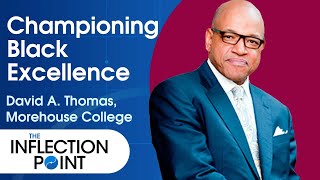
This content was created by Automation App. This content was uploaded by Automation App. This is a YouTube video titled "Dr. David Thomas Empowers Morehouse Students w/ Dr. MLK Jr.‘s Legacy | Ep. 16 | The Inflection Point" featuring an interview with Dr. David Thomas, president of Morehouse College, conducted by Monica Langley. The discussion covers Dr. Thomas's journey from aspiring to attend Morehouse as a student to becoming its president, his experiences with racial issues, and his vision for Morehouse's future, including making it a need-blind institution.
Chapters
From the time he was young, David Thomas knew he wanted to attend Morehouse College.
I read that Martin Luther King had gone to Morehouse, so I decided I was going to Morehouse.
Life took him to Yale.
When I got to Yale, I wanted to be a revolutionary.
And after a long career in higher education, he finally made it to Morehouse, this time as its president.
You've landed at the only institution in this country where black male excellence is an expectation and not an exception.
I'm Monica Langley, and this is the Inflection Point. David, thank you for inviting me to the official residence of the president at Morehouse College.
Well, thank you for joining us.
Now, you know, the name of this show is called the Inflection Point. So that is my very first question for you. When was that moment in your life when everything changed?
1968. Okay. Martin Luther King was assassinated, and my neighborhood went up in flames.
Wow. In Kansas City?
In Kansas City, the riots. And I stood in my yard with my father, and we watched the smoke come up. I sort of got this sense that the world was changing and I could help change the world.
And you were a young God then.
I was 11 years old, turning 12 in four months.
Did that set you on the path of wanting to have a role as an activist in civil rights? Was Martin Luther King already someone you looked up to?
So I had read about Martin Luther King. I was probably 9 or 10, and no one in my family had gone to college. But my father told me that if I went to college, I wouldn't have to do what he had me doing every other night, which was going with him to clean office buildings. And he knew I didn't like doing it. And he said, well, if you go to college, you won't have to do this. And my attitude was, I don't know what college is. I don't know anybody who's gone, but I know I'm going.
Exactly.
And I read that Martin Luther King had gone to Morehouse, so I decided I was going to Morehouse. I looked at the Civil Rights movement. I saw two professions that required college. One was being a preacher, and the other was being a lawyer. I realized that I was not cut out to be a preacher.
Why not?
Well, let's just put it this way. I was drawn to sin.
Okay, well, that could be a whole interesting conversation. But we won't go there.
We won't go there. Right, Right. Right side to side. I would be a lawyer.
Let me take you back just a sec. To growing up in Kansas City. Was Kansas City. At that time, racially segregated.
It's an interesting question because I grew up in all black surroundings. I didn't know any different. So it was very segregated. But, you know, it also was an environment where I excelled. And you don't know as a young child that you're getting an inadequate education. And I got to college and had a rude awakening because I had never, ever written a term paper.
But before you got to college, though. So you had in your mind that you wanted to go to Morehouse?
I had in my mind that I wanted to go to morehouse.
Like, to Dr. Martin Luther King?
Like Dr. Martin Luther King.
So you apply to Morehouse?
I applied to Morehouse.
Okay. And did you apply anywhere else?
I applied to Yale, which I had never heard of until a counselor at my high school said to me and one of my best friends, both of you guys should apply to Yale. And, you know, I thought, you know, I'll apply.
Yeah. Did you get into both more because you were excelling?
I got it. I got it.
So you got into Morehouse?
I got into Morehouse, and I got into Yale, and Morehouse didn't give me any scholarship, and Yale gave me a full ride. And my father was very clear. You know, he said, hey, I know you have this romantic thing about Morehouse, but I know you can add. I have zero. You have zero. Morehouse gave you zero. That's zero. I have zero. You have 0. Yale gave you a full ride. That's a full ride. Yeah. So I followed the money.
Well, it didn't turn out badly for you. Let's.
It didn't turn out badly, but it delayed my getting to Morehouse by 50 years.
Exactly. Well, we'll get there in a sec. So you went to Yale because you had been so motivated from that inflection point with Dr. King's death. Did you go there with the intention to carry on as a civil rights activist?
By the time I got to Yale, it was probably more radical than that. I wanted to be a revolutionary.
So what did that mean?
What that meant was I not only had become aware of the issues of race, but also the issues of class. So, you know, when I got to Yale, I very quickly became involved in the Black Student alliance at Yale.
You didn't just become involved. You were the president.
Yeah, I became co. President, chairman, co chair of the Black Student alliance at Yale. I led protests and, you know, was pretty much an activist.
Wow. So now were you still thinking, I'm going to be a lawyer, too?
The more I came to understand what Lawyers did on a day to day basis. I realized that they didn't do what I thought they'd do. I realized that, you know, lawyers catch problems after the fact that.
So what did you decide to do then with your life? You had to declare a major at some point.
Second inflection point. I discovered this area of study called organizational behavior. How organizations change, how people change inside of organizations.
You went on to even pursue this area even more. You got a Couple Masters, a PhD in Organizational Change or organizational behavior. And then you went on to become quite an expert in the field in academia. You were at Harvard Business School for many years.
I was at Wharton for four years. And then I went to the Harvard Business School and I was there for 22 years.
And then you became the dean at the Georgetown Business School.
Right? I became dean of Georgetown's McDonough Business School in 2011. In addition to, you know, what jumps out on my resume, which is that I'm a guy who studies corporations.
Yeah, yeah, yeah.
And executives.
And you wrote a book on that. It was one of the first studies that really looked at minorities in corporate America.
Right, right. And it was the. It was the first database systematic study of that topic and one of the largest studies of executive development, period, that's ever been done.
Okay, 2017. You were at your dream school this time, not as a student, but as its president.
Right.
What was that like?
There was that kind of there are no accidents in the universe sort of quality to it.
Right. Did you feel like it was the job you were meant to have? Ultimately.
No. No, I didn't want to be a college or university president. I actually had turned down those opportunities and I had been offered, you know, bigger deanships and presidencies, and I turned them all down. This wasn't what I'd always wanted to do, but it did have this quality to it, of it was meant to be for me to be here. In this season of Morehouse's journey into the 21st century.
Exactly.
You know, what makes me valuable as a leader is not that, you know, I'm wildly exceptional at any one thing, but what makes me valuable is that, you know, I've been great at a combination of things, that very few people bring in one package.
Right. So Morehouse recognized that.
So Morehouse recognized that.
It's interesting that you say that. You know, in a way, it's perfect for you to come here at this time, but you could not have predicted the George Floyd murder and, and the impact that would have.
Right. I couldn't nor Could I have predicted the pandemic, both of which have had profound effects on the way we've evolved in the last 20 months?
Let's talk about the George Floyd murder first. What did you think as soon as you saw the video or heard about it?
George Floyd was a black man. So I thought about my students and my sons and their vulnerability, right, to being victimized simply because they were black and their humanity could not be seen in some moment.
Now you're 64. Did you experience this and had seen this your whole life, too, though I.
Experienced it when I was young. You know, I still have a vivid imagery image of my brother and I on our way to a basketball game. We had put our money together and we had bought a car, and it was 1973 or two, and we get pulled over by the police, hadn't done anything, you know, And I remember at one point, the officer disappears and he's taken a long time. So I get out of my car to go to say, like, what's the problem? And the police officer jumps out and pulls his gun.
Oh, wow.
And says, you get back in that car, you know, And I flash back to it and I think, gee, you know, he could have just started. I was lucky he didn't start shooting. But it never occurred to me at that point in time that anybody would look at me as a. As a threat. You know, I was good student, churchgoing.
Yeah.
You know, respectful.
Yeah. So, David, where do you think we are as a country on race right now?
We are in a last chance moment to reckon with race. And I say that from the vantage point of on the positive side. I've heard more, what I regard as genuine conversation and engagement about the unfinished work of this country around race than I have heard since Ronald Reagan was elected. In many ways, I think we turn the lights off around issues of race in 1980.
And now they're back on.
And now the lights are back on.
So that's a positive.
So that's a positive.
But there's a negative.
But there's a negative in that. What we also see mobilizing, right, are the forces of denial about race and the ways in which race has been used as a cudgel to divide us. And I don't think it's an accident that that corresponds with what we're seeing in some of these voter registration laws that are coming out at the same time. Again, you know, I see evidence of people being willing to step up and engage in deeper and authentic ways, and I see it in individuals as well, as organizations.
Let's talk about organizations like Corporate America, though, right? In the Fortune 500, there are only four black CEOs.
Right? And that's down from 20 years ago when there were nine.
So what's happening and what can we do about it?
I think what we can do about it is become, you know, much more intentional about the need to develop diverse pipelines of executives so that what you don't have happen that you would see in many of these corporations that once had black CEOs. When you looked two or three levels below them, the diversity disappeared, which continued to make getting a black CEO sort of like, you know, a unicorn event.
Exactly. And you, as the president of Morehouse, can actually have a role in developing a great pipeline.
And that's what we do.
Exactly. So first, though, tell us the historic significance of Morehouse.
We are the only historically black college that is singularly dedicated to the education of men. And for 154 years, we produced black men who've gone on to provide leadership and service in every realm of life. One of the two black male senators in the US Senate is a Morehouse man. The most highly ranked African American in the Biden administration. Morehouse man, we produce Secretaries of Homeland Security, Health and Human Services, Surgeon Generals, the head of the nsf. You could just go on down the line. Science.
I saw that you said the mission, your mission at Morehouse is to produce excellent black men at scale.
You know, I just gave a speech this morning to our new entering freshmen and sophomores who weren't here physically last year. And I sort of said, do you know where you have landed? You've landed at the only institution in this country where black male excellence is an expectation and not an exception. And the only institution singularly dedicated to producing black male excellence at scale. You can go anywhere and find two or three. If you were at our orientation this morning, you would have seen 670 in our entering freshman class and 500 in our sophomore class, all in one room, all college ready. That's Black male excellence at scale.
Now, one thing you're doing to make their experience here even better than the historical significance and what you've done forever is since you became president, you've raised over $100 million. Or just this last year, you raised 100 million.
As of now, since I've been president, we've raised roughly $200 million.
Okay, so that's a chunk of change.
I know that because I just had my board meeting.
Okay, so that's a chunk of change.
That'S a chunk of change. Three and a half years. Not bad.
Yeah.
You know, my great ambition is to make Morehouse a need blind college. Which means you get admitted with no regard to your ability to pay. The other way I capture it is there will be no more David Thomases. There will be no more young men who really know Morehouse is the best place for them to be at this time in their development. And the only reason that they are not here is because they cannot afford it.
So you don't want anyone else to have to walk away from a Morehouse?
I don't want anyone else to have to take 50 years to get to Morehouse.









