Elevating Your Prospecting Motions With Sales Hub
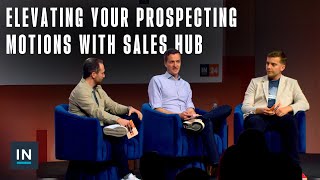
Scott Judson from HubSpot and Jaeba from Pleo discuss how to build better prospecting strategies with Sales Hub. They cover AI overwhelm, lead scoring challenges, and why Pleo uses a mix of inbound, outbound, and upsell motions to fill the pipeline.
Chapters
Foreign.
Thanks everyone so much for coming. I know it's like Friday midday here. We're like just a couple hours away from our flight, so really appreciate everyone still taking the time to come out and see some sessions. So, bit about myself, my name is Alex. I've been at HubSpot just a couple of years now and I've got to work on Sales Hub this whole time, which has been really exciting. But what I'm most excited for, I think about this session is that I'm joined by two people that are really on, I think the front lines of all things prospecting, both as a revenue operations leader and then also as someone whose teams are actually building a lot of the products. So thank you both for joining. I'll kind of let you introduce yourself. Scott, you want to go ahead and go first?
Yeah. Hey everyone, My name is Scott Judson. I lead product development for HubSpot's sales, engagement and prospecting tools. And I've been at HubSpot now for 10 years next month and I've spent my entire time working on the Sales hub since I've been here. I actually started in product support back when the sales hub was just a simple chrome extension that just did email tracking. I then moved into onboarding and implementation for a couple years. So I had a chance to work with a lot of our customers and partners on CRM and Sales Hub onboarding. And then after that I moved into product development where I've been for the last seven or so years and working on Sales Hub the entire time. So excited to be up here talking about prospecting and yeah, with that Jep, maybe you could tell everyone a little bit about yourself and Clio as well.
Yeah, my name is Jaeba, I come from Clio where I am heading up a team that we call business architecture and technology. So it's a team that sits under revenue operation. I joined Pleo four years ago back then where commercial operation as we called it back then was three people. Now we had 40 people in revenue operation. We sit in a team responsible for the go to market tech stack. So every tool that sales CX and marketing is using primarily hotspots. Of course, if we should jump on to Pleo. Pleo is in a leading expense management solution out of Europe. So we do corporate cards virtually and physical expense management, reimbursement, invoices and we are focusing on Europe mainly. We have eight offices across Europe and plus thousand customers, active customers. So a lot of salespeople at different offices, which is interesting in terms of this setup.
Awesome. And so just so everyone's here, everyone here is caught up on Pleo. Can you tell us a little bit about how Pleo got started with HubSpot?
Yeah, HubSpot has actually always been at Pleo. When Pleo started they started out with the marketing hub and our COO back then just decided we're also going to use that for, for our CRM. When I joined four years ago, I came from a background of consulting, have not done any revenue operation and my first task was actually to implement Salesforce and I did three months of prepping and then the C suite said no, they were not like willing to do the jump into Salesforce. So we spent the last four years in terms of pushing HubSpot to the max to see what we can get out and been a really interesting journey.
Yeah, I love that. And you were like hired to do one thing and then you know, as we all know, things never change when you're actually hired. So it's pretty cool that you actually worked your way back to HubSpot. So one of the things that I'm most excited to talk about today though is over the past couple of days at Inbound, I think we've heard from Yamini, we've heard in the different keynotes and sessions the themes of just like how challenging it is for go to market teams in these environments. And I think today I'm really excited to talk and like really drill down on prospecting. So Jeff, as someone who leads like a really modern rev ops organization and you're working in these different constraints in this environment, what are some of the biggest challenges that you've seen when it comes to prospecting today?
I think definitely some of the challenges as Gemini also saying is the whole thing about automation and AI planet planning staying in there is coming so much content out there so you just get buried in the mass. One of the things that we're also struggling with is the enablement part like enabling SDRs and AES to use the tools to its full potential. And then as we are running out of Europe, we are also heavily hit on GDPR data security and different rules in different countries in terms of what are we allowed to call or send emails without a consent. So the whole consent tracking across systems has also been very complex.
Yeah, yeah. And you mentioned, you know, scaling and enabling your team. I think, you know, one of the things that we see a ton at HubSpot biggest challenge for growing teams is just getting an aligned go to market team. You know we always hear challenges between marketing and sales marketing generating MQLs, passing it off to sales, sales not working those leads, marketing getting frustrated, sales also getting frustrated. And nobody really has a good sense of what's working well. And I think it sounds like Pleia is doing a great job of actually bridging that gap between marketing sales, which we'll talk about in a bit.
Yeah. Now Jeff, I wanted to kind of give everyone kind of a bit of an overview of some of the success because in just the past couple of years, Plio's seen like tremendous growth. You've seen, I think 50% increase in revenue, a huge increase in your customer base, and also a large increase year over year in active users. So I think people here today would be really curious to learn more about like what are some of the growth strategies you as a leader Pleo have kind of employed to continue to grow your business as you've expanded into mid market in some of these more challenging market conditions?
Yep. PLEO came from a traditional inbound focus. So when we started out, the main lead generation pipeline was inbound a lot on Facebook actually. And then we also built up a partner community over the times, accounting partners. And over the time we've kind of seen that these pipelines has become too expensive to actually run. So we've been having an increased focus on increasing the outbound motion. And that has over the past years been a big focus on increasing outbound to kind of substitute the different pipelines.
Yeah. This is actually amazing for everyone in the crowd. This is a very cool map to see and how PLEO is doing it. And I'm curious, maybe for everyone in the audience, could you tell us a little bit about how does your pipeline kind of break down? What's the distribution of all these different sources between sourcing, marketing generated? Yeah.
So I would say today 1/3 30% is coming from self sourced outbound, the other one is inbound and marketing. Some of them go product led, so they go directly through the entire signup flow. Some of them is marketing, qualifying a lead and handing it over to an AE or an SDR based on potential. And then we have partners also where they go product led or to an AE on SDR to kind of warm up the leads. And this is what we're trying to define as the scoring model. So based on a lot of criteria, we define tools to what kind of motions they're going towards.
And you mentioned that the kind of marketing channels are getting a little bit saturated. They're a little bit more expensive for generating leads. And so self sourcing is Kind of a new motion for y'. All. Can you talk a little bit about what your strategies are like there? What kind of tools you're using for sourcing your own pipeline?
Yeah, so basically we're working with a territory model where AE and SDRs are set together in a territory and then the AE primarily works on getting inbounds and high quality customers. They also do a bit of outbound but elsewhere it's the SDRS that is running on what we call tier two customers is doing outbound. And the main motion that we're running today is LinkedIn Sales Navigator. So identifying ICPs there and reaching out or just searching in HubSpot for existing contacts, we're working a lot in terms of different motions. Also using AI to identify new potential ICPs, adding them to the system and also sourcing them into HubSpot. But the primarily use case now is self sourced by the reps. Got it.
I've heard of LinkedIn Sales Navigator before. That's a common one. Cool. And then you also have on the far right here, sort of a post sale pipeline generation process. Maybe you could talk a little bit about that too.
Yeah, yeah. I think it's a really interesting motion that a lot of people seem to forget. I think we could kind of split it up to three motions. Like one is being the in product upsell and this is simply the possibility to just upsell your product without a human touch. But we have added two different motions as well. One that we define as CSL where customer success rep is able to qualify a potential that goes back to the sales teams for them to then reach out and potentially do an upsell. And the last one, and I think one I cannot take the credit for it, but that I think is really interesting, is what we call upsell triggers or execution engines where we have a lot of different product triggers. And based on the customer's profile, what is the potential of the customer? What are the users pattern in the product? We send triggers to HubSpot that would create a task or deal for the rep to saying here there's a possibility to upsell for X, Y and Z. And then they start reaching out to the customer to sell or push this this product. So it's a data LED model for kind of identifying potential upsell.
Interesting. Okay, so as the person responsible for HubSpot systems in your organization, like what are some of the tools that you're actually using inside of HubSpot to help you manage pipeline generation and all of this.
So we did a big move, what Is that six months, a year ago in terms of moving out of an external outbound tool into HubSpot prospecting. So that has been a big move and had a lot of doing a lot of enablement in terms of getting reps to use the prospecting workspace. We are not fully there, 100% honest. There's still a lot of enabling happening. But then some of the tools we're using is heavily the lead object of qualifying contacts and generating a lead for the SDRs or the AES to reach out to. What I really like about that process and tool is it's made it possible for us to give a structured process of both how to generate a lead for marketing, saying, now we hit a certain threshold for an inquiry score, but also the possibilities to saying if an SDR needs to qualify lead, they need to move the lead to qualify, they need to provide certain informations and they have to create a deal. So before the process was a bit saturated, right? They were not all doing it the same way. We had different difficulties in terms of tracking the quality of the lead. What I think is also relevant in the prospecting space in terms of how we're doing today is the possibility to create feedback. So if they disqualify the lead, we require them to submit feedback in terms of why this lead was not valuable. And I think as you said, sales and marketing is always this constant battle. Sales were saying, you're delivering shitty leads, but when marketing asks why, sales never really have a good answer. So now we're trying to force sales to do it. Are we there? I think there's still struggles in terms of converting this feedback to measurable actions in terms of saying, okay, these are here where we actually need to update. But I think the SDR and a handoff have helped a lot. And then of course, sequences testing CTAs, all the traditional features of HubSpot that you would see, like the old school messages that is definitely used.
So you talked a little bit about the lead scoring process. Could you talk maybe a little bit more about what goes into that? And also maybe what some of the biggest challenges are with the marketing, the sales handoff.
I think that the biggest, biggest challenge is still, as I see it, this in terms of what is a good lead. We can have reps disqualifying them and saying this is not a good lead. But they. We get a lot of questions in terms of saying, why have marketing scored this lead this way? And we have like, we can show you the model, but it's going to Change in a week. So it doesn't really make sense for us to show you that one way site visit gives five points, but it's more in terms of saying. And on the other hand marketing is also saying, yeah, we really don't know how to adjust it because the data is not that quantifiable. So one of the things that I'm looking very much into is this, the new like AI lead score. So hopefully it will solve all the problems.
Right.
You're going to just give a perfect lead score. I think what I'm still seeing as a, a gap is one thing is a score but the other thing is providing the context to that score. So a rep doesn't want to know saying this scored 60 in the lead score, they want to know why. So is it because they visit the website pricing page 10 times? Because that is the information they're going to use in the pickup line when they start calling them. Right. So this is where we probably still have a gap to work on. Yeah, yeah.
I do have one other question actually on this. You mentioned sequences at the end. Can you talk a little bit more about how your team is using sequences? Are your reps freely able to create sequences?
To be honest, I think we have a lot of room for improvements because we have reps creating sequences themselves. If you ask me, I come from a background of statistics. I would not say that one individual person should be able to beat the market. So I think where we're working towards is limiting the access in terms of who can create sequences because then we're able to split test it and see which one performed better. Where now it's, I want to say the wild west. Every rep creates their own sequence. And unfortunately there's also back to the lack of enablement that they don't really understand the value of a dynamic parameters. So we've seen sequences where they copy, paste or clone a sequence and the only thing they change is the name.
Right.
And it's kind of like then we cannot track progress, track performance. So there's a. It's both feedback to limited access, but also enablement.
Makes sense.
Yeah. So we've talked I think a lot about features like sequences and lead scoring and things like that. But just given everything I think that we've talked about over the past few days from the sales hub kind of things, I mean from the demo station where we're talking to different customers, there's a lot of new releases and a lot of new features that have really came out for sales hub. So I would Love both of your perspectives on what are some of those. Maybe just couple key features that you think are gonna be able to make the biggest impact when it comes to prospecting. Scott, do you wanna start as someone who's helping to build those?
Yeah, I'll talk about a few. We actually released our leads product last year at Inbound, but we've made a ton of improvements to it including this year we into public beta, our leads overview, our summary page, which is basically a place for like rev ops, marketers, sales ops to come together and kind of see all the leads that are in the pipeline. So you're getting this unparalleled visibility into your lead pipeline, regardless of where the lead came from, whether it's marketing, sales, service, product, any kind of channel that it could come from. And on top of that you get this amazing reporting around your pipeline generation efforts. You can see which lead sources are most common, you can see which lead sources are actually leading to revenue. So now marketing and sales can have a real data driven conversation about what's working and what's not. So I'm really excited about leads. Another one that I'll talk about is dynamic sequences. And one of the challenges that we, we see a lot with our customers and with reps in general is that they spend a ton of time trying to get the ears of prospects who will never buy from them. And so they end up wasting their time with a bunch of tasks that are, they're reaching out to prospects who aren't actually interested, who haven't shown any real intent. And so what dynamic sequences do is they help you filter out the noise, basically. And you're only going to get tasks created for your reps when they've actually engaged with your content. So when they show real intent that they're in a real buying cycle, then your reps start to get tasks for them. The way I kind of like to think about it is like when you go to Google and you search for like a new pair of sunglasses and then you go to Facebook or Instagram and start scrolling your feed, you start to get ads for those sunglasses. That's kind of how it's going to work for your prospects. As they engage with you, they're going to get more from your reps and so it'll be a little bit more intentional and it'll be better for your prospects too. They're going to get the actual content that they want to see. So those are two that I'm really excited about. And I'm curious, Jep, what are you.
Liking so far, I think. I think now I come from the tech side, right. So everything with AI is really interesting because we say, okay, there's a big room for improvement. So I think some of the top three would maybe be the deal insights that is running in a beta. Now, in terms of giving the rep a quick overview of risk objections, like latest communication, that is one we hear a lot in terms of saying, can we use this AI tool to summarize the information? Then the other one is prepping for meetings. I know some reps spend a lot of time prepping for meetings. I know some reps don't spend enough time prepping for meetings, but at least the ability to give them a tool to prep for meetings would increase the quality of the meeting and also reduce the time spent. So that one is also interesting. And the last one is the whole thing a concept about guided selling. As I said, one of the struggles is enablement. We have a quite young sales team with a lot of sales reps and it is struggling in terms of saying, where is your time most spent the most optimal way? So the concept of guided selling and saying, okay, now the best thing you can do is reach out on these potential leads or these leads have re engaged, follow up on these meetings. So I think that is the one that I think has a huge potential in terms of increasing the efficiency of the cell team.
Yeah, yeah.
And it's been so fun, I think just over the past couple days talking to everyone at the demo booth, kind of getting their hot takes. We do actually have to wrap up here soon. It's like the fastest half an hour of all time. But I want to talk about just a couple of things here when it comes to measurement. So, Jeb, how do you typically go about reporting on not only like pipeline generation, but the effectiveness, the impact that your reps are having, and what are some of the things that you look for as you go to coach a lot of your teams?
I think there's two things of it that, that we've kind of managed to do. I think one is creating the main source. I cannot take credit for it, but. But basically a framework to do the attribution in terms of where are the league coming from?
And.
Attribution is a hard game. Right. There's always a million opinions of how to do attribution, but we at least agreed on a framework and saying this is how we attribute it to sales or to marketing or to partnerships. And the other one is because we have moved out of an external outbounding tool into the prospecting tool. It's been a lot easier to kind of see the full end to end conversion from a lead to a deal to money in the bank. And this gives us some bit more insights in terms of telling the SDRs saying, okay, you are closing and booking a lot of meetings, but they're not generating any value in the end where before, okay, we're just saying, okay, you book a lot of meetings, fine, that's what you measured on. But now we're kind of able to get a lot more insight of whether these deals or meetings actually add value.
Yeah, that's critical. Right? So I'd love to know, kind of looking forward to next year. Pleo's obviously had a ton of success. You're thinking about how to replicate that success going forward. What are you thinking about as kind of next year is coming around the corner? How are you going to replicate the success and even exceed it in terms of getting new leads, getting new customers? What are some of the challenges tools you're thinking about using?
I think definitely some of the things that we are already testing actively now is the whole concept of AI agents. So AI doing a small part or a few steps of a task. So we're testing outbound and prospecting agents both inside HubSpot and external tools as well. It is sourcing of ICP leads into HubSpot using AI and then it's also the co pilot functionalities like doing a specific task, so summarizing a meeting or summarizing an email, rewriting things. Personally I don't believe on the full funnel AI rep thing yet, but I must also admit like the more slow about everything doubles in 18 months. Now we saw the scene the other day that there was six months for AI. I might be wrong, like let's talk in a year and see if it's changed. But I think what we're focusing on is the smaller parts.
You mentioned a little bit earlier you have like your AES working on like your tier one accounts. You have SDRs kind of going after tier two. Is there a segment like do you expect to kind of deploy AI agents against. Do you think they'll go against all segments or just as, you know, a smaller segment in particular?
I think it would primarily be in what we would call tier 2. So helping the SDRs, taking, maybe the SDRs to take like some would say AI can also do calling. We're based out of a lot of different countries where English is not the native language, so calling will not be the first one up. So if we can get agents to do the first 12 emails and then have the SDRs to call. Then I think we've done a really good job. So I think it would be Primarily to assist SDRs doing the first thing, both prospecting, so finding qualified leads, but also writing the first tailored personalized message to the reps, to the. To the prospects.
Yeah, makes sense.
All right, so we've talked a lot about a different. A lot of different prospecting motions, different AI strategies. Now to wrap things up here before we head off, I would love to maybe get, you know, from each of you, what are some of the top takeaways from today's session? What are some of the things that I think people can take home, take to their business and start to try and implement or experiment with?
I think one of the ones is definitely diversify the pipelines generation. So not only running an inbound motion, but consider what else can we do to not be as vulnerable for potentially Facebook increasing prices or so on and so forth. And then I think one of the others is also definitely standardizing the process of a handover between marketing to sales, but also sales to cx. Having a structured process in terms of requiring what are the information that you want and how you do it helps a lot in terms of being able to measure performance of different demand sources or different channels, the attribution and thereby being able to say, okay, where should we invest going forward? So I think that would be the main focus areas. I would say should take away.
No notes. I like them. The only thing I would add really is like, I think it's really smart to diversify your pipeline generation strategies. We know that not every company is getting just a ton of inbound leads all the time. You have to be looking for other ways to generate pipeline. So whether it's. Whether it's doing outbound, whether it's using a partner channel or product channel or something like that, it's good to have multiple sources, especially if some of them start to dry up. Like marketing maybe isn't as effective. Some marketing channels might not be as effective as they once were. The other one that I would add is just experimentation and bringing an experimental mindset to your pipeline generation efforts. A lot of these channels are changing. There's new channels popping up all the time, and you need to figure out kind of like what's working, what's not. And so really adopting sort of an experimental mindset in your organization so that you can actually see what does work and what doesn't is critical. And obviously you can then use HubSpot to help track this and actually see what's leading to revenue. So, yeah, experimental mindset would be kind of the big ad here that I would put them. Yeah.
I love the idea of experimentation. And I think checking back maybe Jeb with you next year to see if you're right about the full funnel a see, we'll see how that works out. Well, that actually wraps us up for time here. Again, thank you everyone, so much for joining us Friday afternoon. I know a tiring session, so we appreciate it. And Jeff, thanks for coming all the way from Denmark to be here in Boston.









