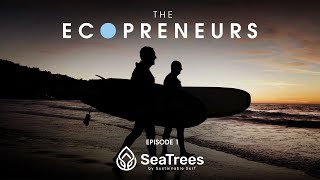
Michael started Seatrees to restore kelp and seagrass after an oil spill destroyed marine ecosystems. The ocean has lost 85% of kelp at Palos Verdes and half its coral and mangroves globally. His app lets anyone fund restoration in 45 seconds by removing sea urchins and replanting underwater forests.
Chapters
I'm not sure what I would be without the ocean. I'm not sure where in space I would be without having the majority of the planet as the centering place. It feels like home. It feels right. And you protect what's home. You protect your family. You protect what you love. San Francisco, 2007. This oil container ship hit the Bay Bridge and all the oil was headed out to the Marin Headlands where I live. Wave upon wave of toxic, gooped up oil was just washing in on the beach. I started to feel this cognitive dissonance. I'm using the ocean and I'm not giving back to it. And it's changing literally under my feet. We've lost half the world's coral reefs in the last 50, half the world's mangrove forest, half the world's kelp forest. You name it, and we've messed it up. I realized that I had to make a change and dedicate my life to trying to fix this problem. And that was the start of sea trees. To me, being an ecopreneur really means one thing. You're looking at the most pressing issues on the planet, and you're looking at how to solve them as part of a business. And you're keeping the planet at the center of every decision that you make.
So as a geologist, I think about geologic time and the history of the Earth, and there's been six major mass extinctions on the planet. All of them have been caused by CO2 emissions. And we're actually emitting CO2 faster and at a higher magnitude than has ever happened in the history of the Earth.
No matter how many trees we plant on land, we will never reverse climate change without including the ocean ecosystems, sea trees as a part of this plan.
The ocean plays a huge role in sequestering carbon because it's the original carbon sink. Since the beginning of time, it's always been this place where excess carbon dioxide could be captured. Now we're seeing so much extra carbon dioxide in the atmosphere because of burning fossil fuels and deforestation, it's reached its cap. It can't handle much more.
This is an existential threat. I want my daughter to have a livable world that's more important to me than anything else in the world.
We realize, okay, this is a way to make blue carbon conservation tangible. Plant a sea tree to put back.
More of that seaweed, more of that plankton, more of those sea grasses so that they can do what they do naturally, absorb that CO2.
I wanted anyone in the world to be able to have this Impact literally in the same way that you could order up a rideshare or something on your phone, go to seatrees and restore 10 square feet of kelp forest. It'll take you 45 seconds to do it. Why isn't saving the planet as easy as buying something off the Internet?
The place that we've been focusing our efforts is the Palos verdes Peninsula. Over 100 years of time, we were able to document the loss of over 85% of that food forest. If I went out and showed you the loss of the redwoods in California, that 85% of them went away in 100 years, people would be pulling their hair out. It's an invisible forest to most.
So we are here in California at the Channel Islands harbor, and we're going to be looking at the kelp forest ecosystems and we're going to be exploring how we could possibly get involved.
It all the gear out here.
Down the bottom.
I think people aren't talking about the ocean as a major solution for climate change, because what's out of sight is out of mind. But scientists are. The ocean really does hold the key to helping us mitigate the impacts of climate change.
So the work that we've been doing has been down in the Palos Verdes Peninsula, that kelp forests. The main problem there was an overabundance of these purple sea urchins. It's the sea urchin divers who will go down there to put the kelp forest and that ecosystem back in balance. Our role is to try to find the funding for it, to create scientific partnerships and then really bringing the story home.
We've been restoring kelp forest for a couple decades. The decades prior to Seatree's involvement, we were hammering away in a vacuum. And Seatrees has now just made us available to the world and we've had more people interested, more curious folks, more support coming in from around the planet than I could have imagined was possible.
I think Seatrees success to date is establishing a repeatable model, a template.
I love the fact that this project also creates a beautiful synergy between the scientific community, the volunteers that are in that area, the fishers that are in that area as well, creating jobs and living wages for people that need it.
We just gotta assemble the right team, give them the right tools, give them the proper support, and then voila, in a year's time, you have an ocean that went from a moonscape to the most amazing underwater environment that I've ever seen in my life.
Protect what you love and it's kind of that simple. And that's what Seatrees is about. And to be a surfer is to kind of have a very intimate relationship with what you love.
But that's where I think surfing can be really helpful because surfers are a face of loving the ocean. And we use that power of surfing to engage and inspire, to help tell the story of the ocean can help us solve climate change. We help the ocean.
For 20 years, I was so grateful to travel around the world as a professional surfer. That also gave me firsthand access and understanding to our ocean health and how that has transformed in the 20 years that I was traveling and surfing. And I really think as surfers, we're really like ocean stewards. We're the ones that are really aware of that ocean health because we're living and breathing in it. I'm so grateful to be an ambassador for Seatrees. They're not talking about what they're gonna do. They're doing stuff now. And sharing that stoke with my community is what being an ambassador is about.
I think the surfing community is a perfect ambassador for that message because we don't have a sport without the ocean. We don't have a sport without the. I want the world to know exactly what Seatrees is doing because they're doing really important work. They're literally helping save our planet with.
The app and with how easy that Seatrees has made it for people to donate and get involved and activate. It makes you feel good.
You literally plant a tree. Dollar plants a tree. Dollar plants a tree. Two clicks. You've done it.
If we can galvanize people to understand that they can have a hand in restoring the ocean and helping mid climate change, I really believe that this is the number one solution that we can all be a part of.
To push an idea beyond California takes an insatiable desire to commit your life to influencing the world. Michael and Kevin, that's basically their life's work. They're spending their currency of influence on reversing climate change.
Don't be scared to be the only or the first. That's how you create change, is by being an innovator, by being, you know, someone that breaks the mold.
It doesn't have to be that complicated, really. It's about things that are very natural to us, which is taking care of the planet that takes care of us.
I tell my daughter Oceana, who's just about to turn 10, that I wake up every day trying to make the ocean as good a place as I remember it. When I was growing up and I was her age. I keep that, you know, in my heart and in my mind of, like, this is who I'm doing it for. This is why I'm doing it. Yeah. There's a larger world out there that I want to do this for, but for my daughter, that's where it hits hard. That's.