Finding Your Voice at Work and in Your Career - #BossTalks FT. Ebony Beckwith
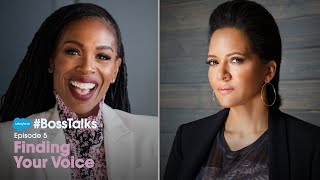
Ebony Beckwith and Christina Jones, Chief Engagement Officer at Salesforce.org, discuss finding your voice at work. They cover why silence costs you opportunities, how to build speaking confidence through practice, and concrete moves like listening first in new roles and actively amplifying others' stories.
Questions this video answers
Chief Engagement Officer, Salesforce.org.
Take the first 30–60 days to listen and get to know people (virtual coffee chats, etc.).
Trailhead (Salesforce’s free online learning platform).
Chapters
I got a feeling that you got.
A feeling that this is gonna be good. Say hello to the new world winner.
Hello, everyone, and welcome to Boss Talks. This is a new series presented by Salesforce, featuring career conversations with people I trust and admire. To keep it real, today we're talking about finding your voice. Everything from gaining the confidence to speak up in meetings to learning how to express your views and opinions at work. Finding your voice is one of the toughest but most valuable things you can learn in your career. I know from my own experience it took many years of me trying on different communication style, constantly iterating or tweaking different audiences for different roles I held, but the work is so worth it, and here's why. Effective communication is critical to effective leadership. So today we're going to talk about how to find and use your voice in a way that helps show your value and influence and maybe even impress those around you. To help me out, I've invited a true boss, my dear friend and colleague, Christina Jones, chief engagement officer@salesforce.org Christina, welcome to Boss Talks. Thank you so much for joining us.
Thank you for inviting me. Like, I've been looking forward to this all day.
I love that. Me too, my friend. Before we get started, I have to tell everyone a quick story about the first time I met you. You've heard it many times. So I saw you present at a kickoff event, and I was immediate like, who is she and how can I be her friend? That what was going on for me? And I went up to you and after, the rest was history. So now we talk almost every day. We text all the time. And when I talk about or think about my personal board of directors or who I want at my table, you are without a doubt one of those people. And I think it's so rare to find those people who have your back like that. And when you do find them, don't let them go. So I want people to learn more about you. Can you give us an overview of what you do@salesforce.org and how storytelling really became central to your career?
Absolutely. So currently I'm@Salesforce.org as their chief engagement officer. And my focus since I've been over in tech has been to humanize the conversation around technology across every touch point so that people can see themselves in it and understand how they can engage. And I would argue there's no more critical space to do this in the nonprofit sector, the education sector, and in these sectors where you have what I like to call action leaders who are driving Real change. And it is important to lead, to help action leaders like them elevate their voice so that people understand the work that they're doing so that they can tap in and help. You know, Ebony, you and I say this a lot. You know, the worst thing you can do right now is do nothing. So we're creating a platform and a community where people can tap in and help.
Tell us a little bit more about your experience of finding your own voice.
So it's funny. I remember specifically When I was 25, I was working at New Line, and I had the opportunity to work for an incredible black woman who was just unapologetically herself. She was head of Creative. I worked in Creative at the time, and I was like, whoa. I'd come from Warner Brothers, which was much more corporate, much more, like, buttoned up. So I was trying to, like, fit myself into that space. And then I was lucky to have her early on in my career, so I could say, see that? Oh, I could just be Christina. And I've never gone back from that. And I think that journey. It's not always easy to stay true to who you are. Right? You want to blend in. The old rumblings from our teen years maybe still back there, but the beauty of us as humans is our differences. And so, like with the teams that I have, I encourage and really demand that they show up authentically. I think that word's overused a lot. But how can you serve the communities in which we work if you're not true to yourself? Especially in the space that I work in, which is helping people tell their story well, you need to be really comfortable with your story as well.
Help us apply that more broadly. What are some things that people can do to find their voice?
The way that you find your voice is by using your voice. You know, there's like, there's a little voice in your head that tells you not to speak, that what you're saying isn't right, that you will be judged. Shutting that voice down is critical. It's in order for you to start being comfortable enough to start using your actual voice. Like, moving away from having to be perfect and always saying the right thing at the right time. Getting used to the story of yourself and the stories that are important to you is how you find who you are authentically.
So part of it is about finding your voice, and the other part is about actually using your voice, which is not always easy to do. So I wonder if there's a memorable moment that comes to mind of a time when you Spoke. Spoke up and you used your voice.
We have to use our voice even when it's uncomfortable. I am not. I don't. If you've heard me talk, you've heard me say this a lot. I'm not comfortable with a lot of public speaking. I am an introvert. I like studying people. But if you're going to have innovative ideas, if you do want to drive change, sometimes you have to be comfortable using your own voice and your own face. And this is where the authenticity is critical. Right. Like, why do you care enough to drive this change? Why do you care enough to lead these conversations? Means that you need to be also comfortable with the fact that your voice matters. Your voice matters. And of course, in any day, my greatest passion is creating space for other voices, whether it's in my team or other teams taking a second to look into the room and who's not spoken, even if they're not on your team. Like, if there's someone quiet that's collaborating with you, like, why can't we all use our platform to drive change at any minute of the day? You're really great about this, Ebony. Like, how do you look across the room and see, like, untapped talent? I think that there is an over reliance on people who talk a lot. Or the loudest voice in the room is not always the smartest voice in the room. And so even as you grow into leadership, making sure that you don't fall into that old trap of listening to the loudest person who's probably not saying anything really.
That's right. And inviting all voices to contribute to the room. Right, Exactly. I think that's so important. But I think it's also, you know, you just mentioned being an introvert. I'm an extroverted introvert. I had to learn how to be extroverted. And it can be a surprise for some people because we speak often and we're asked to do it, but it's not something that comes naturally. It's often very intimidating for people to find and use that voice. So let's talk about the cost of not using their voice.
What a shame if you don't use your voice. I think about that a lot. Like, what is all the untapped talent out there that is sitting there waiting to be discovered, but locked up in a box? I know that everyone who's listening has had an idea that they haven't acted upon. And then they're like, dang, why didn't I say that I had that idea? Like, can we stop that? And you know, I worry a little bit about the social media culture, because what's happening is that you are trained for perfection. Like, you want everyone to see you at your best, and so it doesn't teach you how to be you. And I think that that carries on into work where people want to say the right thing. I was on a call the other day with another leader. We were talking about having courage as a value. You know, courage to speak your piece, courage to say, maybe not the popular thing in the room, but on the flip side, he was also saying that it's important for him to always look happy and be. And I said, well, but are you courageous enough to be vulnerable? Are you courageous enough to be your authentic self so people can feel connected to you? I think that is. And that, again, is like using your voice not just to manage people, but, you know, to lead people. I'm proud of the teams that I've grown. I've grown people leaders, not people managers. There's a big difference. But you can't lead with a fake voice.
Let's talk about how vulnerability is a part of, you know, sharing your authentic voice. And how does that. How can people tap into that? Because I know probably for you as a storyteller, you want that authenticity and that vulnerability. That's what you're trying to bring out in people. But it can be sort of counterintuitive, especially in corporate America, to think that I'm going to, you know, what does vulnerability have to do with this conversation? So maybe you can help us unpack that.
You don't want to build a whole career on artifice. You want to build a career based on who you are. Ebony, as a person, what are you passionate about? Like, what motivates you? And also, like, I love, like, getting to know. Like, I love when we can laugh and play and joke. You know, like, I am. I am. Like, those are those moments of, you know, connectivity and those moments of, like, saying, I don't know and can you help me? I think makes you a real person. We're not perfect all the time. We should not aspire to be perfect all the time. The humanity is what makes us interesting.
I want to go back to a question. We get a lot around speaking up in meetings, especially in this new Zoom environment. So I want to make sure we tackle this head on. What advice do you have for people who are trying to figure out how to insert themselves into the conversation, really going back to the cost of not using their voice, especially in this new virtual world?
I want to answer for young executives. I also want to answer this. For leaders of young executives, it is, you have to create a space. Space for everyone's voice to be heard. Because the worst thing that can happen, in my opinion, and shame on any executive that does this, is when someone is courageous enough to raise their hand, to have an opinion, to say something, to not create a space where they can be supported. Like, beyond just that moment. Consider what you're doing to this person's self esteem and courageousness to say something. And on your end, imagine the missed opportunity that you have by not hearing the idea. But if you do have something to say, say it. Say it. And for those in the room, welcome it.
I often think about, like, that double Dutch, you know, sometimes it's hard to figure out, like, when do I get in? Do I get in now? Do I get in? And sometimes you're gonna trip up, and other times you're gonna be like, yes, I nailed it. But just having that space open for people, I think is so important.
I think something else to consider is show up for your friends in the room, too. I remember when, early on, when I was presenting and I was a nervous wreck, and you, like, held my hand, and you're like, you got this. This is a great story, Christina. Just say it like, you know, it doesn't matter how long, how far along you go. Stories and creative are my little babies. And I get like. And, you know, and I think having your. What did you call? Board of directors is important. Like, you and I brainstorm all the time, but we also show up for each other in the room, which kills some of that noise that might otherwise be there when people see, like, oh, this person is not here alone.
That's right. And I think that's something that holds people back too. Like, they feel like they're the only one, or they don't have. They can't phone a friend. You know, I'm the only young person. I'm the only woman. I'm the only person of color. All those things that we tell ourselves, and I know we both have experience with this. I think one tip you just gave around navigating it is realizing that you do have friends and people on your side so that you're not alone. But also your story is one that needs to be told and heard. So how do you personally navigate that feeling of being the only. Maybe you are the only in the room?
It never gets easier. It. It never gets easier, which is why I'm passionate about this, is these things all go together, right? Like, if you are the only one in the room, it is easy to, like, not keep true to who you are because you don't want to rock the boat because you are the only one in the room. And you're worried about what people will think. Reverse engineering. This is like, you make it to the room, you do start to drive change. You pull up more seats so there's more of you at the room. Not just more of you, but just more people, more diversity of thought. So, like, it's not just you who has, like, the crazy idea, and who knows what ideas come out of that. The more that you create an inclusive workforce. That's what we're talking about.
That's right. Christina. I want to talk about power dynamics. I know we've talked a lot about, and I hear you talk about this a lot. Changing the makeup of a room, and I love that because that is a complete and total boss move. So share more about that.
You have to. You have to. It's not just the smart thing to do. It is the right thing to do. Like, think of all the people who came before us. You know, we talk a lot about Shirley Chisholm, and she's like, I'll pull a folding chair up. Shirley Chisholm would not be happy with a folding chair right now. She would be demanding her full seat and if not her own table. And we are at that point where we. That's what we should all be doing at every level. And don't just look at one person to do that. Like, ask yourself, what change are you making? Like, when you look at the last three people you've hired, who have you hired? Who have you promoted? How are you part of the change as opposed to waiting for some big change to happen? It's uncomfortable to have that conversation with people. It's not playing the diversity game, which is like, I'm a black woman. I left. Replace me with a black woman. It's the creating an inclusive workspace where you can clearly identify the right person for the right role from an inclusive selection, a diverse selection, a selection of all qualified executives.
That's right. One of the things you said earlier that I want to come back to, you talked about telling other people's stories. You don't hear too many people in their professional careers really talk about helping other people. So intentionally, sometimes there can be a fear of helping other people shine because it takes away from your shine. So I'd love to hear what you think about. You know, for me, I'm like, I want all my friends to Be fabulous. The squad is looking good. And so. But talk about that, you know, sometimes you can find that it can be very competitive. So talk about your desire to really share other people's story and what that adds for you and the other person.
I have so much disappointment for people who come from that scarcity mindset, that mindset that I have to have everything, everything must be mine. I can only shine. That comes from a lack of self, I think a lack of self esteem, a sense of, like, there's not enough for all of us. I like to come at it from a different space. Like, you and I can both be fabulous in the same room while driving change and creating so much opportunity that there needs to be more tables. There's not just one table. The last three jobs I've had didn't exist before I took them. You know, like, there's opportunity for all of us. Use your platform intentionally to create opportunity. Me giving, like, a shout out to someone who's not in the room because of what they did, like, takes me two seconds. But could be the difference in their career with their supervisor, I don't know. But did it hurt me to help them? No. Creating projects that create opportunity for other people who otherwise would not have visibility is something else that, as we get into these roles, is important to do.
I think it's also really so important to lift as you climb, you know, and to take other people along with you. Like you said, it only takes a few moments, you know, and it can have such lasting impact.
You can find your again. Like finding your tribe in your career is equally important. Like coloring outside the lines with your friend is amazing.
All right, so final question, Christina. I'm asking everyone what their superpower is. I could name so many for you, but I'm going to ask you to pick one. So tell us, what is your superpower?
Listening. Listening. Trying to be. I do my best to be present and listen. I don't want to tell the story, people's stories of how I perceive them to be. I want to tell their stories.
Well, thank you for telling such powerful stories and thank you for all your words of wisdom today. I know we're soaking them all up and we're going to start putting your words of wisdom into practice. So thank you so much for being here with us today, Christina.
Thank you, Ebony.
And now I want to hear what you have to say. So let's hear your questions.
Hi, Ebony.
My question is, after receiving an opportunity at a new company, how would you suggest finding your voice in a new corporate culture and managing new personalities. Trey, that's a good one. So this might seem counterintuitive, but the best way to find your voice and to understand the culture at a new company is to start by listening. I know I've suggested to people on my team to take some time, maybe the first 60 or 30 days in their new role, to get to know people, learn what they do, and see how everyone works together. And in this virtual world, that might mean setting up virtual coffee dates or happy hours to get to know your colleagues more on a personal level. That way, when you're ready to speak up and share your perspectives and meetings, it'll be a lot easier, you'll feel more comfortable, it'll be more well received because you know your audience and they will know you and help you. I also say that finding your voice is not a one size fits all approach, meaning that what worked at one company doesn't always work at another company. And you might have to get comfortable being uncomfortable at first and really try some new things before you learn what's effective in this new environment. But I like the beginner's mindset that you're taking. That's a great and very helpful, powerful first step. Thank you all for your questions and please keep them coming. I will read a few each episode, so please comment on our LinkedIn page or send me a tweetbonybeckwith using Boss Talks I hope you all enjoyed today's conversation about finding your voice. To continue building meaningful skills for your career, head on over to Trailhead, Salesforce's free online learning platform that helps anyone skill up for in demand jobs in the Salesforce ecosystem. With that, I'm Ebony Beckwith. Thank you for tuning in to Boss Talks and see you all next time.









