Fireside Chat with Ayesha and Steph Curry | Salesforce
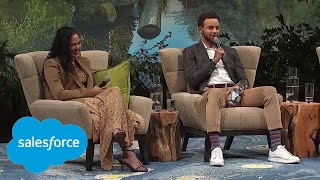
Ayesha and Steph Curry talk about Eat, Learn, Play, their nonprofit tackling childhood hunger, education, and safe spaces for kids in Oakland. They discuss their personal journey and the community impact of their work.
Chapters
Please welcome senior editor, Fortune, Ellen McGirt.
Hey, everybody. Having a good dream for us? I have a feeling it's about to get a whole lot better. So I'm here to introduce two people who really need no introduction, but I'm going to give it a try. I like to think of them as a new American dream story. A Love Story. Two kids who met 14, 15 in youth group became college sweethearts. Guided by faith and family and community and a tremendous sense of adventure, one grows up to be one of the most decorated professional basketball players in the modern era. Three time NBA champion and two time MVP to be exact. The other who has translated her love of home and hearth and food and cooking and writing into a growing restaurant and lifestyle empire. All of this while raising the cutest family anyone's ever seen. But this is also a love story about their adopted city. A beautiful, historic, creative, unapologetic, and necessary city complicated enough to produce both Boots Riley and Barbecue Becky. I know you know who she is. A city that's over policed in the streets, but underfunded in the schools and where one in four kids are hungry. It's a city that could use some love and good ideas. So I find it particularly poignant that as the Golden State warriors were moving across the bay to San Francisco, Stephen and Aisha Curry decided to do something bold for their adopted hometown of Oakland. Here to tell us the story about their new nonprofit, Eat, Learn and Play, is Aisha and Stephen Curry. Please welcome them.
Hello. Thank you for that very kind introduction.
Well, you really don't need an introduction, but I think Oakland does to the world. And what you're doing is so extraordinary. Eat, Learn, Play is still pretty new. You launched in July. Could you tell us a little bit about what it is?
Yeah, we're very excited about it. I think in terms of what Ayesha and I have done and what we've been on our hearts since, you know, we've had the opportunity to, you know, being out here In Oakland since 2009, we've done a lot of things in the community and tried to, you know, aspire to bring our passions in a way that can give back and really impact people, impact our community. And it was kind of sporadic, you know, doing an initiative here. You know, she's done a lot of work with no Kid hungry in the past, but in terms of, like, all of our different things that were kind of disjointed and we wanted to feel or bring a way to bring all of our passions together, our expertise, and build A team around, you know, those initiatives, and to do it in Oakland. And so Eat, Learn, Play was born out of that. It's been a very exciting journey. We did launch in July, but it's been something that we've been truly working on for about two years now. And so to be able to, again, impact the community is something for us that's important. It's been ingrained in us since we were kids growing up, and we have an opportunity to do it at a very, very large scale. And Eat, learn, Play is that. And so you want to talk about Eat, Learn, Play?
Absolutely. So I'll talk a little bit about our core pillars, which are very ob. Eat, Learn, Play. We thank you. Our goal really is to provide healthy, nutritious meals for every child, regardless of where they come from, of course, starting in Oakland. And the ultimate goal is to end childhood hunger. Like you said earlier, one in four children right here in our backyards are going to school hungry. And I feel like it's unacceptable. It shouldn't be the case. And so we're. It's our mission while we're here on this earth to try and end that learn. We want to provide quality education and make sure that all kids have access to quality education through, you know, pre, through high school and then to college, but through college as well. Because a lot of people, you know, they have. They have the ability to get somebody to college, but then what happens when they're there and they don't have an example of somebody that's been there? And so it's our goal to make sure that they're seen through college and nurtured through college until they get into the workforce and then creating safe spaces for children to play. Something so simple that sounds like, oh, a park. But there are so many children and cities and spaces and food deserts and places that just don't have safe spaces to play. So we want to change that narrative and allow children healthy, active lifestyles, which in turn, we've all seen the research. It lessens anxiety levels. It helps children thrive in school. So it's just a whole full circle thing. And these three key things are three things that we truly believe help nurture and build up the best possible child so that they can thrive in adulthood. And we're not reinventing the wheel. It's really been our goal to kind of collaborate, because one is great, but together we're better. And so it's taking all of these people and all these organizations that are doing amazing things and combining forces and using our platform to Be able to connect and bring everybody together so that we can amplify everyone's work.
So I do have to acknowledge that you did not name this nonprofit after yourselves. A lot of people do. Can you tell us a little bit about the decision behind that?
Yeah, I think in general, I mean, it's bigger than us. We obviously understand the platform that we have and the, the voice that we have in this world. And we've been blessed with that and tried to do everything we can to leverage that in every situation. But when we're talking about basically what Aisha just kind of described and taking care of the entire child and those three pillars, this is work that we're doing now to hopefully set up a very, very long term run at really changing lives. And again, it's bigger than anything that Stefan and Aisha ourselves can do. And so that was important to kind of make that a message at the beginning with how we named it and make that something that hopefully people can gravitate towards. In terms of your own childhood experience, communities that you come from, and issues that need to be addressed, and how Eat, Learn, Play can be something that you can gravitate towards and hopefully get behind and help and provide resources, time, whatever the case is. And that will continue to hopefully have a snowball effect way beyond, you know, my playing days or anything that, you know, that's short term.
Ayesha, you're going to be cooking for a long time. I'm pretty sure I left her earlier. That's a nice, sustainable career.
No offense. As long as my hands are still here. It was going to come out bad anyways. I'm the type of person that likes to just address the elephants in the room before I enter. So it's not. But I think for us, like, another reason why we didn't name the nonprofit after our namesake is our family is huge on impact over legacy. And so while it'd be nice to pass away and say, oh, look, look at their found the Stefan and Aisha, like, who cares about that? That's not what it's about for us. It's about how did we impact the community? What does it look like now? Where are we going? And we felt like Eat, Learn, Play was a very direct way of letting people know what we do. So that at the end of the day, it's about how can we impact the community, not what did we leave behind for our namesake. Nobody cares about that.
So before we dig into the nuts and bolts of how this works and how busy you've been, can you just Take us back just for a few minutes to when you first came. Came to Oakland and how you fell in love with the city and how you've gotten to know it and just where your footprint is. Footprints are.
Like I said back in 2009, when I got drafted by the warriors and, you know, coming from across the. Or coming across the country, I grew up in Charlotte, North Carolina, and. Yeah, who. We got some Charlotte people in here.
Oh, okay.
Respect. Respect. And so it was a whole new world for me, Aisha, being from Toronto.
Yes. That's what I'm talking about.
I feel kind of jealous. There's only one Charlottean and a bunch of. That's okay. But, yeah, we got drafted out here. I mean, I was 21 years old. Didn't really know much about the Bay Area. Didn't know much about Oakland. And, you know, fast forward 10 years later, we've grown up here as adults and been able to raise a family here, really get to know the people and the community, not just through the relationship with basketball, but just in your everyday life. And the spirit of Oakland.
Yes, yes.
History of Oakland, the cultural influence of Oakland, it is so present. If you just walk down the street, I know it's changed a lot, but in terms of just what that city stands for and just the hope that is present every single day, it's something that is just contagious. And, you know, the reputation that Oakland had from when I was just growing up, from what I knew about it, it's just so different when you get into the streets and meet people that are doing amazing things. And that's been our experience with Eat, Learn, Play. Just like Aisha said, we're not trying to reinvent the wheel. There are so many people doing amazing work on the ground that their stories need to be, and they need to be amplified to be able to do the work even better and even more efficiently and impact many more people. And so those stories have really just impacted us as a family, and this is our adoptive home now. And so, obviously, there's been change again with the warriors and us moving to San Francisco. But Oakland has been where we've grown up, and all of our experience has been just so special. And so we wanted to maintain a presence there as best we could.
So this would be a good time to tell some of those stories. I know you've had a pretty busy day today on Eat, Learn, Play Business. Maybe you could tell us a little bit about that.
Absolutely. We got to take a trip this morning to the Martin Luther King elementary School. And did a visit with no kid hungry to check out the breakfast program that they've implemented there and got to speak with some of the kids. We had a little assembly and first partner Jennifer Newsome came along with us and we were able to just, you know, see how these kids are thriving and what a difference something as simple as a breakfast can make, especially when it comes to education.
Yeah.
We left there and then took a trip to the Oakland Unified School District central kitchen. And so this, this is actually amazing what they're doing. I don't know how many thousands of square feet it is, but it's a huge building that they've built out with storage, commercial kitchen and an education lab and a full garden to be able to provide 30,000 meals for free for all of the students in Oakland to be able to have a hot lunch. So I think that that's really spectacular. They also have again, their education lab, so students will be able to come in, whether it's on a field trip or a day trip from class, and learn about their food, learn about how to grow their food, taking it from the land to the kitchen and creating a meal, which I think is so important because especially when you go into places that there are so many food deserts. I feel like the art of knowing where your food comes from, how to grow it, it's a lost art, if you will, because they just don't know and it's not accessible. And so for the fact that OUSD central kitchen is making this so accessible for these kids, I think it's really gonna create great change.
So how this works. Yep. What else did you do?
We went to college track. And so that was actually a really cool experience. We went to college track's location. Right. Third and Rahway in Oakland. And we were there with how many kids? There's probably 40 to 50 first generation high school students that today was the biggest day in their educational journeys. They were submitting their first rounds of applications to colleges.
Oh, wow.
If you ever want to get inspired by the next generation, like these type of situations where you get to ask kids just what makes them tick, what they're passionate about, how they want to change the world. I don't remember talking like this. When I was 16, 17, 18 years old, we sat around in a circle and everybody shared some of the excitement or what they're excited about, the next journey in college, what they're nervous about or anxious about. And it was a very open kind of setting to get their feelings out. At the end, they all went over to their computers and all hit submit at the same time. Really took that next step in terms of hopefully understanding where their future is going to be. And then they had a celebration and that was where we were there just to celebrate them and their journeys. They had to hit a button and everybody announced themselves and said what their accomplishment was and everybody going crazy. So when you talk about inspiring the young kids to pursue their education, it was inspiring to us to be a part of that process, to know that the work that's being done, not just what E Learn Play is doing, and not just in Oakland, but around the country, the next generation is their force to be reckoned with. And it's pretty amazing to see.
So how Eat Learn Play works now is it's a grant making and support organization where you've partnered with some incredible local organizations. There's also brands involved too. Let's talk about both. Let's talk about the organizations first. How do you choose them? How have you gotten to know them beyond their specialty in your three pillars? What are you looking for when you look for an organization that you want to partner with?
Yeah, sure. I feel like this sounds silly, but our team tends to move off of a vibe, truly. So it always takes a couple of visits to immerse ourselves into organizational culture and just to see how they're moving about what kind of change they're making for us to decide whether or not we want to be in a partnership, see how it's impacted the children that they're helping and then from there we, we make our decision. We love local right now. So we've right now partnered with a lot of local organizations. And then for us, just when it comes to brand partnerships, which I think is what you're asking also too, yeah, we, when we look to work with a brand, we. One of the biggest components of our decision making process is how can this create change outside of ourselves. And so we usually say no when they're not willing to participate in our Eat Learn Play endeavors.
Did the CEOs have to go in the dunk tank like you did on launch day? It was Google launch day for Eat Learn Play. And that was really fun.
I think a lot of it, like Aisha said, it was just overall leadership too. It's yeah, a lot of parallels to the tech world and kind of just from a non profit standpoint, you know, leadership and how people are represented and just the vision that, you know, those people in charge have, you know, it goes a long way and it's a huge indicator of success and like she said, it's a lot about vibe, but it's more or it's also about, you know, just being able to just spend time with them and see if our ideals are aligned. And, and you ask those questions around, are you really going to be, you know, eager to participate? Whether it's sending volunteers or, you know, if it's actually getting funds, going towards initiatives that we're, you know, passionate about and those type of things, Those are the questions that you ask going into that process. And for us, I think the reason that Eat, Learn, Play is, is happening now is because of ready to, you know, having the ability to dedicate time to this because it is something that is, you can't just, you know, you just can't write, check things, write checks. It has to be something that you're really invested in, that you have that follow up, that you have leadership that we've been fortunate enough to have on our side as well and really spend that time having those conversations, really strategizing and goal setting and, and then following through. And, you know, that's been a really rewarding experience through all of this, even in a short six to eight months of actually activating and going out there and executing what we want to do.
Besides the fact that I think it would be a lot of fun to be in a planning meeting with the two of you, especially her, 100%. I'm also sure that you know and have known for a long time that there are very serious and big reasons why kids are hungry, why, why there's no place for them to play, why we're losing talented people by first grade, second grade, third grade, they're not treated correctly in schools, they're disproportionately punished, all of these things. I know that, you know, because I know that you've got reams of research on it and that you behind the scenes are sharing this research. So I'm curious how you want to address the bigger systemic issues that make this work possible. How do you plan to work with lawmakers and policymakers and will there ever be President Curry one day? And it's not just because we're desperate.
I know. I mean, a lot of it's kind of the relationship building and understanding, you know, we have to listen, we have to be able to learn and to be educated. And that's only with the people that you get in the same room with. And I think that's a big part of just our presence here in the Bay Area and doors that have opened, you know, whether it's working with Mayor Libby Schaff in Oakland. Or like you said, first partner Jennifer Newsom, like, those relationships are ones that you can truly make sustainable difference and policy change. That is a core goal of what Eatler Play is about. And I know, Aisha, you can talk about it in a second. Just about when you talk about kids going to school hungry and losing kids at that early of an age where they don't even have a chance to succeed because of fundamental deficiencies in their life, those things should not happen. And I won't say a thunder. You have a huge want to change that in a material way.
Yeah. I mean, I was talking about this this morning with first partner Newsom, and I said, we're one of the only thriving countries that have children going to school, that don't have a proper lunch that's afforded to them. And I think that just shouldn't be the case. And so it makes me question, are we really thriving? Are we? Our children are going to school hungry? Are we? I just feel like it shouldn't be a question. And so I was speaking with her, like, how can we. What do I need to do to make this happen? Where do we need to go? Who do we need to speak to? And so it's just trying to get in the right room with the right people to make it happen. And I know it's going to be a journey, but I think with our. With our organization, that is my biggest goal, is to try and at some form of a government level, have a meal program be the standard for all kids at any school, regardless of where they're going, where they come from. I think it just shouldn't even be a question. So that's one of my biggest things that I'm. One of the biggest missions I'm on right now.
How are you? I know you're surrounded by experts now, and you've got access to some really interesting people. How else are you learning about what's happening and the reasons for it and how to rank those priorities? Because, you know, when I think about the work that you're trying to do, it's almost. It hits everything. Their parents are at risk, they don't have jobs, maternal health. How do you rank all of this?
That's the thing, right? That's such a hard question, because how could you possibly.
How can you choose?
Yeah. And that's something we're figuring out. That's why we have, you know, a team of people in our corner helping us to figure it out. Because if you left it up to Us, we'd be trying to do every.
Please.
Because we're not the, like, let's pick and choose type of people. So me especially, I have to get reeled back in sometimes. I have way too many big ideas, and I want to solve the world's issues, but I realize that pinpointing and tackling one at a time is very important. And so we're in the process now of figuring out what steps to take first and where to go next.
Yeah, a lot of us, again, on just, you know, the relationships that you. That you have with people on the ground and hearing what the community needs from the community. And a big part of that is, you know, we've had. Me personally, I know she's been a huge sounding board and help and getting us off the ground, but there's a lady named Regina Jackson from the eoydc, the East Oakland Youth Development Center.
Okay.
It's kind of funny, like, how it goes through. I won my first MVP in 2015. And as a part of the award, you get to donate a car to a deserving group that you kind of choose on your own. And so that's where I first met her. I got to donate the car to the EoIDC to use at their disposal. And we formed a relationship from there. And she has been instrumental in terms of identifying those issues, you know, providing like, real life examples of how these issues are affecting the kids at large and then kind of pointing us in the right direction to how we can, you know, potentially, you know, intervene at the level that we're at and kind of, you know, strategize going forward. And there's so many people that are, you know, you have to listen. You can't come in figuring, thinking you have all the answers. And I think that's been a huge part to our journey in the beginning is just being open minded and have open ears to what the community is saying and then, you know, trying to strategize from there.
Showing up with a car is a pretty nice way to start. I just want to sidebar for a quick second. Ayesha, when I said that you were part of. You were growing a rapidly changing empire, I mean, it's really going fast. Could you just give us a couple of minutes, just letting us know where you are? I mean, you're a New York Times best selling author, you're a restaurateur. You've recently. Not that long. Well, a little while ago, you sort of revamped your lifestyle website. Just tell us where you are.
Yeah. Oh, boy.
Please.
Okay. You're throwing me for a loop. Well, we're about to open our fifth restaurant location, which is crazy. And that's been a joy. But even through that, like working with organizations like the Bread Project, which is an organization where they bring either formerly incarcerated people or people that just need, you know, help getting on their feet, they teach. They teach them how to bake, they give them a place to stay, and they nurture them until they can get back in the work field. So even things like the restaurant partners with them to make our buns for our burgers. So we're always looking for ways to kind of make an impact in that way. So fifth restaurant is opening in January. I'm opening my first permanent. So I've had the pop up in Jack London Square in Oakland for my store for going on a year now, which is crazy because it was supposed to be two months, and now we found a permanent location down the street in Oakland on 23rd Street. And so I'm really excited for that. I'm actually in the middle of a rebrand right now.
Oh, okay.
Can't talk too much about it.
All right.
But it's exciting. Yeah. There's a lot going on.
You know, I just want to. Just talking with you both, it's just so clear to me that this is caring about community, and it's just baked into everything you do and every decision you make. And that seems to be a great filter for thinking about how to choose a partner, that they think that way, too, that everything is an opportunity to not center yourself, but to center the issues and the people who need you 100%.
And we've been really blessed that the people that we have partnered with so so far have gone above and beyond the standard when it comes to getting involved with elearnplay.
So I do want to. This is. I know that you both have sophisticated portfolios and giving, but I wanted to talk a little bit about your work with Malaria and your travels overseas. You tell us a little bit about that program because it really is extraordinary. And of course, the. The CEO, he's right here in the audio. Where is he?
It's interesting how you meet people. So, yes, when I was in college, my college roommate, who's now a business partner, he started a. Huh? Yeah. And my best friend, he started. He's probably watching this, like, come on, man. Yeah. And so he started a three on three tournament called Nothing but Nets to raise money for malaria bed nets to be sent over to continental Africa. And so part of that process, or, sorry, it was called Buzzkill, that was raising money on behalf of Nothing But Nets to send money to Africa. And so part of that, I got introduced to the cause and became a champion of Nothing But Nets. And the CEO of our foundation now, Chris Helfrich, who's here, he was running Nothing But Nets at the time and doing a lot of amazing work with Nothing but Nets and the UN Foundation. And that's where we met. And so you think about just a common idea of how can we impact not just here in the States, but overseas as well. And we identified that specific cause. I got to go to northwest Tanzania to a refugee camp where there were about 40,000 Congolese refugees there. We spent, you know, three days, I believe, on the ground passing out bed nets, just talking to the people there and hearing their stories. And one, it was just about just as a parent not being able to protect your child. There's an alarming stats on, you know, children under the age of five being affected by malaria. And so we had just had Riley at the time. And so it kind of just cemented, you know, from a parental perspective how much those bed nets matter to them in terms of protecting their families. And it was really a rewarding experience. And we did a lot of great work there. And so that's just springboarded this entire relationship that we've had. And the idea of eat, learn, play has kind of come to life. And again, you just find like minded people that want to impact the community and are passionate about it. I can speak for our team that this isn't a job. This is a, this is what they've been called to do. And you can see that through every single conversation we have and just how diligent they are. And so, yeah, it's really, really cool experience being a part of that cause and, you know, nothing but that's still on the race to end malaria in continental Africa. So a lot of great work. Again, that's just not happening here domestically, but internationally as well.
Was that the first time you'd seen that kind of poverty or that kind of post conflict situation?
Oh, 100%. And it's kind of hard. It does change you. And it's something that it's hard to really put in the words to do that experience justice. But it's only just double down that, you know, emotion in terms of like any way that you can impact just one, just one child, one parent, one family. You're doing amazing work.
Did they know who you were?
They didn't. And it's kind of funny, I Did see a bunch of those. I bet you now there's a 2019 Golden State Warriors NBA champion shirt there. I saw a lot of losing wardrobe there now, but they didn't know. They didn't know who I was. But I did get to play on a clay. They manufactured a clay basketball court, official, regulation size, with some makeshift baskets.
Stop it. They knew you were.
Then a couple people started to figure it out when I got there and started playing, but that was just cool, Just basketball, sports in general, kind of the play aspect of Eat, Learn, Play Sports connects so many people on a level that is unheard of in this world. And so using that as obviously an engine to create change and create exposure and awareness on issues that matter and bring people together. No better example than me playing basketball in Tanzania with some refugees and having fun, and they gave me a little trophy to bring back home and all that. So it's pretty rewarding experience.
See the power of play and a refugee camp. So the two of you have an incredibly powerful network. A network of powerful people. And I just. I have this. Many of whom are public figures, many of whom are athletes, many of whom are business people and who are increasingly moving into work, social justice work, raising issues. You okay?
No, I've been sick for, like, the past couple days. Thank you. Good. I'm fine.
Thank you so much for coming and showing up. I know. See if we can get you some ginger tea.
Oh, yeah.
So in my mind, I have this. Maybe it's just a group text, but I just. I imagine a network of beloved, powerful people exchanging best practices on micronutrients and how to get all of these things that we need to solve these systemic problems. How do you tap into your network and how are they supporting you and how are you supporting them?
You want to take it. That's something that's been, I think, hard for the both of us. We really don't like calling in favors. We're do it yourselves kind of people for the most part. And so, you know, it took realizing that Eat, Learn, Play and our other daily work endeavors are two separate things. And so you kind of have to tuck your tail in between your legs and ask for the favor when it comes to the organization, because that's what's really important and people should want to rally around it. And so, I mean, a simple text, a simple call goes a long way. Getting hold of people's publicists. I can't believe that's a thing, but it is. And you just ask. You can't have any shame when it comes to this stuff. Right. We're trying to make a difference.
That's right.
And so I think it was for us, realizing the difference between asking a favor and asking someone to help impact the community is what's really helped us. So. Yeah. I don't know. You have anything to add?
I think just in terms of. It seems more and more that the people that we come in contact with, whether it's my teammates or people from other industries or whatnot, there's a overwhelmingly apparent kind of initiative to use your platform in a way that, I don't know, in generations of past has been there. And so, like, those conversations kind of come somewhat naturally in terms of, like, what people are doing and, like, what's going on, you know, with elearnplay, or celebrating what other people are doing and finding ways to, like you said, rally around those causes and those efforts. There is no a group chat. Sorry, there's no like. There's no like. But it's just a matter of just having that shared perspective that we're all doing things in our own authentic ways.
Right.
But there are connectivities along the way that you should definitely be able to support. And, I mean, even just being here in the Bay Area, it might not be, I use that word, famous, but just notoriety. People with notoriety and the ability to help are very willing to do so if they feel a connection to what you're doing. It's been apparent just here with even our launch event that we had and our golf tournament that we had here on the Bay Area, just trying to create those relationships, even more people came out and, you know, the who's who of Silicon Valley, the CEOs that are just extremely excited about, you know, their philanthropic endeavors as well, and just whatever resources they have available, just being so generous. Like, I. We're blessed to be here in the Bay Area, to have those relationships and whatnot, and hopefully that'll continue to create a fire. And again, it's just about finding people that are doing it in their own authentic ways. And I think we all have a.
A saying that you're both excellent at technology. I mean, your Instagram and you just everything.
You saw me in the background.
I know. I did. I did. I did post.
I was struggling. Maybe it's because I only have one hand.
Yeah, he's got the lame paw there, but I know so. But you understand how it works.
For the most part.
I did witness an unfortunate event like failing to post. But you must. I mean, you do have the resources of the Bay Area you, your disposal. And people do love you and care about these kinds of things. How do you envision using technology to get some. The stats. I mean, even just getting the stats out, the fact that you even say the numbers. This is my actual beat at Fortune. And I'm out there for three and a half years. It's like kids are dying. They're being awareness, school to prison pipeline. These are real things. That's where the next black CEO is, in a prison somewhere. So how do you plan to use this? These. Your.
That's one of. I mean, you love it and you hate it. And that's one of the reasons why I love it, is because with the click of a button, you can raise awareness to millions and millions of people. And so I think it is really just getting the statistics out there and getting the numbers out there and letting people know how they can help something as simple as that. Just to put it into perspective, in Oakland, you know, the child going to school hungry numbers 1 in 4. Across the states, it's 1 in 6. And so what are we doing? Like, you know, it's literally in our backyards. And so just like letting people. People don't know that because if you don't know, you don't know. And so it's just figuring out how to, you know, make sure we're using our platform and that gift of technology to the best of our abilities. And I think honestly, just putting it out there whenever you can, weaving it into whatever we do goes a long way.
I also think on both our behalfs, we're trying to find ways to just use every channel, whether it's just our own social media pages or the organizations that we work with, try to find ways to cross pollinate across all the different endeavors that we have. Like she said. So in terms of like brand partners that you select to go into partnership with, making sure they have a like mindset and that the things in the campaigns that you're doing have some give back, you know, perspective and make that a priority and make sure that's weaved and it has a synergy through everything that we're doing. And our, we're both kind of dabbling now in the media space and have our own production companies and so trying to find ways that if you find a project that has a stat or some ability to make people aware of a situation that they might not have come in contact with, get behind those and be champions of them and share those with the world and let people tell their stories, those type of opportunities you want to be selective about them because you want to make sure that they're powerful and that they're moving the needle. And it's something that we really believe in. But those opportunities have just, you have to have a perspective on using every opportunity, every distribution channel, every brand partner, every company that we invest in, all those different angles. There's so much opportunity there, and it's important to have that perspective going in.
So it's sort of an organic approach. Do you have any idea, Are you reviewing scripts? Do you have any sort of related projects in the works that you could talk about or even in a general way? I'm curious.
Yeah, there's. So we have had some wins. So Aisha has her endeavor that she's done her cooking show on Food Network and abc. Sorry, the family food fight that we had. There's so much opportunity in terms of now if it's on, you know, with a partnership with ABC like we had, or if we had the ability to. We had break. I had a movie breakthrough come out in theaters this past summer, a documentary called Emanuel about the shooting that happened in Charleston, South Carolina, back in 2015. Those opportunities can continue to set the stage for how we can storytell through media and through, you know, entertainment and impact families and, you know, of all generations. Whether you're laughing at it, you're crying with it, right? You're understanding it, you're with it, or, you know, you're being presented with information and you're processing it, there's so much opportunity there as well. And so again, it's all about being authentic. And that's the, that's the hardest part about. There's so much opportunity there. But does it really, you know, resonate with us and who we are and what we're trying to do?
Yeah, I think storytelling goes a long way too, especially, I mean, just speaking back to Oakland with what Oakland's going through, this transformation in a sense, but it's like, how do you keep the heart and soul there? And so I'm in like the very, very, very early stages of working on a documentary about a block of women in Oakland, five black female owned businesses, and just telling their story and how they're kind of keeping that heart and soul in Oakland. And okay, I'm one of the businesses, but that's okay. But the other four, but the other four women.
Sometimes it's okay to be.
In the story, but the other four women are, are incredible. And they're what really drew me to wanting to be in that space and just seeing the Potential and just knowing together, us as businesses, what we can do for the community. And so I'm really excited. I can't talk too much about it. Cause again, it's like it's in its an embryo right now. It's in its. It's not so. But look out for that. I'm really excited about it. But I feel like something simple like that with everything and all the change that Oakland's going through that can draw eyes to it once you, you know, it comes out and create some sort of an impact and change and hopefully, you know, get people excited about Oakland and bringing their businesses to Oakland. I feel like I've never experienced being in a place before where there's so much heartbreak and heartache and need.
Yeah.
But people are still so passionate and loving and caring and, like, proud of their city. And who, like, who doesn't want to be a part of a place like that that's evoking so much change, but still has so much heart to it. And so that's why we decided to start there, because Oakland really has nurtured us. It really is a special. Sorry, I'm rambling. It really is a special place to us.
We only have a few minutes left, so now's the time. In front of the greatest conference audience in the world.
This is a beautiful audience.
You are a beautiful audience. I do. I love coming here. And I wish you could see what you look like from up here because you really do look like hope in the future and all good things, right? Yeah. But now is the time to put out the big vision and how you think this can scale and how your community approach can be meaningful in other communities that are specific in their ways and what we can do to be part of it.
I mean, it's been an amazing journey so far, like, we've talked about and kind of the process now that we're on. And we've identified our initial run of grantees that we're really excited about, you know, again, telling their stories and broadcasting the work that they're doing on the ground. We talked about aisha's mission on, you know, getting sustainable policy change around food programs in schools.
Yep.
And our work in Oakland is a priority. It's, again, it's our adoptive home. It's where we want to start. But every community has its own set of needs and issues and problems and things that we can all be a part of that journey. For us, it's about continuing, again to listen to what is going on at the ground level. And that's a process and a long journey. And so we've. We want to be very impactful and efficient in how we go about our business. And I think that's what we kind of started on right now. And so in terms of just following our journey and our path, we're going to be broadcasting everything every single step of the way. If you can find ways that in any of those three pillars, you have people that are on the ground doing amazing work and you want to, you know, put that on the radar, we got a way to get that information, and we can hopefully, you know, create those relationships. And it's just all about continuing to build hope for the next generation, because, like Aisha said, that's. It's so profound in Oakland. And I know that is a similar thread in a lot of different communities, but that's something that, you know, we're all about right now.
Yeah. Good job, babe. I feel like, you know, especially in a room full of change makers, I feel like everybody's always talking about scaling.
I know.
And everybody is so quick to scale, and we want to grow. We want it big, and we want it now. And for me, especially when it comes to this, I think crawling before you walk is the best decision, because people are quick to scale, and then you scale and you have a beautiful ship that doesn't sail.
And.
I just. I want to make sure that we do this the right way and that we, you know, make the change first in the place that we intended to start that out for. And once we feel like we've gotten to a great point there, then we think about scaling out. But until then, I really believe in the village approach. And for us, you know, no matter where you go in the world, everyone has their tribe. They have their village. So the saying, it takes a village to raise a child. And so really right now, in the here and now, our goal is to truly just be the village for the people around us that don't have that village. I mean, we're here today because we have our little village at home, but there are several people that can't even go to work and take their children to school because they don't have anybody around them to do that. And so it's really our goal to find those people, to wrap our arms around them and to, you know, create change in that small. What some people might think is small and insignificant is a big, big, big change. So we're gonna. We're gonna crawl for a little while, and I think that that's always smart, beautiful fundamentals.
We're gonna crawl right along with you. Thank you so much for being here. What a joy to meet you both.
Thank you very much.









