Fireside Chat with Marc Benioff and Diane Greene | Salesforce
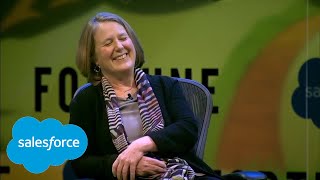
Diane Greene discusses founding VMware, its growth and EMC acquisition, and her later work at Google leading cloud initiatives. She covers Google Cloud's infrastructure, BigQuery, and AI capabilities, and the opportunity to democratize AI through cloud APIs.
Chapters
Ladies and gentlemen, please welcome chairman and CEO Salesforce Marc Benioff.
All right, all right, all right. Good afternoon, everybody. Are you having a good time? All right. Fantastic. Wasn't Michelle Obama amazing? Great. And did you like the keynote yesterday? Are you ready for Lenny Kravitz and Alicia Keys? Yeah, I've been walking around and I was out on Dream Valley. Wasn't that awesome? Did everybody hear Neverland perform? It's one of my favorite things every year is to hear them. And, oh, and I should also say LT Smooth. Wasn't he unbelievable? Yeah. I don't go anywhere in the world without LT Smooth. And what else have I enjoyed doing? Going to the customer success showcase. Going over to Moscone West. Has everybody been in trailhead and seen what's going on down there? Incredible. Okay, what we're going to do is we're going to have this fireside chat with Diane Green. So let's welcome her out. Diane Green, where are you? Diane? Here she is. Welcome. Welcome to Dreamforce. All right, let's have a seat. And everybody just relax and enjoy yourself. And what we're going to do over the next hour is we're going to get to know Diane Green and hear about her vision for the world and everything that she's working on. But this is kind of an amazing story because it goes back about 20 years. And about 20 years ago, a friend of mine called me and said, I want you to meet Diane Greene two decades ago. And I'm like, who's Diane Greene? What is going on?
And where were you at the time?
I was at Oracle. It was a long time ago. And sitting on the 11th floor down the hall from Larry Ellison, and there's a knock on my door and I'm like, who is it? And in walks Diane Greene 20 years ago. And she said, I'm starting a company and my husband and I have a huge vision for the future. And I'm like, who's your husband? And we're going to get there. And what's your vision for the future? And let's just go back there to 1998, because here you are. And I guess we should introduce the players. But can you just tell us a little about everything that you've been doing kind of in your career, what your background is, and also introduce your husband who is one of the co founders of that incredible company?
Well, you know, I was a naval architect before I did that VMware thing, but so I don't know where you want me to start.
Right at the beginning. Where Were you born?
Actually, it's cool and natural.
Actually, I don't know where you were born. I don't even know where you were born.
Wikipedia says Rochester, New York, but it's not true.
Oh.
I sported.
We're going to correct. Wicked.
No, no, no. I really enjoy it, but. Because I can always tell when someone took my bio from Wikipedia. But is that a marker?
It's like a cyber security thing. You know what's going on. If it says Rochester, it's Wikipedia. It's a honeypot. Okay, so.
But I was born in Annapolis, Maryland.
Annapolis, Maryland. What was your family doing in Annapolis, Maryland?
Mostly sailing, actually. I mean, my. Yeah, it's really amazing. I mean, if you. My father was this amazing person. He was actually accused of being a communist in the McCarthy era. But anyhow, he. So he had to reinvent himself.
Let's hear about that. That's good. These are the stories we want to know. We want to know about you.
I hope we have more than an hour here. No, so really quickly, it is an interesting and topical story. He was an aeronautical engineer. He's running an aircraft company. And a competitor in the government kind of turned him in as being a communist. He was just a good capitalist. And he lost his security clearance. And so he couldn't be the CEO of this aircraft company. And because of the scare tactics, he had to be a draftsman. And he invented himself in a new career as a civil engineer eventually. And he went before the US Supreme Court twice. William L. Green versus the United States of America. And he won both times.
What was the suit?
Well, the first was to regain his. To prove that he was. He shouldn't have to get it reinstituted, his security clearance. And then the second was for compensation.
And is this how he met your mother?
No, that was. He had an airplane and it was. Someone brought her along to go flying with him. But anyhow. So she was brave because he built his own airplane.
But he had built the airplane and he said, let's go.
But anyhow. So how did we get off on that?
This is good. This is what we want to know.
So I grew up in Annapolis and my parents started the school I went to. It was very progressive school where we had seminars and did projects back in long time ago. Really good way to do education. And then I raced sailboats, which kind of was very formative. And that led to naval architecture. I'm skipping a few things.
Don't skip anything. We want to know it all. Those were some seminal moments you just skipped. Where did you go to college?
I went to three colleges. Undergrad. I started at University of Maryland and I went to did a little stint at Texas A and M. I was racing my sailboat and I was going where what made sense for that? And then I finished at the University of Vermont and then I went to MIT for grad school. And then that was naval architecture. And then after doing that for a while, which was pretty interesting, but not great for women. And why was that? Well, it was mostly the oil industry, which was a really well established industry. And I'll tell you something about that in a second. It was a very well established industry with established ways of doing things. And I wanted to go offshore. I really liked being out in the ocean. And there were no places women weren't allowed offshore back then. Yeah. So I would design all these things, but I couldn't go out there and install them. I had to listen to my friends tell me how it went. I was like, God, this is hopeless. So I switched to computer. I was doing a lot of computer analysis. I learned Fortran. I decided I better do computer science. And I went back to school at Berkeley and got a degree in grad school and computer science. That's where I met my husband.
And that's where Mendel came in.
Yeah.
And was he your teacher?
No, no, he was a grad student.
I don't know. He is a great college professor though, isn't he? Like the very top. He's one of the top computer science professors. Professors in the country.
Well, he can't boast about my husband, but he's pretty good. He teaches at Stanford.
You can boast about him. It's all right. He teaches at Stanford now.
Yeah, he's a professor at Stanford. Does research and teaches. In fact, he's moved up the stack. He was a systems professor, and when we did bebop, we realized it's really about the application layer now. And so now he's teaching the applications course. Maybe Brett wants to go back and take that one. But anyhow. So, yeah, I went back and got the degree in computer science.
Brett Taylor at Salesforce was one of his students.
Yeah. When I met Brett, the first thing he said to me is, oh, I took computer science from your husband. It was one of my favorite courses ever. So that was nice. Yeah, it was a hard course. So the fact that it was one of his favorite courses means Brett was pretty good at computer science.
Yes, Brett is very good at computer science. We're very lucky to have him. I don't know if he's in the room. But Brett Taylor, who then went from Stanford to Google, did Google Maps, started his own company, which got acquired by Facebook, then became the CTO of Facebook, then started another company, Quip, which has got acquired by Salesforce.
By Salesforce, that's right.
Anyone here use Quip? All right, we got. That's Brett Taylor. So here we are. And with Mendel. How did you meet Mendel?
Well, he was another graduate student in computer science. And it's a funny story, for some reason a bunch of us went up to Lawrence Livermore lab and I had to get back. And he said, well, I'll give you a ride. And he had a motorcycle and I had never ridden a motorcycle. And I'm like, okay. And I got on the back of this motorcycle and then he took a wrong turn. We ended up on the freeway.
He only told you it was a wrong turn. Actually, it's a tactic.
And that's how I met him.
Yeah. That's awesome.
Yeah. But the thing I was going to tell you that's interesting for women, the oil industry and then computer science. So computer science really felt very open. And when I went to Berkeley was when women in computer science was at an all time high and the percentage of women in the program and it's just starting to get there now. And so it was, you know, every. I never felt any kind of pushback really. And I recently got a chance to spend several hours talking with Gloria Steinem. So I asked her, what's going on? Why didn't I see this? And now. And she explained that when in her inimitable way. Well, of course, whenever a field is starting out, there's no established ways of doing things and gender doesn't matter. It's. Everybody's inventing this new field. But as soon as money comes in and status come in, the men come in and they take over. And I'm thinking, well, that was the oil industry, but now the women are kind of getting there in computer science.
Yes, absolutely.
Yeah. Isn't that interesting?
Very interesting. How did you end up with Gloria Steinem?
Oh, I ended up on an airplane with her. For nine hours we sat next to each other. Yeah. Like we. It was really one of my most wonderful experiences. Yeah.
So you're with Mendel and you're at Berkeley and now you're married and somehow you guys have a vision to start a business together. Is that right? Was that right out of Berkeley at that point?
No, I. So from Berkeley I went to Sybase and then to Tandem and then to sgi. And then I did a startup, low bandwidth streaming video in 1993 and we had the whole YouTube vision a little bit before because you could only show a postage.
I was just at the beginning of the Information Superhighway 93. Right. There was trials, right.
Dial up modems, sending dial up modems.
And we were just at the beginning of.
It's a little better than that, but.
Yeah, it was the beginning of video codecs right there.
Yeah, well, that's what we had. We had a way to do real time decoding of the video codec and anyhow, so that.
And were you and Mendel working together on that?
No, no, he was getting going at Stanford and I was doing this actually with another Stanford professor and that got bought by Microsoft. And then. And we had a kid at that point and so I thought, well, I'll stay home with the kid for a while. This is good. And then he was doing this virtualization research at Stanford and it was interesting. Is this too much detail? No, no. Okay. So Mayfield Partners was having a sunrise breakfast and they had asked him to come and talk. And he was like, I think I'm going to talk about intel and Microsoft. And I said, I'm going to this place. And you know, and I went. And he started talking and he said, you know, if you could ever get a level of indirection, you know, between the processor and the operating system, you know, you'd really have a chance at changing things. And I think that's when VMware was born. And we went, what year was that? That was 97. And. And we went, you know, we started talking about it and he was doing his research. He had done it originally as a way to instrument systems and he was getting really good performance. And then he was really frustrated that you couldn't run. Nobody would adopt new operating systems because you didn't have the applications. And so he was using this as a way to get people to adopt new ideas. And then what happened was he had a paper out and he got this email from someone. It was under blind review. And someone at University of Washington. This is too much.
Nope, this is great.
Someone at University of Washing. I should ask them if it's too much.
They don't matter. Only it's. Right now it's just me and you. They're not there. This is just me and you hanging out all perfect.
Anyhow, he got this email saying, Bill G. Rick R. Nathan. Nathan Maribel, Rick, Rashid and so on. Would like to read your paper that was under blind review and I said, hey, let's get a patent file. Anyhow, we decided this really should be brought to the X86 architecture. This weight or put in this level of indirection with running multiple arsenal.
This is the beginning of virtualization.
Yeah.
This is the start of that entire concept, really.
Not completely. I mean, IBM had done it for the mainframes. They had virtualization. They did it for a different reason. And it had died out. And so much so that when intel built their x86 processor, they didn't put in any support for virtualization. Yeah, because IBM used to have it, and it just completely died out. And then we revisited it and we, you know, we just thought it would be so useful. In fact, my first office manager, I hired 10 people. She still reminds me. I mean, she comes over. By that time, I just had six months into the company, had my second baby, and she was sitting there with me while I interviewed this woman. And I said, yeah, this stuff's going to run on every machine someday. And she's looking at this woman with the baby in her lap saying, yeah, we're going to make our virtualization run on every hardware. And it happened. Kind of.
It did happen.
Yeah.
And that's really what happened. Right. Because in just the next year after that, in 98, you and Mendel founded VMware.
Well, by then I had found. Yeah, we founded it in 98. And we did it with two of his grad students and another guy that had gone to Berkeley grad school with us that had written a lot.
That's where I got that knock on the door for the first time that I need to meet Diane Green.
Yeah, yeah, yeah.
So to Rachel came into my office, and he said, we have this vision for virtualization.
And what did you think?
Well, I'm like, wow. I actually thought it was wow because it was. You know, I don't remember much, but.
It must have given you the idea for Salesforce. The cloud.
Yeah, that's where I got it from. This is it. Exactly. I was wondering where I got it from. But the thing that I was. The point for me, in my mind was I remember very specifically because we were having this conversation backstage, and the meaning was much more meaningful for me than it was for you. But I remembered very distinctly, you came in, you had this huge vision for virtualization. You really painted this vision of greater efficiency, really, of hardware and software.
You know, I was trying to shut Oracle out of my mind, which is why I hadn't. I do remember it now.
So am I, actually. So we have that in common. And then you basically said, we're going to have this huge vision for virtualization. We have this incredible architecture. And you and your husband painted this technical vision which was super compelling. And at the time I was having my own thoughts about, you know, was I going to leave Oracle and was I. So it was like on my mind, wow, what are these guys doing? And so I remember the meeting, you know, like it was yesterday and did.
You say you wanted to invest?
I wanted to invest. I didn't get that chance. We can talk about that later. I think you were worried about Oracle potentially being a competitor because at some point you went deep on the conversation and then I think you were worried about Oracle and I was still at Oracle. So sorry, I forgive you the irony of it, but I believed right from the beginning. And then VMware just took off like a rocket. Right. I mean, it became one of the very fastest growing software companies of all time.
Yeah, we basically grew over 100% every year I was there. It was pretty amazing.
You were the CEO of the company.
Yeah.
And you were creating this incredible company and then all of a sudden you had that incredible growth period from 98 to 2004.
They were highly profitable.
Highly profitable. Incredible. We're getting there.
No, we don't.
What Incredible company. Amazing, right? Huge technology, massive differentiation, trusted brand, world class management team, phenomenal customer trust. These are all the things that you're creating as the leader of VMware. And then in 2004, you file your S1, you're getting ready to go public, you've created the whole vision of the cloud.
We actually didn't file it until 2007. We were looking at filing one. Yeah. And then you got a call.
You got a phone call.
Well, yeah, it had to do with my board members, but yeah, we got acquired by emc. And fortunately, you know, they had just acquired Documentum and Legato, which were far bigger than VMware at that point. And so they just.
You were about 100 million when they acquired.
We were on our way to 100 million. We hadn't hit 100 million or we were about a. Yeah, no, we weren't quite there yet. And they, you know, they were pretty busy and so they just did it and they kind of left. And actually what happened was they all started descending on us and I was like, oh, they're going to destroy the company. And so I said, why don't you send a VP to VMware? They can sit next to door to me, they can come to all my Meetings, but anything from EMCs to go through that VP and that worked incredibly well to where we kept going.
You continued to be the CEO of the company, you sold it, but really that was really irrelevant. Right. You continue to drive it forward, which.
Was a huge advantage because I didn't really have to stay. So I could say, look, if you want me to stay, I think it needs to work this way and if you don't want me to stay, that's fine. But that's an unusual position to be in which lets you do things in the way you think they should be done.
Well, you were doing a phenomenal job and you were fast tracking to a billion in revenue.
Yeah, yeah. And in fact that was one of the keys because when you get acquired, sometimes people want to leave. And so I said I could see we were going to get to a billion. And I told Joe Tucci that. I said, how about if you give me a huge tranche of stock that I can give out when we hit a billion, as long as we hit it within this time frame. And he thought it was impossible and he gave it to me and it held the company together. And we were all united in going to hitting this and we hit it ahead of time. Yeah.
And then you took the company public as well.
Yeah, took it public. That was fun. Yeah, yeah. And then I left a year later.
And you left a year later. But it's probably one of the greatest success stories of the software industry. And I don't think there's been a more successful female CEO in software than Vayan Green.
Two billion. When we.
Two billion, that's right. Yeah. Pretty awesome. So from this incredible path from Annapolis all the way to VMware and the IPO and the huge success and multi billion dollar company and incredibly changed the whole industry with virtualization and getting everybody's. Everybody's computers fundamentally just much more efficient and well, you can. All right, but this isn't about me, but thank you. Okay, now here we are, we have that arc and that's kind of the arc. It's an amazing arc. And now you've left VMWARE and left emc and you're kind of out there. But now were you had you got a call from Larry Page or Eric Schmidt to join the Google board, Is that right? Was that.
Well, I've always known Larry and Sergey from Stanford. From Stanford.
Yep.
And.
So when did you first meet them?
They were grad students. Well, Larry was a grad. It's a funny story. I was, you know, remember the Internet Archive I was at a. Brewster Kael was having an event that I went to, and somebody was standing next to me. I didn't know him. And we started joking around about what Brewster was saying, and he started saying, well, I know how to do this search thing. And it was Larry. And that was the first time I met him. We were just joking about all the things Brewster was saying. It was kind of a fun way to meet him. He was still a grad student, hadn't started Google. And then when we were.
This must have been right when you were starting VMware. 98. 97. Right in that area.
Yeah, yeah, 97. And then we started. And they started a couple months afterwards. We were a little bit ahead of them. And so we were moving out of our space and we were going to try and convince them to buy our furniture, but they came over, but they were buying tables for their furniture. They didn't want real desks, so we couldn't sell our desks to them. But we were friends. We would go to each other's parties. And then we started competing for talent and. And the joint parties stopped.
Because you were trying to hire people into VMware and they were trying to hire people.
We were both going after really strong systems people and, you know, it was quite a competition. Lot of respect for them, though. And so. But I've known, you know, always just thought the world of Larry and Sergey. And so I went over to. Larry invited me over after I left VMware. We talked, but, I mean, Google was such a consumer company, I just couldn't see anything. And then he said, well, a few years later, they invited me to join the board. I thought, well, that was really neat and did that.
When was that?
It was, I think, seven years ago. So, yeah, 2000.
2010.
2010, yeah. And so I joined the board and started asking, well, why don't you guys have a public cloud? And it all went on and on. And they were thinking about it, and then there was a suggestion that I come in and run it. And I'm like, no, but let me help you hire someone. And then I did my little company, Bebop, which was a lot of fun right now.
So you start. What year did you start bebop?
I think 13.
2013.
Yeah.
And this is really now the next startup for you and Mendel?
Well, this one Mendel didn't want to do, so I was just doing it. But towards the end, he got interested enough and came in and, yeah, I was doing that with another Stanford professor.
What was the Vision for bebop.
I don't know if you want me.
I do.
We really thought. We still think that. And I think you guys are doing a fantastic job. But enterprise software is hard to use. And with the right kind of infrastructure, you could make underneath for the application, you could make it. Make it much easier to make. Really great. I mean, you can have a voice interface, but if you do need the richness of the workflow and everything else, you could make it really. So we decided that we would set out to do that. And I learned a lot about design and user experience. Really great few years studying that. And then we decided to build an application so we'd make sure we weren't drinking our own Kool Aid. And so we built this Haier application that's actually doing extraordinarily well. Google Hire or something like that. Yeah, I think it's got over 600 paying users in a couple months or something. A few months, but. And we did a Jobs API. And while this was going on, I was helping Google look for their cloud person and they weren't, they're. They weren't finding someone googly enough, I think.
And how do they know that? How do they. What are they? What does that mean? So somebody googly.
I think the reason I filled the bill for them so well is I really love working with engineers and I have a technical background yet, like, I have a lot of fun on the business side. And that was a good combination. You know, I think it's basically. And also I don't really like to tell people what to do. I like to have us figure it out and go, but I like everybody to. I don't like chaos, but, and, but I rarely ever, you know, have to say, no, do this instead of that, because people just do the right thing. And I hope people that work for me would agree with. And so I think that fit with Google. So anyhow, they.
They acquired Bebop.
So they acquired Bebop. They didn't realize what a gem they got with Bebop. Bebop's actually really cool thing.
They were really after you.
Well, no, I mean, we did due diligence on Bebop. They were a phenomenal group of people at Bebop. And we already had a lot of stuff like. And it was pretty ambitious. But I did have to defend Bebop quite a bit when that happened. Yeah, but it's a phenomenal group of people over there. Yeah. So anyhow, they acquired Bebop.
When was that? What year was that?
So that was December. This December. It'll be two years.
Two years this December. So that was two years ago. So that was 2015.
Yeah, December 15th.
So Bebop was just a couple years old.
Yep.
And now you're.
And I had just taken my first VC round from Mark Andreasen right before that. That's crazy.
Was happy about that.
Well, you had a good return in the record short time.
And now all of a sudden you're not just on the Google board now, you're a Google executive.
I'm on the Alphabet board.
Oh, right. Alphabet board.
And a Google executive.
Yeah, and a Google executive. So that's the way to say it. So you're on the Alphabet board and you're a Google executive now.
Yeah, it's unusual.
Yeah, very unusual. I mean, I don't think there's another story like this in Silicon Valley. I mean, it's the story of a great entrepreneur, a great visionary. Right. And also this great love affair that you've had with Mendel and how it's influenced this whole. Not just your companies, but our whole industry. And it's amazing. And also that you have such this incredible legacy behind you with VMware. And now here you are, you've had this huge vision for bebop and kind of just right at the beginning there was some kismet with Alphabet and Google and now you're. Now you have a new vision for kind of the industry and the public cloud.
Well, cloud. I mean, I started as a board member going over to meet with the Google Cloud folks. Well, I don't forget it was called something different then, but meeting with them once a week for a few hours. And then I started really looking. Well, I mean, when I was at VMware, the cloud was happening and we were talking about what we were going to do, but didn't really. It wasn't going to work with emc and you know, the cloud is. But now it has become even more than I thought. You know, where it is the place every company is really changing how they work. I mean, it's totally fascinating. I've Never, you know, VMware was pretty wonderful and we had a lot of success, but now, you know, you know, we're talking.
VMware is more of a system, software type product.
It was a subset of what the cloud is. I mean, cloud has virtual machines, it has no VMware.
And those technologies are enabling kind of the cloud or the public cloud. Is that the right way to think of it?
But we didn't at VMware, we were talking with the chief architects and sometimes the CFOs because we saved them so much money. But. But now it's really a conversation with all the top people in the company about how to change their processes. I mean, you see it too, but I mean with the communications for mobile and with IoT and so on. So now everything can talk to each other. Everything. And every day more can talk to each other. And then you have. When you put all you can take all this is what our partnership's about, taking all this data and putting it together and then being able to run analytics and machine learning on that. All of a sudden the way people used to do things can be. Has the opportunity to completely change. And so it's a real revolution in all the processes in a company. And it's pretty amazing. It's really fun to be a part of that. Yeah. Don't you think?
So far, so good. Let me ask you. And I think speed is also another part of that. Right. Everybody can go faster because they don't have to lay down this infrastructure. They're more agile.
Yeah. Because we're divvying up what. Everything happens. Yeah. You just sort of assemble your application and that's all you have to do. Yeah. You don't have to worry about availability and security and scalability and all those things. Communication.
So has this surprised you in the last two years, the kind of. The potential of the public cloud and what's happening? I mean, it's kind of a shift out of the system software area into this. More of this kind of almost, you know, application frameworks?
Well, it's the whole stack. I mean, Google Cloud. Yeah. It has G Suite, has our Gmail and our drive and hangouts and all that. And then it's got Google's data centers that run. Google has just about eight. One of them is within a hair's breadth of hitting that billion. Anyhow, seven today. Billion active user application applications that serve over a billion active users, which. Which is kind of amazing. And that runs on that infrastructure which, you know, it's like 10 billion investment a year. So that just the scale of that, all of it, we're putting in new data centers once a month. It's just like the scale is really. And we're pretty much carbon neutral. And I like Google. Google really is always trying to do the right thing, similar to you guys. And so you just have everything is there with all the data analytics, machine learning, AI in there. I got my friend Fei, Fei's a good, longtime friend of mine, has come over and she's running our AI now, Fei, Fei Li from Stanford. And so yeah, it's. The power of the cloud, I think. A few months. Well, my first day at Google, I went to our Iowa data center and one of those buildings, you could fit the Stanford stadium in the Stanford football area. Football stadium. And I mean, you know, these things are massive and there's, you know, they're clean, cleaner. It glistened more than a hospital. So clean. A really amazing place. You know, it's the future. You know, it's science fiction almost. And so in fact, funny story, I went up, you know, we have these Tensor processor units which are processors optimized for AI. And they were, the first ones were just out. And I went up and there was blinking and everything. And someone said, that's Google Brain, which is also the name of the research group. And that got quoted, I told that story, I got quoted in the press. And the research group didn't appreciate being called a bunch of machines because they're a very formidable research group of wonderful people. But it was like, whoa. But then as I've gotten to start working with all the customers, you know, it's just fascinating and exciting to help people this way. You know, just, I mean, it's their company, it's their vision. And then we brainstorm about what's possible. And you know, we're the sort of bottom of this most, for the most part, you know, we come, come up the stack. Yeah. So, and then on the G suite stuff, you know, whenever anyone joins Google and starts using it, they're like, I can't believe how product. I mean, you know, like my team and I, we did a board meeting a few weeks ago. They wanted to hear about Google Cloud because they spent a little bit of money on it. And it's exciting too. I mean, it's Google's fastest growing business. And so we never had to meet. We just collaborated in these slides and documents. You know, we wrote a document together which we all collaborated on and wrote comments and interacted. And then we did our slides and did the same thing. We pulled it all together. You know, we got together for one hour and we did our board presentation. It's amazing. And so companies really change when they use it. They work as a. You guys are about collaboration too, and us together is about collaboration. And so that's a super fun piece of what's part of Google Cloud because you, you're touching people more directly. You know, like virtual machines. We touch the system administrators, but now we can touch Everybody.
We have 30,000 users on G suite and a half for a very long time. Getting off of Microsoft Office was probably one of the best decisions we ever made. We don't have to talk about that, but it is amazing the level of depth that we have around that.
Oh, thank you. Yeah, yeah. Well, just getting ready for this conference. We collaborated with your team and our, we were back and forth in these docs. Yeah, yeah.
And so Google has that kind of unusual vision, right? So you have, yes, you have your data centers, you've talked about that. The data center is hospital vision. And then you know, football stadiums, glistening football stadiums. Then you have obviously the system software layer which is so robust with lots.
Of windmills and solar and all that. Yeah, yeah. But then you have. Sorry, what was the next one?
Then you have your system software layer and then you do have.
Yeah, so we basically, I mean, I think where we are, we're really, really, I mean I think we have the best infrastructure. Like our performance and availability and security is really quite excellent. I mean when did Google go down? Right. Or get in our mail? You don't get hacked. But then where we're really clearly differentiated is in the analytics like BigQuery, the AI, the machine learning. And then we're open, we're the cloud that's really serious about, about open source. So we've open sourced. Like Hadoop was not open source, that was a paper MapReduce. And since then they've been open, sourcing and so TensorFlow, the machine learning, is open sourced. And we did this. You know, the way Google runs internally is with these containers that you can pop up and down and get orchestrated. And we put that in our cloud, we called it Kubernetes and we open sourced it. And now that's how people are running their applications. And so recently we came out with a way that it can run on premise and in the cloud. So if people wanna start moving to the cloud, they can just do it on prem and they can start building in these containers and then if they wanted, they can spill over and take advantage of the cloud. So it's a really kind of open source based hybrid strategy that lets people work at their own pace. So we just rolled that out and it's really. So I feel like that's a point of differentiation too. You know, it's cool.
Which parts of that architecture are most surprising to you?
Most surprising. I mean, the containers don't surprise me at all. The reason VMware had to have full virtual machines is because we couldn't change the Operating system. So if you can't change the operating system, you have to be completely self contained and run a whole operating system. But now that virtualization is so accepted, you can do it in a lighter weight way with these containers. So that we always knew would happen. And you know, security is pretty interesting. I think security has become the number one problem for the world in tech. There's other problems in the world but you know, protecting your ip, protecting, you know, your assets, protecting your communications, you know, is a, it's hard to know if it's secured for anybody. And so I find that super interesting. And, and for me like one of the first things when I went to Google is they took me in a little tiny windowless room with two people, two top people in our security group and they just told me all these stories of how people had broken into things and you know, like with a 2 nanosecond window or something and it was just very sobering. And I gave them my Mac and I said I'm only running on a Chromebook, thank you very much and have to this day. But I, so I, you know, the exposure that we have from a cybersecurity standpoint in our world is been pretty eye opening to me. How about you?
Well, this isn't about me, is it?
I can try.
I want to ask you, you touched on something really important which is Chromebooks, Android, Google, the system software, the application layer, the cloud. I mean it feels like it's a completely comprehensive vision that Alphabet has right, for Google has for all aspects of computing. Is it as comprehensive as it seems?
Yeah, well, I mean Google historically had this comprehensive view of the best way to bring their applications to the world. And now I think what's going on is with cloud we can bring everything Google has to the world. So we're bringing all the machine Learning through the APIs, like you know, simultaneously speech translation just changes your world when you can do that or image recognition, video search and all these things. And so the cloud gives us a way to take all this technology and bring it to the entire world. And then the other thing going on, which I actually credit this partnership with really being the start of in a certain way. And maybe it took someone like you to help us make it happen, but now we're really coming together as one Google being able to take the customer's data from the ads and put it, join it with other data. So Google has got all these amazing, we have Android, we have Chromebooks, we have, which is really a Chromebook is so secure, it Has a custom chip in it that verifies the boot every time you start it up so you can't tamper with it. And then it gets all its updates over the Internet so you'll never have ransomware or something. It is the most secure way. You combine that with Gmail, it's secure. Cause Gmail do you know if you got phished and you probably wouldn't do this but if you did give away your password, we would recognize it and we would say mark, someone wants to log in and we don't think it's you. Is it you? And we wouldn't let them do it. And we got the hardware based two factor authentication going and the whole thing. But anyhow, so it's nice to bring Android and Chromebooks and Geo maps places and then what we have in ads and search and. Yeah, well, search, I mean that information is not available but for you know, because of protection reasons, not because we don't, you know. Anyhow, it's pretty cool to bring all.
That and even voice with Google Home.
Yeah, yeah. Voice, speech recognition, natural language processing. Yeah, all these things and more coming out all the time. We have all these. A lot of research going on in health, a lot of medical APIs starting to happen. You know, medicine has so much data and it's so ripe for what machine learning can do there. So that's been an exciting area. Yeah, yeah.
Where is all this going? I mean you just painted a very comprehensive vision not just for Google but for our whole industry with all these different user interfaces. You know, you talked about the voice, you talk about the phone, about the notebook interface, the cloud, the agility of the cloud security. Where are we going over the next, you know, look at a major health category like application category like health. Where are we? Can you paint us a vision for the next one to two decades? You've been so clear on the last one to two decades. Can you tell us what's going to happen in the next 20 years?
Well, I obviously can't say what is going to happen, but I do. You know, clearly, you know, it's going to really. People talk about democratizing AI. I think we're democratizing technology in that with the cloud and all the platforms and utilities and APIs that you can connect to and so on that you'll be able to, I mean whether, if it has no workflow, you know, just a quick. It takes today with a function, I mean it's about three minutes to put something up and have it available to people. And if it's a little more complex with the workflow and so on still. It's just, it's almost assembling a Lego structure or something, and then you just. Everything is taken care of. It's just out there for people to use and do whatever the person that envisioned this application wants it to do. I mean, that's sort of been a vision of yours too, but that's. So what that means is absolutely anybody with a vision of using software and data can make it happen. And then the data is going to get more and more shared. One of the things I really like is I think companies are going to increasingly work together because, you think about it, we're all so used to using APIs, we're all so completely connected. The, the security is working. And so, you know, it's not that much work to have two things work together anymore, whereas it used to be years and years of project planning and everything. And so as you do joint things together and have success, it's got this positive feedback loop. So I hope that happens more and more. I've always loved partnering and, and a lot of people are worried about what technology is doing, but I actually think it's going to get so much easier to use. And as we get more and more data with all the sensors and everything, there's going to be more and more need for people to use it. And so I think it's incumbent on us to really get out there and take these tools and train people, because I think pretty much any human being will be able to create something useful from the technology. It won't just be a computer software nerd, and I'm a nerd, so I can say that, I guess, but anyhow. So I think that, that we have no idea what that's going to do to our world to have that many people with that much power to do to create better ways of doing things. Do you agree?
One question I was interested in was that you didn't mention the word blockchain. And when you talk about very important.
I think that's a revolutionary sort of distributed way of. Of knowing what's okay and what isn't. I think it's phenomenal technology.
You see that as part of the Google cloud. When you talk about companies sharing data with each other, will they use protocols like Blockchain and platforms like Blockchain, or will it be a proprietary technology?
Yeah, I don't know. It's really about money interchange, but absolutely, it's a good technology. Yeah. Yeah. Don't you think?
Well, Diane, I want to thank you very much. You had, it's an incredible story. You know, we saw these incredible arcs that you have. You had this incredible arc from when you all the way from Annapolis through Berkeley starting VMware and selling VMware. And now this incredible arc from Bebop into Google. And now we're looking out into the future again. And is there any other final thoughts that you have about where we're all going together and what your experience has been here at Dreamforce?
No Dreamforce. This is my first Dreamforce. Shame on me. And I really love, I love how kind of non commercial it is and inspired and it's sort of holistic in a way. And yet we're all got jobs to do and we're all moving our jobs forward. Forward. So. And you know, LT Smooth is like just great. And so I've really enjoyed. It's been a privilege. I mean I was like I got to sit in the front row yesterday and that was fun.
Well, it's been a great relationship and knowing you has been one of the joys over the last several decades. So thank you for that and thanks to all of you for participating today. Diane Green, everyone.









