Fireside Chat with Trailblazer Yo-Yo Ma | Salesforce
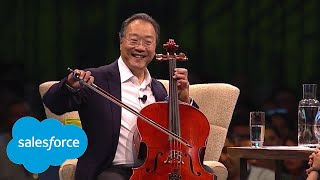
A recorded fireside chat at a Salesforce event where Yo-Yo Ma describes his two-year global project performing Bach's six cello suites across many communities, combining full-length concerts (about 2.5 hours) with local engagement and "days of action." The conversation covers why Bach is meaningful, how the tour visits places from major venues to border towns, Ma's musical beginnings (started cello at age 4), reflections on craft and purpose, and short live performances (including Soledad).
Questions this video answers
63
4
About two and a half hours
In August of last year
Six continents
Chapters
Good afternoon, everybody. I am thrilled to be here today to see all of you and to introduce to you a man who is a hero of mine. Please welcome to the stage Yo Yo Ma. I almost sat on the cello side.
So, Ladette, I just want to say one thing. Do you want to switch? This is a goat pillow and this is a teddy pillow.
I'll take the. Yeah, I'll take the bear pillow.
I'll be the goat.
Orange is my favorite color. Nice. I like that. Super comfortable. I did actually almost sit in your chair and then I realized, oh, I should not be sitting next to the cello. No, that should not be.
This was just, you know, it's a prop.
It is not a prop because we're going to ask you to play for us in just a little bit. How are you?
Great. Yeah, great.
You look great.
I'm so excited to talk with you because I have admired you forever more.
Are we rolling on this?
No, no.
More, more.
And to know that we will talk today is very exciting to me. But I promised the team that I won't ask you too many questions.
Okay, It's a deal. I'll ask you a lot of questions.
Okay.
You've been busy. What have you been up to?
I played with my grandchildren yesterday. We had Father's Day and that was wonderful. But otherwise I've been touring. Actually, I've been doing something that I love deeply because I have felt conflicted most of my life, saying I love doing certain things, I care about other things. The two don't go together. So what I've started doing is putting all of it into one activity for two years. And that has made me emotionally and intellectually and spiritually feeling no matter what hardship I go through, it's okay. Because what I'm doing is the right thing for me at this moment.
You're talking about your two year tour where you are taking Bach around the globe.
That's right. So you're thinking, well, why is that special? Or why is that different from what I've done in the past? Well, I don't know about you, but I don't know about any one of you, but whether you have bucket lists, whether you think that one day I would like to do this, I'm 63. And as a 63 year old, which.
Is young, by the way, for the.
Record, I don't have that much longer to live in terms of chronology. So one of the things I do know is as I get older, you care more about how you spend your time. And so I thought that the way I'd like to spend some, spend my time is to actually work in a way that I think music has always been ideally in my head, which is it's for everyone. But we know when we live in this world there are all kinds of, you know, categories, and we think in categories, we think in specialties. And it gets so sliced up that I think the very purpose of music or culture, things that we invented to give us a better understanding of ourselves and of our world, that should help us live. I started thinking, you know, I want to actually go to everywhere and see and bring the best that I can do and then talk to people, talk to people to find out what they're doing, why they're doing it, who's actually making a difference in their place. Maybe it could be in the border area or could be in areas where you're dealing with what's the thing that people want to talk about and to really spend time doing that. And I think I've been more fulfilled. I've learned more since the last maybe 11 months than I have in a really long time.
Wow. You kicked this off in August of last year. So you're coming up on almost a year of doing this and you've been to more than a dozen locations. And I guess it's a concert, but it's far more than a concert. Describe for people this two and a half hour musical session that also has a day of action. How do you pick where you're at going to go? What are the 36 cities? Do you know them all?
Well, I think we're going to. We know most of them. I think we're going to six continents. But we started in Red Rocks outside of Denver, which is one of those magical places. Red Rocks, Yay. And. But we've done things in, you know, in Cleveland, but then going into Youngstown, into Warren and working. They're to understand the pride and resilience that people feel in areas that may have even become economically challenged or devastated in some cases. But what is it that they're proud of and what sustains them?
Are you bringing art there or are you trying to learn from the people there?
I'm trying to learn from people there because I just bring what I do, which is I play this instrument. The Bach suites happen to be the greatest music written for this instrument. And playing all of them is really hard to do. But that's not why I'm doing it, because I think it's music that can be shared with everybody. But it doesn't mean you have to love it. But I'm there to actually get to know people. So in Flint, Michigan, you know, again, making a place where people made things for three generations, they wanted to say, I don't want you to come and visit and tell us or one tell us what to do or ask questions about our water. Because everybody comes and asks us about water. We want to show you what we do here, that what we've built and what culture has actually done to keep us together. And that actually makes us want to stay in Flint and not leave. And so those are some of the places I've really loved going to because I meet. And then there was a wonderful artist, Tunde Olanoran, who's a hip hop artist. And I've met him and we're going to work together. We're just going to.
And that's not everybody would say hip hop artists, cellists, we see an album in your future.
Does anybody have a problem with that? But, you know, I mean, we're both learning, right? I mean, and that's one of the things. This whole sales force, the couple days you're spending is about connections and making connections with people that I otherwise might not naturally meet. But because there's a drive to think about common purpose, social purpose, social impact. We got along like a house on fire. And we actually did record a track together the other day because he was in Boston, he was in town and. And I think it's going to be a good thing.
I love it. So talk to me about the Bach suites because they're notoriously difficult to perform. They last, your concert's about two and a half hours. I mean, it's very intense and long. Why? What message does Bach bring in those six disparate sort of suites?
Well, I think one of the things that I think that I love about Bach is that it's music that I have played for friends weddings and unfortunately also at their memorial services. Now, how could a piece of music encompass both? You probably know music that can do that. But. And I think music is something that actually, unless you want to say otherwise, I think music actually brings people together. It's a convener. So we invented music so it can bring people together. And I think Bach does it in a special way. I think of him as a scientist, composer. Why? You're looking at me like I'm crazy. I might be crazy, but I think in this case there's something to it in that imagine someone who is incredibly objective, just looks at everything and tries to just lay things out, but he's also, at the same time, totally empathetic to anything you are that you feel. So the scientist part of him holds you at arm's length. The empathetic part of him understands you. And he, in his music, does not put himself in the center. He is observing, commenting. So imagine that's, you know, in my mind, it's like a favorite uncle or aunt who does. But you could say anything to. But they will also say, you know, maybe when I was that age, I thought of this and that, and this is how I dealt with it. And you leave having a different perspective on the thing that you were concerned about.
I was a terrible flautist in school, so I'm curious, since I never really mastered Bach or anything at all. How do each of those cycles, how do they differ from each other? I mean, do they. Does each one tell a story? Is there a message in the first that's different from the second and different from the third?
I don't know if you're interested, but.
I'll give you some examples. Yeah, I think we're interested.
No, I mean, seriously. Okay, I'm going to play you five seconds of each suite and you'll tell me what you think. This is the first. Okay. That gives you a sense of what this is. This is number one, second one, Number two, number three, Number four, Number five, Sam. So each one is, I think, as different in character. For example, this one, Once upon a time, I thought, this reminds me of nature, infinite variety, because. And it's the same, But different. And so how can you code something that's infinite? I think Bach did it in the second suite. You know, I thought this is, you know, you feel always down. You try to go up, you end up going down. So the whole piece, each of the movements go down, but, you know, at the very end, after six movements, you have a. So you end up on a high note. So I think of that as someone that is looking for a bit of hope. So, you know, it's like that light at the end of the tunnel. You can be down and out, but at the end you can actually make it. So, I mean, I can go on and on and on with each one of these suites. And what I think is unusual is that in our days we were talking about identity politics before, as we are wont to do, because what else are we going to talk about? How that is incredibly prevalent today in our national conversation. And one of the things Bach did was that he took dances from everywhere around where he lived. So it could be an old German dance and then an Italian dance or French dance, and then a dance from Northern Africa that moved to Spain and then went to South America and then went to France. A Saraban, the heart of each suite. And then popular dances like minuets, berets, and ends with a jig, you know, Bach. A German composer living in a country that wasn't even existing as a country, writing music and putting together everything. And that's. We have the same thing that happens in jazz, we have this in rock music with the influences that come in to make something really special. Those of you in retail, you know that everything that you make comes from everywhere else, right? I mean, doesn't that. That's. And this was one inventor, one scientist, composer who created an organic whole out of a lot of different things, but it had a value and a particular purpose.
What has been the reaction when you have so far gone nationally and also to the border, which we'll talk about in a moment. What's the reaction when you play Bach for people?
You know, what's interesting is that we have all kinds of metrics that say, you can't do this here. You can't. You can't do that there. Nobody will.
No one will sit for two hours and 15 minutes of a musical concert.
Exactly. Think of the bathroom breaks. I mean, you know, get a life.
Can't happen.
Exactly. So, you know, they say that this is not possible. And yet we tried it out in a number of places. We tried it out at the Hollywood bowl, and what was amazing was 17,000 people actually paid attention because the intention was, I think, the right intention. I think that's part of it. I mean, you're smiling because you say, he's lying for you.
No, I'm not. I'm thinking. I wouldn't have said 17,000 people at the Hollywood bowl would be focused on Bach for two and a half hours.
We played it in. I played it in Bombay, in Mumbai. I've done it in, you know, in. While at the border, and I've done it in all kinds of places. In Mexico City, we were going to give a free concert in the plaza. Revolucion. The Revolucion. And it has about 5, 6, 7,000 people can be there. 27,000 people ended up showing up. It's a free concert. They were hanging from trees. I can't explain it because I've never really done that before. But I think part of it is it's about more than music. It is music, but it's about something else.
I think what's the something else, too?
I don't know. But I think it's what you do. It's about what made you decide to go and to go on your own and to do things that you really.
Care about, striking out and doing your.
Own and really caring about it. So it's not like that you're using all of your experience to put something together and say, you know, I don't have the metrics to say, oh, a couple million people will watch this thing that we just did on Puerto Rico because nobody's interested in Puerto Rico anymore. Well, that's not true. That's really not true.
Sort of bucking the conventional wisdom of how it has to be done. Why did you go to the border? I mean, nowadays going to the border is a very political act. And you held a concert, really, on both sides of the border. What was your intention? What did you want to say?
Well, I think the original plan is to actually go to borders and to understand what's happening at the edge between countries or between peoples, between languages, between cultures. And I think the edge is a really interesting place in science, in culture, in politics, in economic thinking. It's always places. It's the place where a lot of creativity happens. And we don't hear about all the things that happen at the edge, but we actually need to hear about what happens at the edge because then the center can make better decisions. And so I think I was going to go to the border between north and South Korea, between Israel and Lebanon, and between, you know, to many places to actually go and check it out. And so this edge, it was really interesting because the amount of traffic that happens between people who go to school, who work on either side is so huge. People routinely go to either side for schools. The mayors, the two mayors meet twice a week.
People on the border describe the border very differently than Washington, D.C. describes the border. Right. A completely different world.
You cannot. We have to resist reduction. We have to resist making things simple. The border is not a border. It's a lot of different things. So the place I was was separated by the Rio Grande and there was a bridge that is very much, you know, the things I learned. It's our second largest port in the United States after Los Angeles, more than New York port. It's over. You know that. Right. And I didn't know that. I thought Los Dos Laredos, you know, two little tiny towns. And so. But actually that amount of traffic and trucks go through. So it's a very different. It's very different being there. And that's been true, I think every time I've visited any place that I read about first. And then when you go there, you see a different.
When people would share on social media, it was interesting because they would just say, this is the border. And they'd show a shot of your concert. Right. Like you all are talking about the border, but this Yo Yo Ma is playing on the border, like this is the border. And it was a very different sense of what the narrative is around immigration or around the border or around this line that we have that I think becomes a prevailing conversation that's often filled with a lot of hostility.
Well, the thing is, I think we all know that people are much more complex than we make them out to be. So the people that are close to you, you see their complexity. But for someone who's 10,000 miles away, it's easy to say, to make a generalization about who they are, but they come closer, you see them as people, and suddenly they are infinitely interesting and complex. And so you can't make. It's very hard to make those types of generalizations.
How old were you when you started playing cello?
I was four.
What was the first song you played?
Well, actually, it was the very first thing I played for you.
That's the first thing you played as a four year old?
Yeah. And you know why? Because it was really simple to learn. So let me play for you the first eight notes. 1, 2, 3, 4, 5, 6, 7, 8. Okay, now I play this note once. I play this note three times. I play this note twice, and I play. I play this once. Does that add up to eight? It's over three strings. So a four year old, you can do. You can learn that in one day. You can learn that in.
You can learn that in one day. But we appreciate your optimism for the rest of us.
Look, three strings. You just move your bow, you take a finger off and then put it back again.
Why did you start playing cello?
Why? Because it was the biggest instrument.
I mean, did you have an interest or did your parents?
It was the biggest instrument I could play. I wanted to play the double bass. I was too little. I had big ambitions for big instruments. So this is, you know, so that was a compromise. I had to promise my parents not to go for anything bigger.
Did they know right away that you were a child prodigy?
Well, when they could see that, the next day, Just two notes, that's different. And the third day, There are about 42 bars in this piece. So in a little bit over a month, I learned this Whole piece. Now, that's not being a child prodigy. It's. Anybody can do it with a modicum of. Of neuromuscular flexibility. It's true. You shake your head. I taught someone how to play Happy Birthday on the piano by numbers the other day, and it worked, except I screwed up because there was one number that I was missing. But they did it, and he turned 60. That was his 60th birthday to himself. And so anybody can learn to play an instrument, but what's different is how you care about it, what you put into it. Because I had a teacher in college, a wonderful teacher, who said, yo, yo, you do okay, but you really. You don't know what you're doing, and you haven't found your voice. I said, I found my voice. What do you mean, you haven't found your voice? I'll give you 13 years to look for your voice, and maybe you'll find it. And I was thinking, what in the world does he mean by that? I play the cello and say no? He meant the way we talk about writers or branding or whatever, the identity of something that is that you cannot reduce any further. And that's the thing that you want to hold onto.
Did you know when you got it? Because there are people around you when you were very young who identified you as that? No.
The problem is this. I have a lot of problems, and some of the problems I was really good at solving. When I was seven, I could take something that was fairly difficult, and I would be on the school bus going to school, and I would solve it in my head. I could sort of imagine what it was like. So that's the kind of facility that's nice. But in college, this teacher said, you don't know what you're doing and you haven't found your voice. And another teacher would say, you know, it's really. It doesn't matter what you do. It's like, what are you advocating for? What's the composer's voice that you're trying to understand? Unless you can actually advocate for the composer, it doesn't matter what you do. You can show off. You can show that you're good, and it doesn't mean anything.
So there's a difference between being technically good and then the expert level is being able to elevate what the composer was trying to do.
Well, that's one way of looking at it. But then again, it's about. So we spend many years learning how to do something. And I always say that the thing that we never talk enough about in Music school is making sure that every person in the room is the most important person who teaches that. You know, I never had a teacher just say, you know, if you cannot. So the teachers are saying, do the composer bit or play the instrument bit and make it fantastic. Show how great the composer is. But how about how great you individually are and how different you are? You're not a generic group of 5,000 people. You're each individuals. And obviously, Salesforce is trying to get you to discuss things so that you feel there is a connection, that there's a connection that ties all of you together, no matter how different you are and what different places you are. That's a lifetime of work. What do you care about?
When did you figure it out? And was there a moment where you said, eureka, I have it now. I get the caring about it.
My problems go further. They go beyond college. Say, what happened then is we went to the same college and we actually compared notes. And there's one piece of wisdom that came out is that we both felt, meh. Like, yeah, some people love their calls. I felt like a misfit, you know, and obviously singing that is not a misfit.
No, same. I felt the same way.
But the thing is, you know, we.
Felt kind of like trying to find your place.
Yeah. But apparently a lot of people felt the same thing. So. Anyway. But my problems go further because I had tiger parents who. Two tiger parents. One, two, Add them. So my tiger parents said, you gotta do music, and this is what you do. And I was 4, you know, and I never felt I made a choice going to music. So I was always thinking I should be doing something else. And that's something else is the other part of what the Bach project is about, is about actually, you know, the social impact of actually what strengthens people, what gives people hope, legitimate hope. And it's not playing Bach for them to say, okay, here's a pill for hope, you know, it's more like, you have to know a lot more to be able to do. What Peter Segal said this morning to some of you says, how do you find your authentic self? Goes back to Leon Kirschner saying, you haven't found your voice. So that is what I struggled with until I was 49. Because when I was 49, I found finally, I'm a slow learner. Figured out that I could be doing all the things I'm interested in and be a musician at the same time. Because music is one lens from which you could actually go and explore everything.
It wasn't either or. It was all of them.
And, yes, up to a certain point, because now I'm actually. I feel I'm actually putting everything that I know to use for a particular purpose.
Do you have a favorite song that you like to perform?
Well, you know, I wanted to ask you whether you know this. Do you know the song? This song is Soledad.
It's such a sad song. It's so sad.
It is.
It's a.
It's a.
It's a heartbreaker.
And a wonderful guitarist who was Asto Piazzolla's best friend, Horacio Malvacino taught it to me. He said this was, you know, Piazzolla was in the depth of sadness. Soledad means lonely, right? Yes. And he. He just. That just came out. And I wanted to.
I love it. But it's such a sad song.
I always think, well, that doesn't matter.
I want. What's a happy song? That's your favorite song. Let's call that one Soledad.
So. All right, so I will actually play for you something that. That connects three people. Now, here it is. You all know who Duke Ellington was, and you all know who Aaron Copland was. And you also know who Gershwin was. Because if you fly on United Airlines. Okay, sorry. So you say these are three American originals. That what connects them? So I would venture to say there's one person that connects them, and it's the guy who wrote this. Sa. Sam. Beautiful. Okay, so.
How do they intersect?
All right, so the guy who wrote this piece, his name is Antonin Dvorak. He was invited by a lady, Mrs. Thurber, to come to leave Bohemia, the Czech Republic, Czechoslovakia, to go to New York in the 1890s to teach at a music school, which he did for, like, three years. And that's the only time he spent in the States. He came to Chicago for the Columbian Exposition in 1893. So it's the 400th anniversary of the Columbus voyage, plus one. And he taught students, and his students taught other students, and they were Duke Ellington, Aaron Copeland, and Gershwin. And you know what he said to them? He said, don't do what I do. Don't imitate me. Listen. Listen to what is around you. Listen to the music of the musics of Native Americans, of immigrants, of everybody. And then you'll know what to do. And that's the future of American music. And it took two generations for that to happen. So it's, you know, culture operates differently than, you know, a specific business plan. It took 40 years to measure the gravitational waves, and 1,000 physicists to do one measurement. 40 years. This is two generations. But the seeds that all of you plant is unbelievable because it's. But you can determine what seeds you choose to plant as a parent, as your mother, who was such a great influence as my parents, as tigerish as they were, they planted certain seeds that I rejected and other seeds that I thought really they were worthwhile. So that's the long term effect of what you individually and collectively can do, can connect generations and connect people of all kinds that are not part of your immediate necessarily, you know, grouping that we say it is.
How many Grammy Awards have you won?
I don't know, 19 something.
Yeah, yeah, 19, yeah.
But you know what? I love the Grammy Awards. I do not say anything bad about any award. It's wonderful to get awards. I hope everybody gets lots and big ones. You know, every brilliant.
Sometimes you get a Grammy, you get a Grammy, you get a Grammy.
Sometimes they're ugly, sometimes things fall apart sometimes, you know. But I hope you get lots of paper, you know, parchment can hang on your walls. It's all great. But you know what? I want to ask you something. What do you consider the most meaningful, successful moments of your life?
I'll answer that because I think it was what I was thinking about for the question I had for you is because for some people the award is the thing that it's a really important symbol of something that they've achieved in an album that they put out. I don't know. Once years ago when I was covering Hurricane Katrina, we had to live on the street on Canal street. And we were there for about a month and a half and then I'd swap with my co anchor and we were walking back in the early days through the Baton Rouge airport to fly home after two months and people gave us a standing ovation. And that was so much more meaningful to me than any award I've ever gotten. And awards are always delayed, right? They're always a year after you've done the thing. So you kind of don't really even remember a lot of the emotion around the project. But I think it was this idea that you could affect people that just random people in an airport felt like what you're doing matters. And so I was going to actually ask you that same question around. You know, getting Grammys obviously is huge and you had so many. But what's the thing that matters most to you in recognition? Is it cheers at the end of a performance? Is it just one person saying that they were moved?
Is it the big Award, I think so. I have several ways of answering that. The one thing I always say to people is, of all the things I've done appearing on Mr. Rogers Neighborhood, Sesame street and Arthur, I am proudest of. And the reason I say this is that when you appear on, let's say on Mr. Rogers neighborhood, you're going into a child's space. If they accept you, it's a permanent connection. I'm just a visitor in their space. They can say, yes, no, but they really like something about that thing that you do. 20, 30 years later, people will come and say, you know, I saw this and I started doing music because I just bugged the living day lives out of my parents until they finally gave me something that I wanted to do. And so that's so powerful, I cannot. You know, it's not about the applause. What does matter is making sure that people in the room are incredibly important. Because I think success to me is not. Is actually has something to do with education. And it has a lot to do with the idea of education and performance being memorable. Because if you guys forget, like, what you did today, tomorrow, what was the point? Right, honey? What did we do yesterday? And it's the same thing with education. If you get an award but you don't remember what it was about, then something's missing. So somehow, for me, what is important is that some people take just anything away from, let's say, a gathering like this, and you just connect to something else. So it's not like it stays in your mind, but you tell a friend about something, you've actually furthered that connection.
What makes it sticky?
Yes. The stickiness of it. And it's about living material. It's not about, oh, I absorbed this. Now I know I did Paris in two days. It's not about that. It's about somehow you had that experience and you drank in that experience, and it's now making you think differently about how you drink a glass of water. You know, then that's success for me.
What's the toughest piece to play on the cello?
Soledad for you?
What's a tricky one? That's. That's really hard, that when you master it, everybody says, that's it. You're an expert.
Okay, so here's. You know, and I'm not trying to be Pollyanna ish. But everything is hard until it isn't. Everything is strange until you make it your own. And this is what I love about things, like people who can tell stories and make me empathetic to the story. You are describing. And this is something that I think a lot about. And then I'm trying to think of what's really hard that I'm. So. I need some time. So here's something that I think is really interesting about playing music. You can be very analytical about it, or you could just open your heart and absorb and feel. It's almost impossible to do both at the same time. One neural pathway shuts down the other. But yet, when you make decisions, or I make decisions while I'm playing a piece, I have to do both in order to make good decisions.
So then do you toggle back and forth between heart being open and playing emotionally and then technical mastery?
Yeah. It's like being a mother.
I'm not sure how me having a big glass of wine at the end of the night has anything to do. I'm kidding.
No. But it's about shifting back and forth constantly so that you. I really believe that.
Right. Navigating the two spaces.
Yeah. And so that's. So you want to be present. Totally present. But that's what cultivation is all about, is you cultivate yourself so that you can do those things. I think. Right. It's like I'm a terrible time manager. I can't figure out what. I need people to help me because I get overwhelmed. I stop using my analytical skills, and then I get paralyzed. So, you know, I'm still thinking, but. I'd like to try something, So I'd like to. How much time do we have?
12 minutes.
Okay.
But I think take as long as you like.
No, no, no, no, no. I'd like. Since this is. Since this whole hour is about, you know, business as a platform for change, and we're thinking about this. I'm thinking that one of the things that I've been hearing is that a lot of people trust businesses more. As certain other parts of our world.
Are failing, institutions are losing trust.
That's right.
Business is growing in trust, which is.
Really interesting, because I would have thought that in culture, the currency of culture is trust, because it's about understanding, and it's common understanding that we can rely on from which we can build things, whether it's in science or whether it's in music, whether it's in the social sciences or whether, whatever it is, it's about building blocks of trust that. Oh, I get it. You think this way and you think this way. I get it. We can work together, because I know how this goes. So as business is moving towards gaining more trust from clients and customers and cultures, I Think the fundamental part of culture is always about the creation of values. Right. And if business is actually creating value and we want politics to do that too. But I think a lot of people are very worried and so what can we do? And I think Salesforce is a great company to actually start from the very beginning. DNA the one, one, one thing. That's really admirable. I want to do a one, one one thing for me so that I feel like I'm being responsible. But I think what I'd like to. Maybe, you know what, I changed my mind. I'd like to play for you a piece of music that I actually played for the baptism of my second grandchild because, you know, again, it's an almond of the sixth suite, but it is, it's very multi layered and it has, I think a lot of hope in it. So here it is. Sa.
You've teed me up to ask you about hope. Are you an optimistic person? Would you describe yourself that way? Realist? Optimistic.
I make myself optimistic. You make yourself an everyday decision every day. What about you?
Yeah, I think I'm a naturally optimistic person. I think sometimes you have to try hard at it. But it makes me remember how much music reminds you to be optimistic.
That's interesting. I think family reminds me to be optimistic. You know, I think first of all, if you have little kids, you can't say, don't come to me, daddy's depressed. It doesn't work. And it's, I think, you know, having people to care about makes you optimistic. It makes you want to live. You.
You've recorded the Bach suites several times. You did in the 80s, right, when you were in your 20s and then again 15 years later or so in the 90s and now again as you take it on the road, if I were to listen to each of those recordings, would I be able to say, wow, the difference from your 20s into 15 years later is I can hear it. And the difference from the 20s to now, it's. I can hear it. What changes over time?
Well, I think, you know, I was giving you a sample of what I might have sounded like as a four year old playing.
We think that sounds amazing.
You know, it's accurate. Oh, it's, you know, everything is good. But remember I started talking to you about. We're talking about the infinite variety of what can happen. So I started playing with Mark O', Connor, Edgar Meyer in the 80s who. And Mark O' Connor is a great fiddler and one of the things. Yeah, right. You love Mark o'. Connor. And he plays the violin differently than what other violinists play. First of all, he sometimes shortens the bow where he plays this way, or he holds the bow very differently. And if you shorten the bow, what you can do is, you know, you can play faster, you can play with less sound. And so part of the second recording was to experiment with what we learned from fiddling tradition, which is transnational. 500 years of essentially, note for note, transferring music from parent to child, from parent to child, and which matches the time period when people were playing instruments of which we don't have recordings for. And by shortening the bow. So it's an engineering kind of thing. What does it do? It goes from being able to play. Full out loud to playing Lego. And very different from. You can start to hear much more variety. It's like seeing, you know, a photo of a tree in the morning, and the light is about to strike it, and it's beautiful, but suddenly you see a film of it, and it's like you see the light playing with the leaves all over the place. And I think now I've kind of reverted back. I've learned what I can do from a shorter stake. So this is one example. And now I'm playing sort of in a more traditional way, but I can incorporate it. I'm gonna play. Sa.
Yo Yo Ma, the master. What an honor. What an honor, and what a pleasure.
Thank you. Thank you.
Thank you for the conversation and also the performance. It was phenomenal. Thank you.
Thank you so much. You know, this is so great to meet you.
My pleasure was mine.
All of you, thank you. Have a wonderful couple days. And Soledad is so wonderful to be with you. Thank you.
The greatest experience of my life.









