Ford’s Electric Car Future with Jim Farley - Ep8 | The Inflection Point | Salesforce
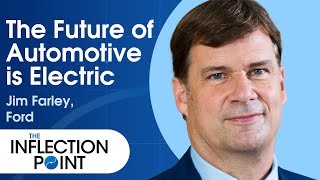
Jim Farley, Ford's CEO, talks about electrifying the Mustang and F-150, the infrastructure and labor challenges ahead, and how Ford is using vehicle data to serve commercial customers. He also discusses his family's car obsession and his cousin Chris Farley.
Questions this video answers
110 years
Stock went from $1 to $15
Months
Chapters
Some people were born to do one unique thing. And Jim Farley was born to leave Ford. I saw a media report that called you the coolest CEO in the world. His grandfather worked for Henry Ford and helped build the Model T. We've been.
In business for 110 years more.
When Jim spent time with his grandfather, they didn't play ball or read Dr. Seuss. They read car magazines. Now those same car magazines are talking about Jim and his new role as Ford CEO. That's because Jim Farley is transforming Ford.
You know, I came to Ford to serve other people. I didn't want to be a generation of people that saw Ford fail.
As the daughter of a Ford dealer in Knoxville, Tennessee, I can tell you this is not your grandfather's blue oval. I am so happy to have Jim Farley on the inflection point. Welcome, Jim.
Good to see you, Monica.
This show is called the Inflection Point. So I want to ask you, what was your inflection point? Is there a moment in your life when everything changed and it made such an impact on your life? You can say that made a difference to me?
Yeah. It happened in an interview. I remember after 20 years at Toyota, I joined Ford. We turned around the company. The Stock went from a dollar to $15, and I started to get a lot of offers. And I was in an interview with the founder of a tech company, and he turned to me and goes, why are you in the auto industry? You should come to our businesses a lot sooner. Simpler. That's just such a hard business. And I remember going back to my hotel room and thinking, I do not want to take the easy way. I want to take the hard way. I want to surf forward, even if it's difficult. And it turned out to be difficult many years, our stock price floundered again, and we had to kind of redo the company again. But I committed there and then. That was an inflection point that I wanted to follow my heart.
Wow, that is profound because you do love cars and you love Ford. You were called Jimmy Car car as a baby. Now, did that start with your grandfather, who we know was, you know, an early employee at Ford working on the Model T for Henry Ford? Or did you just love all things on wheels?
Yes, it was very much my grandfather. I got really close to him. And like a lot of us grandparents have freedoms that parents don't have. And my dad was a banker. And so, you know, I'd watch a NASCAR race or something. He'd get mad at me and say, you know, I Want you. I don't want you to do that. Which incentivized me even more. And then I had a breakthrough where I got to work for Phil Hill to put myself to graduate school at UCLA. And while I was getting my MBA and I worked in his shop restoring old 1920s and 30s cars. And I really just loved that job more than any job I ever had. You know, at that point, I kind of decided, hey, this is what I want to do for the rest of my life.
That wasn't when you drove a car illegally across the country?
No, I was a little bit younger. And you're right. I bought a Mustang when I was 14, and I lived in the back of it and restored it over the summer. And then I used my airplane ticket I traded in to for gas money to make it across the country back to Michigan. And yes, I didn't have my license or insurance or even a spare tire, but it was a great two days.
This is so funny that your dad didn't even want you watching NASCAR races, because as a kid, I used to go to NASCAR races, not just watch them. Remember my dad's dealership, Talladega Ford? I know East Tennessee Motor Company used to sponsor David Pearson, and I used to go to those races. But you didn't just watch them on tv. Then you started racing cars. And shortly after you became the CEO, you won an endurance race against teams and you raced solo. And now you're preparing to race in Le Mans. Right. So why do you keep racing? You are the CEO of a Fortune 12 company now.
I think, first of all, I love competing, and racing allows me to do that. It's my main hobby. You know, some people have golf or tennis or running. For me, it's racing. Cause it's my yoga. Like when I get out of the race car and I concentrated that hard for a couple hours or even during a test, I forget about everything. I feel so relaxed and rejuvenated. It's like a week vacation in the Bahamas to me. I just feel so refreshed, ready to go back to work. And, you know, being a racer, working on the car allows me to stay really connected with what we do. And the people in the company and they see me as one of, you know, that we're on the same team, so to speak, and we. We're in it for the love of it.
When Bill Ford offered you the job as the CEO, did you have one condition to him?
I did. I said, hey, Bill, about the racing. And he goes, I like a CEO with petrol in his brain and his veins. I was like, so we're good? He's like, yeah, yeah. Boy, was that a lift up my shoulders. I got on the immediately on the phone with my race team and said, we're good, we're okay.
So you knew you had to have that racing in your life.
Yeah. I mean, I hate to say it, but I think there are things you gotta stick up for, whether it's your family or your loved ones or, you know, your hobbies. When it's all said and done, you know, you have to have who you are, you have to feed what makes you you. And that's one of the things that makes me me.
This shows your longtime love and so many Ford customers, longtime love with the internal combustion engine. But now at Ford as a CEO, you're actually leading the electric revolution.
Despite Bill Ford being frankly, head of the whole industry and being a spokesperson for environmentalism for more than two decades now.
Exactly.
You know, the management team finally caught up with Bill. Our strategy is to electrify our most iconic products like Mustang or F150. And I would say, as someone who's grown up in the car business, an electric car is just a better car.
To hear you say the electric car is a better car is kind of shocking. Why is it?
Yeah, I had to get there myself too. But, you know, I think if you are just objective about it, for a lot of people, not everyone, but a lot of people, it's got more interior, room for the same amount of overall length. Also, you remove 40% of the moving parts and the parts you're removing are the most complicated, most expensive ones to repair, like engine and transmission, they're gone. So it's a much simpler vehicle. It's a much more simple vehicle to make. It's also a digital vehicle, so you can update it or over the air. You don't always have to come into a dealership to get it changed or improved. Now, for someone who lives in rural Texas who wants 800 mile range, yeah, probably not the best solution. But for a lot of customers who use their vehicles, you know, maximum a couple hundred miles, it's actually a great solution.
And the trend is going electric. Right. We had California really first at that. California Governor Newsom praised Ford as being early on with supporting the electric electric vehicle. And now with the Biden administration, they've rejoined the Paris climate Accords and Biden has come out now and said he wants the government fleet to be electric. So my question to you is, Jim, what does this mean for Ford? Your customers and the planet.
So it's a really big deal for. For all the OEMs to get serious about electric cars. And, you know, our strategy is different. And we were the only brand, except for a few others that committed to the Paris Accord and California as one national Standard across the U.S. you're absolutely right, and that fits our values. But there are a lot of business challenges too, because it doesn't break as much. Actually, the easiest part is getting the electric vehicles developed and bought by consumers. The harder part is all the second tier effects, like building out the infrastructure, especially for commercial customers. Also, the labor tails, you know, these vehicles are simpler to make, and that means if we don't do anything special, a lot of people will lose their jobs in our manufacturing.
The business part of this is more complicated in actuality.
Absolutely. Because, you know, we've been in business for 110 years more, and we are a family company and, you know, we have to figure out how vertically integrated we want to be. Do we go into cell production? That that would allow a lot of labor to come over, from making engines and transmissions over to making the electric vehicles. Even though the assembly of the vehicle is much simpler and requires less labor. We can find other jobs for the same people. But to do that, we have to work with government and regulators to make those opportunities available. Most of the battery technology comes from Asia, and so we have to build large battery production facilities in the US and we want to do that with US Workers. And so there's a huge transition. And a lot of people don't know this about Ford. We have more American hourly workers than any other car company. We have more vehicles made in America. A lot of other people moved to Mexico and Canada and other places. We didn't. And so we think about this maybe more than others, because we are the leader in American jobs, and the cell production is a big decision.
Wow. So you have even more on your plate than I thought. I know. Even though you're the CEO, you got into the design of the Mustang Mach E a little bit, or maybe a lot. And the new Bronco sport that everyone is excited about, and they're both getting rave reviews. But you also are just as ecstatic when you talk about a product line that's not nearly as sexy. That is the commercial vehicle. I've heard you talk passionately about the small businesses that use your commercial vans. The florists, the electricians, the plumbers. Why is that? What was your light bulb moment that got you excited about this?
There was a gentleman. He was a plumber and he was saying, you know why he loves his job. And he was basically saying, look, people don't notice me, but I'm building a cathedral. I make my town run. And I started to think, you know, all those white trucks out there and vans that we all take for granted, that we don't even look at are really the things that keep our communities running. The police cars, the ambulances, 50% of those are Fords. And why, why as an organization should we feel so much better about a sports car than that plumber's truck?
Now what you're doing is you're bringing connectivity to these business customers. Now this is a whole new way to make small businesses more productive.
Yeah, absolutely. So light bulb moment for me to go back to. The theme of your show is I was in the UK listening to some of our small business owners and they started to describe their relationship with the data coming off the vehicles. I said, oh my God, these people like the data more than the vehicle. It was a huge eye opener for me that for commercial customers, if we can connect the vehicles and use the data off the connected vehicles to find error codes, we can make the quality better. We give the data for the customers so they can teach their drivers how to drive better. If we censor the vehicle and use the data off the vehicle, we could literally change the cost for these customers in a way that the product couldn't. So this is a game changer. In fact, I would say I thought the electric car was going to be the coolest thing happened in my career. I was wrong. It's the connected data vehicle is really the game changer in our industry.
Okay, so you're doing all these bold moves at Ford and it seems that you are taking Ford from an auto manufacturer. It still is. But to an E mobility company. Is that the goal here?
Yes, I think it is. And I would say from a product company to a service enabled by software and products company. The way we're changing is I would kind of draw the analogy to when mobile came to the baby bells. You had people who had real profitable landline business and they had a transition to wireless. We're kind of at the same point now where these battery electric digital vehicles are kind of our equivalent of the wireless business.
So. But this is all futuristic. This is inspiring. But you also are making some hard calls since you took over some really tough decisions. You shuffled your executive ranks and retired several top executives. You also are restructuring global operations and you closed some factories in Brazil. So is this your way that you're driven to make Ford profitable. I mean, what are you doing? You're rocking things out.
Yeah. I would say, look, we don't have any more time. Our equivalent of the wireless business is here right now, and we're out of time. The bottom line is it's time to be decisive. We have three parts of our plan. We have to get our automotive operations to be sustainably profitable because that funds everything. We then have to modernize that, like battery, electrics, data and software first and services first. And then we have to actually disrupt ourselves. We have to literally disrupt the idea of personal ownership of vehicles.
Well, obviously Wall street is in love with you. I mean, your stock is surging, and they love that you're willing to make the hard calls as well as the plans for the future. So while you're transforming, Ford, the industry at large is under a great transformation too. I mean, do you think dealers or going to exist in the future?
I do, but it'll be different, you know, if you look at what, how Target adapted to its competitive model with Amazon. You know, I think our business, when you crash a commercial vehicle or when you have physical repair to a vehicle, you know, I have to physically go do that somewhere. But I do believe the model is going to change a lot. Yes. We will have e commerce platforms. It'll be kind of a mix of in person and digital. We learned that from COVID We actually did. Like 90% of our sales were, you know, docusign documents, mobile pickup delivery of people's homes. And people liked it.
Yeah, exactly.
So it was a real kind of breakthrough moment.
Now, let's talk about your charity. You and I texted last weekend and you had just come in. It was 18 degrees in Detroit and you had been at the Pope Francis Center. I think you had been volunteering to help the homeless. Tell me what you were doing.
Yeah, so I always give out socks and medication and get people's mail. Cause it allows me to talk to the homeless one on one and connect with them. Last year in Detroit, there was, I counted about five people that I knew that passed away in the cold, froze to death. The people here, you know, they put their life at risk every winter living outdoors.
Exactly. That's eye opening. Let me ask you a question. As the CEO of Ford in a position of power, why do you think it's important to lead by example?
I think it's part of the culture at Ford. Like we're a company where people volunteer without being asked. We had people driving to South Dakota to make ventilators and they volunteered. No one asked them in the company we just made available. Hey, 3M needs 100 people from Ford. If you're a process engineer in a manufacturing, they need manufacturing expertise to make more ventilators. They need to 10x the output. You know, people drove to South Dakota in the middle of winter and stayed in their trucks overnight for weeks and weeks, because that's what kind of company we are. I grew up in a family where you're not just there to consume, you're there to help other people. And that sense of service to the Ford employees or to the community of Detroit doesn't stop when you're the CEO. In fact, it becomes more important because, you know, as a CEO, everyone tells me how great everything's going. But when I'm handing out socks at the Pope Francis center, you know, I see things and myself a little clear.
Let's talk about one subject that is a little touchy, but I think we can talk about it. It's not a secret that Chris Farley, the famous Saturday Night Live comedian and the actor, was your cousin. Can you tell me a little bit about Chris and your time with him?
Chris is very unique in our family. You know, we all pick our own things, and we go deep. If you're gonna pick something, do it well. And he was very good at making people laugh. He was a professional at it. And I loved Chris. You know, he brought joy to so many people. And I love being around him. Cause he was in person. He was just like he was on the set of Saturday Night Live. And his whole family are just terrific. Both of his brothers are comedians still to this day. And so comedy is a big part of our big, loud family. We love laughing together. And Chris was the ringmaster.
But you also watched him struggle with addiction.
Yeah, I think we're all surrounded by addiction one way or the other. And, you know, it's a humbling experience watching someone so talented, you know, do what they do. And I have to say, you know, those were Chris's choices. On the other hand, you know, we have to be very empathetic and be there for those people in our lives. And it was so much fun to see Chris excel at what he loved a little bit. Kind of like me in the car business, you know, he was great at what he did, and he loved every day of it.
Now, one last thing before you go. As you know, since I'm a daughter of a Ford dealer, I was fortunate enough to have a Mustang as my first car. Now, after this conversation, I'm thinking I need a Mustang Mach E and I've even pulled the specs on an all black one that I think looks pretty cool for me. As you see, I'm in all black. So what I want to know is there's a waiting list. How long do I have to wait before I can get a Mustang Mach E?
We'll take care of it, Monica. We'll take care of it for you.
No, seriously, how long is the waiting list?
Months.
My 22 year old daughter's like, I might want a Bronco sport. I'm like, oh my God, we're all about Ford now. So you're hitting different generations.
Yeah. Our products or services, they have to be vehicles or services that people can't live without. And I know it's important to our employees to have a leader of an organization who loves the product.
Listen, Jim, I believe you were born to lead forward, starting with your grandfather raising you to love it. And I thank you so much for being with us today. It's been inspirational and enlightening and fun.
Thank you, Monica. You're the best. I had a lot of fun today and thank you so much for giving us the opportunity to tell a story of a company in Detroit.
Thank you, Jim. Next time on the Inflection Point, I'm joined by Frank Slootman, the CEO of Snowflake. What was it about Snowflake that got you there?
It was producing orders of magnitude faster results, you know, 10 times, 100 times. So this was revolutionary.
A hallmark of your management style is no bs.
I get hired not for people's health. But they need change and they need results. So I can't mess around. You?
Frank Slootman, retired.
I've been under the gun from the age of six, you know, on. I absolutely knew that I was burned out. And in order to recover from that, that just takes.









