From Athlete to Advocate with World Champions Megan Rapinoe and Ibtihaj Muhammad | Salesforce
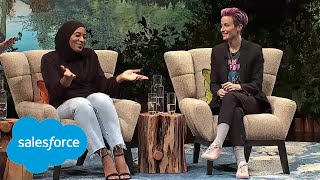
Megan Rapinoe and Ibtihaj Muhammad discuss how their athletic careers shaped their activism. Rapinoe fought for equal pay after winning the World Cup. Muhammad launched Luella, a modest clothing line, to fill a gap she couldn't find as a Muslim athlete.
Chapters
At a very young age, we learn.
To make a distinction between you and me. Simple, right?
But what if somehow.
What if somehow I could see the world from your perspective and you could.
See it from mine?
Think for a second. I know all your hopes and dreams.
You know what it's like to have a daughter who struggles with is she black enough? Is she white enough? You would know what it's like to not have enough confidence to express your ideas.
You'd know what it would be like for people to take your culture and turn it into a theme party. You would know that every time that you say you have a husband, people.
Pause to be gender non conforming, to.
Be comfortable being uncomfortable. At a lot of times. You know what it's like to lose your little brother to hiv. You know that there is struggle and pain, but also a lot of hope.
And suddenly, suddenly and suddenly we would.
See that although our lives are very different, they are also very much the same.
And that bigger than you and me is us, Navo.
And as us, we know this. You don't look like us, worship like us, live like us, or love like us, to stand with us. Of course, you'll always be you and I'll always be me.
But there's nothing stopping us.
There's nothing stopping us.
There's nothing stopping us. There's nothing stopping us from becoming us. We're stronger as us.
We're stronger as allies.
Please welcome Chief people Officer Time.
Sue. Sue.
Hi.
Hi, everyone.
You know, sports metaphors are often used when we talk about equality. And perhaps none more than we need to level the playing field. But let's think about that for a moment. Leveling the playing field assumes a lot of things. It assumes you know where that playing field is, you know how to find it, how to get there. People on the playing field who may have gotten there before you have invited you on to play and they've invited you as an equal, not as a favor. And once you're there, you're given a shot, they pass you the ball. And the fans who are all around are cheering, not just for some of you on the field, but they're cheering for all of you. So a lot has to happen if we think about that playing field. And most of all, you don't want to find out that just around the corner, right out of your line of sight, there's another field. Wait a minute, how'd that happen? And the grass is literally greener on that field. Wait a minute. And you know what? You didn't know about that field because you weren't invited. No one told you about it. And it turns out they were playing a totally different game on that field. So one of the things I love most about sports is that it represents the optimism of humanity renewed over and over and over again. You lost your game yesterday. You know what? You're going to win that game today and you're going to win that game tomorrow. So today, speaking of today, we have the amazing opportunity to hear from two powerful optimists who decided, you know what, maybe waiting for that invitation to whatever other field there is, I don't know if that's going to work. We are inspired every single day by how they show up in the world. And we're thrilled that they've shown up here with us on this stage. So please welcome champions on and off the field, Ibtihaj Muhammad and Megan Rapinoe. Awesome.
Great. Absolutely.
Oh, my God.
Woo.
This is awesome. It's just like the Olympics right here. We're cheering.
This is basically what it's like.
It's basically what it's like. I'm actually super psyched that we are here at something called Dreamforce, because it really is. You are the personification of the force of your dreams, really creating the reality that you've made for yourself, the progress that you've helped push forward, how you've shown up, and the wins and the victories both on and off the field. So I'd love to hear a little bit more about how that all got started. So, uptaj, why don't we start with you? How did the fencing journey begin?
I grew up in New Jersey, about 30 minutes outside of. Are you from Jersey? Yes, I am. Very exciting.
Woo.
Who else?
Jersey.
There's a lot of ice. You're very excited. Very great. I grew up about 30 minutes outside of New York City, Maplewood, New Jersey. And our family, my parents just really pushed this idea of sports. We didn't have much of a choice. It was like, which sport do you want to play? And as a Muslim kid who would eventually wear hijab, and it was really difficult, this idea of uniform. For me, when we think of the uniform and what that means, there's this idea of unity. It kind of creates this family, like, bond. And for me, as a kid, I didn't have that because I was always adding something to it to make it more modest. And at 12, I discovered fencing. I was at a stoplight. My mom and I saw fencing in a school cafeteria. My mom said, don't know what that is, but I want you to try it out and the rest is kind of history. I went to the Olympics after that.
That's what normally happens when I go to the grocery store as well. It's amazing. And what about what your mom saw in the window? Said I'm going to find out more about that.
Well, she probably got tired of going to the sporting goods store to add stuff to your form. But it was really this unique opportunity for me as a young athlete to participate in a sport that uniquely accommodated my religious belief. That was the first time I really felt a part of a team. I was 12 when I started fencing and I didn't know that there would be opportunity for me in sport where people didn't see me for being African American or didn't see me for being Muslim, or didn't see me for being a girl. It was really just about, could you win? And so my mask, once I put my mask on, I kind of felt like a superhero in a way because it was really like, how hard can you work and can you win?
That's awesome. And Megan, how about you take it.
All the way back?
All the way back.
We're going all the way back.
I mean, I think the catalyst. I'm one of six kids. I'm a twin and we're the youngest. The brother above us is five years older. So I think probably as a babysitting mechanism, we were dragged everywhere. One of the places we were dragged was soccer fields. My older brother played Brian. So I think having a built in buddy right on the side where my mom could just be like, do her thing over there. Brother was practicing and we kind of fell in love with it from there and then obviously progressed from there. But I think it was just being able to play and kind of having that freedom and having someone that you could actually play with kind of was the catalyst of loving the game, I guess.
Both of you have spoken so powerfully about team and what that means and how you show up for each other, including, you know, once you're there, it really is, can you win versus what do you look like and where do you come from? How do you. In a world in which we have this amazing opportunity to stand up for things we believe in, how do you balance both being seen for who you are and what you're proud of, as well as stepping on that field, letting that all go and letting the actions speak for themselves.
I don't really try to balance it. Yeah, I love it. Yeah. I don't think you need to. Like, it's funny you talk about the idea of a uniform. And like, I always hate uniforms. Like, I love you, Nike, but like, I hate the idea of a uniform. The thought of 20 people all wearing the exact same thing at the same time in the same way. And like, they never want modifications like the, you know, the they, the people or whatever. And it's just like, why can't you bring your own personal style to it and just like express yourself in some sort of uniformity, but just express yourself in the way that you want to or that you see fit. And I think I take that, you know, to your question. I don't really try to balance it all. Obviously I have to wear a uniform while we're out there and you are part of a team. But I think for us, at least on the national team, we would much prefer everybody's personalities to be out there front and center, understanding that when we let everyone free and let everyone just be themselves and that's how we get the best out of the team. So I don't really think about like, oh, now I'm on the field, or now I'm doing a speech or now I'm here or whatever. I'd probably lose track and do something wrong. So I figured I'd just. It's all the same thing. To me. You're just representing yourself, you're representing your country. I think if you're authentic and you're coming from that place all the time, then it really doesn't matter what space you're in or where you're at, you just get to live.
Yeah, Love that.
Yeah. I think that it's that opportunity that exists to just kind of go out there, you show up, you bring whatever your best attribute is to the field of play. And I think that that's one of the. The, to me, that's the highlight of being part of a team. Right. You can especially, like in my sport where we're facing these three other people and there's just three of us on the team are facing these three other athletes. And you're going to have an easier time with some countries or some athletes versus others, but you always show up for one another. And if you have like. And as we know, sports happen in ebbs and flows and you may have like a down moment, you may not have the best day, but maybe your teammate shows up that day. And it's not about, like you said, where you're from or this identity that you necessarily bring to the field of play. And I feel like if you, for me, if I did bring that with me all the time, it would almost feel like a weight I would have to carry around. And I think that sport gives me the opportunity to just go out there and, I don't know, live my best life through expressing myself, I guess, with a weapon in my hand.
Right. You are a superhero.
Obviously.
It's interesting. I mean, I. It's incredibly inspiring to hear how you stand up and bring your fullest self. And that's what it's all about. And I think for those of us or those who might be in the audience or watching, who may not have that courage or might be scared, I remember growing up as a little kid having that same feeling, having been told by other people of color, yeah, you know, Asians don't really count. Or like, you know, you. How do you. What kind of advice would you give to, you know, children growing up or seeing you and seeing how you're showing up in the world? How did you know how amazing that they have this moment to be able to watch that? What kind of advice would you give to them?
I mean, I lived for Megan during the World cup as, like, all of us did.
Right. But I think.
But you know what? I think to me, the highlight was just to see this expression of unapologetic self.
Yeah.
And it's such a freeing thing to make this decision that I don't care what you think. I don't care what you think. I don't care what you think. This is who I am. You can accept it or you can not, but actually we don't care. And I feel like that was something that for me, I had to switch as a kid because I was bullied. And I was so often made to feel like a square fitting in circle spaces for a multitude of reasons. Sometimes it's about my skin, sometimes it's about my hijab. And I was just like, you know what? This is ridiculous. I'm just going to. I'm going to be myself. And I actually don't care what you think. And this is why I live for you during the World Cup. I mean, in general, but also, I just love people. I just love the idea of people just going out there and being like, actually, this is who I am. And we don't you to like it. And that's okay.
Yep.
Yeah.
Love it. And I think, you know, and you both talk about being allies and we, you know, we just saw that wonderful video and I think we've got amazing allies in the audience both, you know, from all over the world. I think the Kohana is here, and I think we have Faithforce also here and around the world. Salesforce has done a great job about, you know, building those communities and really helping everyone support each other. And what does that look like for you off the field? You know, do people ask you those questions? Something we think about is, now that you've had success, people are always reaching out to you, right? Wanting a little bit of a piece of you. And what is that? What does that feel like in terms of asking people to show up for each other? How do you pay that forward in a way that empowers everyone to actually show up for others? How does that look like for you?
I think just touching a little bit on what Abdi was saying about kind of not caring, and I think it's easier to do that when you're in the majority group. I think it's easier for me to do that in ways I'm not constantly being harassed about my hijab or my skin color or whatever it may be. And I think four people in the majority group, like, I was watching the video, and it just kind of struck me because we always say, like, oh, you know, you can't understand someone's, you know, someone else's perspective or whatever. But it's like, you know what? I think you kind of can, like, you just believe the person that's saying it. You know, it's like, yeah, it's like, yeah, so it's like, I don't need to, like, wear, you know, hijab or to understand exactly what it's like to be Muslim or a person of color and to just be like, whatever, cool, I got you. And then I'll stick up for you in all of these other spaces where maybe you aren't in or you don't have access to or these are the people that are bullying you. Like, that's our job as an ally, as a person in the majority, in some sort of way, is to kind of, like, collect and correct our own people and to signal to people that maybe are different or whatever. It's like, you're actually not that different. Like, I don't need to personally understand it to the nth degree to understand it and to validate it and just be like, cool, I got you. And now we're just humans. So I feel like that's the way I show up as an ally is to, like, listen and actually believe what people are saying, Because I always feel like if you're not totally down with it or you can't understand the perspective I'm like, well, they just told you, right? You either didn't listen or you don't believe it, or you're not validating it. And those things for me are just really easy things. Like, if I believe Ipti, then I do understand, and I can have that empathy, and then I can change my behavior and change the behavior of people around me and signal to other people, like, this is how we're gonna interact together and this is how we're gonna treat each other. So I feel like being a white person is like, we just need to signal to not only people who may be different in some kind of way, but also to ourselves and to the people around us. This is how this is gonna go down. Not any other way.
Right? My word, Megan. Yeah.
And thinking about representation, how we show up for each other. Both of you have done a lot off the field and recently, congratulations again on the clothing line that you rolled out this week.
We got a collab in the mix. I know we've got a collab.
And you've had a collab for a couple years now, right, Luella? So, Luella and Reink, that we're announcing today that we're going to do a collaboration, right, guys, you heard it here first.
You heard it here first.
There's going to be a collaboration.
It's all happening.
And so. But tell me why? What did it mean for you to choose clothing? What did it mean for you to choose something that's so personal and representative of how you show up every day?
Well, I feel I've always, I think, been a bit of a problem solver, and I have no background in clothing or business or anything like that. But I knew that there was a void within the modest fashion community. If you wanted to find a long sleeve, floor length dress here in the United States, you are often ordering it from overseas, paying, like, exorbitant shipping fees, whatever. If you did find companies here, there were things that were a bit dowdy or dark, maybe something your grandma would wear. So not fashionable. And that's where Luella comes in. We manufacture everything here in the United States. We work with female manufacturers that employ women, so we feel like we're a conscious clothing line at the same time. And we will try to keep everything super affordable, but also fashionable and again, modest. So I feel like it was providing something to a community that I'm a part of. Like, as a kid, I didn't have the opportunity to buy clothes like this. It was really hard to find. I was always layering from, like, these really cheap stores and Fast fashion. And I just wanted to be a part of the change.
Well, it's like, it's all about, like, representation, right? Everybody always says that, like, we gotta have representation. But, like, what does that actually mean? That means, like, not being able to find something cute because no one thought of it, because no one's in the room. So, like, we kind of had the same sort of feeling. Like, we, you know, Reink will start in clothing and hopefully branch off to many things, but we're kind of like, why can't I find a dope pair of sweatpants that actually fit me? Like, I don't fit men's extra small. My hips are not this wide, and my shoulders are not this wide. So, like, trying to, you know, represent something in the culture and in, you know, clothing, it's something that every, you know, it's like one of the things that every single person pretty much on this planet does every day is get dressed. I feel like it's a big stressor for a lot of people who don't fit into this, like, perfectly binary world. And for us, it's like, we don't want to be this, like, androgynous brand. That just means looking like a lesbian. That's just, like, looking like a boy lesbian. Like, that's just, like, looking gay. So it's like, even though, like, androgynous is trying to be all inclusive, it's like, you're not inclusive. You just, like, you know, slapped androgynous on, like, smaller men's clothes. So how do we actually design something?
I didn't know if I could laugh. I was like, should I laugh?
Yeah, just like, let's just call it. Let's just call it what it is. Like, you know, it's pretty simple. It still doesn't fit anyone, you know, still doesn't work. So, like, yeah, how do you.
We.
And you probably feel this, you know, the same way, but we definitely felt this starting our company. Like, we just never felt like we were really fully represented. It's always through someone else's lens, and it's not always a bad thing. Oftentimes it's mutually beneficial. But whether it's Nike and the clothes we wear for Nike or the way we're represented in an ad campaign or the brand ideas or whatever it is, we kind of just got to the point where we're like, yeah, we can do this better. Like, we actually know exactly how we feel. We know for us what's missing in the market, and we feel like, why not us? Just give it A chance. We have as good a chance as anybody else doing it. We might as well use the experience that we have and the perspective that we have to do something for ourselves that we feel like other people are feeling as well.
How's the reaction been?
Glowing. Yeah. Yeah, we think great. Sales are great. People seem to be really into it. The stuff is actually really nice. Like, on the hand, it's well constructed. You know, for our first, like, major drop.
We're.
We're pretty excited about. There's, of course, like, a million things that we see when we look at it. We're like, everything's fine. But overall, we're really happy with it. The way everything came out, the way things fit on different body types and different genders and all that. So we're. We're so proud and so happy that it's actually like a living thing in the world.
Awesome. And to go back to everyone wearing the same uniform on the field at the same time. Tell us about the World Cup.
Yeah, I was there.
I wasn't playing.
Oh, my God.
I had to do pink hair to get out of the uniform. Basically. I'm like, need to change it up. The World cup was insane. I mean, obviously, the soccer part of it was great. We did the thing we were supposed to do. We won. Amazing. But, yeah, to be able to transcend so far past the sport is the best part of it. I feel like we gave people a vehicle and an inspiration, motivation to. To talk about these things that people want to talk about. And sometimes just really hard, like, you're the only woman in the office or one of a few or whatever, and you're going to, like, bring, like, equal pay. You're going to be like, oh, hey, hi, it's me again. You know, and now you have, like, this kind of, like, fun way to bring things up. And I think that we sort of showed people a way forward and a path forward in this time that's divisive, to say the least. A way to express exactly how you feel, what you stand for, and who you're with without it being this really negative name, Callie kind of thing. We can leave that to other people, but for us, it's like, this is what we're about. This is who we are. This is who we stand with, and we're proud of that. And also, we're awesome. And we did the thing, so we're gonna go.
So you were there?
I was.
And how was that?
Well, I wasn't gonna miss a chance to see this. I knew we have the Same management team. So I was like, oh, I'm going.
Yeah, we have to make this happen.
Find a way. But she gone.
I know. It was so fun to watch it in person. I mean, it's one thing to see it unfold through the news or watch it on television, but to be out there and support, especially just like Olympic teammates and Cher and a lot of the journey, you know, like, to be an ally, like Megan said, to show up for them, whether that be using your social platforms or even physically be there. But I support everything that the women's team stood for in that moment. And I think that Megan's, like, so sweet, like, we, we, we. Which I think is awesome because it's a team. But I feel like she really spearheaded this idea of, like, be unapologetic and, like, stand up for communities that. That often go unheard. And I appreciate so much of the work that you did during the World cup and even the things that you do now. Clearly, I'm a fan and also a friend, but I mean. I mean, I'm obviously, like, rambling at this point, but I feel like it just. It means so much. It really does. And I think, especially for us as female athletes, I think that oftentimes our ideas and the things that we stand for don't. Aren't as often heard as they are when they come from male athletes. So I don't know. I'm just here for Megan today.
You've also done pretty well.
I've done all right.
So tell me, how was the Olympic experience for you? It was interesting learning about. Hopefully I can share this. But, like, your first junior Olympic experience did not.
Are you really taking it that far back?
Oh, I'm. We are totally done.
We're doing all of that.
But it was. But it wasn't what you had hoped for, right? And then to see that road and get to the Olympics, what was that experience like for you?
Well, I don't know how far back you're going. Junior Olympics, or if you meant, like, I failed to qualify for my first Olympic team, so that was also a mess. But to. I mean, the Olympics, to me, still feels like it was yesterday. I can't believe we're on the heels of the next Olympic Games. It. I mean, it's still a pinch me moment in my life. It was something I worked really hard for. And I'm assuming that you read my book from what you're saying. In my memoir, I just document a lot of the really difficult moments as an athlete, particularly as an athlete of color. On the US Fencing team where it was a struggle. And so to have the opportunity to represent the United States at the pinnacle of sport was really the highlight of my life. And I know that I wouldn't be there without being resilient. And I feel like it's important to use our platforms to kind of share these stories and these journeys that are not as unique as we all think. You know, it's something that I feel like happened because I worked hard, but I share my story because I want especially the youth out there to know that you can have a similar story, a path of success if you kind of ignore the people around you and you just do your own thing.
And it's interesting if we think about the people around you and the courage to be like, yeah, you know what, I don't care. I'm going to show up the way I'm going to show up. And then at the same time, you both have built really strong communities around you, whether it's family and friends that you rely upon. Right. When training takes so much out of you or being on the road all the time takes a lot out of you. How do you take care of yourselves in those moments?
Self care?
Yeah, as you can see, I'm hacking all over the place. I'm really sorry, I'm trying to hide it. I keep a pretty tight knit group and with that, always interested to talk to new people and get to know new people. But I feel like it's not that I don't care what anyone thinks because I obviously do, but it's the people who I really get my feedback from are people that are going to be really honest with me. And so I think part of that self care for me is always getting that feedback. Like, am I sort of, you know, being true to myself? People that have known me a long time, I mean, part of what's interesting about this time is like, you know, anybody can just come up and like, you know, tell you you're amazing. And there's a lot of people doing that right now. Like, what does that mean? You know, it's like this person doesn't know me. They don't know me from like 10 years ago. So like how many data points do they actually have about that for me personally to feel good about myself and what I'm doing? So I keep it pretty tight and they are quick to let me know if I'm ever slipping. Great, thanks. Hi mom. Yeah, she's like, I just had a.
Couple of things that I want to.
Talk about and then, yeah, I'm mommy or mom.
That sounds like both.
Yeah.
This is a proverbial mom. And then just from like, a physical standpoint, I mean, we're on planes all the time, all over the place. Drink lots of water, sleep, try to keep the alcohol to a minimum and try. Should probably not have any, but, you know, continue to work out. So just kind of trying to take it all in as well and, like, realize this is an extraordinary time in my life in that sense. But also it's just extraordinary. It's out of the ordinary, like, eventually it'll go back, but just trying to really enjoy this moment and, you know, also leverage it for the things that I feel like are good and worth the time and energy.
Yeah. Similarly, I'm very appreciative of the moment. I think it's a very intentional practice to live my day with happiness. Like, my glass is always half full. I don't, like, even in the face of everything that's going on, like, I mean, God forbid you turn it on the news right now. But I still try to be positive because I really.
You've been pretty good these last couple days. Yeah. Pretty exciting stuff.
I mean, it's like, is it a soap opera? Is this real? I mean, it's pretty juicy right now, but yeah, I really try to be appreciative of the moment. I realized that it's not something that's important to everyone and just like Megan said, take advantage of the opportunity that's in front of you.
Totally. Soap operas aside, let's go back to the equal pay question. Let's do that.
Right.
How are we doing?
We're doing great. We feel, as we've always felt, very confident in our case, and not just in all the legalities and the technical part of it, but just in general. Where are we going? What are we doing here, really? We're digging our heels in about this right now. The whole world is really shifting in a more equal direction. And so I'm not sure exactly what's holding up the other side or what the point. I feel a little bit like.
Just.
In the weeds and kind of can't see the forest for the trees. But we feel good about where we are. Certainly the World cup helped. We have a lot of public support and media support, but more than that, like, we have lived it and we know it and we know what is true and we know what's fair, and we're not going to stop until we get that. So we're pretty resolved in the way that we feel and feel confident and organized as a team, and we'll take whatever steps necessary to move forward. I mean, hopefully we don't have to go into litigation. No one really ever wants to actually go to court, but, you know, if we have to, that's sort of what's on the table. So we feel good about where we are. We're always open to any conversations that can be had. I say this a lot, but they're the only team, or we're the only team they can have, and they're the only federation that we can have. So we're forever tied together. As much as we both love it, I always think, though, about the incredible force that could be if we were actually working together. And that kind of actually what frustrates me and makes me the most sad and most pissed off is, like, you have an extraordinary group of women, and you will always have that. The team will always be that person. And those women and, you know, they're seeing firsthand what it's like when we're organized and educated and together, and we're a pretty strong opponent, I would say. So just imagine, you know, if the goal is, you know, in a large sense, to push the game forward and to serve the game and to grow the game in the United States. Imagine if you could do that with 23 of the most powerful women, not only in the sport, but in culture and in our society right now, and you'll sort of always have those women. Like, imagine what we could do. I just feel like this is a stupid fight, and it's a waste of time and energy and money and brain power and resources and it all. And it's going against what the ultimate goal is for our team and for the federation alike. So. So I'm looking forward to the day where it's over and we can actually get to the business. So, yeah. Thank you. Ball's in their court.
Yeah.
As Colin Kaepernick just said, ball is in their court.
Ball is in their court. I was thinking, you know, when you. Sometimes when you stand up for something, you have to kneel, and you chose to do that as well. I was thinking, actually by this time, since the workout was last weekend, that maybe Colin Kaepernick would have landed with the team. That movie played out a little bit differently. But talk us through what went through your mind in terms of making that choice to Neil in order to stand up.
Honestly, I think it was just what I was saying before about we do actually have the capacity, while me not being Colin Kaepernick or not being A person of color who has experienced these things personally. As soon as I heard him speak and what he was saying, obviously seeing all the coverage about it, realizing how his message was being muddled purposely in a racist fashion and in order to keep the status quo. I mean, as soon as I heard him speak and what he was saying, it's like, well, this shit's not. Not happening. You know, we'd just gone through such a violent and crazy summer in 2016. There was so many very public shootings caught on camera. There was also the five Dallas police officers who were snipered down. And it's sort of all this kind of same thing. And so right away, I was just like, oh, well, this makes sense. This is something that I can do. This is how I can show up. I've been in a position of asking people to show up for me, whether it be marriage equality or whatever it is, equal pay. So I was just like, oh, this will be an opportunity for me to show up and hopefully gain other people in support. I didn't think I'd be one of two or three white athletes to show up. I feel like we really should be disappointed with ourselves as a whole with that. But, yeah, I just felt like it was not something that I mulled over for a long time, as anyone in my life knows. I didn't discuss it with anyone, not because I was hiding it, but just, you know, I just did it. It just was the right thing to do. And I think, obviously, in hindsight, I stand very firmly on that and still stand very firmly with Colin Kaepernick and everything that he stands for. But to me, it just goes back to. It's like, do I believe you or not, and can I help you or not? And if I believe you and there's a way for me to help you and you're not doing it, then that's on you.
I'm not surprised that his story was spun in the way that it was or also that people didn't show up in the same capacity. Right. It's shocking that we have these huge entities that exist, whether it be NBA, NFL, soccer, whatever. And athletes have a choice, right? We have a choice, a conscious decision to show up for one another, and not just like, athlete to athlete, but, like, human to human. And I think that this is all driven, financially driven, the decisions that people make, because they don't want to lose endorsement deals, they don't want to lose their jobs if they don't have guaranteed contracts. So I think it's a lot of self that happens in the conversation where people kind of talk themselves out of being allies and, and finding their footing in activism, which to me, as an athlete who comes from a smaller sport, who is a person of color, it's so infuriating. So it's like, I mean, my mindset is that God has something written for you already. So like, why not just go out there and throw caution to the wind and show up for one another and stop being so self absorbed? But then again, in fencing, we don't make a lot of money. Yeah. Who's to say what I would do if I were LeBron? I don't know. I'd like to think that I would show up for other people. I really do. Yeah. I mean, to me, it's like Megan said, it's not even something that you consciously think about. You're like, well, of course I believe you. I can actually see this person getting shot on camera by a police officer. There's no gray area. We see it unfolding in front of us and it's a matter of, like, what do we do? And also, as I mean, to use the opportunity of everyone in this room, don't think that you have to be an athlete or you have to have a large platform to show up and be an ally. Like, if you have one follower, if you have a family that you sit across from at dinner, if you're a human being, you can actually show up for one another.
Yeah, Actually, I say that all the time because I think people feel a little bit paralyzed by the enormity of some of these problems and what it's going to actually take to, you know, chisel into them. Like, you don't have to start in an international organization to, like, actually affect the problem. Like you said, like, people will be going home for the holidays. Are you having those conversations? And the hardest conversations are the people that are right there next to you that know you, that, you know, maybe you know they're a good person, but they're making an offhand comment. Are you going to say something? Because, like, that's the problem, is that in our own communities, in our own lives, we're not having those conversations. So then when it's time to stand up for someone you have no idea about, you don't know them, and it's time for you to put yourself out there to believe in someone else. And you can't even have that conversation with your uncle or aunt or whoever it is. You can do those little steps and those make the biggest difference in society. Think if everybody was having those honest conversations in their households all the time. Then we go back into the world with that greater sense of empathy. Like, things would change so much quicker.
That's right. You know, we think every day time is this wonderful brand called time for Kids. And what we pursue is, you know, how do we equip the youngest of our citizenship, right, with news literacy? How do you equip them with understanding what the truth looks like and the questions that you can ask. And I think about, you know, what are the messages that we can equip again, our children with and like, and just seeing people start with the question, ask the question right within your individual realm of family or your workplace or the club that you're with or anything like that, asking those questions. And I think what's important as the partnership to asking the questions is really being there to listen and just to be have that empathy and to show up for each other. Fencing is such an interesting sport in this way. And just as you said, there might not be a lot of money in fencing right now. And also, you're one of the very few people of color who are either on your college team. And so what was that journey like in terms of both asking those questions and listening, in terms of how you move forward, using fencing as a metaphor for showing up in the world?
Well, I struggle with this idea because I don't think that posing the question should always fall on the back of the minorities or like the oppressive people. Right. So my standpoint on this as an athlete was that I shouldn't have to carry this baggage with me when I'm competing. It's unfair. And I think that this idea, even as a black athlete, that have to be exceptional in order to be accepted. Frustrating. And so my approach in sport, whether it be like my 10 years on the national team or my time at the Olympics, was just to show up as my best self as an athlete. So how well can I do and let me focus on my craft because that is an opportunity that's not given to everyone. And I worked for this. So I'm going to do this right. I don't have time to try to check your racism or your bigotry because it's not my job. Like, clearly you're super ignorant. It's not my time to kind of undo and understand why you're like this. I've never carried that burden with me. I'm like, I don't. It's too much. And as someone who is often one on one in spaces, I just, I'm Sorry, I just don't have time. Some days I have time. Whether it be at the airport and having to check someone for being rude or racist or whatever, I have time today.
But most times I got time for your ass.
Yeah.
Cause you're rude.
Most times. I honestly, I feel like it's a form of self care to just kind of like be able to exist in my own space and not have to constantly go behind and, you know, try to understand why someone is this way and use my opportunities as like very visibly Muslim woman or African American woman. Like, let me use this opportunity to show them that we're not the way that you think we're. I'm like, no, actually you're ignorant and I don't have time. But that's a choice that I make. Everyone's not like that. And I respect whoever has time. I personally don't. It's too much. It's like, it can be really overwhelming. And as an athlete who my goal is to represent my country or myself, well, that day in competition, I mean, Megan can tell you it's like you have too much going through your head. You know, game day, whether that be nerves, anxiety, focusing on whatever goal you have that day, you just to add that layer, I think can be really overwhelming.
Yeah, no, totally.
Yeah. We don't have time for the bullshit. Like, it's just, you know, it is true. It's like you get to a point, at least clearly we have, where I'm like, this is not my problem. You are not my problem. You can't burden me. Like, I'm gonna. I'm passionate and I talk about a lot of things and I want to show up in those spaces. But yeah, to constantly be trying to deal with other people. Like, even during the tournament, the president's tweets, I was like, do you think I have time to deal with this? What is this? Actually, these are words together, but that's it. People ask me all the time, how was that? Was it crazy? And it's like, I know know it was crazy, but in the same sense, I'm like, I don't have time to deal with it. This is not even sentences. First of all, like, you think I have time to deal with this on, like the biggest stage of my life?
Like, and didn't you have like a whole country to take care of?
I'm like, I'm like, you also don't have time to be doing this. That's another story. Yeah, yeah, it is just kind of like, no, I'm gonna. I need to, like, focus on myself and actually what I'm doing will answer. I don't even know if there's question marks in there, but, like. And whatever you're trying to do over here, like, you can. You can do that. But, like, I'm actually busy, so.
It's so good and so true.
It's so true.
Like, I'm busy. Yeah. Booked and busy.
Booked and busy.
Right.
She's busy.
Look, and I think. I mean, and that's, you know, that I personally, I really appreciate how you show up in the world, you know, and I just think that is what we can do the most. Every single person sitting in this room, everyone who's watching, people, you know, and again, you sit across, like you said at coffees or at dinners, that giving ourselves, allowing ourselves to show up as who we are is the most powerful thing that we can do. And so I have to say, I have three little nephews, Benjamin, Collin, and Gunny. And I just could not be more proud that they are growing up in a world that the two of you are leading and driving and showing us how it's done. So if I can ask everyone to give a huge hand to Ifti hug.









