Future of Work - Leaders Tell All | Cloud 100 | Salesforce Ventures
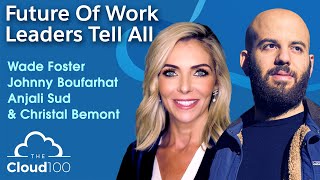
Panel from Cloud 100 (video) with CEOs Anjali Sood (Vimeo), Wade Foster (Zapier), Johnny Bufordhat (Hopin/OPN), and Crystal Beamont (Talend) about how the COVID-19 pandemic changed work and product priorities. Key points: many companies shifted to more distributed staffing and asynchronous work practices; Zapier emphasized asynchronous work and automation (Zapier founded as distributed in 2011); Vimeo saw remote headcount grow from ~10% remote pre-pandemic to a more global, distributed workforce and increased enterprise video use; Hopin/OPN expanded into hybrid events (added Boomset integration) and increased internal event/engagement tooling; Talend is focused on "data health" — a confidence monitor for data quality and anomaly detection. Culture practices discussed include executive red/yellow/green check-ins, icebreakers, Vibe teams (weekly events, city-based community leads), recognition programs, and asynchronous video to reduce meeting overload. Final quick-style question: CEOs named desired future tech (data health, affordable renewable energy, teleportation).
Questions this video answers
2011
About 10%
Approximately $3 million
Boomset
Chapters
Hi, I'm Anjali Sood, I'm the CEO of Vimeo.
Hi, I'm Wade Foster, co founder and CEO at Zapier.
Hello, I'm Johnny Bufordhat, founder and CEO of OPN.
Hi, I'm Crystal Beamont. I'm the CEO of Talend.
Welcome to Cloud 100. All right. Hi everyone. It is great to be here at the Cloud 100. I'm really looking forward to this conversation we have for CEOs and leaders here who are building the companies of the future and the software of the future. And so we're just going to dive right in. Obviously, all of us in the tech world have had to adjust pretty dramatically in the last year with the pandemic and this immediate shift to remote work. But actually, I think Johnny and Wade, you both were already embracing remote work before the pandemic. So just curious, you know, how if at all, did you have to change how you, you and your teams worked? And did you learn anything from this last year and a half that's shifted how you think about remote work? Johnny, maybe you could start.
Well, I was hoping we would start because, I mean, before the pandemic, our company wasn't that big. So most of the way that we operated we were a fully remote company. But we didn't change much. And a lot of what we learned about how to operate remotely was from Wade and Zapier and other great companies like GitLab, et cetera. So I'll pass that on to Wade because I think he'll give a better answer than me.
Well, you're too kind, Johnny. We started Zapier in 2011, fully distributed from the get go. You know, in terms of how the pandemic changed our operating model, you know, we're fortunate in that a lot of the rituals and routines that we'd set up continued to work through the pandemic. But that wasn't universally true. Remote work in sort of a, I guess, quote, unquote, normal time is different than when you're going through a pandemic. And the key things were the things that changed around us. In particular, I think about things like caretakers losing access to the normal things that they have access to, schools being shut down, daycare is being shut down. If you're taking care of an older parent, all of those things now fell to the burden of all of us. And if you're trying to juggle a day job while watching a child at the same time, you know how difficult that is. And so for many of us, 40 hour work weeks that were sort of the norm became quite challenging. And we didn't have the sort of normal rhythm of the day to get that work done. And so I can't say that we were unimpacted by the pandemic because of that. Just because we were remote to get go, all the other stuff in the world definitely had an effect. There were things that we were able to do to mitigate some of those hurdles. I think one big thing that we continue to strive to do is be asynchronous in a lot of our work. That bakes in a lot of flexibility in terms of how you approach things. If you can handle things in the morning or in the evening or whenever is best for you, that frees people up to do things like take care of their kids, help them with homework, help them with zoom school, what have you, and then you can sort of get to work when makes sense for you. So I think really leaning into the flexibility that remote work can afford through asynchronous work was one of the key habits that really made work better. Not great, but still better through the pandemic. So I think that would be the one really important adjustment that we paid attention to.
Yeah, that makes sense. And, you know, I mean, Vimeo is an example of a company where we were about 10% of our workforce was remote. So it was a big adjustment for us. And if anything, I think we've become more distributed globally as a team, and it's actually been awesome because our user base is so global and we've really been able to kind of bring in talent from many more parts of the world, which I think has been a real benefit to the business. Crystal, you had a really interesting experience. I believe you literally stepped in as CEO, like, a few weeks before the pandemic hit, which must have been, yeah, amazing timing. So how did you navigate that transition of literally, like, coming in and getting up to speed while also managing through this sort of crazy time?
Well, it certainly was an interesting time. And it was something that no matter how long you were in the chair, I think it was a challenge. It was really about the uncertainty of knowing, you know, how much you could continue to run fast, when you had a lot of plans ahead of you and how much you needed to slow down, just to see around the corner of what was next. And I think what it did, if to put a positive spin on it, was really required action and decisiveness because there wasn't really a choice to just sit and wait. I didn't feel like that was the right thing to do. And so really it was about putting things into action. Not just about what we were going to do from a strategy perspective, but how we were going to take care of our employees and what it meant to define well being that went outside of physical health, but also mental health, which is a really big focus for me. And the way that I think about taking care of the people that run this business.
Well, I think it's an incredible feat. I can't imagine having to do that while becoming the CEO of a company for the first time. So let's talk about each of us are leading companies that are trying to use technology to help people work better. I know Vimeo. Since the Pandemic, we saw a big spike in large companies using video in ways they hadn't before, live streaming their town halls and Netflix, like quality HR teams sending video messages to welcome employees. Everyone, every employee is sort of becoming a content creator. And we've been sort of building the tools to make that easier. I'd love to just kind of for each of us to share sort of what are the things that you've seen that the Pandemic has actually changed behavior and opened up opportunities for your technology? And what innovation are you most excited about bringing to your customers? Maybe, Jonny, you could start us off?
Absolutely. So for us, obviously the past few months we've seen a huge amount of adoption, not only of the typical type of events that you'd expect hopping to be powering a virtual conference like, but more on the internal conferences that people are hosting inside their company. So whether it's a company all hand or a workshop or a sales kickoff or whatever it is across the company. That's where we're starting to see lots of usage because people are starting to adopt this, a more virtual and remote mindset. Even if you're going back into a hybrid workplace, you still need to talk to all your employees wherever they are in the world. So outside of the extended use cases, outside of company recruitment fair and virtual conferences, we're seeing a lot of that. On top of that, we made some quite interesting changes to how our product works in terms of we added boomset, which is a physical event provider, to our suite, so that we're able to power these hybrid events right in the middle, where you have people attending on site, but also virtually. And so innovating in that space, which really wasn't a thing. Hybrid events has been super, super exciting for us and also a huge opportunity for us to invent and that's what we love doing. As a company.
I'm curious, do you think that you can create a world where or technology and experience where the online experience is just as engaging and sort of effective as the offline experience?
I think there's two parts to it when it comes to engaging and effective. I think when it comes to the effectiveness, I think 100%. I think organizers already run events on hop and see that they get to attract people, 10 times as many people wherever they are in the world. So and the sort of data and analytics that they're getting from these events are unlike anything you could get from a physical event, from how engaged they actually are with the content that they're watching and who they're networking with and who they're engaging with at the event. Now from an engagement piece, I think it really depends. I don't think the virtual component is going to compete with a fire breathing sort of event where you're kind of learning yoga or whatever it is, where it's really, we call them experiential events, but everything else that's content based, I think virtual is a lot more engaging and I think it can be a lot more engaging. And that's why we have, we've implemented so many integrations. As a platform where you're able to now implement trivia inside Hoppin, you're able to, you know, to really far third party projects like if you wanted to play poker within a session during a hop in event, you'd be able to have that sort of extreme setup and all these things add to that engagement piece. And you asked about what the most exciting thing for us in the long term is. We're super excited. We think that similar to how Vimeo sees the world from video being the future, we also see video being the future like many other companies. And I think we're going to be doubling down on not only the larger events that you see happen in, but also smaller, smaller to medium sized meetings and events. And I think there's a next gen that's coming because of the pandemic where companies realize how much innovation is needed in order to take us to the next steps of hybrid and remote workplaces.
Well, you're definitely speaking my language, Wade. What are you seeing at Zapier?
Yeah, I think Crystal talked a little bit about the importance of speed and agility and decisiveness and I think so many companies realized how important that was. And at Zapier, I think that's one of the things a lot of our customers benefited from was being able to build automation, build new systems and processes in minutes and hours rather than days and weeks. We had a customer that provided event building exercises at museums in New York City. And overnight that business lost basically all of its business, went from $3 million to nothing and had to lay everyone off. But they were able to pivot to team building.com and start providing online experiences in part because they were able to build out the entire business through Zapier in a weekend. And that business now has more employees than it had before the pandemic. And so being able to build out these applications, websites, workflows, automations, whatever you want to call those in such a short amount of time is something I think all of us have learned is that ability to adjust, adapt or on the spot and having technology that allows you to do that is so critical.
I think that's a forcing function. I think it's a wake up call for something that's been long overdue. I look at it as if you could take a positive out of it. And I always try to look at, you know, the reality of a situation is it checks you to see if you're, you know, you're working at the level that you need to be working both on behalf of your company and your customers. And I completely agree with you. I think it's more behind quite frankly. I think if we take a look at how long it took us to get here, you would never want this to be the thing. But now that it is, it's what it's like what's possible, you know, how do we push ourselves beyond what, you know, what's even thinkable right now. And it's the same for us. I mean we look at customers like Viair Medical. You know, ventilators were a pretty or have been a really important part of solving for at least the, the repercussions of COVID And we have Bayer Medical who they could at most create 60 ventilators a week. 60. And Ed would tell me the guy runs all their data that processes the operations of their organization. He's like crystal, like maybe we could get it to 61. They do 600 a day and they do that because they had to rethink the way and it's automation. Exactly what you were saying. And it's though they had to force themselves outside. But if they didn't have a good foundation of data and some of the things that require you to run operations at a speed that you can. It for us was really about, you know, showing up for our customers in a way that they had to stay in business, they had to reimagine the way that they met their customers online. And you know, we have pharmaceutical companies that had to make sure more than anything that the data they were using were helping them instrument and make good decisions and operate their business. And you know what happens when you don't have good data. It's not necessarily the best outcome. But I just think this is a wake up call and I don't need to wait for the next one, I'll tell you that right now.
Yeah, I think necessity is definitely the mother of invention and I think we're all experiencing it. And if anything, what we observe is a lot of people were very reactive at the beginning of the pandemic because they had to be. And now as we're sort of reemerging, people are becoming more intentional. Intentional about the way that they design their technology stack and workplace environments. I think it's a good segue to a topic that I'm sure you all have been dealing with a lot, which is culture. If anything, I know I've learned a lot about being more intentional about sort of supporting employees, ensuring people are informed, productive, engaged during this time. And I'm, I'm wondering, does anyone have any great hacks or solutions or things that have just worked incredibly well beyond what you imagined or that you're definitely going to be continuing that you want to share for other leaders? Anyone who has a good one.
I mean, I can jump in, you go, you go, go for it.
You would think having run a remote company for a decade that we would have this solved, but I still think this is even an area that we realized how important in person activity is. We relied on in person events twice, three times a year to really build that human connection. And when that disappears, I think you start to notice how transactional distributed work can seem. It's an email, a Slack conversation, a quick zoom call, and it's usually down to business. And if you do that for a prolonged period of time, you start to notice things just don't click quite in the same way because those relationships aren't established. And so one simple thing that we've started doing in our executive meetings at the beginning of the pandemic is our red, yellow, green, check ins just to make sure we understand. How are people doing? How are people showing up? And then two, we have these silly icebreaker questions. You know, this week we asked what was the first concert you ever went to? And it just is a quick reminder that, hey, we're working with other people who have lives Outside of work, who have things that we care about outside of work. And I think that when we get into the difficult problems that we face inside of work, those reminders just help us treat each other as humans along the way.
Yeah, I'm just going to draft after that. I think first of all, that's awesome because it's a. We're all humans, right? And we have obligations outside of work. And I always thought that it was interesting that people thought you walk in the front door and then you can shut everything else out. It really doesn't work that way. And I think that you look at the type of people that you really, if you want authentic, diverse culture where people really bring their best selves, that means you have to support them in things inside and outside the company. And this again was a wake up call, I think, to say, hey, first of all, people can't turn things on and off, so fluidity and flexibility is key. But also we have to really think about what it means to take care of our people. And they spend a lot of their time focused on the things that we do at work. So it's an eye opener, I think for a lot of people.
I think one thing for us, we implemented a Hop and Vibe team and I guess this is something a little bit different I could share. For us, it might be a honeymoon period type thing, but at the company we have an internal MPS of over 90. And I think the way we've done that is through this Vibe team as well as being obviously probably a honeymoon period with how long. We haven't been around for as long as a lot of the other companies. But it's worked incredibly well for us. This team basically runs events weekly for people from mental health events to trivia nights to events now city by city. So wherever we have more than 10 people in a city, they have a community member that works with a Vibe team to run whatever type of events this per city they want to run or per town if there's anyone within 10 people plus. So that vibe team has been instrumental for us. And I gotta say, it is a little bit of a pitch. But I mean, we have, we've been using Streamyard even before the acquisition of Streamyard to basically turn our all hands events into a show. And I think it's something that most of our employees talk about. Our all hands events are really fun because we really produce it the same way we would a TV show and it's really enjoyable for everybody.
That's awesome. I'll share two hacks. One, it's sort of related to the vibes thing, which we've definitely, as we've scaled and gotten more distributed, just we need to be better at recognizing great work. It's really hard. It's one of the things I think a lot of us have lost with the pandemic. So we rolled out all these like TeamIO and Love IO initiatives to basically make sure like at every corner of the company, no matter where you are working, we're kind of giving people shout outs and then the other thing. And I'm sure everyone can empathize with this, but we went through a period right when the pandemic hit where it was like meeting overload. And one of the things to the point that we made about asynchronous communication, doing things like asynchronous video messaging. We use our Vimeo record tool, but there's a bunch of others. We really shifted the mix of when meetings actually need to happen versus recording your screen to walk through a presentation or a demo, quickly sending that out and getting comments back. And I think there's a. There's a real tangible productivity benefit while also retaining the sort of connectedness that you get of seeing somebody fit their face talking through a complex or nuanced idea. So I think those have been two that we will definitely be kind of leaning into as we look to the future. All right, so we're running out of time, but I want to ask one last question for the group. If you could wave a magic wand and make any future facing technology or capability just be available in your palm today, what would it be? Crystal, do you want to start? You bet.
It would be what we're working on right now, what we're providing, which is data health. And what I mean by data health is the ability to actually have a confidence monitor, if you will, for every person in the organization who interacts with data. So that when Talend is running your data operations, we actually can not only let you know that everything's on track in terms of the quality of data. It's ironic to me that no one can measure quality of data today or define it, but more importantly help people see trouble coming. And there are a lot of anomalies in operations and in instrumentation of a business that if you could get in front of those, imagine how much we could help companies really think about avoiding risk, but also looking for opportunities. And I just see it as a foundation to and being core to everything that companies are looking to do. So that's what we're working on. And that's what I'd wave a magic wand to develop.
Wade, what do you think?
Well, not necessarily directly related to our work at Zapier. For me, affordable renewable energy for all to me has got to be the thing that I, if I could wave a magic wand, I would give that to all of us.
Johnny.
Yeah, I'm going to go outside the business as well and I think for me it's teleportation. I'm really into accessibility and what's more accessible than being able to be wherever you are anywhere in the world? So that's something I would easily wave a magic wand and beg for.
Johnny, you figured that out, buddy. I'm right there. I'm your sign me up Virtual events.
What is doesn't matter anymore, right?
I love that. Thank you all. It was a really great discussion and we appreciate it. Bye.
Thank you so much. Bye.
Thank you so.
Much.









