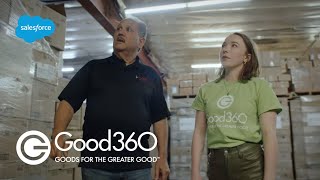
YouTube video (Salesforce) featuring Good360 staff describing how Salesforce and AI agents (Agentforce/resource-matching agent) accelerate disaster response by integrating systems, automating routine admin, and enabling staff to be on the ground. Speakers report large increases in distributed product (cites ~$50M last year and >$100M in first quarter this year) and emphasize matching donations to needs quickly.
Questions this video answers
42 years.
Close to $50 million worth of product.
Over $100 million of product.
Chapters
We are living in the future we thought might happen one day. Fires, hurricanes, they're happening with more frequency. They're more intense than they've ever been. Are we ready to adapt? This is a moment in time where good360 can step in on a much greater level than we have in the last 42 years. Our entire mission is based on taking surplus product and we make sure that it gets to people that actually need them.
Typically with disaster, generosity is not the problem. The problem is getting the right product to the right people at the right time.
Before salesforce, we actually weren't on the ground at all within the first couple weeks after disaster because there's so much work behind the scenes that we have to do to coordinate.
Our team was being bogged down with everyday admin things.
If a partner would call me to ask where was a donation at, I would have to call three different teams to try to figure out where that product was.
Now with salesforce, everything is integrated. It has allowed us to see a full story of what our community needs.
By leveraging salesforce, we're able to scale up our activity pretty significantly.
Last year we went from distributing close to $50 million worth of product to disaster impacted communities. This year, just in the first quarter, we are already over $100 million of product distrib.
What we like to do is have our people on the ground. That's very important in the disaster recovery space. That's really what we're working on with agent force. Now.
Our first agent that we're building is our resource matching agent.
Think of it as a digital assistant supporting our team in analyzing what's coming in, analyzing the requests that are being placed with us and do the matching.
We are now able to ask, do we have this donation? We have a nonprofit that could use this.
We realized we could get very simple agents off the ground in a matter of days, not weeks or months. And through data cloud, we hope to give that agent access to real time data that comes from all systems. Now we have a smarter, faster agent that is making better recommendations, leveraging everything that's available to it company wide.
When we're working with agentforce to be able to accomplish these things, that gives me time to get out with our partners and be able to interact with them on a human level.
Let the agents take care of the stuff you don't want to do, they'll do it at scale, they'll do it really well and let you focus on why you do what you do. I think that that's really where I see that transformation, and I can't think of a technology before that that would really accomplish that to that level.