Holiday Shopping Predictions: Everything You Need to Know | Blazing Trails | Salesforce
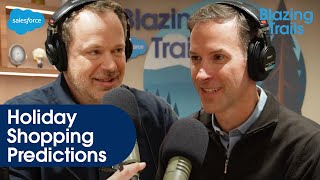
Interview (Nov 2, 2022) with Rob Garf (VP & GM, Retail, Salesforce) about holiday shopping predictions and retail trends. Core points: margin pressure is the primary risk for holiday profitability; digital and physical retail are increasingly blended (stores influence digital orders and store associates’ roles are expanding); holiday buying is shifting earlier (large share of digital sales in early November); marketplaces and third‑party "edge" channels are growing; sustainability is an under‑leveraged way to demonstrate retailer values across the shopper journey. The piece highlights operational responses (automation, scaling scrappy tactics, headless/composable commerce, first‑party data) and urges embedding sustainability messaging to differentiate without eroding margin.
Chapters
Welcome back to Blazing Trails. I'm Michael Revo and I'm here with Rob Garf. He's the VP and GM of retail here at Salesforce, and we're getting ready for holiday season with some of Rob's predictions. Welcome to the show, Rob.
Hey, Michael. Thanks so much for having me.
Okay, awesome. Well, you are leading our efforts around retail here at Salesforce with all kinds of information. Just to kick it off, can you tell me about the team here, what we're learning and how we do it?
Yeah, absolutely. So I have the pleasure of overseeing our industry insights team and think about them as analysts out in the industry all the time understanding where the market is going. We do that primarily based on a lot of the data that flows through our platform. We bubble that up, we strip out all the personally identifiable information, and it really becomes after billions and billions of shoppers on a quarterly basis, the de facto standard of what's happening is in digital. We manifest that through our shopping index. It's a publicly available site on salesforce.com built on Tableau, totally interactive, and we supplement that with primary and secondary data. So we're out there all the time, not just during the holiday, but the whole year long to help our customers understand and benchmark their business.
That's awesome. So throughout the year, people can come check out the information.
Salesforce.com you'll be able to check it out and again, slice and dice it. You can look at it by your vertical, by your size, by your geography to really get a sense of what. What's happening in the overall business and be able to benchmark what it means for your business.
But today, we get to hear it directly from you.
Let's do it.
Okay, so let's jump right in. And can you just give me an overview of some of the key themes this year?
Yeah. Well, you know, I guess the overarching theme is margin. And there's a lot of risk that the margin will be the Grinch that steals Christmas. So let me tell you what I mean by that. We all know we've experienced it in our daily lives, just the increase of prices, whether that's energy or whether that's labor, whether that's in retail, packaging, and supply chain. So it just costs a lot more to do business, and that's going to really take a stronghold this holiday season. But it's not all doom and gloom. I've been talking to customers about this for more than a year to figure out how to optimize, how to scale the business. If you think about it over the last couple of years, in the course of the pandemic, retailers got really scrappy. They had to move very quickly to really accommodate these new consumer behaviors. And now it's all about turning to scale, automation, productivity. And again, there's going to be a fine point over the holiday of what that's going to look like.
Yeah, I guess if you think about it, retailers have had to deal with this for a while now. You know, the supply chain, all the issues around the pandemic. So they've had to learn how to get scrappier, as you say. Tell me a little bit about that. What are they doing?
Yeah, exactly. So it's not only in supply chain, of course, that gets the headline that we've seen over the last couple of years. But think about it from a customer service perspective. Automating some more of those customer service interactions, enlisting bots to take care of some more of the basic questions like where's my package? What's the status of my order? And even in the store itself, if you think about the associates role has expanded, expanded over time, but it's also increased the cost. If they have to do pick, packing and shipping, if they become service agents, if they're social media managers, we need to make sure that we schedule properly for them. We really smooth out all the operational complexities around pick, packing and shipping. These are things that didn't exist a couple years ago. And retailers need to accommodate it, like I mentioned, scale for it in terms of labor and also provide the right incentives. So the associates in this case are not only scanning, bagging, but they're also doing these other roles and being rewarded for them.
You know, it's so interesting because you've had this digital transformation that was driven just by what was happening, naturally accelerated by the pandemic. And now companies are really having to connect with customers in the digital world, in the physical world, and make that seamless. And that's not easy.
That's not easy. It's actually really complex. And we've been talking about this in the, in the world of omnichannel for a long time. Like you said, In 2020, over the holiday, we saw 50% year over year increase digitally. In 2021, we saw 5%. So over the last couple years, we've seen a seismic shift in digital, but the stores don't go away. The stores still play a really important role. And now it's about weaving together both the physical and digital.
I mean, it seems like the physical experiences are really coming back. I Mean, just as an aside, I took my kids to Disneyland last weekend.
Awesome.
And it was. It was awesome. It was a great experience, but it was so crowded and across the park, throughout all of their retail experiences inside the park, you could see you could pay online. That whole. We ran through the whole park with an app. So you're just seeing this blending together so much. What are some trends? What should we look for and be seeing in the near future with this blending of the physical and the digital?
Yeah, sure. So I think you hit the nail on the head in terms of blending this together, because it's not one or the other, but it's really bringing them together. In fact, our research shows that those retailers that have a physical presence this holiday are going to grow 1.5 times higher in digital. And it's because the stores are working hard for them across all channels. Actually, that research came from the derivative of 60% of digital orders are now influenced by the physical store, which whether demand is being generated or demand is being fulfilled. That's because the store associates are being asked to be service agents, digital stylists, digital concierge, social media managers and so on. So they're drumming up demand, especially as people come in the store, they may or may not decide to actually purchase something, and then when they go home, then they might go online and actually consummate that deal. And so there's so much interplay that's happening across the board. As you mentioned, in the hospitality world, if I back up over the pandemic, loyalty has really been defined as health, safety, convenience and trust. Health, safety and convenience and trust. And really the common denominator there is removing friction. The friction that was removed was I want to buy online at home in the safety and comfort of my house, and I want to have that order fulfilled, whether it's to my doorstep or in and around the store. And that removing of friction doesn't go away. There's a whole new baseline of expectations, and a lot of that friction is removed when you can start the process online and continue it in physical and all the way in between. Our research, actually, Michael, shows that on average, consumers traverse nine different touch points in any given shopping journey. So it's being able to weave really the experiences together, streamline them and remove that friction. Because again, that expectation doesn't go away as we come out of this pandemic, as in also acutely, as we think about this holiday season.
Yeah. And what I didn't hear in that list was price, which is interesting. Sure. I remember at the Beginning of E commerce. In the earlier days, you would be in the store and you'd be in the aisle and you'd look at something and then you'd look it up and can I get it cheaper? It doesn't seem like that's how people are looking at it anymore. It's much more about experience.
Experience plays a key role. I was just talking about this with a customer earlier today from Mexico, one of the biggest department store retailers and what we called that back in the day was showrooming. You'd go into a store as consumer, you check out that tv, you try on a product and then you go home and find the product for cheaper. And so retailers hated that. Now actually, retailers are opening up the opportunity to visit online while in the store, especially around endless aisle. If a product isn't physically available, if the inventory isn't in that physical store, we don't want to walk that sale. We want to find out where it is throughout the entire supply chain and another store at a partner site and be able to make sure the consumer gets it where and when they want it. But to your point, we can't ignore value. Let's get to retail and some of the predictions we're talking about here. Value does play a critical role this holiday season. Now, of course, Value Forever really was a code for price. It's not just lower price, although about half of consumers told us, based on our proprietary research, they're going to switch a brand this holiday season because of price. But it also is value. Value in the experience, value in the convenience, and by the way, the values that the retailer has and how they match up with the values of the consumer. So value is going to play a key role this holiday season. There was a lot of switching that happened over the last couple of years as consumers try to find product when inventory scarcity was at an ultimate high.
Right.
And now they might switch again as they look for value.
Anecdotally, I'm out there in the world. I'm seeing stores are full, people are out there shopping. But you can't ignore the economic headwinds of what's happening right now. So tell me, what do you see as the impact coming up in this season?
Yeah, there certainly is this pent up demand. People are excited to get back in the world again. They like to shop as an experience. But we can't ignore the headwinds and the economic uncertainty. And that shows up in terms of not only the value that consumers are seeking, but our research shows that consumers are going to buy earlier and earlier in the holiday season. Now this has been a dream. They love to smooth out demand throughout the entire holiday season. This allows them to have a better demand forecast, allows them to take some of the product off of their balance sheets, free up shelf space, free up their operating margins. But it's always been difficult to pull that demand forward. Consumers are so conditioned to wait till Black Friday, Cyber Monday to really get that best and final deal. What we saw, if I could just back up for a moment then talk about what it looks like in the context of this holiday season. In 2020, demand was pulled earlier because if you remember, there was a surge in digital and there was an issue with shipping capacity. People were worried that the product wouldn't get to their doorstep. UPS, FedEx, USPS were off the charts busy.
Yeah.
2021. If 2020 was around the last mile, 2021 was around the first mile. Getting the product in the domestic supply chain through the. Whether it's the freight or it's the railway system to the distribution centers, out to the different nodes of the supply chain.
Yeah.
So if 2020 was around the last mile, 2021 was around the first mile. This way it's driving in 2021, price is pulling the demand earlier. And that's because people are afraid the products were only going to increase in price. Let me give you a specific example here. July this year, Prime Day, we saw any retailer not named Amazon have an increase of digital sales by 21%. 21% over the two days the year prior. To put that in perspective, Q3, we saw a negative 4% increase in digital sales. So we saw a population, people saw the demand, saw the excitement of Prime Day. Other retailers benefited from that. And people were buying because they saw a good deal. They wanted to buy it earlier. They're going to buy and hold and give the gift later on in the season.
Are we going to be buying Christmas gifts in July? Now you know, what's the impact of this? Because it does seem like it's just getting earlier and earlier. And is it just going to even out what's going to happen?
It is getting earlier. If you notice, you see Christmas decorations and products and signage going back to September. It actually helped see a boom for the back to school season. In reality though, what we are seeing is 30% of digital sales will be done in the first three weeks of November. So what if I were to zoom out for a second? We've moved from Cyber Monday to Cyber Week and now we're looking at a Cyber month and so it's critical that retailers win those first three weeks of November because there's a lot of demand, there's a lot of excitement and, and people are actually clicking the buy button.
Right. Okay. So things are moving earlier. People want to get ahead of not only the shipping and the availability, but also price.
Correct.
So there's still at the heart of it. How do you get your customer to connect with you and your product? So what are ways that companies are working right now to connect with customer and go beyond just price and just this purchase for holiday? Talk to me about that.
Well, we're warning once again this season that retailers shouldn't play the game of discount chicken. Yeah, yeah, you might know discount chicken. We are continuing to warn retailers not to engage in the game of discount chicken. It's a losing proposition. So the heritage, the history of discount chicken is the idea that retailers put together the most well thought out promotional calendar going into the holiday season. And after the first weekend, they typically rip it up, call an audible and then they try to chase the deal. And the consumers have can come conditioned to this, so they wait until Cyber Monday or even therefore after to get that last big deal. And it just ultimately erodes margin. And what we're saying is retailers need to engage consumers, they need to engage consumers earlier. But it's not about throwing discounts at the problem. They're finding ways as an example to lean in to sustainability and sustainable shipping options. So they're reaching out to their consumers and say buy early and we're able to ship it to you in the most environmentally friendly way. They're also doing things like exclusive products. I was talking to a stroller manufacturer just recently who inked a deal with a department store and actually did a product launch through and to their loyalty program members, they actually sold out before they were able to sell it to anybody else through that department store or on their own site. So this idea of exclusivity, if I were to really summarize it, it would be leaning into exclusivity, urgency and sustainability. Those are three messages that don't have discount in them. And so retailers are really looking to engage without necessarily engaging in a game of discount chicken.
Yeah, I want to come back to the sustainability point, but there's a trend in preparing for this episode that I learned about, which is more and more retailers are engaging other third parties on their sites and selling. So you'll see this at madewell and Gap and some other places where you can get different brands on their sites. This is new as A consumer. Oh, I was surprised to see that. So tell me a little bit about that trend.
Absolutely. We call this shopping at the edge. And there's really two reasons this is being accelerated. One is on the consumer side and the other is on the retailer side. So on the consumer side, what's happening generally is shopping has become such an embedded and fragmented experience. It used to be very linear and discreet. I'm going to get up in the morning, go shopping, it's going to be an experience. I'm going to go get some lunch, maybe I'll see a movie after, but I'm going to hang out and that's what I'm doing for the day now. It's so embedded in everything we do. So consumers are not only being inspired on properties like social media, messaging platforms, gaming consoles, voice devices, but they are actually now buying product directly in what I consider to be the next generation of shopping malls. The idea is inspiration is being conceived and therefore buying is happening and removing the friction between inspiration and purchase. So more and more is happening on these third party destinations on the edge of the retailer's property. So that is what consumers are driving on the retailer side. Retailers, especially as they see headwinds, are looking for growth levers. Yeah. And one growth lever is monetizing their loyal shoppers, is in the early days of the Internet, we call it monetizing the eyeballs. Right. And so the idea is they have a destination, they have loyal customers where they've gained trust and now they're extending their assortment into other areas that have complementary products. So whether that's accessories, whether that's services, it might even be financial or healthcare or travel and hospitality. And so it's really interesting, generally speaking, this trend, whether it's driven by the consumer and the emerging channels on the edge or retailers and growing and monetizing the eyeballs is this ecosystem that's taking place where consumers, because they're looking for convenience, because they don't want the friction as part of the shopping process, they are more inclined to not only browse, but buy on these digital destinations.
You know, and it's interesting that you talked about trust because it does seem like that that is the spine that holds this together. When you think about companies are going to open up their shopping experiences, their place of business, their home in a way to these partners who have to share values. It's got to be there. And that also seems to translate to the customers as well. So if I'm there and I trust this brand and they're presenting me with another option, I'm going to feel much different about it, but it seems like you really have to align and do that carefully.
Yeah, well, I agree. The values need to align. I think you said it really well there, Michael. The other thing to keep in mind is as we think about this ecosystem, our marketplace economy is there's a volume game there which has been beneficial for some destinations, but then there is a unique curated game. And I think that's what you're talking about, where consumers are more inclined to do business, as you said, with retailers and brands that they have trust, but they need to be careful when they open up those partnerships that they align with the values.
Yeah. And so I imagine this is a growth opportunity, but probably a little bit scary for some retailers out there. How are, what are you seeing in the marketplace?
It's totally scary because retailers want to own and control that brand. They want to own and control that customer experience. But we're seeing a democratization of the brand. The consumers, as I talked about before, are already breaking down that and democratizing that experience. So now it's the retailers catching up and recognizing it. They're recognizing that consumers are engaging with the brand whether they like it or not on all these third party and emerging destinations. And now they're just. And you know what, what's always a bellwether with this, Michael, is what the luxury brands are doing. When the luxury brands are willing to give up some of control, which isn't very often, then you know it's onto something. And what I mean by that, if you look at what luxury brands are doing with WeChat in APAC, they are allowing for commerce happening on the messaging platform. It's not the same magical experience that you would get by going into the store, but it is connecting with the consumers on their terms. How they want to shop, how they want to browse, how they want to engage with their friends and family and network to get validation on something they're buying. And oh, by the way, because the payment method is already embedded in that messaging platform, they can purchase it without any friction.
I mean, this notion of shopping in other regions where outside of the US where you have super apps and everything seems much more seamless as this digital experience. It seems like social shopping and some of the. That hasn't taken off as much here. I'm curious, what's the trend there? What's happening?
Yeah, it hasn't taken off. Again, shopping at the edge is something that's been talked about but necessarily hasn't been executed as well. And that's the point. We are still making it really difficult for consumers to make the purchase. We're just creating too many barriers, whether that's in the checkout funnel or the payment method or the fulfillment options, or even how you return and get service. And so the notion is there. Actually, our research shows over the next two years, about 33% of all digital transactions will happen on a marketplace. 16% will happen on these emerging destinations outside a marketplace, and then the other roughly 50 will be on a retailer site or a brand site. So if you net it out, 50% of digital transactions are going to happen off of the retailer's property. So when I'm talking to customers, whether it's about the holiday or their long term digital transformation strategy, it's not just about standing up a website and hoping people come, but it's rather infusing digital wherever the consumers are shopping, giving the consumers more control over that experience. And by the way, that also translate to the physical store as well.
Yeah, I mean there's a trend I'm seeing, again, this is totally anecdotal, but my kids just recently got phones, I have twins and they're teenagers, they just turned 13 and they love Depop and all these sort of sneaker heads, you know, outside of anything that I'm really that aware of. But it seems like there's a big trend now to sort of these aggregators.
That's right.
You know, so how should a retailer be thinking about this when. When this is now becoming so normal?
I know. Do you consider Depop a retailer? Maybe. I liked how you use the word aggregator. Intermediary is another word I often use with retailers.
Yeah.
You know, the way I've been talking to retailers about this for the last couple of years, because this isn't necessarily a new trend, it's only accelerated because of the consumers shopping at the edge and not only wanting to be inspired.
Right.
But clicking that buy button. What I tell retailers is they must think about democratizing their brand, really giving more control to these third parties. And that's why if you get techie for a moment, headless commerce or composable commerce has become so in vogue because in the past when you had the website where it really took on most if not all of the digital engagement and transactions, you can have a stack that was pretty much in place and rigid. But now retailers must syndicate. They must synchronize the critical information about product, price, promo, inventory, customer, and be able to really push that out to these third party platforms. Oh, by the way, I say this with fully recognizing retailers have a difficult enough time pushing that critical information within their four walls. Whether it's to their call centers, for their service agents, whether that's to the store, for the store associates, whether it's their marketing team, the list goes on.
Right.
And now we're asking them to take it one step farther in pushing all that critical information, the data, the business process and rules and the workflow out to these third party platforms. So what I talk to retailers about, we got to be much more agile. We talked about getting really scrappy over the last couple years. So it's nice to test how we can sell on TikTok or how we can work with one of the live streaming apps where our store associates can look at a new product, drop or launch, and then allow a consumer to buy it right there in real time. But we must think about not only being scrappy, but how we scale, as I referenced before, and how we do it in an agile manner.
I mean, it feels a little bit like the big race for identity when Facebook and Google and many others were looking for that sort of, oh, sign in on our platform and then you can follow around. Again, not as close to the technology here, but that seems like an interesting thing if you can atomize some of the processes and be able to do that as a retailer and have people connect into your systems but from anywhere.
That's right.
Is that the vision?
That's the vision. And it's also if you think about the macro trend in terms of third party cookies go away and more and more difficulty from a regulation perspective, actually manage that first party and zero party data become so much more important. And finding mechanisms, finding ways for consumers to engage with you, provide information about themselves in order to get an elevated customer experience. That is so important. So when we go back to the holiday and we think about removing friction, anything we can do to really smooth out that journey, where we acknowledge, in many cases it starts online and then goes into the store and then it weaves in between. Of course, the phone is the connective tissue between. The digital and physical space becomes that much more important.
Yeah, yeah. Well, behind all of that technology is the customer relationship. And as we talked about how important those values are, I wanted to get the conversation back to sustainability. This is becoming so important for me. Even as I travel or think about my purchases. I think everybody is really thinking about this out there. How should companies be thinking about sustainability as part of their strategy?
Sustainability is so important. But you know what, it always has been important to A certain degree. My team actually looked at the top 100 online retailers globally. We looked at their websites and we saw how many, what percent actually had a public declaration around their environmental types of initiatives and how they are performing on them on an ongoing basis. And actually, it was really nice to see 81% have a public declaration of what they're doing.
Yeah, that's a big number.
Yeah, it's a big number.
Yeah.
But the problem is they're playing hide and seek with their sustainability issues. What I mean by that is they're all hidden on their investor relations page or their About Us page. I know I'm a sample size of one, but I'm pretty in depth with retail and I don't even spend the time to go to those sites to see what's going on.
Right.
I don't go to those pages to do the research and do the homework. What we're predicting this holiday season, though, only because of that, 23% of retailers will actually embed their sustainability initiatives throughout the shopping journey, specifically promoting it in an email, putting it on their homepage, making it a filter as part of their search and navigation, having it part of the checkout process and the shipping methods. And so there's such an opportunity to embed the retailer's values, particularly around sustainability, much more than they are now, putting it front and center and allowing the consumers to make really informed choices about what they're going to buy or what they're not going to buy based on the sustainability initiatives of that retailer.
This is a trend you're seeing with more and more companies are putting that information out there.
More and more are, but it's still actually very low at 23% going to this holiday. So there's an interesting opportunity to differentiate based on that. You know what? Consumers like it because they feel part of the process. They feel like they're actually making a difference because their choices will ultimately have an impact on the environment.
We've talked about on the show before what's happening in the back end in terms of companies looking at who they're doing business with, whether it's shipping or materials. The reporting that's happening there is part of RFP processes, part of how companies are deciding who to work with. Is this a trend that you're seeing in the retail space as well?
Yeah. I mean, we see, based on our research, that consumers will make a decision or do business with a retailer if and how they are approaching sustainability. But you have to counter that, Michael, with where we are economic headwinds. People Feeling the pinch in their wallets and looking for value. And these trade offs are something that people are making on a day to day basis. So retailers have such an opportunity to fully promote it again to allow the consumer to make a concerted choice throughout the shopping experience.
Well, let's see what happens and what people decide.
That's right.
Okay, so to wrap it up, I want to go back and get a recap of some of the predictions from today. So, Rob, can you take us through your top predictions?
First of all, we're going to see an earlier and earlier start to the holiday season. We're already starting to see that even some demand got pulled earlier in the July time frame. With Prime Day, consumers are going to shift to value, but not just about price. It's the other values as well in terms of experience, convenience and the shared values that the retailer has with the consumer. We're also seeing the store come back in a big way. 60% of digital orders are influenced by the physical store. But that means there's a changing role of the store and the associate and that has an impact on margin in a good or bad way, depending on how you manage that. We're also seeing sustainability is critically important, but we can't play hide and seek with our sustainability initiatives. Only 23% of retailers will actually promote sustainability throughout the entire shopping process. So all that being said, there's so much opportunity to differentiate, but we must do this with margin in mind. We are at risk to have margin be the Grinch that steals Christmas. So there are such opportunities throughout the entire shopping process to not only get scrappy, which we're really good at over the last couple of years, but also scale. Think about automation, think about productivity, think about the bottom line.
Okay, Rob, this prediction episode has been really fun and in a few weeks you're going to be back and we're going to catch up and see how you did on some of these predictions. And we're also having a couple of your, your friends from another podcast come. Can you tell us who we're, who's joining us?
That's right, the Scott and Jason show. Big time retail gurus. Been on their podcast the last couple of years right after Cyber Monday. And we're going to do a little collab here I think. Right. We are speaking of ecosystem. We're coming together, bringing Salesforce, bringing retail together and we're going to amplify it in a big way.
Right. So check out the information below, check out our show notes and you'll be able to catch up on all the latest retail coming up in a few weeks. Okay. Rob, thank you so much for joining today.
Michael, such a pleasure. Thank you. And happy holidays.
Okay. Happy holidays to you.









