How 23andMe is Revolutionizing Healthcare | Ep. 26 | The Inflection Point
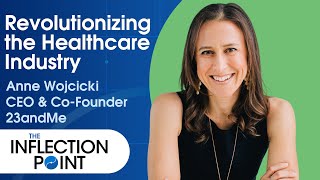
This is a transcript of a June 22, 2022 interview on the show 'The Inflection Point' where Monica Langley interviews Ann Wojcicki, co-founder and CEO of 23andMe. Major themes: Ann's personal inflection points (early career risk-taking, high-profile divorce and FDA scrutiny), 23andMe's founding vision to put individuals at the center of genetics and crowdsource research, direct-to-consumer testing (health and ancestry), ethical emphasis on consent and transparency, scale and research output (large customer base and published papers), business evolution toward therapeutics and integrating genetic data into clinical care (acquisition of Lemonade).
Questions this video answers
"Healthcare is a $4 trillion."
Over 12 million customers.
2006.
Lemonade (a healthcare telemedicine platform).
Chapters
For Ann Wojcicki, success is in the genes. As Co founder and CEO of 23andMe, Ann revolutionized the field of genetics.
It was really all about how do I put individuals first and foremost as like the center of the product, engage them with their genetic information, and that we together are all going to benefit from the human genome.
Her goal? Transform the healthcare system.
Healthcare is a $4 trillion. We're trying to pioneer a different way of looking at that.
I'm Monica Langley, and this is the inflection point. Hi, Anne.
Hi.
So I need to ask you about your inflection point.
Yes.
Was there a moment that so much changed for you and it changed the course of your life?
I think there's really two. So first, I, you know, I grew up on Stanford campus. I grew up in an academic environment. I only knew, you know, professor ville and academics. And I always thought, you know, I'm gonna be an MD, I'm gonna be a PhD and I'm gonna study and I'm gonna be at a university. Like, it never occurred to me that there were other things. And I graduated college. I was hanging out and my mom heard that, like, in San Jose there was a job fair. And she said, you should go. And I remember walking around and there were all these like. Like NASA was there, like all these interesting opportunities. Like, I could be, you know, I could be an astronaut, engineer. I could do all these different careers. And there happened to be somebody recruiting for banking. She colleges. I go out at utemp and I came back and I was like, I'm not in banking, but, like, this idea of, like, healthcare stuff is really interesting. And she said, and you had been.
A bio major at Yale?
I was a biology major. I wanted to be a doctor. I always loved it. And she pointed me to somebody, the Wallenberg family in Sweden. She said, well, they're looking to hire a biotech analyst. And I actually went to the job interview only to get the frequent flyer miles. And at the end of it, I came back home and I turned down the job. I got the job offer. And I said no. I remember my dad said, you know, I thought it would have been really interesting for you to take that job because it's so different from everything we've ever done. And I called them back and I said, I was like, you know, I'd love to actually try it. And they offered me the job again still. And I think about that moment because if I'd pursued the path which I had known, everything would have been different. And I took A risk. I took a risk going into, like, I didn't even know what a balance sheet was. And I've always thought about that moment, like, the serendipity of the fact that my mom, like, told me, like, go to this job fair, like, and the chance meeting of this. Of the woman who recruited me, and then the fact that I actually followed up on that opportunity. Like, everything in my life came from that moment. And it's one of the reasons why I always encourage people just to. You never know what experience is going to be transformational for you. So you need to, in some ways, just allow yourself to have lots of opportunities. I think that the second moment, that was obviously transformational and in some ways, in a different way. You know, we hear a lot about the FDA warning letter that 23andMe got. And I think what happened, which people don't realize, it was also the same time I was getting divorced, and it was also the same time I had two small children, like two children under three. So in this time period, I had the FDA come after me. I had articles like 23 and stupid. We had a lot of investors who came to me, and they're like, you know, normally people at this time, you just fold up and you go away. And it's a lonely moment where you realize it's all on you and you have to own the fate of how you want to be perceived, who you are, how you want to push things and what's feasible. It's all on you to decide your future. So I always think back on that moment as well as, like, there's parts of me that are like, I made it. I survived.
So people may not know who was your husband at that time when you were getting a divorce to make it so high profile.
Yeah, it was high profile because I was married to Sergey, who is one of the co founders of Google.
Sergey Brin.
Correct. Sergey Brin, who again, who remains a good friend. And it's the father of your. Two of my two children. And, you know, things in life change, but it is also one of those things that you're never fully prepared for.
And that was a transformational inflection point.
Yes. And I had also never been. I always took these pictures of. I used to take pictures of what my web profile looked like before I got married. And I had zero search results. And I remember always thinking, I was like, ooh, that's so nice. And it was one of those moments when we got divorced, and then also with the fda, how much you were.
All over the place.
People talk about you, and it's a little bit of that world, which I never anticipated. I never sought out that kind of publicity of, you know, defining who you are and not letting the rest of the world define who you are.
You know what, Ann, though, I also saw around that time period, you were on the COVID of a magazine called the world's most daring CEO. What did you think when you were called the most daring CEO? Did you think you deserved that moniker? You were kind of out there.
Listen, I think there's a lot of CEOs admire, so there's a lot of people, I think, out there that are pushing boundaries. But I think that what I try to do and I think what 23andMe tries to do is really fight for the rights of an individual in healthcare. And so I do think there's a little bit of a David and Goliath kind of element of, like, healthcare is a $4 trillion industry, and we're trying to pioneer a different way of looking at that. And that, you know, again, whether it's. That makes us the most daring, I think it definitely. Some people might say we're unrealistically optimistic. And I like to think that, you know, unrealistically optimistic individuals can absolutely create a new world.
What was your vision when you created 23andMe?
The vision from the inception has not really changed from the vision of how we've actually executed. So it was really all about how do I put individuals first and foremost as like, the center of the product, engage them with their genetic information, and that we together are all going to benefit from the human genome. We're going to crowdsource research, we're going to crowdsource figuring out what the human genome means, and we're all going to benefit. And you can benefit from additional insights about you understanding what your risks are and changing your behavior. Like, really understanding what behavior changes are going to most benefit you. So it was really all about, you know, creating a different type of system that's centered on you and you made.
It accessible to regular people. I mean, you could get a $99 genetics test.
The difference with 23andMe is it was because we're direct to consumer. It was not about maximizing the margin. It was really about enabling access.
So you as the founder and the CEO, I'm sure you've had every test. Have you changed your life?
I'm about prevention and knowing what your risks are. And my mom had breast cancer, and I'm on the higher risk for breast cancer. So there's Things I did, like, I totally cut out recreational drinking.
They told me when I was diagnosed, no more drinking.
So I think about, like, you know, the data, like, having that information actually really got me to change a behavior pretty early.
Now, when you founded 23andMe, I think 2006, did you feel like you were just, like, taking a big leap or that it could make it?
We started with the knowledge that no one today has ever had their genetic sequence and that in the future, at an undefined time period, every single person will have their sequence.
What about your business model for 23andMe? Are customers just curious about their genes like we've just talked about, or are they more curious about their ancestry or both?
It's definitely varied over time.
Oh, so you've seen it change?
Like, in the early days, I think people thought more about health. Like, genetics was associated with health more. The ancestry stories have really went viral in 2016 on, and it. It exploded. Like, people are looking for identity and they're looking for that connection. And suddenly your genetics really opened up a porthole that you had never knew existed before. And you had all kinds of people then discovering their ancestry, traveling around the world, and then you had the connection of DNA relatives, like, matching people online. And I think back also in those early days of the company, we never, ever, we thought maybe, like, one or two people would connect one day. Like, it never occurred that, like, you. You'd connect so many people.
How often does this happen for you all?
I mean, I get somebody. Somebody probably tells me a story once a day. It's quite common that people are finding that there's different relatives or they're finding, like, I found that I have a first cousin that we.
A first cousin that you didn't know.
Yeah. And we're super close now. Oh, my gosh. It's really. I mean, it's great. I mean. And the thing about 23andMe and genetics in general is, like, it should just all be about choice. Like, you don't have to do any of these things.
Yeah, but I guess a lot of people really want to know this, Stu. But there are unintended consequences, though. In some ways. Some people are really happy you are happy to find your first cousin, but some people may not be so happy they have a father they didn't know they had. But do you feel a responsibility for this?
What's different than 23andMe versus almost all of everyone else in Silicon Valley is, I think the third hire we had was a professor, Joanna Mountain, who came from Stanford, who Ran population health research studies, but has a strong background in ethics and genetics. And so we sat around, we spent a year actually coming with our consent form before we ever even launched the product and getting lots of feedback from individuals about what are the true risks, what is it that's sort of like a sci fi fantasy and what's a true risk.
That's an interesting way to put it.
Yeah, because there's things like, you know, you know androids are not coming anytime soon but like the non paternity is a real, it's a real risk. And I think a really important aspect of 23andMe has always been about choice and transparency. So like our approach to privacy is not to be paternalistic but to really make sure at every step of the way you know what's going on and you know what that Choice is. But 100% people get the information and they don't necessarily expect that, you know, their relative is not going to be their relative. And it's a surprise and it's hard.
How many customers do you have right now?
Over 12 million.
So you have a lot of data Ann?
We do.
So is part of your business model to now monetize that data and how are you doing it?
Well, if you think back on the mission of the company is really about understanding the human genome and benefiting from the human genome. And the only way the human genome is spectacularly interesting to me because it's only four base pairs, so it's an A, C, G and T and you get different combinations and that can yield a snail, it can yield a banana or it could yield you. And like for me I find that endlessly fascinating that were like you have such a simple code in different combinations yield all of this diversity on the planet. So how are you going to understand what that code means? And the way you're going to understand what that code means is by having a lot of data. And that's why again, the inception of the company was really about how can we crowdsource research. Because at no one institution like Stanford.
Harvard.
Glaxo, no one's ever going to be able to get enough information. It has to be a crowdsourced kind of mission to say let's bring everyone together, let's figure out what the human genome means. And so as we're on this mission, we have over 200 papers now that we've published. But one of the huge opportunities is to understand the human genome, but then to actually try to change it in some way. So 23andMe started a whole therapeutic side of the house, really, with this idea that part of our mission of helping people benefit from the human genome is going to be about finding cures.
What percentage of your customers opt in? So their data. I think I opted in. I want my data to go to research.
Yeah.
What percentage does that?
Yeah, most people. That's what's amazing. So I think that's part of what we're tapping into here is like this idea that everyone, everyone wants to help and make a difference.
Do you think you are, to the point you have so much data now on the genome that you're like the Google of personal healthcare?
I think. I mean, I think that's a great. But I think we're always, you know, the genome is so spectacularly complex.
I ring up if you're could be the Google of personalized healthcare because you're part of the fabric of Silicon Valley. But you also have such a unique tie to Google, don't you?
Yeah, it was founded in my sister's garage and my sister has been there for quite a while.
She was like the 15th or 16th employee.
Exactly.
She's the CEO.
She's the CEO of YouTube now. I mean, yeah, there's moments where we sit back. I mean, there's like. You talk about inflection points as well. Like, there's moments where we sit back and we're like. We really, like, we really, really did have like a very normal childhood.
But, Anne, when you said you had a normal childhood, let's step back for a second. Could you really have such a normal childhood when everyone knows that you have such a crazy, brilliant family? And as a founder of 23andMe, I have to ask, is it all in the jeans?
Well, I mean, it's all relative to the environment we were in, but we grew up on Stanford campus, so everybody around us had a parent who was a professor.
And he wasn't just a professor. He's head of physics.
He was head of physics.
Physics is a tough class, but my.
Dad would probably say, like, art history is a tough class for him.
And then your mom was a big sister.
My mom runs the journalism program at Paloto High School.
And then look at you. We talked about your sister. Your other sister is. She's a successful.
She's a professor at UCSF in a big. In epidemiology.
Yeah.
Very popular.
Now look at you three girls. All big successes and brilliant.
Okay.
You're one of the few women who are heading a tech company. There are not that many. What does that mean to you?
Well, I think it's important. I mean, it's become very clear representation matters. So I realized, like, my role is important. It's important to be a role model. Like, if you, if I'm lucky enough to have this position, then I have the responsibility to be a role model and to like and to support also the next generation. And one thing that I love is seeing the number of women CEOs in sort of like this next generation of healthcare companies.
Did you find that once you became a big time CEO of a public company that you were taken more seriously?
It took a really long time for me to have my own identity. When I would go to the World Economic Forum in the early days, people always look at your badge and if it says partner, you know, they look the other way.
You're a partner of.
I was a partner of Sergey's.
Yes.
And so, you know, you can't. I got in the relationship knowing that. What surprised me is that it was really only until probably a year or two ago that the press stopped referring to me as Sergei's former wife. And even though I'd done all these things, like I'm running 23andMe, we finally, we did like, we went public, we have this back. We do lots of things. Almost every article still referred to me that way. And so what's great is like I finally going back to that other. My second inflection point is like you make a decision in your life about what kind of life you want to have. There's absolutely moments where you know, it's just conservative, like in whether it's like a male dominated field and you get excluded for one reason or another or like the old boys club. And the old boys club definitely comes up every so often. And then you get, you know, healthcare is very conservative and it's a bit of.
And you are out there with a revolution in a way. Yeah.
I mean, yeah, not everyone loves it.
But I've seen articles where it says that you are giving the healthcare industry a heart attack sometimes, you know, the establishment.
But what I'm pushing for and what I'm an advocate for is like really a true partnership between the health care world and the individual.
What's next for 23andMe?
Well, we recently acquired a company called Lemonade and that is a very transformational acquisition for us because 23andMe has always been in the position of, you know, delivering data. And it's become abundantly clear to me that over the last 16 years people get their data and then they get stuck when they take it to their own health care provider. And so we want to become that leader that's helping you integrate it into your healthcare.
So tell me, what is lemonade?
Lemonade is a. It's a healthcare platform that has access, you know, telemedicine, so access through text messaging or video calls or telephone to healthcare providers in all 50 states.
You're becoming quite the healthcare mogul here.
I do this job because of the individual impact. Like, I feel like we really are impacting people every single day, and we impact people in truly transformational ways, and that can be on the health side, on the ancestry side, like you. We like what we do is incredibly meaningful for people, and it genuinely changes lives. So it's amazing. I mean, that's why I said, I do what I do and I fight for it because it's so impactful for people.
Ann, thank you so much for joining.
Of course.
The inflection point.
Yeah, I love it. I love inflection points. Yeah. Now it got me thinking about all kinds of inflection points. Thank you.









