How a Coffee Shop Continues Serving Customers from Home | Leading Through Change | Salesforce
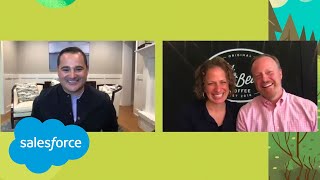
Amy and Ben Wright shut down all five Biddy and Bose Coffee shops and laid off 120 employees in April 2020. They pivoted to selling online with handwritten notes and social media, using Salesforce tools to manage the shift. Salesforce committed $50,000 to support the business.
Chapters
You.
Good morning. I'm Leah McGowan Hare and welcome to another one of our live weekly conversations as part of our Leading Through Change series, a chance for you to hear tips from business leaders who, like all of us, are doing their best to get through this COVID 19 pandemic. Now, before I turn it over to today's host, Salesforce EVP of CRM Applications, Bill Patterson, I want to preview the next hour. Bill will be interviewing Amy and Ben Wright, the co founders of Biddy and Bose Coffee, a small business out of North Carolina. Now, they have a remarkable story, not just about how they started their company four years ago and what they stand for, but how they're pivoting their business model to meet the moment. If you have any questions for Amy, Ben or Bill, please submit them in the Q and A section on your screen and we'll try to get to as many as possible later in the show. If you're watching on Twitter, please use the hashtag Leading Through Change. After the conversation, we'll have a split special musical performance by the one and only Lionel Richie. And as we did last week, we want to support the World Central Kitchen Jose Andres organization that is providing meals to people who need it the most right now. By texting meals, that's M e a l s 280100 you can donate $10 to the World Central Kitchen. In alignment with Rally for Restaurants, Salesforce will be matching donations up to a total of 200,000 through June 1st. Again, text MEALS to 80100 to help US carriers only message and data rates may apply. Now over to you Bill.
Thanks Leah and thank you for joining us during this unique and difficult time today. We're here to connect, help and learn from each other. Our hearts go out to everyone affected directly or indirectly by this pandemic and our gratitude is with those on the front lines keeping our community safe and healthy. Here at Salesforce, our top priority is doing our part. We are making some of our technology available for free in response to the COVID 19 crisis. Salesforce Care is a free set of rapid response solutions to help companies stay connected to their employees, customers and partners. Right now, you know I believe we are here to create innovation in service of others. So right now we are looking at how companies are pivoting to keep their businesses moving forward and pivoting quickly in the midst of this crisis. Brings me to our guest today. That's certainly the case with Amy and Ben Wright from Biddy and Bose Coffee. I want to tell you a little bit about their story because it means so much to me personally. Four years ago, Amy and Ben founded Biddy and Bose in Wilmington, North Carolina, and named it after their two youngest children who have down syndrome. All of their coffee shops are run by people with intellectual and developmental disabilities. Their mission was clear to make the world a better place, not only for their children, but for everyone living with disabilities. The first time I heard about Biddy and Bose, I reached out to him directly and I'm just so glad they responded. I had to learn more about how we could help them in their mission. And the coffee shop has been a huge success. In 2017, Amy was named CNN's Hero of the Year. And this year at Dreamforce 2019, they were awarded our very first service equality award. Things were going so well that they expanded their business to five different locations, all in the United States. That was before the world with COVID 19. So please join me in welcoming Amy and Ben today to talk about their experiences and how they are managing through this leading for change moment. Amy, Ben, I just want to start by welcoming you and asking you how you and your family are personally holding up during this time.
Good morning, Bill.
Hey, Bill. It's great to see you. And we're delighted to be joining you today. Thank you for asking about our family. Our four children are doing very well. We are spending a lot of quality time together as a family. A lot of dog walks. But we are grateful for our health during this really scary time.
How has this pandemic really impacted your business in recent weeks?
Well, about two weeks ago, I think it was, we made the decision to shut down temporarily all five of our coffee shops, and that meant laying off over 120 of our employees. It's been very difficult. As you can imagine. It's difficult for all of the business in America for the most part. And you know what exacerbates it a bit is some people with intellectual and developmental disabilities don't understand exactly why they've been laid off. So we've had to be very careful to do our best in explaining that it's temporary, it's not their fault, and we're going to do everything we can to remain viable and bring them back to work just as soon as possible.
And I think to piggyback on what Ben said, you know, the majority of our employees, 120of them, for them, it's their first job ever working at Bedembo's Coffee. So to have the excitement and the ability to start saving and planning for their futures and then have to put all that on hold has been a scary time for everybody.
I can imagine. You know, part of the magic of Bidimbo's is the in store experience, and I experienced it myself at your flagship store in Wilmington, North Carolina. It's the interaction with the staff, it's the atmosphere, it's the welcoming. It's a sheer love that you feel, you know, in your workplace. It's the feeling that you're part of something special. So my ask of you is, how are you trying to replicate that today online while keep serving your customers?
Well, we're glad you felt that. We hope everybody that comes in our shops leaves with that feeling. And what we've tried to do since this pandemic hit is create that experience as well as we can online. And we have online business where we sell our coffee beans and our merchandise. And with every order, we include a handwritten note from one of our employees so that customers still feel connected to our staff. We've ramped up our newsletters. We have launched a social media campaign called fill your feed. And we're trying to share good stories about what's going on with our employees and continue conversations with our employees, having them interviewed and then sharing them through our social media channels. Just trying to stay connected to our customers because they mean so much to us and we want them to continue to feel connected to our business and our mission.
You know, I ordered coffee. I got a handwritten note from Elizabeth. It completely touched my heart. It's the simple act of doing something so basic and routine that ultimately is differentiating for your business. And I think you have such a purpose driven business. It's so much more than coffee. You know, it's about accessibility. It's about making the world a better place where everyone has an opportunity. How has that sense of business purpose really helped you think about this transformation of the business during this time as well?
Bill? I think it's a good reminder that what we try to do is meet people where they are for who they are. And I think a lot of times in business, we try to meet people where we want them to be instead of where they are in that moment. And I think the whole world sort of is going through this time of figuring it out. And it's very much what we do on a daily basis. When our kids were born with down syndrome, we couldn't drop everything and go get PhDs in special education. We just had to figure it out. And when we started the coffee shop, we just had to figure it out. And this, this COVID 19 epidemic is so horrific and everybody's just having to figure it out. And it really is kind of pulling us through. It's kind of more of the same. It's just another iteration of having to figure it out.
One of the lessons you've taught me both is the importance of taking care of all of your employees. No matter what their ability level might be, no one can really be left behind. And I'm curious, what lessons can you pass on to other business leaders that they can then take forth about making their future more accessible to everyone?
I think what Ben said about meeting people where they are is step one. I believe as business owners, we are making accommodations for our employees with disabilities and without disabilities. Everybody has needs. And I think when you figure out what those are and you just meet people there, it brings out the best in your employees, which is what we all want to do as business owners. And you know, we practice that daily as parents of two children with down syndrome and one with autism and we bring that to work. And I, you know, a lot of the time I look through the eyes of being a mother when I have conversations with my employees and I and I think about them as family members and treating them such and it really does make a huge difference and I believe brings out the best in them.
You know, at times like this, Amy and Ben, I know your business model is put to the test and your ability to shift and pivot that business model is why we're talking today. Maybe you can talk a little bit about some of the choices that you made prior to COVID 19 that have allowed you to pivot so quickly from an in store coffee shop experience to now an e commerce business for Biddy and Bose coffee.
I'll kick that off by saying the best decision we ever made was teaming up with Salesforce to have all our ducks in a row. Little did we know we'd find ourselves in this situation right now. But I'll kind of like Ben, take over from there. But working with Salesforce such that our website was streamlined and able to handle incoming communication, which we're getting a lot of, that was well established. So I feel like we were really prepped for this moment. I don't know if you want to add to that, Ben.
Yeah, just. It couldn't have happened at a better time when you reached out to us, Bill, and we teamed up and started working together. It's just really enabled us to respond and to pivot from being within six feet of one another retail business to primarily right now, you know, we're online and online social media and the salesforce tools that you have enabled us with have just been so instrumental in that. So we are so glad that we're not just doing that now.
Well, it's been amazing to partner with you. You guys are amazing business and we know that right now so many small businesses are really fighting for their survival too. This isn't a story we know the ending to at this point in time, but in your case, I know it's to be continued and it's going to be continued in a thriving way. What advice do you have for other business leaders who are finding themselves at this critical point for how they carry their business forth in an era where many people don't know the ending at this point?
Bill, I would say I'll call it the three, maybe the four Cs. The three Cs are communicate, communicate and communicate. And I don't just mean with your customers, I mean with your employees, with your vendors, your suppliers, everybody. Everybody's in the same boat. Everybody's figuring this out. And you're not always going to have the right answers or even a good answer, but just letting people know what it is you're trying to do. There is light at the end of the tunnel. While this is a different movie that we're all watching and living through, we think we know the end of it and there's light at the end of the tunnel. So the fourth C would be, you know, capitalize. Boy, if you can find some additional capital somewhere, somehow temporarily find it. All the things that business owners know to do when times get tough.
So three Cs of communicate and 1. 4 of capital. I think that's great advice for everyone here listening to the call. You know, I know we have a lot of questions coming in from the audience today to and I want to bring back my colleague Leah right now and let's go through them together.
Perfect.
Great.
Let me unmute myself. Hello. Well, welcome back. And first of all, let me just sort of, sort of what resonated with me in that conversation? Communicate, communicate, communicate. Meeting people where you're at. And the thing that just totally touched my heart, Purpose driven business. Your mission and goal of accessible for all, creative, creating space for people of all abilities is just so heartwarming and just I know with that you are not going to fail. This is just a piece of a chapter and you're about to completely flourish. So I thank you for being that beacon of light and beacon of hope for not just small businesses, but for all of us with that, let's go ahead and grab the first question. A question from James for Amy and Ben. What was the response like when you opened your business and how do you think your sense of business purpose helped lead to so much success so fast?
Wow. Well, from day one, we had a great response in our community. We had a line out the door. We were going to open that business whether people showed up or not. It meant that much to us. But I think, you know, where our mission started was creating jobs for people with disabilities in our community and has really evolved into more of a human rights movement and showing the value of the lives of people with disabilities to the world. Because when other people pick up on that and they recognize that, then other business leaders are going to organically find a way to put people with disabilities on their workforce too. But it's been a wonderful journey.
You know, it's estimated that about 200 million people across the world have intellectual and developmental disabilities. And roughly 80% of those people do not have a job in their own community. So this resonates with people. You know, if the numbers are like that, then just about everybody you meet either knows someone or has someone in their family with a disability with the same problem. So having a purpose like we have and the mission that we have is just critical for not just our family, but for many, many people in the world.
Great.
Thank you. A question from Martin and this question's for you, Bill. You mentioned Salesforce Cares. What is that and how do customers or how are customers using it?
Great. Thank you, Leah. Thank you for the question, Martin. I firmly believe that technology should be.
In service of everyone.
And Salesforce Care is just that. It's a set of free products that we've built and made available to companies to stay connected to their customers, their employees, their partners, and really their communities as they navigate through this COVID 19 crisis. We are incredibly proud of this program. We launched it in a little bit more than the week. We have over 2000 companies from across 47 countries sign up for their four today. If anyone is interested in learning more, you can go directly to salesforce.com to learn more about the Salesforce Care offering. But essentially, if you have needs about rapidly responding to your customers or keeping your employees all under the same communications right now, where every moment matters in this crisis. That's exactly what we've created to help all in this moment in time.
Thank you for that. A question from Emily for Ben and Amy. How do you think these new global challenges will fundamentally impact your business?
Well, the global challenges won't stop. You know, we're a connected world and we're all going through what we're going through now. At the same time, I think we just have to adapt. We have to continue to do more of what we've always done, which is just adapt to the situation at hand. And if you can do that and do that with a smile on your face and realize that there's nothing so enormous that it's just going to take you down entirely, you just adapt and again, meet people where they are for who they are and make the best decisions you can with the information at hand. That's all anybody can really be expected to do.
Absolutely. And I love that what you just said reminds me of a saying my grandmother used to say, your purpose is always bigger than any problem. Right. So you all are definitely example of that. Question from MC on the live stream for Amy and Ben, what Salesforce products are you currently using and how have they helped you with your e commerce business?
Wow.
Well.
I might need some help from Bill or the Salesforce team to give the exact names of what it is that we use, but I'll tell you that one of the really huge things was when people pepper us with questions about how we do things and so on and so forth. At first we got nothing but emails and then Salesforce stepped in and they created like a help center for us. That was just incredible. I don't know exactly what you call that tool, forgive me for that, but that has just been an incredible thing for our business, to be able to respond quickly to people with good information rather than just responding to them eight weeks later, because that's how long it took to get to the massive emails.
And additionally, I'd say that Salesforce is there to answer our questions, to support us in ways that we never even dreamed existed. We're working on some trailhead right now to help guide other employers with hiring people with disabilities. It's a great use of our time while we can't be open and operating our shops. So we're excited to be rolling out that trailhead at some point here. And we're incorporating our employees in that planning process too, because we want their voices to be heard. They're the best advocates for themselves. So why not have someone with autism help design that so that employers better understand them? So lots of good things on the horizon.
And one thing to keep in mind too, that sometimes is easy to forget, is you don't have to be born with a disability. People acquire disabilities anytime in life. Right. One car accident, one stroke, one heart attack, one slip and fall, and you join the group. So it's not just about people born with down syndrome or cerebral palsy or autism or what have you. Disabilities come in lots of different shapes and forms, and we need to find ways to get out in front of it, figure out how we feel about it. Very much like we're doing with this COVID 19 pandemic. Right. Everybody's trying to figure out, how do I adapt in a world affected by COVID 19. We'll have another pandemic someday. Now, at least those of us who are alive going through this will have a better idea. The curve, the learning curve won't be quite as steep. Perhaps there's some similarities there.
Great. Thank you. Here's a question for Bill from Sandra on Twitter. Are there any customers who have been using Salesforce to help respond to this pandemic?
Yes, as I mentioned, there's 2,000 using our Salesforce care offering. But I want to highlight maybe a couple of the heroes. They're really doing something amazing on our Salesforce platform today. And the first is Nicole Solt at Lippard Components out of Indiana in the United States. Nicole is connecting a company with her greater community as they convert their production lines at Lippard to help start manufacturing personal protective equipment here to fight the pandemic. It's just an amazing story of how someone has just again pivoted their business on a dime to really respond to the crisis. Now, their Italian teams have been supporting the government on face shields and. And they're using now their sewing lines to produce new masks and gowns as other PPE items are in shortfall. So Nicole is doing amazing things. Can't thank her enough for all of the work for the community there. And then also Julie o', Donnell, who works at Connect rm, which is a technology platform that connects nurses and other care providers with nearby healthcare facilities to deliver staffing where and when it's needed the most. We are in a situation in many geographies where the healthcare system is just overflooded. And using Salesforce to help schedule that process, you know, to get scarce resources out to the places where it's needed most is also just another great use of the platform. So, Julie, Nicole, great examples of leaders and trailblazers in their own right, going out there and taking the platform and applying it for the good for all of us.
Great. Just love hearing those great stories. All right, next question is for Amy and Ben. A question from Heather on the live stream. You Two are so inspiring as business owners and especially to me as a parent. My 4 year old son has down syndrome. Do you have any advice for parents?
Would you like to take that?
Oh, gosh. Well, it's great to hear from you. And you know, I think it's just believing that your child can accomplish anything they set their mind to. We feel so blessed to have two children with down syndrome and one child with autism. It has taught us so much about who we are and what we were put here on this earth to do. And we're just, you know, we're excited to see what their futures hold. And I don't know if I'm going to add anything to that, but it's.
Well, we think and talk about it a lot. There's so much to say on it. We appreciate the question. I think one of the things that I'm sure that the person asked the question has thought about is when you have a child with a disability, you have to learn how to switch gears without a clutch a lot of the time. And said differently, you're grinding those gears a lot of the time. It's difficult because you're going back and forth from typically developing to people with disabilities. But I think it's a lesson for all of us that if you approach people again, not every disability is a visible disability. You approach them in a very neutral gear and figure out, you know, figure out who they are first before you try to get them to figure out who you are. Right. Seek first to understand, not to be understood, is the notion there? But anyway, back more specifically to your question. Just keep advocating for your child. I know that you do. The world is not built for people with disabilities. We're trying to change that. The business world is not built for people with disabilities. We're trying to change that. So just help us get the word out about what we're doing and get other businesses to consider hiring people with developmental and intellectual disabilities.
Great advice. Thank you for that. And just great advice in parenting in general.
Right.
And I really believe in that concept of meeting your kids where they're at and understanding them instead of trying to have them understand you all the time. Absolutely. You learn so much in this parenting journey. As a parent of three, I can attest to that. I am still in school. The next question is for Ben and Amy from another Ben. For a lot of customers, this crisis has opened up a communication line of transparency and openness, maybe for the first time among employees. As a company that prides itself on culture, can you offer some guidelines on how you've been able to weave vulnerability and empathy into your business.
Well, we sure can. You know, we just try to do a good job of listening, make sure we understand the needs of our staff and our employees.
And again, lots of communication.
We.
We just stay in touch. We make ourselves available and we communicate with them so that they know that we've got their back and that we will be returning to work here soon. That is the plan.
Awesome. That's just such great information. A time for us all to be open and transparent about how we're feeling. My manager has been amazing and opening up our meetings with that every time, so. Hey, Bill, I think that was the last question and I want to throw it back to you.
Amy and Ben, I want to thank you both for joining us today. You know, what you have built is more than a business model. It's really a business purpose. I know you'll make it through this because your mission is just too big to fail. And you have given me personally such a gift to learn what great service is to the world that I want to repay that gift back to you. Today we want to help you get through this crisis. So today I want to give you some good news. We're going to be purchasing $50,000 worth of goods from your website. Lots of coffee subscriptions, lots of those amazing hoodies that you guys love and have the hashtag notbroken t shirts. And I have two of them. I know. And I wear it proudly and I know because it's running on salesforce it will run safely and that purchase will go through no problem. Gonna be a lot of well caffeinated salesforce colleagues dressed in biddy and bose gear. Because we love you guys. We love what you do, we love what you stand for and we think that it is again a mission that we are so happy to support well into the future.
Thank you so much, Bill. We are just in awe. Just speechless.
Bill, you and the salesforce organization once again have shown who you are. Every time you communicate with us, you show us who you are. And this is no exception. And from the bottom of our hearts, we thank you.
Thank you both.
You can find more of our leading through change stories@salesforce.com blog. And if you're interested in how to scale and operate an agent work from home environment, come here from dell during our webinar Wednesday, April 16th at 9am Pacific Time. Finally, one more reminder. Please text meals that's M E A L S to 80100 to donate $10 to World Central Kitchen again. Text meals 280100 to help. And for all of you at home, while we're all at home, we can use some coffee. I know. I love my coffee. I've ordered care packaging package for my friends and family and you can too. Now get a pen because you'll want to write this down. Give you a second to get a pen. All right, here's the website. It's Bitty and BO coffee dot com. Now that is B I t t y a n d B E a u s C O F F e e dot com. Now order some great coffee, a mug, a warm sweatshirt or all the above and have it delivered to your door or surprise a friend. You can send it to me and support Biddy and Bose in the process. We'll be right back with you right here next Tuesday, April 14th. Until then, please take care of yourself and each other.









