How a Live Climb Became a Global Cultural Moment ft. Alex Honnold & @Netflix's Brandon Riegg
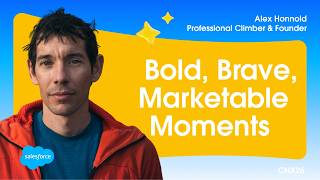
Alex Honnold and Netflix's Brandon Riegg discuss how a live climb of Taipei 101 became a global moment. They cover the risk management that made the stunt safe, Netflix's strategy for turning bold ideas into breakout content, and Honnold's foundation work funding community solar projects.
Chapters
Please welcome SVP Corporate Philanthropy and Employee Impact, Salesforce, Naomi Moranzoni.
Hello, welcome. Excited for our final session here. Look, I have one of the coolest jobs at Salesforce. My job is to prove every day that business can be a force for good. And we do this by investing in innovative solutions and asking the question, how do you take a bold idea and make sure that translates into real outcomes? Look, we're all marketers here, and we know that this moment is harder than ever. It is hard to get attention. It is hard to keep trust, and there is more content out there than ever before. So that's what this conversation is about today. Because we know that we need to think about how do you get not just those breakthrough messages, but the stories that matter. In 2017, Alex Honnold free soloed El Capitan. He did it without ropes.
Yeah!
No ropes, no net, no margin for error. And the The film that captured that climb won an Oscar. In January, he free-soloed Taipei 101, and that was broadcast live around the world on Netflix. Millions of people tuned in. Brandon Rieg was the executive at Netflix that made that bet. He has built his career bringing us our favorite shows, Formula One, Drive to Survive, Love is Blind, all of these shows that were bold moves that weren't reckless. Now, today we're not just going to be talking about climbing walls, big climbs. We're not just gonna be talking about streaming numbers. This is a master class in storytelling. It's about the framework behind those bold moves. It's about the preparation, behind the risk. And every one of us as storytellers who are choosing what story do I tell, when do I say it, how do I say it, we have something that we can learn from this masterclass. So please join me in welcoming Alex Honnold and Brandon Reig. Okay. All right.
Welcome. In the round. All right, let's do it.
Hi everybody. Sort of a, it's an unusual format.
Yeah. See all of our friends. Yeah. Okay, Alex, I'm gonna start with you cuz I think when people talk to you, one of the first questions you heard me talking about risk, everyone thinks about, oh, you're doing these crazy things, you're making these big stunts, these big moments, but you talk a lot about this is around low risk, high consequence. Talk to me about the intentionality. What do you do behind this?
Yeah, certainly the intention is to minimize risk as much as possible, to make something— I mean, the aspiration with free soloing is to take something that looks crazy and looks impossible and to make it feel comfortable and fun and safe. And so, you know, I can ideally achieve that through training, through preparation, through visualization, like through whatever techniques it takes, but to make it feel as safe as possible.
You don't go in— you said this before— you don't just walk up and you're like, oh, that looks cool. I'm going to go climb that. You really took hours and hours of preparation behind that.
Yeah, or years of preparation behind that. Yeah. I mean, people see— I mean, I think the film Free Solo did a really good job of showing the prep that went into it. But even that was— the filmmakers were with me for the 2 years ahead of time. And I've been sort of aspiring to that climb and working towards it for maybe 8 or 9 years before that. So, you know, I put a tremendous amount of time and effort into it. And I think that's something that people often miss because they watch like a YouTube clip or something. They're kind of like, he just walked up to that rock and he climbed it. And you're like, no, I've been climbing 5 days a week for 30 years. Like, this is literally my whole life. I've been grinding. So like, everything I do is in service of this.
Yeah. So Brandon, we're talking about that focus and that intentionality. Right now, we know consumers don't have a lot of focus, right? We are hyper distracted. Everyone's clicking between the different streaming services. When you think about Netflix, how do you think about that content that's gonna stick, that content that's gonna break through?
Yeah, I, I wish there was an answer that was bulletproof, but you know, we work in a business, I think as, as you all are familiar with too, where success isn't guaranteed and certainly isn't even the norm in some ways. Um, but I think what we found from the early days of our original programming was, you know, we used to say like, it's a fresh take on the familiar. So we're not reinventing things, but we, we are challenging ourselves in the creative community to come up with sort of a new or more innovative approach, whether it's a dating show or—
Is it fresh, not unfamiliar?
What do you say? A fresh take on the familiar.
A fresh take on the familiar.
Which is a nice catchy phrase.
Yeah, yeah, yeah, I was like, that's clever.
But, you know, and I think when we've done that, more often than not, it has paid off in some of the bigger bets we've made, whether it's on the scripted side with something like House of Cards or Orange is the New Black, certainly on the nonfiction side with Drive to Survive, Love is Blind, and Taipei 101 or Skyscraper 101. So, you know, there's nothing given. But I think you, you don't say, I want to do the status quo. You're always going like, well, what is the next thing to be bold and brave and fearless about trying, understanding that there's no guarantee for success. But the times that you do succeed sort of validate the times that you didn't succeed. And that sort of— that's what pushes the ball forward.
And a little bit of comfort with that idea that maybe along the way you're going to fail, that it's not all going to— they're not all going to be those breakout success.
Yeah, I mean, I think, you know, we obviously were, you know, founded with some Silicon Valley underpinnings. And my first week there, somebody said, listen, my one piece of advice, if you're not failing, you're not trying. And that, to like a content person, is sort of a transformative thing to be told, but also really unburdens you because you suddenly go, okay, let's not worry if it doesn't work. And that's a mentality that's very different than I say what traditional media has come up with over the last, several decades.
When we talk about failure in climbing, climbing is an incredibly humbling sport. And this idea that each time you go up against that wall, you may not— you may not get to the top. You may not get over that crux you're thinking. Talk about when you think about failure within climbing and the work that you do.
Yeah, actually, I love that because in climbing as well, if you're not failing, you're not trying. And I think it's important to draw a distinction here between free soloing, which is what you've maybe seen in the films, because that obviously you have to succeed because if you fail, if you fall, you're going to die. And so, in the case of Skyscraper Live or Free Solo, these big free soloing objectives, obviously you have to succeed. But in general, in climbing— but it's important, though, that those two events— I mean, those each represent a couple hours of climbing spread over many years apart. The rest of the time, like I said, I'm climbing 5 days a week. And on those days, you basically want to be failing all the time. If you're not failing, you're not trying your hardest. And you're not pushing your own limits if you're not It's like, how do you know what your limit is until you fail? And so as a climber, you're basically always failing. And then it's just on very select occasions that you're like, OK, this is the moment where it's time to perform. And then you execute. And you make sure you don't fail on those days. But actually, though—
We all remember that failing actually gets you right.
But I'll say that it's easier to know that you're not going to fail on those days when you've spent literally weeks, months, years failing consistently because you really do know where your lines are. You know what you're physically capable of. You know what you're capable of even on the days where you're really tired, even on the days where the weather's bad, all those types of things. Like when you've been failing nonstop for years, you're like, "Well, I know when I fail." And so it also means that you also know what you're capable of succeeding on.
That's where you're going to, it's high consequence, but really it's low risk because you have done all the high-risking.
Yeah, exactly.
I think something that not a lot of people know about you, which is something we're really proud to be supporting through Salesforce, is the Honnold Foundation, which is, tell this group about what is the Honnold Foundation? How did you start this? What are you working on?
Yeah, so in 2012, which is hard to believe it's so long ago, but I started the Honnold Foundation. So the Honnold Foundation is a nonprofit that supports community solar projects around the world. And I started it when I was living in my van still, just traveling full-time, because I felt like I should be doing something useful in the world. I mean, I love rock climbing, and rock climbing is amazing, but at the end of the day, it doesn't really matter. It's just climbing rocks. And I felt like I should do something that had some real impact, some I wanted to do something of significance in life, so I started donating a third of my income to the foundation. And over time, obviously, that's scaled up, and with the support of partners like Salesforce and many other companies that have contributed now, I think this year we're passing $20 million in cumulative giving to— Thanks. But basically, it's just been my personal approach to try to do something useful in the world. I settled on community solar projects basically because I felt like energy access was a foundational need. Access to energy is a base need for all humans around the world. And I think, as of right now, there's still something like 800 million people on Earth without access to power. And I feel like that's crazy. So that's what we're working on.
It's an incredible organization. We've been able to support really interesting organizations that, for example, in hurricanes, You know, they create hubs for people to go there. So when the power goes out, that stays on, they're able to get that access to relief. And you do it across a broad range of different organizations. One of the other things that I think is interesting about you is, you know, we talk about at Salesforce business as a platform for change. So thinking about all of the tools that we have at our disposal, not just our philanthropy, but, you know, our product, our employees, and we think about bringing them to service of our communities. You do something really interesting, which is bringing scientists along with you on some of your climbs, taking them to places that they wouldn't be able to reach to do that work around climate change. Talk to me about that, how you are using your platform and some of those experiences.
Yeah, I've had a few different expeditions that wound up being TV shows in which we took scientists to sort of remote places to sort of do science in places. I mean, the real benefit of that isn't so much the science that they're doing, it's it's elevating their platform, like basically putting it on TV that doing climate science is cool, and that what happens in eastern Greenland is important, and things like that. But I think it's kind of the same motivation behind the Holland Foundation, which is ultimately, if you're going to do something, you might as well try to do something useful. I mean, I love rock climbing, and I love traveling to these places and going on expeditions. But if you're going to be doing that, when possible, you should try to do it in the best way that you can, try to do something useful, try to bring team members that can actually contribute to the world. Like one of these expeditions we went— to climb tepuis in Guyana, which is like these giant— actually, if anybody's seen the movie Up, the Disney movie, where they're like kind of flying around these crazy towers sticking out of the jungle, basically went to climb those. Those are real things in Guyana and Brazil and Venezuela. And we went with this scientist. And on that trip, we found, I think, 6 new species. And you're kind of like, oh, how crazy is that, that all it takes is just getting the right person at the right place, and you just discover all these things that are new to science just because nobody's really been there. You're kind of like, well, if you're going to go on a trip like that for your own pleasure to rock climb, you might as well discover some new species while you're there. You're like, jeez, it's like, what an opportunity. And so I think the more I've learned, the more I'm kind of like, well, if all these opportunities are around, you have to take advantage of them.
Yeah, and I think part of that is bringing that information and inspiring people to act. And so Brendan, I think about the work that you do. And so full disclosure, I'm married to someone who loves race cars, Formula 1. I could not stand watching Formula One shows, watching that with him. And then Drive to Survive came out. And I am fully addicted. And I am like, oh, there's a new episode. And I think a lot of people like me maybe saw this as kind of a fringe thing or something maybe just for the people who are into cars. And you brought it into that mainstream. When you think about evaluating these new stories, these new shows, What are you looking for?
I mean, it sounds obvious, but I think for a lot of the folks on the teams, you know, we've been working in entertainment for a good amount of years. And so we've seen, you know, a lot, or we've seen the ebb and flow of the business. And you kind of know when something comes along that just grabs your attention, that sort of makes you sit up and go like, oh, that's a different take, or that's a different idea. So there's that bucket. And then there's some, like with Alex and The Climb, you know, I'd worked at ABC when we did Nik Wallenda, and I remember the Felix Baumgartner space jump, and we did a lot of David Blaine stunts. And so there certainly was a history of those those things working. And for whatever reason, that category had sort of fallen by the wayside. And yet it was something that I distinctly remembered as being very powerful piece of programming. So when, you know, Alex came in and talked to some of the folks on the team, it was a hallway conversation that lasted maybe 10 seconds where they pitched the idea and I was like, 100%, we should do that. And then it was about figuring it out. But, you know, you kind of, you do know when you see it. I think again, it's, You know, we, we're in the business of trying to surprise and delight people. And I think, you know, there's different approaches that different networks or platforms have. Ours is just one that we want to keep pushing the bar and sort of meeting the consumer where they're at because we think that sort of is the most consumer friendly. But that does take a willingness to lean into risk for sure. But again, the upside feels like it is much greater than what the potential downside is.
But so it was a 10-minute hallway conversation. I heard from Alex—
10-second hallway. What? 10-second hallway.
10 seconds, even less.
Yeah, they came and they said, oh, by the way, we just saw Alex Honnold, and he pitched this idea. And I was like, let's do it.
Because that was— you had this— you told me that this was just a story or an idea that you had for a while. What was the conversation between— other than 10 seconds, I mean, you could recreate it right here for us now, but like, How does that work? How do you build this connection and trust between two partners on something that is risky like this?
I don't know. Well, I mean, so the skyscraper idea had actually been born sort of in 2013, I think. I'd scouted it for a different TV project with a different network that ultimately pulled the plug because they thought it was too risky. Not just, I think, the risk of me falling off, but also just the budget stuff.
Oh, that's a big risk, you falling off.
I mean, that's risky as well. But basically— No, I don't know. It just didn't come together for whatever reason. I mean, TV is fickle, like that kind of stuff. Who knows exactly? But it never came together then, but it stayed in the back burner for me that I knew that it was possible. I knew the building was striking, inspiring. Everything about it was perfect for climbing. And so basically a different production company and I were sort of working together and the idea came back together. And then Netflix, you know, I mean, to your credit, were willing to take that chance and was like, yeah, let's do it. Let's try this thing that nobody was willing to do in the past.
And I also think it's what are you putting out there, right? Whether it's a marketing thing or whether it's a TV or film project. And we had said to the creative community, look, we have this live functionality. We have a pretty clear vision or strategy over the types of things we want to do. And we challenge you guys, refresh some of the things or feel invigorated. You sort of have this wide open slate on a service like ours compared to— the traditional linear model. And so I think we've shown that time and again, and the production company that Alex had partnered with came in and said, we have this really loud idea. It's been difficult or challenging to pull off for a variety of reasons, to find a partner. And we just have a different mindset. And I think that's why there was no question, because in terms of what we were aspiring to have as a live offering, this checked all the boxes. Now, there was risk. I don't want to be flippant about it. I said to Alex earlier, it was last summer, and we had a lot of internal discussions about it, and the PR team, the comms team, the safety team were like, "Is he really doing it with no safety rope, with nothing?" And I was like, "Yeah, yeah, he says it's easier than it looks. He's not that worried." I was this quasi-decisive because he had such confidence, and so I channeled that. But I, as I said to Alex before, I was sitting there with my, at the time, 4-month-old, and I got nauseous watching it. My hands were starting to sweat. My mother-in-law was berating me for having put somebody in this position, you know, because it was suddenly very real. It's like, this is a very binary proposition. He's either going to make it or something not great is going to happen. But, you know, it— again, you have trust in the partnership, you have trust in the people, and, you know, you And you lean into risk at times when it feels like you're doing it in a responsible way.
OK, let's talk about the—
Can I just add an aside? Because actually, I think it's interesting this emphasis on the live component of the show because from my perspective as a climber actually doing the thing, there's literally no difference whether it's live or not. And ahead of time, there were tons of people approaching me that's like, oh, isn't it crazy with so many people watching? And I'm like, well, I don't know how many people are watching. I don't care. I'm clinging to the side of the building. The thing is, is that so for my experience, the actual climb feels the same either way. It's a handful of my friends hanging on the outside with ropes filming. It's like I'm working with all the same people either way. The crew's all the same. Basically, my experience is exactly the same. But in a lot of ways, doing it live is actually better because as soon as I finished, we were done. The show was over and then I just went home. I literally flew home the next day. I was like, this is amazing.
Whereas— No post-production to deal with.
Well, that's exactly. And so, you know, with the film Free Solo, I did this —free solo that I've been working on for whatever, 8 or 9 years. It'd been this life project for literally years. The next day, we took a rest day because everybody was like, oh my gosh, we're smoked. And then we spent the next 5 days up on El Cap filming, filming close-ups, filming tights, shooting your hands, shooting your feet, shooting other things, shooting different light, getting still photos for the other imagery. We basically just toiled another 40 hours on the wall. And it made for an incredible film. Everything about it's great. But I'm like, that was a lot of work. I mean, a live event, it's pretty chill. And so I think—
Chill for you. I mean, it's like, yeah.
Yeah, well, basically, I just think it's important, you know, people are like, but it's live, that's crazy. And you're like, no, live makes it easier. It's like, you know, because either way, the experience is the same. You just climb the building and make sure you don't fall off.
I think the crazy part, because I was just, I was getting so many texts from people being like, tell those people in the building to stop bothering him. And I was like, I'm texting them the same thing. Like, what are these people doing trying to take a selfie? Like, let the man climb.
I watched it after the fact, I'm gonna be honest. Like, I'm one of those people, I couldn't, like, and I think this, I mean, this is a question I think for you. So yes, for you as the talent, as the climber, it was like, great, it was done, it was over, you didn't have to do those additional shots and whatnot. But that was a decision to make. I mean, with Free Solo, like, spoiler alert, we knew you were fine and cool, and it was, how are they gonna build the story?
And yet it's still a harrowing watch, I think, for a lot of people.
It is, I mean, right? Yeah. So what was your thinking? Why were you— why for Netflix was live was the way to go on this one?
Throughout my career, I've worked on a lot of live shows, whether it's The Voice or Dancing with the Stars and things like that. So I had been aware of, I think, the power of what I'd call just live TV. And the reason for this, I think especially you touched on the beginning, we're all facing, you know, a culture right now where there are more options for entertainment than ever before, right? Whether it's social media, whether it's the internet, it's video games, there's all these TV channels and services. So attention is at a premium. And to really, to really cut through, you know, it takes a lot of things. And it's not just the idea. Sometimes it's the execution and whatnot. And it just felt to us that with something where the stakes couldn't have been any higher, where it felt like a big spectacle, that the thing that served it best was it being live. And if you chose to engage with it in real time because that was the version of it that you wanted, that was great. But equally, you know, we have a service that has grown with on-demand programming, and you may not be surprised to hear that, like, we doubled the audience in the post-live window. And anecdotally, from our audience research, a lot of people like you were like, I just could not watch it live. Like, I just didn't have the stomach for it. But what was great is that people still wanted to see it, and so they came in. But, you know, it's hard to break through. And I think— I do think as human beings, you sometimes have this— not sometimes, you have this drive to want to feel like you're part of something bigger or have a communal experience. And live does offer that. It could be the Taylor Swift concert. It could be watching Alex climb the skyscraper. But there's something to be said for when your friends and family are tweeting tweeting and talking and texting. And I think it reminds us of the connection that we have to one another. So that to me is— there's not a lot of things that check those boxes, but certainly with someone like Alex and the sort of challenge he set for himself, I thought it met all the criteria we looked at.
One of the things that I thought was really interesting about Taipei was the weather delay. So you had 24 hours. It got postponed. Alex, I'm going to come to you on some of the why and some of the learning there. Um, what in the marketing world, if you delay, you lose momentum, like the gas sort of goes out. Um, but instead it even created almost more urgency and more excitement behind it. When you think about something like, um, Skyscraper Live, like was that lightning in a bottle or is there repeatability? Is there a framework behind that where you can think about something similar that, you know, grows in that momentum?
Yeah, I think Look, I think the principles remain the same in terms of what can make for compelling TV. I think, again, he's one of one, right? And so his craft and his skill set are applicable in a way where we'd love to do more with him if he wants to do it. But I think equally when we've looked at other stunts, and again, if you look, Felix Baumgartner, that was an incredible moment. Nik Wallenda, again, that was incredible. So we know they don't come on that frequently, and you have to be ready when they do and be opportunistic. But yeah, I think it is possible to— I think it's possible to replicate the appeal or the buzz of it. It's just no two things will look alike, because they're all bespoke sort of attempts.
How do you weave between— how do you sort of differentiate that lightning in a bottle? What are some of the markers or signals that you're looking for that you're like, OK, This one, yeah, maybe that one.
Yeah. I mean, I've got to imagine for you all, it's like there's some products are bigger than others. Some campaigns are more robust than others, right? Like, I think you're picking and choosing. Even for Alex, like some climbs are— Are just better than others. Right, and others are like, you're like, damn. So I think we look at that in a similar way. It's like, and sometimes they surprise you. I'll give an example of a show. We have two baking shows. One was Nailed It. One was called Is It Cake? And conventionally, if you have kids, hopefully they've watched it and you've watched it with them. But, you know, those are sort of cute little cable shows and you know what generally the audiences that those attract. And yet those are two examples where they became very big and outsized relative to what the expectation was. So there's those happy, you know, circumstances. But I think for the most part, you have done this long enough, you start to get a sense of what could work. I mean, the Mike Tyson-Jake Paul fight we figured was going to be pretty big. It even exceeded those expectations. But, You know it when you see it, generally.
Alex, go ahead and get a little bit to the preparation and the work that you did. I think one of the interesting things that you were talking about was in that weather delay, that wasn't a risk. That wasn't one that you were like, hey, maybe I'm going to go to— talk a little bit about what your preparation, some of that experience was, and some of that decision that came.
You mean the decision-making around the weather delay? Yeah. Well, I mean, it was a really easy decision to make because basically you just can't climb the building in the rain. And actually, but that had been part of my preparation that on the flight, When I went to Taipei, I had sort of intentionally decided that during the week of preparation ahead of time that I wanted to climb on the building when it was wet just to see what the tolerance was, to see, you know, if it was possible when it's wet. 'Cause climbing on rock, you can still, actually, there's a famous climber that has a quote, "You can still climb in the rain, just not as hard." And so, you know, it's like basically you can climb on wet rock, it's just kind of slippery, and so you have to be careful. But I was kind of like, well, maybe you can climb on a wet building too anyway. So I tried it in the rain ahead of time with ropes, preparing, it was totally impossible. I couldn't— it's just so slick. I mean, you can imagine wet glass and wet metal. You literally can't hold on at all. But I haven't climbed that many skyscrapers, so I didn't really know for sure. And so I tried and was like, oh no, you can't do this at all. But in a way, that made the decision-making super easy and super simple because I was kind of like, well, if it's at all wet, you can't do it. And so you have to wait for it to be dry. And so that just makes it clear.
But even the preparation you talk about of why that time of the year— I mean, you guys really looked into everything.
Yeah, we looked at the weather. I mean, the thing is other times of year it's too hot. It's too humid. In theory, that was actually the dry season. I mean, it was raining, but actually it was raining less. I mean, it was like misting quite a bit, but not that much precipitation. So all it really took was a couple hours of not misting for it to dry out entirely. And so we were watching the weather constantly. We were— yeah, I mean, we had obviously planned for it. I mean, this isn't the type of thing you do willy-nilly. You put quite a bit of effort into it.
Alex, how do you pick your projects, whether it's the wall, the building, what are you looking for?
I mean, I think I personally like looking for things that are new for me, that are challenging in the right way, things that are different, that push me. I mean, I think with the skyscraper, it's really hard to get the opportunity to climb skyscrapers. Unsurprisingly, the people that own these buildings don't really let you climb on the building unless it's for a thing. And that's why it's so great to have a partner like Netflix for this because you just don't get the opportunity to climb something like that without it being for a reason. And so for me, pulling together this reason to get to climb this really striking— and the thing that I'm looking for in an objective like in a skyscraper are the same things I'm looking for in a rock wall. So you want it to be singular. You want it to be striking. You want it to— like, Taipei 101 dominates the city skyline. It's so much taller than any other building. And so from anywhere you are in the city, you look up and you're like, oh my gosh, look at that. It's so incredible. And in the same way that El Cap— when you drive into Yosemite Valley, you look up at El Cap, and you're like, look at that wall. It's just totally next level. So, you know, I'm always looking for objectives that just inspire me in the right way, ideally that are in sort of the sweet spot for difficulty where it's, you know, hard enough to sort of push me and to challenge me in the right way, but not impossible.
So. So a question for both of you. I think in this moment, when we talk about trust being hard to keep, a lot of that hinges on authenticity, right? And that people, the sniff test You don't pass that as easily as you used to. It's really important to make sure that you're connecting in an authentic way. What's challenging, I think, in both of the worlds that you inhabit is that as you look to scale, so whether that's taking a hit show and take it global to a new market, or you're taking something like climbing in the mountains and bringing it to the cities and doing this, how do you balance authenticity with that scale and growth? How do you think about not dilution of that, of that work and that storytelling that's so powerful as you bring it to new markets? So I'm going to start with you, Brandon.
Actually, may I just say, because I think my answer will be a little more specific to this climb, and I think you'll probably have something a little broader to say about it. But I think specifically with climbing the building, it was interesting because I think the production company and sort of the TV element of it, they kind of wanted to make it extreme because you're trying to appeal to this broad audience. And I always from the beginning was like, you know what? Extreme extreme. Like, let's just frame it as like, this is amazing, this is beautiful, this is cool. I was like, anybody watching me climb this is going to see me smiling and having a good time and thinking like, this is incredible. And so from the beginning, I was always reluctant to frame it as like, this is extreme sports, because I was like, obviously this isn't as hard as a lot of the rock walls that I've climbed, things that I've spent literally years practicing on and training for. But it's like, you wouldn't want to see somebody do that on live TV because that's, that's too much. Like, that's, that's, that's just too too extreme. I mean, there's certain things that actually are just too edgy for, I mean, that should be the new Netflix tagline, making content so extreme that nobody watches. It's just like too, it's like just too, you're like, ooh, that's like right on the edge. And so those are the types of solos that you do by yourself in the mountains because you care about it. It's like you're not trying to do that for broad audiences. So anyway, my point is just that I felt like talking about authenticity, it's like as long as you're true to the fact that like, this is challenging, but it's not the next level in difficulty. It's challenging enough to be fun. It's engaging. It's beautiful. But ultimately, I'm up there because I'm excited to be climbing something like that. I'm excited to have a good time. I think the whole thing is, you know, I'm excited for the experience. And so I'm going to be true to that and just go up there with a big smile and have a good time. And I mean, my bet was always the audiences would see that and be like, that's cool. Like, he's— you know, and I suspected the audience would still find it sort of intense to watch just because the nature of what it is. You're still like, but if he falls, he dies. Like, jeez. Anyway, OK, that's my specific use case.
But you do see that. I mean, in your shows, in the things you watch, you see that joy. I mean, that's one of the greatest things is you've taken a passion and you've turned it into this incredible career and ability. But you see that in any of the videos of you that you are having a good time on the rock.
Well, I mean, and that's the whole point. It's like I'm climbing for my own pleasure. I'm climbing because I think it's amazing. I think it's beautiful. I think it's worth doing. And I don't think you need to— try to pretend otherwise. You don't need to make it seem super extreme. You're kind of like, no, this is amazing. I mean, it's challenging, but I'm doing it because it's cool and I like it.
Yeah, I mean, right. I would say for you, you're like, OK, I think for the rest of us, we're going, that doesn't look easy or achievable.
Yeah, I'm not saying you should go do it or really that anybody else should do it.
I'm definitely not doing it. That's like Michael Jordan being like, hey, you just score. It's like, OK. Yeah, look, I think authenticity is the thing that works the most. And I think it's how do you harness that, whether you're marketing something, whether you're putting a project together, whatever it might be. That's the challenge. I mean, there's the safer path, which I think a lot of us know. And there are times when maybe that's the right move. But it takes a different sort of initiative to say, let's try something different. Let's still stay true to it and be authentic. But I do think— consumers respond to that in a real meaningful way. And you see that, I think you see that in the things that have worked in popular culture. I think, you know, I think you see that genuinely in social media. I mean, a big part of the discussion we had with F1, and I love seeing them on these ads, but, you know, typically sports leagues, they really cling tightly to their brand and their IP, as they should. You know, they're running a billion-dollar league. But when they came to us and they said, what we want to do is we want to break through in the US, like, that's really the big goal. And I said, hey, I get that. I said, in order to give us the best chance of that, you need to entrust us with doing what we think we do best with our producing partners. And that means you don't have the final say in what is on screen. And we can certainly address things like they don't want to, you know, if you're in the garage and there was a bunch of technical sort of secret stuff that's like, sure, we'll blur that out or cut it. You know, I go, if you look at social media today, the people that are the most vulnerable and open, they show the highs and they equally show the vulnerability and the lows. That's who the public responds to and they connect. And if you can have that in a show versus like a real polished PR, like puff piece, like that's the difference. And I think, I'm sure, you know, you see that with advertising, you see that in marketing, you see that with products. So I don't think it's a secret. The challenge is like how do you go about conveying that to the consumer. And you know that, you know, like with what I do, most of the times you're not as effective as you hope to be, but eventually you do get there.
I mean, so when things like Drive to Survive, right, these really incredible produced also shows, when you're thinking about greenlighting a show like that, when you're going to make this multimillion-dollar investment, you're going to make this big swing, what is the ROI that you are looking for? What are you— how are you beyond viewership, What is it that you know, like, okay, this is success for us. What does that look like for Netflix? Or is it just viewers?
Well, no, I guess from a business standpoint or when we got into live, I said, look, I said the two metrics are hopefully high watch and then a lot of what we call conversations. So a lot of buzz, that it's going to be very talkable, buzzy effect. So those are the two north stars, right? It's like we want to have a lot of people watching, we want to have a lot of people talking about it. But again, in a business where the majority of the time it's not deemed like, you know, home run or success, what you stress to the team is you want to have a good at-bat. And you can't predict ever with 100% certainty whether something will work or not. But as I've said, I like if you're being bold and you're making the best decision for the product, and you have a good at-bat, I said, that's really, in my experience and my belief, that over the course of time, you bat .300, .400, which is great. You know, I think with Alex, it was, this feels like a singular opportunity. It's a great team, it's a great piece of talent. This feels like a must-see, can't take my eyes off of it opportunity, and let's shoot it. And I think even if nobody had watched it, I guess you could say it would have been a failure in terms of the business goal, but I would have still maintained that it was a success from the execution goal. It's like he did it. It looked beautiful. It went off safely and smoothly. We were very proud of the finished product. I think, you know, Alex was very happy with the finished product. And at the end of the day, that's what you can control and you have to live with that. And yeah, yeah.
I mean, this idea around buzz and creating stories, one of the things that I think was also interesting, and Alex, you are often, you are the hero in most of these stories, right? This is Alex and the climb and the ability. One of the things that you do really interestingly at the Honnold Foundation is you actually flip that around, and you've done storytelling and produced movies for some of your grantees, really trying to say these are the heroes of the story. Tell me about why you pass the mic that way. Tell me about, tell this audience about some of these organizations that you've done some films with.
Yeah, well, I mean, all we're doing at the Honor Foundation is supporting our grantees, supporting our partners, basically giving money to communities for them to execute their vision for what will make life better, basically using solar for energy access within their community. And so, I mean, to me, it makes total sense that you basically help them tell their stories. I mean, these are folks that are— and the projects that we're funding are often quite diverse, ranging from solar-powered boats in the Amazon, in the Ecuadorian Amazon, to solar on native lands in the US to— I mean, basically, because energy access, because having electricity can be used in such a diversity of ways, like for refrigerating food, for food processing, for connecting to the internet. Basically, we supported this school in Guatemala with indigenous rural girls. It's like, basically, energy access is just so important to so many different things. And they're just doing all these amazing projects that that really it would be great if more people knew about. It's like everybody loves good news. It's nice to know that people are out in the world doing meaningful projects like that. And so I think anytime we have the opportunity to share the work that our partners are doing, it's a big benefit to them, obviously, but also I think it's just good for everybody to know that there are projects like this going on in the world.
One of the stories that I was most impressed with was the story of the land guardians that you have that were in one of the communities. Can you tell the audience a little bit more about—
What did you say, the what?
The movie that you had done around the Land Guardians that were using solar to be able to call in to stop the illegal forestry.
Yeah, yeah, I mean, that's exactly— that's another good example where it's like you're in a rural community in the Amazon. I mean, basically empowering indigenous communities in these rural places is often the best way to protect the lands around them, because it's like, obviously, nobody cares more about their land than the people who actually live there. Who have lived there for hundreds of generations. And so if you're trying to protect the rainforest, often the best way is to basically empower these communities. And so once they have access to power, then they can charge drones. They can charge cameras. And basically, they can enforce laws within their domain in the same way that anybody else could, where when they see illegal mining, they see illegal deforestation, they can basically document it, report it to authorities, and then hopefully get those activities stopped. And so it was— I mean, we've funded several projects like that in different regions. It's interesting because I think before we funded that work, I didn't totally know that that is actually one of the best ways to protect the environment is actually to help these human communities that live in those places. And so it was really an educational opportunity for me just to be like, oh, if you're trying to protect nature, you're often better off helping the people that live there because they will protect their own lands better than anybody else is going to protect them.
Absolutely. More value out of standing forests than taking them down. Yeah. Part of the way that you work through the Honnold Foundation is really rooted in the idea of trust. You've talked a lot about trust that comes from your climbing background. I think the trust that you can see that exists between Alex, you, Netflix, and Brandon. Talk to me about how trust and partnership works within your world.
Yeah, actually, I mean, our approach with our grantees and partners is not that dissimilar to what you're describing in Netflix where there are only certain things that are that you have control over, which is sort of your process. And so we vet our partners carefully, and then once we do, we trust them entirely. And so we send them the money, and then we help them execute their projects the best that they can. And I think that mindset really does come from climbing, where you trust your partners with your life. And so then you're just fully— you're all in. You're literally tied together. And so, yeah, I mean, I think that's— I mean, and honestly, it's a better way to live. That way, you're not always like, looking over someone's shoulder being like, are you doing it right? Are you doing it right? Let's see some accounting. Let's see some, let's get more paperwork involved. Nobody's ever needed that.
What about you? What about trust?
Yeah, I mean, I think there's a, I'd say there's a lot of elements that go to, I mean, trust. Look, I think you can't have scale without trust, right? You can't scale a business if you don't have trust with the people that you work with that will work in reporting. To you, and your earlier question of like, as we globalize this, sometimes on a micro level, it's Alex and team coming and saying, we have an idea, and this is why we think it's a good bet, this is why we think it's a responsible and safe bet, and we trust him. He's the expert in that area. I think with us, as we have grown as a company, we make a lot of bets. We put on a lot of programs. I say all the time, one person can't be the sole arbiter of what we do. And there have been times when I've lobbied for shows that my team has really vociferously pushed back and we haven't done it. And there's been times that I've said, we should do this even if the majority don't have the same vision. And, you know, I think you need to, as a leader, it's like you need to be clear, you need to be decisive, but you also have to empower and you have to allow your teams to go without fear of you looking over their shoulder or micromanaging it. And if you've hired correctly and you build that environment, I do think it pays off and it allows you to scale and it allows you to have that greater success. So, you know, again, I don't think it's a magic formula, but it's sometimes easier said than done. And but it does start with having that, that thing of trust. And, you know, I think now that we've worked together, we've established, you know, another level of trust. And so, as I said to him, whatever you want to do next, we would love to be there with you.
And that's how it goes. I mean, trust is absolutely that foundation of so much of the partnerships, the growth, the opportunities that we have. Unfortunately, we are up to our last question for both of you. This has gone incredibly fast. Really deeply appreciate this. I'm going to ask you each to give one piece of advice to the marketers that we have in this room, people who are trying to get attention, who are trying to maintain that trust, who are trying to do that next bold and big thing, what advice do you have for them? Brandon, and then Alex.
There's a lot. I think I'll go back to something I said at a previous chat. When I got to Netflix the first week, they said to me, somebody said to me, if you're not failing, you're not trying. And I think when you work in a creative medium, when you work in a business where you're trying to reach people, and you know that success success is more elusive. That's a really, to me, like a real lightbulb moment of, you know, you've got to be at a place and also have the confidence in yourself to be like, I know this might not work, but the potential to advance the ball or to have real success sort of like justifies it. And hopefully you work at a place where they encourage you to take those sorts of swings. But I think, yeah, you know, it's like be fearless, be responsible. But I think you have to have a level of fearlessness.
Absolutely. Alex?
I don't know. I mean, honestly, I don't know any advice for marketers. I don't know anything about selling anything. How about advice to humans? Well, actually, I mean, so I was trying to think of advice for marketers, and actually, it came back to what we were just talking about with authenticity to some extent. I feel like if you're trying to sell a thing to people, it's like, ultimately, is it useful for them? Basically, only try to sell something to somebody if it's actually useful form. I don't know. I mean, you know, it's like, that's what I wish I was marketed more to. You know, basically I was kind of like, oh, you know, because I get flooded with things, same as everybody else, where it's like you're constantly seeing ads and whatever else, and you're kind of like, I think the aspiration is that you only sell things that actually matter. Like, you know, do real things of real value. It's like, I don't mind seeing ads if it's like an actually useful product that, you know, could improve my life. Yeah, so I mean, I guess it just comes back to being authentic, being real, like sell stuff that matters ideally. I mean, there are a lot of people in this room and surely they can't all be selling something that matters. So maybe half of you guys can like find a— get into like woodworking.
Well, incredible parting thoughts. What we're hearing here is that we need to take risks. We need to build trust with our partners. And we clearly need to do something that matters. So thank you, Alex. Thank you, Brandon. Thank you, everyone. Thank you, guys.









