How A Top Chef Stays Zen In The Kitchen | Ep. 24 | The Inflection Point
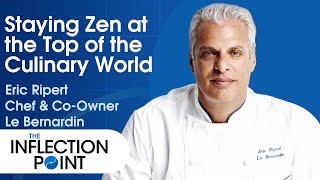
Eric Ripert, chef at Le Bernardin, talks about moving from an anger-driven kitchen to one built on respect, his daily meditation practice, and why simple preparation with perfect technique matters more than complexity.
Chapters
I'm in New York City with Eric Repair, widely regarded as one of the best chefs on Earth.
The minute you start to think about being the best or anything like that, you suddenly are lost.
You have to deliver excellence night after night, plate after plate.
Yes. I mean, in the kitchen, it's not like it's a walk in the park. You have to be extremely focused and it's intense.
Do you have a certain approach to cook?
I want to have a wow effect for me and the team when we tested, and therefore I trust that the client will have a wow effect, hopefully.
I'm Monica Langley. This is the inflection point. Thank you for inviting us to Le Bernardin. This is a special place.
It is special. And thank you for being here. Of course.
Now, what is your inflection point when you realized things were so different for you and would change your life forever?
Well, I had many, but one that was probably the most important was in culinary school. It was a two year program. So the first year we were learning how to be a waiter and cook and many other things. So they wanted me for the second year to become a waiter, and I wanted to become a chef to study how to cook. So they decided to compromise with me and they said, we're going to invite your parents and they're going to see you in a dining room. And then with your parents, we will discuss it and hopefully we all agree that you're going to become a waiter. So my mother sits here, and right here, it's a general from the French army with his wife and a party, and I order the cocktails and so on, and my mother is watching and I come and. And I don't know what happened, but I dump the tray of the cocktails on the neck of the general. So I clean the general, I go back to the bar, come back with the cocktails. I start to serve, and it was an ice cube on the floor. I slid on the ice cube, the tray goes on his wife. The entire tray at that point start to scream, and I'm sent to the kitchen forever.
So it turned out great for you because look where you are today. You are considered, Eric Ripert, one of the best chefs in the world. What does that mean to you?
It means a lot for the team that is working with me and for me also as well. It means that I'm rewarded for doing what I love the most, which is cook. So it's amazing to have compliments like that and to live the dream, basically.
Do you feel a special pressure? Because that's what you're called, you're the best.
No, I don't feel pressured. When I come to work, I think about what I'm supposed to do with the team in the kitchen. Create, be with them, to make sure that we execute properly in a timely manner, to basically please the clients and so on. And that takes all my attention, energy, efforts. So therefore, I have no space for stress. I think the minute you start to think about being the best or anything like that, you suddenly are lost. You're not doing your task.
Do you have a certain approach to cooking?
I like very, very high quality ingredients. They can be modest ingredients, but very, very fresh or very special, and then cooked in a simple way that it's going to elevate those ingredients to the next level.
I've been fortunate to eat here at La Vernadin. To me, there's nothing simple about it. It seems like the most sophisticated meal I ever had in my life. How is that simple, Eric?
It's simple because we master the techniques. When you know the techniques, the process is very simple, and we do not overcomplicate the presentation in a plate. Because I think that the more you put in a plate, the more you're going to lose the essence of the principal ingredient, which is that Le Bernardin seafood.
Tell us about Le Bernardin. When you took over, it was sudden. Was it hard? I mean, you were 29, right, or so when you took over because the co owner died of a heart attack.
Yes.
What was that like for you?
It was very emotional. When Richeliebert Le Course passed away, it was also a surprise. He had a heart attack on the afternoon and then never came back to the kitchen. So it was very difficult. And I missed him tremendously because not only was my boss, but he was my dear friend. And then his sister, who was his business partner as well, asked me to take over completely the kitchen and to create my style and to completely change the menu. And it's what I did and so on. And the menu evolves with the experience that I have in my life by traveling, by eating somewhere else, by interacting with other professionals and so on.
Do you want anyone who walks in and sits down and have a meal to feel an emotional connection with what they're eating? Do you even think of it like that?
I don't think about the client having an emotional relationship with the lobster, for instance. I think about making the lobster delicious, and then I'm confident that something will happen in between the client and the lobster.
But you sometimes have an emotional experience with Some of the food you cook?
Yes, of course. Sometimes the experience is not that good. It's emotional in a bad way. And we work on it and work on it and work on it. And sometimes we stop and change and decide to have another style of recipe. Or most of the time, we continue until we reach the level of, I will say contentment, but it's much more than that. A level of being like, oh, wow. I want to have a wow effect for me and the team when we tested, and therefore, I trust that the client will have a wow effect. Hopefully.
You can talk so easily about being a chef, but part of what you have to do at Le Bernardin is also run the business and be creative and innovative as a chef. These seem like such different skill sets.
They are very different. So creativity is something that you cannot control. You cannot push a button and say, I'm creative, and push a button and stop creativity. So usually I have a pen and a piece of paper, and when I have an idea, I take notes because.
It just comes to you.
It comes to me like that, and then it disappears. And out of 100 ideas, usually 90 are bad, 10 are good. But then it's pretty fine. Then the days are very long. So I spend time managing the business. I spend time in a kitchen. I spend time in creativity. I spend time for myself. I spend time with my family. And this is kind of a holistic approach to my life and to the way I manage the business in harmony with staying sane and also giving back to my family.
You know, a lot of celebrity chefs, and you are a celebrity chef, everybody knows your name. So a lot of them would exploit their name or the name of their business and go put their names on. Other restaurants expand to. We could have a Le Bernardin Las Vegas. We could have an Eric Repair fish sauce or something. Why have you not done that?
So it doesn't make me happy.
It could make you money, though.
Money is not happiness. Money can contribute to happiness, but not necessarily happiness. No, money can buy the happiness that I have with having one restaurant and being most of my time at the.
Restaurant which is named the top restaurant in all of the United States, in all of the world.
We are part of that family.
Okay, let's talk personally about you. Yeah, you. Food has always been, seems to me, the center of your world.
Yes.
Tell me how food has played a role in your life, starting with your childhood.
At age four, I am in a kitchen with my grandmother and my mother, and I want to help. They don't want me to help. Of course. But I'm eating a lot of things. I'm a gluten and I'm a gourmand, and I'm everything.
At four years old.
Oh, yes. And five and six and seven and eight. My grandmother cooked soul food from Italy and from Provence. My mother is very influenced at the time by modern cuisine, which was nouvelle cuisine in the 70s, and cooked fine dining for me. So I'm in heaven when it comes down to eating at the table.
You're speaking about heaven of food, but your childhood was anything but heavenly. Your good friend Anthony Bourdin said it was heartbreaking, horrifying and inspiring. Your parents divorced when you were how old?
Five years old.
Okay. Then your dad died when you were.
10 years old, and then you had.
A stepfather that was.
He was not my friend. So it was definitely challenging, for sure.
Then Chef Jacques came into your life.
Yes.
That seemed to be a very pivotal moment.
It was a very pivotal moment. Jacques was a legionnaire, retired legionnaire, that was a chef. He had a small restaurant, 20 covers. He was by himself in the kitchen and his wife in a dining room. And he had a temper. And he was very well known where I grew up, Andorra, which is a small country, to have that temper and to accept clients or to fire clients in the middle of their meal and so on. Temperamental, yes. It was like a Broadway show. But he liked me a lot, so he let me go to his kitchen, he let me try the food, and he showed me simple recipes and so on. And I was tremendously inspired by him. And instead of studying at night, I was reading cookbooks. So I had bad grades. I was reading recipes from famous chefs like Paul Bocuse and so on. And When I was 15, I ended up in a principal office with mom. And they said, you know, your son cannot go further in his studies. It's really bad. He has to choose what they call a vocational college school and was culinary school. And I was delighted. I was so happy.
And then that's where you went and your training officially began?
Yes.
Okay. So what was that training like?
So culinary school was a little bit boring in the beginning, but I knew I had to go and pay my dues and learn and cut my fingers and burn my hands and so on, which I did, of course. And I finally, two years later, graduated from that school and was ready to go work in restaurant. So I ended up in La tour d', Argent, 1982. They were celebrating their 400 year anniversary.
Wow.
And I was the youngest. I was 17 years old in that kitchen. And it was very, very, very challenging and difficult. We were working, like, 16, 17 hours a day, six days a week, eating very little because we didn't have time. And it was a lot of verbal abuse in the kitchen. We were being screamed at all day long almost. I mean, a lot of physical abuse, too, in a sense that they were kicking our butt, punching us in the shoulders, throwing plates at us, and so on.
And you took it?
Yeah, of course I took it because it was the only way to learn from the best. It was no other way. It was not such a thing as a civilized kind kitchen.
When you became a chef of your own kitchen, did you emulate that to some degree at the beginning?
So in the beginning, yes, I emulated what I had learned from some of my mentors. So I was screaming in the kitchen. I was throwing plates on the floor when the.
Well, what if the food came out and it didn't look right, didn't taste right? You were like, I would take the.
Plate and throw it on the floor. And I was treating the cooks with no respect, basically. And I learned very quickly that, first of all, they were all leaving, especially the best cooks were leaving the team, and nobody wanted to work with me. And I was miserable in my life. And one night I was home thinking, what's wrong in my life? And I realized it was all coming from me being the bad guy that I was the bad person that I was.
What was behind this attitude and behavior?
So I was young, I had a temper. I had definitely some anger. And until I realized that anger is not a quality. Anger is a weakness. And when you realize that, suddenly everything changed. An angry chef is not someone powerful. It's someone weak. Overnight, I decided to switch and change. And I said, I am totally wrong. Starting tomorrow, we're changing completely the culture of the kitchen. And it took a bit of time, but we did it successfully. And I have the kitchen I think, that I always wanted.
Today, you have to deliver excellence night after night, plate after plate.
Yes.
Can you be that chill?
I mean, in a kitchen, it's not like it's a walk in a park. You have to be extremely focused, and it's intense.
Do you ever lose your temper in the kitchen?
I do not lose my temper in the kitchen. I do not lose my temper in my private life. But I'm very demanding with myself and with the team, and I can be very firm. At the same time, I'm always very respectful, but it doesn't mean that I'm going to accept something that is not right.
Has Buddhism helped you in your life or your kitchen?
Even so, for me, Buddhism has been very important. I discover that religion, philosophy, science, for me is the three. But it's very personal. It changed my life completely. Yes. And today I still every morning, wake up very early and meditate and practice and read and educate myself. And then the day starts.
Let's talk about cooking beyond Le Bernardin. What do you eat at home?
It depend of the season. It depends of the time.
What's your go to? If you want comfort food, what do you pick?
In my house, I have always in the fridge French, some camembert and saucisson and things like that. So in the middle of. Or if late at night I'm hungry, I'm gonna slice a bit of dry sausage, a bit of cheese, some toasted bread, and I have few snacks like that.
So you wouldn't get a bowl of cereal and pour some milk over? I mean, you wouldn't have a bowl of cereal?
I don't think I ever had a bowl of cereal.
In your life?
In my life.
Oh, my God. I'm sending you some cereal.
Send me some chocolate.
Do you have chocolate in the house?
Oh, yes. I love chocolate.
Okay.
It's not a day in my life that I don't eat chocolate.
What is the most fun you have when you cook?
I have fun all the time. When I cook. I can be peeling potatoes, and I have fun. However, I have to say, playing with the sauce, it's something that really give me great pleasure because sauce capture flavors, right? And it's untangible. It's like music. You cannot measure flavors. You cannot say, oh, in that sauce, I'm going to put half an ounce or teaspoon of rosemary flavor. It's all in your head. It's all playing with it. It's all making sure that the flavors will be in harmony and will not fade or grow and so on. Sauce are very complex. It's like playing jazz.
So a recipe, when you make a.
Sauce, you are playing jazz.
And you're the one who said you like simple food, and you just said it's all complexity.
But jazz is simple for the jazz man.
Eric, what's next for you? You have spent the last few decades reaching the heights of the culinary world. What excites you? One of the top chefs in the world. In the world of food.
What excites me is to live my passion, make people happy and mentor my team. And when I see members of the team that leave us and are successful on their own. It's a great, great pleasure for me. It's a great honor to be the one who taught them to succeed and be happy in their life. Simple.
Thank you for joining me, Eric.
Thank you so much. It was a great pleasure.









