How Accenture Is Outmaneuvering Uncertainty | Leading Through Change | Salesforce
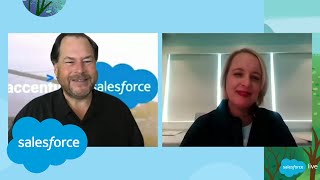
A Salesforce "Leading Through Change" conversation (May 21, 2020) featuring Marc Benioff, Julie Sweet (CEO, Accenture) and Jujar Singh. Julie describes Accenture's response to COVID-19: focusing on the future, calming leadership, rapid digital acceleration, partnerships (public and private), and people-first/stakeholder capitalism. Examples include contract tracing and Emergency Response Management (launched May 19), rapid deployments (e.g., bank virtual agents, PPE distribution), and collaborations to help communities (food programs, Not Impossible Labs). Jujar previews work.com capabilities: symptom triage with Einstein bots, testing scheduling, manual contact-tracing workflows, case and social-needs management, field-worker assignment (Salesforce Maps). The session also promoted donation matching for the World Food Programme.
Questions this video answers
May 19, 2020.
March 11, 2020.
More than 60 million pieces of PPE distributed to more than 300 hospitals.
Salesforce will match donations through July 31, 2020, up to $150,000 U.S.
Chapters
In the last few months, businesses have had to figure out how to pivot quickly to adjust to this ever changing situation. And this brings to mind a quote for me by Tony Hsieh, CEO of Zappos. A big business is like a ship. There's lots of amenities and it can go further, but it's harder to turn quickly. Well, imagine that you're at the helm of leading a 500,000 person company and you have a workforce and clients all over the world while a global pandemic is unfolding. Well, that's the position today's guest found herself in this spring. But she stepped up and she handled it with the three C's. Compassion, care and confidence. Good morning, I'm Leah McGowan Hare and welcome to another one of our live weekly conversations as part of our Leading Through Change series, a chance for you to hear from business leaders who are doing their best to navigate through this COVID 19 pandemic. Now, before I turn it over to our awesome host today, Salesforce chair and CEO Marc Benioff, I want to preview the next hour. Now Mark will be interviewing Julie Sweet, the CEO of Accenture and how she is helping to maneuver her 500,000 person company with agility during this crisis and helping customers turn massive challenges into into meaningful change. Now while we'll also have a special presentation on how you can reopen your business and your community safely with the help of work.com and finally, we'll conclude with a special performance by Alicia Keys exclusively on Salesforce Live. So for those of you watching on Twitter, you're going to want to join us at salesforce.comlive/live to see that portion of the show. Now as we do every week, we want to make sure on Leading through change we are working to help those that need it the most. So millions of people are already relying on United Nations Food program for their food to survive and COVID 19 is making these conditions even worse. This pandemic could double the number of people suffering from severe hunger by the end of the year. We don't want a food pandemic to a hunger pandemic. So to help prevent us, please join us in supporting the world Food program and they're trying to reach at scale 100 million people across 86 countries with life saving support. Now if you can please go to salesforce.com wfp and join us in ensuring that the world's food most vulnerable people can have enough to eat during this crisis. Now through July 31, 2020, Salesforce will be matching donations up to $150,000. Again, that's salesforce.com WFP with that. Over to you, Mark.
Well, hello everybody, and it's great to be back with you on Leading Through Change. This is an amazing series. It's been watched now by tens of millions of people around the world. Incredible. And look, I want to especially thank you, Leah, for what you've been doing on this series, bringing us all together and hosting us. You've done just a phenomenal job with the series, Leah. So thank you so much for your incredible energy and inspiration and vision and everything you're doing. And you're right, today's show is fantastic. We have three amazing people who are going to be joining us today over the next hour, and that includes Julie Sweet, the CEO of Accenture. We're also going to be joined by Jujar Singh of Sales Force and of course, incredible Alicia Keys. And for the Alicia Keys portion, as Leah said, we're going to be shifting over to salesforce.com live. So make sure that you shift over with us to hear the amazing music of Alicia Keys. But let me tell you right now, we have an amazing guest, a great friend, a great partner, a good friend of mine, and she's just an amazing leader. I'm so happy to see her as the CEO of Accenture, Julie Sweet. Julie and I have so many things in common, and we also spend so much time working to guide our customers and our partners in their digital transformations. It's been so much fun to team up with her to do incredible things. But I'll tell you, it's really our common values that have really guided us, and especially the deep commitment that she's had to equality, diversity, and inclusion. At Accenture, Julie has been called by many different organizations the most powerful female CEO in corporate America. And I would have to agree with that. But the truth is she's one of the most powerful, inspiring leaders probably in the whole world. So, Julie, we're so happy to have you with us today.
Well, thanks, Mark. Thanks for having me. And those are way too kind of words, but you've been a real inspiration to me. I became our global CEO not that many months ago. And as I was kind of learning and changing over the last few years, your leadership, which is so well exemplified by today's program, which is bringing people together, but it's also supporting organizations in the community. And that's one of the things that I think you've actually helped change the whole way that corporate America and corporate across the globe thinks about our role. So a Lot's been talked about stakeholder capitalism, and I mean this sincerely, and I've told you this off camera as well. So this is just your example of how you've led the company and how you've done your investments. And what you talk about, I think, has been an important part of the movement and is never more important than right now, where we need to all make sure that we're finding purpose and that we're not letting things like equality and sustainability lose focus as we move forward as a world.
Well, Julie, you're right. CEOs have a choice. They can choose to kind of reflect and be part of the mantra of Milton Friedman, the business of business, of business, that stakeholder, that is kind of stakeholder capitalism's, I would say, greatest challenge. Stakeholder capitalism is really the business of business, is improving the state of the world. These two thoughts that you're either about shareholders or you're about stakeholders. Well, I think in many cases it's just a false choice. I'll have to say, Julie, it's really your leadership that has illuminated that. You have Inspired so many CEOs to become stakeholder CEOs to think about the bigger world, how they are going to see their role in the world as not just generating tremendous earnings, per share, corporate profit, which you've done, but also using your business as such a great platform for change. How you have done that, Accenture, has really inspired me. So let me just ask you, look, this has been such a challenging time. We're facing just an unprecedented moment. What has guided your response to this crisis?
Well, sort of one of the things I'd say at the very beginning, one of the things that we had to rapidly do was to start focusing on the future, because there's a tendency to mourn what's lost, to give you some sense of it. When the pandemic was declared March 11, we just finished our second quarter. We have a different fiscal year. It was the biggest sales quarter in our history. I did earnings eight days after the pandemic. No one asked me about Q2. Right. Like, because it was something else. And it was one of those things where, you know, new leadership team, all of these exciting things that we were doing. And we had to say, look, we need to face where we are and embrace the future and move forward and bring our organizations along. And I think it's important. It's true in our personal lives. You know, it's true. You know, my daughter is graduating from sixth grade and isn't having her little graduation, which is you know, think of all the high school students and the college students, and it's a really, really tough time. And just as a leadership team and with our people making sure that we can embrace a future, and there's a very tough reality now, but at the same time, you see so many great things happening around the world and people coming together. You know, the work we're doing, you know, in the state of Massachusetts, where for the first time ever, the first movers were to create the contract tracing. And we brought this together and we're bringing. And it was just such an example of people coming together quickly. And so I think there's, you know, it's really important to do that. And then the other thing I just do as a leader is I remember that my job is not to put stress in the system. And so being calm at this time is really important because we are facing tough things. And so that's one of the things that I constantly tell myself as a leader is my job is not to add to the stress.
Well, Julie, you know, you're right. We are mourning the past. And, you know, we've all walked through a door into the future. And I think for many of us, we think that the past is coming back somehow, that this is going to be magically over. Everything's going to be back exactly as it was. But it's not. It is quite a bit different here in the future than it was just a few months ago. It feels like we're in a very much of a digital world right now. That's evidenced by this program. We're not doing this on a stage in San Francisco with thousands of people. We're doing this over zoom. We're in a digital first world. And also we're in a work anywhere world. I'm in my home, you're in your home. We're doing these things in anywhere we want to be, and we're using the technology to augment this. I know that's been such a huge vision for you and your company to help companies make that leap from the past and into the future and to be a digital first company and to help them create these work anywhere environments. Let me ask you, Julie, what has been your greatest challenge in helping companies or organizations? I think you're also working with a lot of public sector organizations. I know we're doing some of that work together during this time. What has been your biggest challenge to helping organizations make that leap?
Well, Mark, I think in many ways what I thought would be the biggest challenge was how slow companies Operate. I think what's been is not actually occurred. It's been incredible to see. In fact, many CEOs are saying to me, I don't want to go back because they've seen how the entire organization can move really fast. But there is something happening and a lot of people are talking about digital acceleration and it can become as danger of becoming a bit of a cliche, but there's something real that's happening. What we're doing together at a bank, pre crisis Salesforce and Accenture, we're helping a major bank move from being all about products to be all about customers. A familiar story, right? Big transformation. Well, the crisis hits and all of a sudden that bank's small businesses and their people, they have questions. How do they access the relief program? How do they get their checks posted quickly? The bank was overwhelmed together very quickly with the power of all of us. We were able to use the Einstein bot to put in something, a virtual agent to answer the questions rapidly overnight. Then on top of that, I remember when you announced Dreamforce, the fact that Salesforce would now be able to connect into aws connect in the fall. Remember that? Well, all of a sudden you had to have the agents that were going to still answer calls work from home. We were doing all of that. Now I will tell you, pre crisis, we would have said that was a challenge. But here is a bank that had been investing, who had good partners and we worked together. Now what's happening because we're moving out of response to rethink transformation, we're working with that same bank to say, look what we achieved. Can we think about that same program that we were working on pre crisis and it in smaller increments to drive faster value because we just experienced how to do it. And I think what companies are really finding, and it's true as well in the public sector, is that you can actually achieve faster. Now transformation still is a longer path. If we could transform in 90 days, we would have done it. But how you get there is different. And so I think it's really exciting to see the opportunity of how we've come together and had a great outcome. Because for our people together who worked on that, what they're talking about right now is how they helped small businesses get what they needed then. Now it's like, well, what else can we do together to transform quickly and with more value?
Well, Julie, that is such a great story and it's so powerful and I know we've done so much work with these banks just in last 90 days and helping them to issue, for example, all these amazing loans that they've been doing and also participating in these government programs and working with partners that we have like Encino and others, that's such a powerful moment to see them have to spin up and create systems instantly that have really affected our entire economy. Has that surprised you?
Well, in terms of the surprise, it's less about the surprise and more about the scale. Because I think that what it's really done is we've always talked about partnerships and the power of technology, but the scale at which we did it in that speed has been really, really fantastic. I also think what we're seeing is what agile really means. If you take the work that we did first starting in Massachusetts and now creating the emergency respons management program that I know Judar is going to show later, that was a spin it up, test, learn and continue to do features. It's sort of the epitome of the cloud, right? But very, very rapidly as we've expanded it to different states and California, Louisiana, you guys continue to have new features that we're working on together. And we're seeing that even in how companies are now reopening. We're starting manual. We have lots and lots of companies we're working with right now who can't wait for the technology to be implemented, even if it's short. But then we're taking those learnings and we're building it in with you guys into work.com so that we can quickly implement it. And you're seeing that in so many different places in the healthcare where they're learning and testing telemedicine and so on. And I think it's putting us on a different path. And the speed at which that change is surprising because we were all talking about agile organizations and how you test and learn and do that. And now you have almost overnight organizations embracing it as a new way of working. And I think it's, you know, I talk a lot about the need for resolve because what we don't want to have happen is the hardest part of the crisis past the first stage of response and then we do go back and many of the COs are saying they don't want to. What does that mean? It means that we all need to think about how do we make decisions and how do we institutionalize these changes as we move forward. And I think that's part of the next phase of what we all need to do to capture the good of how we've responded together.
Well, Julie, I think that's so interesting. And I'll tell you why it's so powerful for me, which is that if you had asked me 90 days ago what contact tracing was, I didn't really know. I mean, I know that we worked on something five years ago, and that was for the CDC when SARS was happening. Never got deployed because SARS basically got extinguished. And then all of a sudden, to get the phone call from so many states and so many organizations that we would have to deploy contact tracing because it's a critical way of extinguishing the virus. We need to wear a mask, we need to practice social distancing, we need to wash our hands. And we also need to use contact tracing in coupling with testing so that we test. And then also we have the opportunity to contact people who maybe have been with somebody who's had a positive test. And now to see so many states, especially the ones that you've mentioned and many, many others, basically say we need immediately to scale up a contact tracing system that will kind of create a whole contact tracing core for hundreds of thousands of people who are going to be able to do that all over the country. That's amazing to me. I would never have thought that in a million years that we could actually build and deploy that. You've been such a key part of that in the development of work.com. has that surprised you as well?
It has. It really has been amazing. Particularly because it's not something that you simply do. As you said 90 days ago, we would have said, really? What exactly is that? And to do that, it really takes a group of people who understand the health component, who understand how public sector operates, who understands how the private sector operates, who gets to privacy concerns. I mean, the way that it's been built so that, in fact, people can both protect their privacy and yet we can achieve these public health outcomes has really been extraordinary. And that is something I think that we should all be surprised at and learn from.
Right.
Because what you just described happening was incredibly complicated and yet done very, very rapidly. And, you know, so it's exciting and it's the spiritual part of Embrace the Future. Just think about the other things. We'll take the hunger that Leah started with. As you know, right now we're working together with an organization, Not Impossible Labs under the Hunger. Not Impossible. And we built together an app that allows us to connect people who are hungry with restaurants where there's prepaid food. And we've now rolled that out together with this organization in three cities. You know, very rapidly. I Mean, this was done in days. Right. And I believe that it's those kinds of solutions that are being inspired by these larger things that people are seeing. And so now let's start to think about, you know, education and the. And the new opportunities where we can come together, both in our businesses, to help our, you know, our clients and, you know, do the very important things, but also to find more answers to areas that have been a bit intractable in the past. And that's where I think we talk about, you need to face the reality, what we're in. We have a very tough reality. We are going to have some tough times ahead, both health and economics, but there is also some extraordinary opportunity to work together as society, as governments, and as businesses to make lasting improvements.
Well, I think you're so right. When I think about over the last three months, if you had asked me what we would be doing at Salesforce, I would have never could have possibly imagined what was happening. Probably one of my most shocking moments was we received a phone call from Sam Hawgood, who's the chancellor of UCSF here in San Francisco, our major medical system and university. And Sam basically said, hey, I want to help you. I want you to get involved in something. I said, well, what is it, Sam? He's like, you need to understand we're running low on ppe. I'm like, I don't know. What is ppe? I had never heard of a PPE before. Well, of course, that's mask, that's gloves, that's gowns. And what had happened is, because of all the increased activity in the emergency rooms, he was already starting to get quite low on PPE. In March, before anything had really started, I said, all right, well, I'll help you, and I'll make some phone calls. And I was very fortunate to find one of our common friends, Daniel Zhang, the CEO of Alibaba, who said, oh, I'm going to make sure that you are prioritized, and we'll make sure that you get PPE. We've, of course, acquired now more than 60 million pieces of PPE, distributed that to more than 300 hospitals in the last couple of months. If you had asked me that we would be involved in that or that we'd have to make that a priority for our organization, I wouldn't have thought it would even be possible. Then you look at this other part of it, which is so many organizations, nonprofit organizations, like, we were talking about public sector organizations, commercial organizations, having to rapidly build and deploy applications and technology to help them Manage information in the middle of the crisis. Well, I was surprised. We had to get involved with 11,000 of them and do something really critical for them. And we had built a whole program around that called Salesforce Care, to help them rapidly deploy these systems. That was amazing to me. And then the third thing, which we've been so deeply involved with you, which is to help companies now get back to work safely. Companies want to do things like contact tracing. If they have an employee who gets a positive PCR test, they want to let other employees know who have been with that employee that day. Hey, you want to get checked yourself because your colleague had a positive test, or shift scheduling because not every company is going to be able to bring back the entire workforce at one time in the same day. I know that's even going to be true for schools that our schools are thinking about to try to make density in classrooms not as high. They're gonna have kids in school in shifts. So, of course, you might have team one, team two, team three, and on Monday, team one is in. On Tuesday, team two is in. And on Wednesday, team three is in. And then all of a sudden, it turns out there's somebody has a positive infection on team one. Well, team one is off. And now only team two and team three are coming in. And team one is quarantined for 14 days. That's an application I never even thought thought of before. I can't even believe that there is going to be such a thing. And of course, we have this other one. We have this very nasty thing in San Francisco at Salesforce Tower called elevators. So we're not going to be able to pile 20 people into our elevators when they come in for work. They're going to have to queue up. So the night before, you're going to take your temperature, you're going to tell us you're coming in. We're going to say to you, hey, guess what? You're queued for the elevator at 10:15. Then you're going to get up to the seventh floor. You're probably not going to move around between multiple floors. That's also that if all of a sudden, again, if somebody ends up with a positive infection, you can at least tell everyone on floor seven, hey, you're not coming in tomorrow. But floors eight, nine, and ten, they can. So these are things where technology is going to augment our experience to help us get back to work safely. And that's an exciting project that we've been able to work on with you, because I do want to Help everyone get back to work safely, get the economy going again. And I think information technology can help a surrogate not quite having a vaccine yet. So that's something that I'm excited that we're partnered with. Tell me, how are you thinking about that?
Well, absolutely. We're excited too because it feels great to be a part of helping companies get back to work. I know our teams are super thrilled to be doing that. One of the things that we're really been thinking through with you is that while the issues are common, we need to do contract tracing regardless of industry. But how do you do that within the industry? And what's the need of the manufacturer versus a service company versus a retailer versus a school? And how you can build this backbone and then implement it for the different industries using what's common, but having that kind of real understanding of how it's going to be different. And one of the things that has been helpful is as we've helped people start to do this in a manual way, the relief to know that the technology is going to be here. Because no matter what, people understand this is not temporary. Right. We are looking at a fair amount of time and I think one of the things that we're also seeing is that many of this is going to have applicability even beyond a vaccine because it's also helping bring efficiencies to how you manage people. The way you look at things, automating and bringing information together in ways that you could only dream of before. And so I do believe that taking mental possession of the fact that this isn't temporary and that we need to think about it from a longer term and make it easier on people is also a part of the embracing of the future. One thing I just want to add, Mark, is that not only was it extraordinary what you did with PPE and working with Daniel on that, but. But some of the things that people don't know. I remember the call, we're both members of the Business Roundtable, which in the US is kind of 200 the biggest companies and we get together every week to talk and share. And I remember early on when you made that offer to all of us to say, look, I've got this. And for those of you who are struggling in the early days of the crisis, have essential workers need to keep things open. Let me know and let me give you what we have. Early days. It didn't matter who you were right. We needed and our healthcare workers needed, but we needed, you know, we were still had some manufacturing over open we had people out in the field. We had. Not yet. You know, my mother is amazing. She's making tons of masks, you know, for people now. But that was, you know, before then, and it was just great. And I think it shows you some of the incredible things that are coming out of this, right? Is I could also not have imagined that cost. This is, hey, here, if you need it, let me know, right? And I know people took you up on it because they did need it. And I do think you've got a new level of collaboration between companies, between competitors, really, to say, how do we solve together for what's happening? So thank you for that.
Well, Julia, today is a Time magazine, which is a double issue that I'm so excited about, is about Generation Pandemic. And my heart has really been with all these kids who have not been able to go to their graduations and not go to school for the last couple of months. And, you know, the COVID talks about a global crisis that's changed their lives and how they're responding. And also how they respond will change the world, because I think so much of the future will actually be influenced by these kids who are going through something that I never went through before. This is my first pandemic. But for these kids who are now going, they're on school in zoom, or they're going through a graduation ceremony, virtually their life has been interrupted. And I think that when we look at these kids, we look at teens, we're hearing their words and how they're looking at this and how they're looking at the future quite differently. I said, has that impacted you?
Well, so I have a niece who was graduating from high school, and not only is she not graduating, but she doesn't know if school's starting in the fall. My daughter, who's in sixth grade, so it seems so small, but they have this really special graduation that she saw her sister do the year before, and now she doesn't get to do it. And, of course, these seem in many ways so small when you see the suffering of the people who are out of work, the lines at the food pantries and that. And I think as a parent, we try to get a lot of balance in our lives to sort of say, to acknowledge what that feels like as the sixth grader, but to also educate. And I know that's been a struggle. My daughters are 12 and 13, and early on, I think we sheltered them more because we didn't want them to be afraid. But as the size of the pandemic and the Suffering has come. We found ways to really talk about it with our children because to your point, they will be our future leaders. And I think learning at this time, understanding, growing their compassion. We asked our daughters to select places where we could give, find ways we can volunteer and have them lead it because we want them to connect with it in a different way and not just have it. My generation. And so there's a lot of discussion and worry, frankly, about those going into the workforce now and what the effect is. But I do think there's an opportunity for all of us to build in this compassion and empathy to be a part of how our children grow up. And so that's one of the things I am trying to get that right balance for them not to be afraid, but for them to learn. And so to be part of a different world going forward.
Well, Julie, we're a few minutes away from hearing Alicia Keys. You know that she's one of my very favorite artists in the whole world, and I'm really looking forward to hearing her. And she's going to, we're going to switch over to salesforce.com live in a moment. We're going to have an opportunity to hear from her.
But.
But she has a famous song. And when I hear that song, I always think about you, Julie, because here you are, you are at the helm, the CEO of one of the very largest companies in the world. You are perhaps the most powerful CEO in the world. When I hear Alicia sing that song, I always think about you and everything that you are doing in your life. And it is so powerful to see your leadership. So, Julie, now that you've become this incredible chief executive officer of Accenture, can you tell us what has inspired you in your career and what is your advice for women like yourself who are becoming the leaders that we need going forward?
Well, thanks. Way too kind. But I'll tell you, I'm actually really inspired by my parents. My mom graduated from college when I was a freshman in college. My father never graduated from high school. And when I left for college, so my dad said to me, don't be afraid to embrace new things. Just never forget where you came from. And I really think of that in my new life as a CEO as don't forget our people. And, you know, we talk a lot about Accenture. It's human plus machine people first. But right now, you know, that lesson from my dad and what my parents used to do, they used to say, we don't have money, but we have time. So we always, we grew up serving is, I think all of us as leaders, no matter what we do, whatever level of leadership, we just have to remember it's people first and to show the compassion and the empathy. And so I think as leaders, that that's what, you know, men are women that we have to remember. Never forget where you came from. Don't forget the people. So, you know, I'm very fortunate in what I've done in my life, and I have incredible leaders. And I guess I'll close with one story. When the Philippines was closing, we had to get people enabled from home. We had two people who stayed and helped with workers, and then they all looked around, 50, 60 people, and they couldn't get home because they'd stayed to be enabled because they knew their clients needed them. But all the transportation was done and those two of the people had cars and they drove all night for hours driving people home, you know, and so in all of this, it's not the leaders like us, right? It's the people on the front lines who are really the heroes. And so that's what inspires me every day. Thanks again, Mark, for your leadership, for having this and for the privilege of getting to hear Alicia Keys and her great work. So thank you.
Well, thank you so much, Julie. And you know, I was watching an incredible program last night about Cesar Chavez and what you said is something that he always said, which is always about the people. And I really resonate with those words of vision and leadership and values from you and the inspiration that you're leaving us with. Thank you so much for everything. And we are. We're about to hear from alicia keys on salesforce.com live. But before we do, we're going to see an amazing project that we've been working on with Accenture, which is building this incredible new service called work.com. we're all trying to get back to work safely. And one of the most important ways to get back to work safely is having the information technology that's going to let us rapidly get back into our offices while all being safe at the same time. I'm delighted to have an expert on that with us today, which is Jujar Singh. Welcome. You have been extraordinary over the last several months, and how you've responded to the crisis has just been incredible. And I just would love for you to tell us a little bit about how we should think about getting back to work safely and what are some of the things that we can do in our offices that are going to help us to make that happen now.
Thanks, Mark. I'm calling from my home office where I've been since March and I look forward to the reopening very quickly. As businesses are trying to reopen, they are looking for tools as well as best practices. And this is where the Salesforce team has been hard at work in work.com trying to build these applications. I'm going to preview a few of them. Work.com is a central place where thought leadership, articles, best practices, data and as well as tools are there. Incredible partners like Accenture are actually building a lot of those products and applications too. Thanks to Julie and team we actually have co developed a product. As communities are trying to look for reopening, they are constantly asking about contact tracing. Mark you also pointed that out. But we have to look at contact tracing not in isolation, but in a much more holistic fashion. This is where we have built emergency Response Management for Public Health. Launched it on May 19. So let's dig in and look at that. The first part about reopening is all about data. Understanding the data, where are the hotspots? Understanding it at the macro level is key, but not only that, making the actual people the individuals responsible and making them a proactive part about their own journey. So Lucia Hernandez is an individual who's feeling sick. She starts her journey on the website. As she starts her journey, Einstein bots kick in. They actually help her self triage. Think about how much impact and less pressure will go on our health infrastructure. It helps us scale much better. The information so collected then is brought back where the healthcare professional can actually look at it. They go through a guided process flow informed by CDC guidelines and lo and behold, Lucia is now symptomatic. At this point of time she's worried, where can I get tested? The system at this point of time actually suggests the next best action. That on site testing would be great. With a few clicks Lucia actually can schedule a test appointment. And unfortunately she's COVID 19 positive. At this stage, the healthcare worker actually can see a complete picture of her health, her pre existing conditions, the medications she is taking. The healthcare worker actually can see that she is quarantined. They put the proper care management protocols. But at the same time, understanding the impact of Lucia on the whole ecosystem is equally important for reopening. This is where we hand over the baton to the contact tracers. The contact tracers, in a visual fashion can understand both sides. On the one hand, understand the households, but also the interactions that she has had with the community. Understanding those interactions is extremely key. In a visual way you can understand People who are quarantined, who are being monitored. And with this whole thing, you can add new encounters extremely quickly, whether they are individual encounters or group encounters. At this point, it is also equally important for us to understand Lucia's social barriers. Lucia in this particular case is a single mother quarantined. She needs essentials to be brought in to her. This is where the emergency service managers can look at a cluster of these requests, use Salesforce maps, and assign them to field workers. The field workers can actually see all these requests show up on their map, and with a few clicks, they deliver the essential commodities to Lucia at her home. So in this quick harbor cruise, you saw how a holistic approach to contact tracing makes the reopening extremely easy. Quick test schedules, getting the individuals involved, getting contact traces to understand the impact, and then finally delivering the essential commodities to everyone in place. That's the power of what we are delivering will accelerate the reopening. We are going to be out in the open very soon with that. If you need more tips as well as tools, go to work dot com. Back to you, Leah.
Okay, I want to ask you one question before Mark. That's okay, Jujar. You know, having someone like you online with us is so powerful. We have Julie, now we have you. We're about to have Alicia Keys. Jujar, I want to ask you this question. You know, we hear about contact tracing, and of course, we also hear about it in some Asian countries where it's quite automated, where we don't have the same kind of privacy and civil liberties and rights that we have here in the United States. So all of a sudden, if you get a positive test, everyone that you've been with automatically is notified. Well, that's not how it goes here in the United States. When you're talking about contact tracing, it's not automated like that. It sounds like you're talking about contact tracing. That is technology coupled with human tracers that's going to almost create this contact tracing core of hundreds of thousands of people maybe here in the United States who are going to be employed to be contact tracers, helping to communicate how to take care of each other as a community. Is that the right way to think about it? Help me understand contact tracing, automated versus manual.
Absolutely, Mark. I think for what we are delivering out of the box is the manual contact tracing. Salesforce through the work.com is a relationship oriented company. We understand all the impacts. And our firm belief is that the privacy of any individual is equally important. And our belief is the automated process actually may not be the right way. Bringing the humans and an empathetic approach in manual contact tracing is extremely important. So that's what we are investing in. But as I mentioned, it's not just the contact tracing piece. It's getting those individuals involved at a personal level, getting their consent and then tying it back to making them taking care all of the social barriers. We see all of them as one holistic picture driven by privacy, but very empathetic at the core.
Well, Jujar, thank you for everything that you're doing. You have been a critical leader over the past several months and I, I know you've also recently been promoted to be a major executive in the company. So congratulations as well on your promotion. We're also delighted for you. But your leadership has just been inspiring and it's saving lives. As you see, your technology has already been deployed in so many states, including Rhode island and California and others. And to see what you've done, it's been just incredible. Thank you, Jujar and thank you, Julie Sweeth. It's been an incredible leading with change program. I was so inspired by Julie and how she's using her business as a platform for change. And now also hearing from Jujar on his tremendous leadership and how he and his team have really helping so many, both public and private institutions reopen safely.
Now you can find more about leading through change stories@salesforce.com blog. And before we wrap up, one more reminder to join us in making sure millions of people worldwide do not go hungry during this crisis. If you can just whatever you can give, please go to salesforce.com wfp and join us in helping this organization. Through July 31, 2020, Salesforce will be matching donations up to $150,000 U.S. again, that's salesforce.com wfp now. We'll be back with more shows after the holiday weekend. So enjoy your weekend. Stay safe.
Safe.
Take care of yourself and each other.









