How Anjali Sud Pushed to Change the Video Platform Vimeo and Became its CEO | The Inflection Point
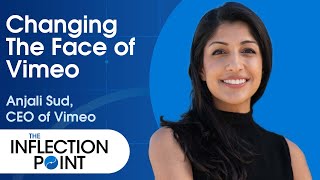
Anjali Sud left home at 14 for Phillips Andover, worked at Amazon launching toys, then joined Vimeo as a marketing executive. She pushed the company to focus on small businesses, ran an internal startup, and became CEO at 33, leading Vimeo through its IPO.
Chapters
I'm in New York City with Anjali Suit, CEO of Vimeo, a role she took on at the age of just 33.
I've always been, I would say, unapologetically ambitious.
A lot of people don't come flat out and say that, especially a woman.
I think there's a lot of stigma for women in acknowledging that you want to do more. And it's why I like to say it, because I think more people should.
Hear that you've said it's good to create your own opportunities.
There's disruption, there's opportunity.
I'm Monica Langley. This is the inflection point. Anjali, welcome to the inflection point. We're so happy to be here with you at Vimeo headquarters.
Thank you, Monica. It is wonderful to have you.
What is that moment in your life which was so dramatic that it really changed you as a person?
I think my first inflection point happened when I was pretty young. When I was 14. I was growing up in Flint, Michigan. Grew up in a really tight knit and conservative Indian community of immigrant families. And I left home at 14 to go to boarding school in Massachusetts to get a better education than what I was getting in the Flint public school. No one in my community had ever left home that early.
Now you had been going to public schools in Flint?
Yeah.
How did you even know prep schools existed?
The story is that my dad and I were at a Barnes and Nobles and there was literally a book, the top secondary schools in America. And we started flipping through it and I just applied. I think I applied to 10 schools, everything from an all girls school in the south to military academy in Indiana. And I happened to apply to this school called Phillips Andover Academy. And upon getting in, my dad and I realized it was, you know, one of the best schools in the country. And the reason that being 14 was an inflection point is because I failed at Andover initially.
But you were a good student before.
And I was used to being good. You know, I was like, yeah, because.
You may have gotten in if you weren't.
I was used to everything being fairly easy. And you know, you worked hard, you did well. And suddenly, you know, at that age kind of realizing the world's much bigger than you realize and. And you know, sometimes you have to just have grit and resilience and persevere.
Who was Anjali then when you started and who were you when you finished?
I mean, I was shy, I was introverted, I was intimidated. I felt like I didn't belong when I walked in and I Walked out feeling like the world was my oyster.
You.
But I was full of ambition and full of dreams, and I believed that those dreams were possible.
Let's talk about where you went after that.
When I was growing up, my parents are both physicians, but my dad's also an entrepreneur. He runs a plastics recycling plant in Flint. And it was always his passion. He really believed that business could be this incredible way to help support a community by providing jobs. He had sort of raised me this American dream. Go after, you know, go be a business leader. And that's how you can positively impact the world. So that's why I went to Wharton and, you know, got obviously another incredible education.
And then did you try to get a job after that?
When I graduated, I tried to get a job in investment banking. And there was a set of companies that everyone wanted to get a job at. And I. I applied to all of them and was rejected. From all of them? From pretty much every. Yeah, it was really any.
All the top tiers didn't want you.
Any brand firm didn't want me. And to be fair, I just wasn't as, I think as prepared in the interviews. I wasn't as strong as other candidates. It wasn't anything else. And I was really lucky. A startup investment bank that had just literally started was looking for their first analyst, and it was two weeks before graduation. Everyone else had a job and I was there. And. And so I took that job. And what ended up happening was I had an amazing experience there. And I think it's funny how looking back those times, you know, you think is. Again, you think it's a setback, actually ends up being one of the greatest gifts.
What did you do after that?
I went to Harvard to get my mba and I joined Amazon, came back to New York City, and my job was to launch this toy category for this startup within Amazon. You know, that was my first real.
That's kind of a dream come true for you, right? I mean, you're at this big, great company, but kind of a little startup buying toys, though.
Yeah, I didn't really have a passion for toys, but it was an opportunity to jump into an industry at a function I had no experience in. And I had to prove myself. You know, I had two people who were reporting to me who had both been buyers in the industry for years.
And you were their boss.
And I'm showing up as their boss with. I have no business being their boss. And so it was just a really good first experience in building trust, earning credibility, doing the work, you know, Recognizing what you don't know and finding a way to add value.
As you go through these experiences, it's clear you're moving every year or two. Do you just get bored or do you want a new challenge?
I've always been, I would say, unapologetically ambitious and a little bit impatient about my career.
A lot of people don't come flat out and say that, especially a woman. Why do you feel confident in saying that?
Honestly, I only feel confident in more recent years, now that I've become a CEO. I think there's a lot of stigma for women in acknowledging that you want to. To do more. And it's why I like to say it, because I think more people should.
Hear that, especially coming from a young woman.
Yeah. And not feel like that's something to be shy about or have any stigma around.
What do you say to the young women that maybe you mentor now about being ambitious, being impatient?
What I would say is find a way to be yourself and find a way to be comfortable in who you are and in your skin and confident and tie what you're great at with what's going to be good for the business. I don't want to be an example of what you should be. I want to be an example that you can be anything and still succeed.
You've said in the past it's good to create your own opportunities. And so you do that, I guess, when you move from places or new roles, when you're helping new businesses.
Yeah. You know, it takes time to really learn. And so you have to be careful. You can't be too impatient. But for me, it was always. I just felt like to be a great leader, I had to be a great decision maker. And to be a great decision maker, I wanted to find ways to experience a lot of diverse problems and challenges and to learn to be comfortable not having all the answers and not being the expert, but having to make good decisions. And I think that was the skill and the comfort that I honed by moving around so much.
Then you landed here at Vimeo. Tell us what is Vimeo and then why you got excited about it.
We sort of think of ourselves as the professional video platform. And I was excited about the platform. Cause I thought, well, video is going through a ton of change and disruption. And where there's disruption, there's opportunity.
Okay, so you started as a marketing executive here and you were 31, but you didn't study the marketing executive very long.
I've never thought of myself as a marketer or I've never defined marketing in a narrow way. I've always thought about it as, how do you help reach customers and make the business successful? That was literally how I thought about my job. And so when I came to Vimeo, my job was first and foremost to understand our customers, to have empathy for them, and to help solve their problems through Vimeo. And it became very clear that there was an inflection point at Vimeo, which was we had previously, most of our users were filmmakers and video professionals and agencies. But slowly and slowly we were seeing a shift in the user base and more and more small businesses were starting to use Vimeo. And I think that's when I realized, like, maybe the future for Vimeo is a different market than what we've been going after. And that became, I think, the impetus for me to get a lot of conviction to kind of push that strategy shift in the company.
But you pushed that strategy shift to such a degree that that became the new company.
Yeah, I mean, at the time, I never thought that's what would happen. And to be fair, I wasn't the only one that saw the opportunity. I was really fortunate in that our board and our investors were the types that said, hey, what they're saying sounds like it could make sense, so let's give her a team. And they basically carved out about 50 people outside of the sort of main goal and strategy of Vimeo. And they let us run for a year. We were off on our own almost.
So you did a startup.
It was like a startup again within a company. I have to tell you, Monica, it was probably my favorite work experience of my career because you're building, you're under the radar.
And so what happened?
So I bet my career on it. And it started working. And so our investors said, you know what, we're gonna make this the strategy. And there's this 33 year old who's never been a CEO before. And she's not a product or an engineer or a technology leader, but she's been doing the work and she's been, you know, she believes in this and will take passion any day. And they said, so you get to run it.
So you were the CEO.
Yeah. And they just literally, one day it was like, anjuli, would you like to be the CEO of Vimeo? And I thought it was a joke.
I notice on your Twitter, handle your Vimeo CEO proud mama.
Yes.
Okay, so it's clear you've incorporated motherhood into your identity as a public CEO. Tell me about that.
Well, I don't really know how to do it any other way, because I'm sure, as you know, having a child changes your life. And I was fortunate to. I was pregnant my first year as CEO and then had my son and then went through the pandemic. And I now have a second one on the way. And I will say, I think that being a mother has made me a better leader. I think I am stronger, I am more flexible, I am more efficient with my very little time. And so I think it's a real advantage. Now.
The parent company I see, is a very dealer company. But not too long ago, you actually left the company in an ipo. You spun off as an ipo. So tell me about that moment for you when Vimeo became a public company and you became a public CEO.
On one hand, I think it was. I mean, it was probably, you know, one of the highlights, most memorable experiences of my life. Remember being at the NASDAQ and kind of standing up and doing a speech and the confettis, you know, going in. Then, of course, you wake up the next day and you realize that nothing's actually changed.
And the stock went. Has gone down.
Yeah, and the stock has gone down. And you realize that.
What does that do to you?
You know, I think what it should do is absolutely nothing. And what matters is, are we building a great company for the long term? Are we building a great product? Are we serving our users? Are we in a market that we believe is the right market with the right strategy? And, you know, I really do believe that I have just as much, much conviction as I did when I was betting my career on this, on this move. I have even more.
In your office, there's a bobblehead of you and they call you Vimeo Protector in Chief.
I don't think anybody thinks that I'm a protector, but I hope that they think I'm an enabler. And this was a transition I went through as a leader is I went from being the doer, the person who rolled up her sleeves and got in the trenches and got the work done. But I realize now that a huge part of my job is it's to empower other people to do great work. And so you. To give people the resources and the vision and the direction, but then just let them succeed. And, you know, I believe that great businesses are built by a lot of different types of people. There's no one kind of leader. There's no one style. And so that's the thing that I try and embody every day, talking about.
Different types of people. When you became the CEO of this new publicly traded company. There weren't a lot of CEOs that look like you.
Yeah.
How did that feel to you?
I think maybe 10 years ago in my 20s, that would have been really intimidating. And I definitely had times in my career where I was very cognizant of how I looked and how I was different. And I felt a lot of pressure to assimilate, to try and act or talk or dress more like what I thought traditional leaders. And you know, over the last few years, I feel like what makes me different is a huge advantage and I think it's my responsibility to use it.
When you look back at your career at the ripe old age of 38, how do you, how would you characterize what your path has been?
I think for me, I hope I go back to kind of why I wanted to be a leader in the first place. I want to learn, keep learning, keep that learning curve. And I want to build and I want to have an impact and I want it to be as positive as possible. So I hope that's what I will eventually look back at.
Is the 14 year old from Flint still willing to fail though? Because right now you're a public CEO. It's not just you anymore.
I think it's healthy and normal to be scared of failure. And I would never pretend that I don't have sleepless nights or I don't get stressed or feel overwhelmed. I'm human just like anybody else. And of course I feel those things. But I do think if I channel that 14 year old, it's that failure doesn't stop you. Right? It's that you accept it, you face it, you hope that you succeed and if you don't, then you try again. For someone who's unapologetically ambitious, there's a lot of ambition left to achieve. So I'm excited about that.
We look forward to seeing what you do, what Vimeo does. So thank you for joining us today on Vimeo.
Thank you Monica. I appreciate it.









