How Arizona Coyotes CEO Became First Latino to Helm an NHL Franchise | Ep. 13 | The Inflection Point
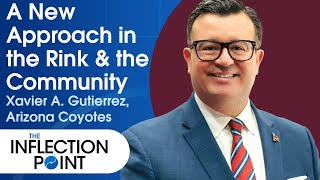
Javier Gutierrez immigrated from Mexico at five and became the NHL's first Latino CEO running the Arizona Coyotes. He's pushing a three-pillar plan: impact, inclusion, and innovation, with a focus on diversifying hockey at the youth level and using the franchise as a platform for community change.
Chapters
I'm here in Phoenix, Arizona, one of the hottest places in the entire country to talk about, of all things, ice hockey.
It does take a lot to keep ice going in the middle of the summer here.
Today I sit down with Javier Gutierrez. Javier came to the US from Mexico at age 5 and is now the first and only Latino CEO in national hockey League history.
Never did, I think in my wildest dreams it would be hockey and that it would be Arizona.
The Arizona Coyotes, with one goal in mind to win on the ice and in the community.
Sports has a very unique voice and a very unique platform to really make a difference in people's lives.
Welcome to the Inflection Point. I'm Monica Langley. Javier, welcome to the Inflection Point. And I'm so happy to be with you in this grandson stadium.
Absolutely. Thank you, Monica, for this. And it's wonderful to finally get a chance to meet you in person.
All right, so you know the name of this show is the Inflection Point. So that's my first question.
Sure.
What was that moment in your life when everything changed for you and it set you on the course that led you to this point today?
Sure. I have several. Clearly the moment when my mother decided to immigrate to the United States from Mexico. But in terms of my personal inflection point, it really was high school. I had an opportunity to go to the oldest high school in California. I grew up in a very working class family on the east side of San Jose and my father worked three jobs. My mother was a stay at home mother. But Bellarmine College Preparatory, which was my high school, really exposed me to a very different socioeconomic circle.
So it's an elite college prep school.
It is.
It's elite. And with your dad working three jobs, you all probably couldn't afford it, right?
Yep.
Did your teachers say, you're a smart boy, you need to go to this school and you should get a scholarship?
I had some excellent teachers and a principal in junior high who came to my parents and said, you know, your son is quite talented and he's quite smart. We think he should apply to this school. And it really set me off to a different trajectory in terms of my academic career and my professional career.
And you could visualize a life that you might aspire to?
Absolutely. I was very much encouraged to apply to every college to think about any industry.
But let's go back. You're five years old. Right. And that's when your mother left Mexico to come to the U.S. tell me about that.
It was scary you know, when I saw my mother leaving her home country, leaving her family, coming to the United States with really one vision in mind, which is a better life for her children. And that really was what she aspired to here in this country. If you worked hard, if you educated yourself that the sky was the limit. And I remember my mother telling me from very early on, she says, I want you to apply to college. And there's two colleges, it's Harvard or Oxford. And I said, and where did you get that? In her grade. So Harvard from Love Story. Right. So the movie with that one and then Oxford, because it was just the international renowned school. My mother aspired to be a nurse growing up, and sadly she and get past junior high. But education was always valued.
So growing up in San Jose, did you have to get acclimated? Did you speak English yet?
Well, I went from the English as second language classes right. To the gifted and talented education classes. So I really give a lot of credit to the teachers who saw a lot of talent and opportunity in me and a lot of promise in me, and really also my parents who really fought for me to get into those classes. But you know, San Jose, in the Bay Area, I talked, I talk about this a lot because I do have a concern about where it is today. Growing up, it was a phenomenal place to grow up. You had this thriving immigrant community, Latino, Southeast Asian, Mexican in particular. And so really, you know, you saw a lot of opportunity there. I'm concerned because when I think of Silicon Valley now, it's very unaffordable. The jobs are either very service low income, or very high tech, high income. So somewhat of a barbell economy.
But did you ever face discrimin or something that inspired you to want to be sure that more people are empowered?
Absolutely. I mean, listen, while it was a positive experience, clearly San Jose was a perfect example of the segregation that you have, especially socioeconomically. You had this very large immigrant community, again, Latino community, but also a very burgeoning Southeast Asian community that was really facing a lot of obstacles for advancement. And the schools, the public schools that had a disparate investment into them. So it really is representative of what you have in these urban and suburban communities where not all the resources are given to all the communities equally. And so, yes, I mean, I absolutely had that as part of my personal journey. And it definitely fueled my interest and my desire to make a difference.
Now, when you graduated from high school, you envisioned a life in politics. I mean, that was your life's dream, was to get into Politics to change the world. Right. So how did that develop in you? And then when did that change?
Sure. Well, you know, the Jesuits have this saying of being a man and woman for others. And that was really ingrained in me. And really my thought process was that being in public service, being in politics was. Was the place that I would do that. And so when I did have the fortune of going into Harvard, and my first night I flew in, I dropped my bags, I go down to the Kennedy School and I have pizza dinner with Michael Dukakis. And I'm thinking, there I was, I was an 18 year old first night at Harvard, and I'm sitting across the table from a guy who ran for president. There were two things going through my head. One, didn't realize how short he was.
Quite short, yes. I covered him as a presidential candidate when I was at the Wall Street Journal.
There you go.
I know.
And the second was, how lucky am I, how blessed am I that here I am, I'm an immigrant to this country, I've worked hard, I've had a number of people open incredible doors for me. And in my first night in college, I'm sitting across the table from someone who could have led this country. And to me, that just was everything that I thought I wanted to be.
And then you did go as an intern to the youngest mayor in California. Right.
So a very good friend of mine, Fidel Vargas, got elected mayor of his hometown, Baldwin Park, California, which is a little bit east of downtown Los Angeles. And he got elected in between his deferral of Harvard undergrad and Harvard Business School. So here he is, he'd gotten elected in the early 90s. And I called him up, he says to me, well, what are you doing this summer? This is the summer between my sophomore and junior years at Harvard. And I said, well, nothing. He says, come be my intern. And I said, be your intern? He says, yes, I want you to do two things. In N Out Burgers was Found it in Baldwin park and I want their headquarters to come back. And second, I really want to make changes in the city and I really like to get your input. And so I did. I spent the summer there and brought In N Out burgers back for 10 years.
I love In N Out Burgers too. That's why I love to come to the west coast to get those.
There you go. We might have to go get some later. So. And then what happened was the fall I called Fidel and I said, I'd like to have your letter of recommendation for a public policy program. And he said no. And I was shocked because he was my only.
You've been such a good intern.
Exactly. I had gold star internship going on.
Yeah, yeah.
And Fidel, I remember the words that he said. He basically said, we need you to go learn how to bring capital back into our communities. That's where you could be most impactful. By the end, I had agreed to do an internship. And another inflection point, and the internship was to go work on Wall Street. And he was right. I often say, you know, listen to the door openers in your life. And he was a door opener. And it put me into a place that I never thought I'd always wanted to be.
And there you stayed, and then you landed with Alex Morello. Tell me a little bit about that experience.
Sure. Well, you know, Alex is a friend. He's a mentor. He's one of the most accomplished business people I know. And I had a chance to meet him in 2010, shortly after the global financial crisis, through a mutual friend.
He's a son of Cuban immigrants. Right. So you all have a little bit of that in common, right?
Absolutely. And when we met, really the opportunity was to take what he had already established as a successful entrepreneur in food and in construction and in banking and really grow it. And we did. I was there for about seven and a half years. I helped lead the investments and the holding company, and by the time I left in 2017, we had owned and operated 35 different companies.
Wow.
And in many instances, we were the largest Latino owned. Fill in the blanks. Everything from a media company based in Los Angeles, largest Latino owned bank in California. And I'm very, very proud of his success. I'm very honored to have been a part of it.
And so then you went off and did some of your own business, and then suddenly Alex, your partner in many of these ventures, goes and buys the Arizona Coyotes.
Yes, that's. That's.
What the heck.
That was my reaction, too. I'll be very frank.
I mean, did you ever envision that he would buy an ice hockey team and then call you about it?
So the answer is no, never did. I think in my wildest dreams it would be hockey and that it would be Arizona and that it would be Alex Morello? No, not at all.
So tell us about how did that happen?
He really wanted to be in stone for a while. And at the time, I was a partner at a private equity firm with my roommate from graduate school at Stanford. And Alex calls me up and he says, listen, I'm about to be announced as the first Latino owner in the NHL. I'd like for you to be there. And so I came.
And you are the first Latino CEO.
Yes.
In NHL history. So this is a big deal.
Thank you.
Okay. Did he say something to you, or was there something in your heart that. You know what? I think I can make a difference here.
It was Alex. He gave me a call in early part of 2020, and he had owned the team for a while, and he called me, and he finally said, I know why you need to do this. And he said something that I'll never forget. He says, listen, sports has a very unique voice and a very unique platform to really make a difference in people's lives. And I think that's where you're at in your life, in your career. And honestly, that really resonated with me. It kind of opened my eyes to this as an opportunity to really make an impact. And, yes, you know, we are all passionate about our teams, and we want them to win, but we also want to create and inspire. We want to unite people. We want to create an organization that people think of, and it brings greatness and excellence into their lives.
When you first started a young man, it was gonna be politics. Now it's as a sports CEO.
Yes. That's where we're at.
It's a little bit different, but you're making a difference.
It's a little different, but it's exactly the same ethos. Right. How can I be a man for others? How can we use our platform? How can we use this arena, which, by the way, has been a voting location. It's been a vaccination center. It's been a water and food drive center. Just the physical space alone and the impact we make on this community during this pandemic shows what is possible with sports.
Now, let's talk about the Arizona Coyotes. Because you came to a team that is not known for being a winner, per se. I mean, it went for nine seasons and getting in the playoffs only once, I think. Yes. What are your plans to turn the team into a winner? What's on your agenda?
I mean, the goal is to win on the ice and to win off the ice on the ice. Yes. We need to come in and really revamp and create a sustainable winner. So that starts with leadership at the top. We hired a new general manager who had won a Stanley cup with the St. Louis Blues and really has that winning pedigree. You know, Bill Armstrong said in his opening press conference, we want people here who will bleed in the desert and this whole concept around having hustle and heart and caring and giving everything that you have. And so that really starts with the ethos of around that and then bringing talent and bringing the best trainers and coaches and development program and really leveraging science and technology in a way that hasn't happened here before and really being best in class, even.
You said, though, that this is a challenged enterprise. I think when you got here. And of course, I read the reports of people saying the team delay payments on to airlines or to vendors. And then there was the draft pick that you all ultimately made that had been had a juvenile court conviction. So clearly you've had a learning curve here.
Yes.
How are you dealing with all these things as a challenged enterprise?
Well, the entire opportunity so far has been a challenge. We started. I started in the middle of a global pandemic. The season had been paused. And. And, yeah, you know, I mean, this is an organizational turnaround, you know, using our skill set of having done that in so many industries. But we start by saying we're committed to providing the resources that it takes to win. But you have had challenges here historically that we have to undo. There have been business arrangements that have really undermined the financial stability of this organization, that we had to make difficult choices. It wasn't for a lack of resources on our part. It was for a lack of wanting to go down the same path that had really hurt the organization as far as, you know, what happened with the draft. You know, we gave a young man an opportunity to really atone for a mistake that he had made. Unfortunately, that wasn't what was in his mindset, and we moved on. And so for us, it really comes down to really identifying the right people to be part of the organization, to be out there with the mission and the vision that we have. And that's very similar to every business that I'd ever invested in and helped run.
You're dressed like a business. I mean, you could have come in here from Wall Street.
My wife, Jerrick, often kids that she doesn't let me leave the house unless I'm dressed like this. But I do think it's important. I think it's important that we are reframing what the narrative is of the Arizona Coyotes. That's interesting that we're serious, that we have a plan, that we're here to really make a difference. And I talk a lot about our vision around that, but that we're business people. We may not be sports people, but we're business people. We have a plan. We've done this before in terms of taking unloved assets and turning them around. And I just think it's important to create that presence as the leader of the organization in this community. And so to me it's, first of all, it's natural to me. But second, I do it because I want people to know that we are very serious and we're very committed and that we have a plan that they should have confidence in.
So you are driven to succeed here.
Absolutely.
So the National Hockey League is in for some change through you all at the Coyotes.
Well, really there's three key pillars to the business plan. It's around impact, inclusion and innovation.
Okay.
Impact is really embracing our role as a community leader. As a business leader on the inclusion, I take great pride in the fact that we are putting diverse voices at the table of decision making authority. I think, you know this, Monica, that we have the largest female executive team in the. And I'm very proud of that. We make that intentional. Right. We're intentional about that effort to bring those voices to the table. Borrowing the great Wayne Gretzky's line of where is the puck going in America? Right.
We have some pucks right here.
Absolutely, absolutely. So where's the puck going in America? Young, female, diverse, purpose driven and tech enabled. And here in Arizona, when we talk about diverse, we're talking about the Latino cohort.
43% of the Arizona population is Latinx. And then here, you're the first Latino CEO. You're like ideally suited to go for this market.
Yep. But we also don't take that for granted that just because we're Latino, we're going to attract for us, it's a matter of us opening our doors, welcoming that community here, and really being the last pillar, innovative, thinking differently. So, you know, a lot of people think innovation is just technology. Certainly we can talk about all the technology that we're embracing and utilizing, but it's also thinking differently.
That's fascinating. And you are shaping the team. As a CEO, you're, as you say, at the leadership level, but can you also do it at the player level?
When we're talking about diversifying the face of hockey, it's really going out at the youth level. We have one of the best youth girls hockey program in the country. The Kachinas program.
Here.
Yes. Here in Arizona. And you would think, okay, it would be probably in the east coast of the Midwest, but it's here and I'm very proud.
So you're trying to grow them up.
Absolutely.
Well, now another thing is as you talk, you can use sport, and that's one of the reasons you came. As a platform for change. Do you think that sports should also be involved in social and political issues?
Sure. Well, you know, it's a question I get asked a lot, both internally and out in the community. And to me, what sports does is it gives you an opportunity to express your values, what you're for. Those aren't political statements when you're for inclusion, when you're for empowerment, when you're for giving people opportunity. And to me, I actually think that sports teams, as members of this community, reflect the values of those communities. So to me, I don't see this as a political position. I see it as a reflection of value. We're here to improve and impact the lives of this community. And yes, sometimes it takes raising your voice and saying, this is what we're for. I understand when people say, I just want to come and watch a hockey game, well, that's great. But we are also members of this community and we reflect the values of that community. And to me, I just don't think that you can be a sports enterprise and not be engaged in what the community's engaged around.
So you're not going to shy away from it if there's an issue that you feel like you've got to go forward on.
I think we have already, you know, taken a lot of action that shows we're a community leader and we are for these values.
Javier, you've made me a fan.
Great. Yes.









