How AstraZeneca is Defining a New Era of Agentic Transformation
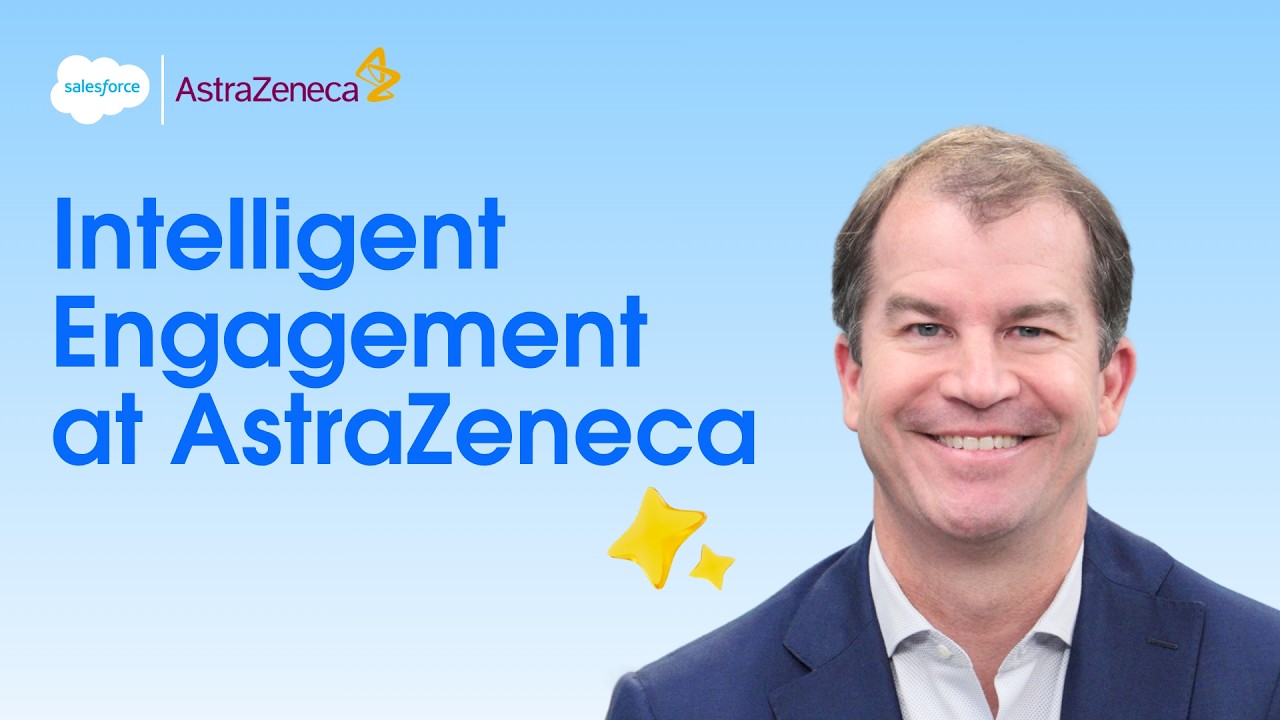
Dave Fredrickson, EVP of Oncology at AstraZeneca, explains how AI agents are reshaping drug discovery and delivery. The company aims to double oncology indications by 2030 and has trained 71,000 employees in agentic AI. AstraZeneca uses AI to personalize physician engagement with the right data at the right time.
Chapters
I can't double the size of my field forces in order to be able to make sure that we're maximizing the opportunity that's there. That's the reason why we've got to reimagine what does it look like to engage with our customers.
Hello, I'm Jeff Eamon from Salesforce, and today we'll be discussing the role of AI agents in the life sciences industry with a focus on how these agents can deliver a A new era of intelligent engagement. And I'm thrilled to be joined today by our great friend and partner, Dave Fredrickson, the Executive Vice President of the Oncology Business Unit at AstraZeneca. And Dave, AstraZeneca, we know, is pushing the boundaries of science, delivering life-changing medicines, and really increasing the chances of cures. What could be more important than that? We're so thrilled to have you here with us today.
Jeff, it's great to be here, and thanks for having me, but also more broadly for the partnership with Salesforce.
Maybe we'll get started here. I'd love just to hear you talk a little bit more about AstraZeneca and in particular how you're entering this new era of intelligent engagement.
Well, I think as a starting point, I mean, at AstraZeneca, our goal is to make very meaningful progress to eliminate some of the most important diseases and conditions that are facing people across the globe. For my unit in oncology, Our goal, our ambition is to eliminate cancer as a cause of death. Now that's gonna be an evergreen ambition because cancer is many different diseases, but we're making really outstanding progress as a field against that. And part of the big reason for that is we're seeing this remarkable convergence of science, technology, and data that is coming together that is transforming our ability to create new medicines, to deliver those new medicines earlier, to find more patients who can benefit from those medicines and to be more personalized. And artificial intelligence is going to help us to even further compress the timelines to be able to get there. And so it's everything from discovery to development to also a big part of what I do, the delivery of those medicines that's going to be impacted by artificial intelligence and the advancements that are being made.
So powerful, Dave. I mean, so many of our families have been touched by cancer. My family's been touched by cancer. So we're so grateful for what you're doing. And we're trying to understand a little bit how we can help too. And so one of the things that we think makes a difference is that when we can surface the right data at the right time to the people who are engaged with healthcare providers and patients, that makes a difference, a real difference. And I'd love to hear your thoughts on how impactful that is to you and your team.
Yeah, it's key. And I think that there's two parts that you get at that are so important. The right data, at the right time with the right message is so important. We need to make sure that we're able to talk to oncologists and care teams about medicines when they're thinking about a patient that that might be most relevant for. And what we're able to now contemplate and to do is, is understand how very specific information about how an individual physician prescribes allows us to be able to tailor the way that we engage with them. But that's only possible if we've actually got systems that are able to, in real time and with precision and accuracy, feed our customer-facing teams with those insights so that they can actually deliver them in a way that makes sense. And I think this is exactly the work and the efforts that together AstraZeneca with Salesforce are working on so that we can be able to do that.
So Dave, AstraZeneca is clearly a pioneer in the life sciences industry, pioneer at innovation. But also in having trust of the community. Sometimes those things can be in conflict, and I'd really love to hear you talk about how you balance those conflicts and how you make sure that you can innovate in a trusted way at AstraZeneca.
Yeah, it's a really important point. I mean, obviously with anything you do in innovation, the goal is to take risks. And at the same time, when you take risks, you want to make sure you're not eroding trust in the process of doing that. So that is core for us. I do think that one of the key things that we focus in on is How do we have high trust internally that the work that we are doing is doing the right thing and upholding the values that we have as an organization? And as you get into AI-based work, it's really core that we understand how agents are coming to conclusions or recommendations that they're coming to. And that's why explainability is so important. We have a lot of work that we are focusing in on where if we've got, let's say, an analytic agent that is working to help identify where gaps Gaps in care exist. What's the explainability? What's the rationale that sits behind that? We don't just want to understand an output and an answer. Actually, at AstraZeneca, we're very much a reason-to-believe place. What's the data that sits below that? How can I see the references? How can I understand the work that's been done to come to that conclusion? And I think that when we've got transparency on that, that we're able to have confidence then in the tools that we're using and the agents in the future that we're going to be leveraging to be a part of our workforce. And working alongside the people that are having these important interactions with our customers.
Makes a lot of sense. And if you, if you go one level deeper on the compliance front, we know that there are a lot of regional regulations and things that make this a really multifaceted compliance challenge. Yet you're also trying to create a unified platform that can operate and simplify the way that you engage with the folks that you do business with. And I'm just curious how you're overcoming some of those complexities and how you're able to provide speed and efficiency and effectiveness with all of that as a backdrop.
Yeah, well, I mean, the key thing is we've got to empower our market-based teams to be a part of the design and the implementation. I mean, I think this is one of the key things that as we work together with you and I reflect on not only the implementation and design work that we're doing now, but even the RFP process that we went through was involving all of our key regions in the decision-making process. And this is not going to be successful by designing it in headquarters and then disseminating it out, right? That's a recipe for failure. The work that we're doing is not only just for the compliance piece, but what data is available, how we can utilize that data, uh, the channels that are available to us. Those really vary based upon the different regions of the globe that we're operating in. And I think part of the appeal of working together with Salesforce is indeed the ability to be able to have a common core that we can use across all of our regions, but then also customize as needed and involve leaders within our affiliates or our markets to be able to do exactly that kind of work.
We also recognize that there are other sources of data, other agents perhaps that you have in other systems. And of course, we're interested in, in helping you provide a holistic solution that might include other agents. And I'd love to hear you talk about how you think about the complexity of that, that patchwork of agents and how Salesforce can help you achieve that vision.
Let's start first with what the reimagination is. And I mean, so today I have within my oncology portfolio about 30 indications that we are taking to oncologists across the globe. So 30 approved, whether it's FDA or the European Medicines Agency, 30 different patient populations that could benefit from our medicines. We have a goal to double that by 2030. How do I make sure that when I'm talking to a specific physician that I know exactly where my opportunities lie with that physician to be able to help them understand how our medicines and our portfolio of medicines can help them address the specific patient needs that they have in front of us? Historically, we used to do this in a way that looked at national market research that we would then take at a subnational level. We'd roll out campaigns, we'd see how that worked, we'd test it, we'd revise it every single quarter. What we're able to do now is n-of-1 campaigns based on longitudinal data about an individual physician. And that's the kind of information we want to provide, aided by agents through Salesforce, in order to be able to best understand how do we engage and move the needle so that we can get medicines to patients who we know are eligible and would benefit from them.
So let's double-click on that a little bit because there's a real superpower that you're giving to your teams with the system that we're developing together, and we're so excited about that. But let's talk just specifically about the role of AI agents in that process. Yeah. Surfacing that information, maybe go a little bit deeper in terms of How do the folks that are interacting with those healthcare providers— what information are they getting that will help them be twice as effective in that context?
Yeah, I mean, we can envision agents in a multitude of ways, but just to take a couple that we've imagined, right? You can have an analytics agent that takes a look at you as a rep with a specific territory. Where are the greatest opportunities? What are the calls that should be part of your call plan over the next quarter? So we have the analytic agent that works together then with a Salesforce Optimization agent that is thinking about call plan, call flow, specific topics that you want to bring up. For our marketeers, we have the opportunity to start thinking about content agents. So not only do we have content that we obviously want to be delivering through our field-based customer-facing teams, but more and more we're also seeing a real interest in non-personal promotions, non-field-based ways. We also want to use agents to best design That surround sound, the additional ways of being able to address specific needs in that regard as well. Agents to do medical legal review, right? You talked about compliance on the front end. Well, all of the content that we do has to be in the context of fair balance and make sure that we've got the opportunity to acknowledge those different elements that we've got. We're using agents today to aid our medical legal review process to shorten the time dramatically Because if we are only able to get content quickly, but we take the same amount of time for medical legal review, we haven't actually addressed the constraint in the process.
So Dave, you're talking a lot about the importance of technology and the role that that plays in this advancement of your business. But there's a, there's a human side too. And so we all need to think about how folks will adapt to and leverage these AI powers that you're giving them. And so I'd love to hear you just talk a little bit about how you're managing the evolution of your workforce and making sure that they can treat these capabilities as digital partners, not something that's external or a tool.
It's a really important point. We, we, we first and foremost absolutely believe that AI is going to revolutionize life sciences. And I start with that because as a company, as a senior executive team, we have incorporated into our ambition for 2030 that we will be leveraging artificial intelligence as a company to more rapidly discover, develop, and deliver our medicines. So the mindset, the expectation has been set for our entire workforce that Agentic needs to be part of our future. Then, and we get into specific work that we're doing across the board, we're engaging with people where we have 71,000 people who've now been accredited through a program that we have for work within Agentic. Then we continue to build the base of how we bring our workforce along with understanding that they will continue to be essential in the work that we need to do, but that those who will be the most successful realize that people who understand how to work with AI are going to be the ones that are the most successful. Those that think that AI is going to be a passing fad will not be the most successful going forward.
Well said. I've seen it with my own two eyes. I've been to offsites with your broader team, and it's amazing how empowered they feel and how excited they feel about your mission. It's really, really energizing. And if we zoom out just a little bit and you think about intelligent engagement and you think about what we're, what we're going to be delivering to them, how do you think that's really going to help translate into these life-changing outcomes for patients?
Yeah, well, I mean, I think the first element of this is that every time we invest in a Phase 3 clinical study, we do it with an expectation that all the patients who can benefit from that, that we're going to get the medicine to them. We know that education of oncologists and hematologists is core to getting there. We need to be as effective as we can in getting that education to the prescribers who are going to be utilizing our medicines. The amount of competition is high. The complexity is high. We need more and more tools to help us to be able to make sure that every engagement is as hard-hitting as possible, high impact as possible. These intelligent tools are the way that we're going to be able to get there. I think without that, we risk spending time on things that are not the right things. And patients will be the ones that will ultimately benefit if we're able to focus on the right things at the right time with the right prescribers.
Amazing. And so if you fast forward and once you're live with Agent Forest Life Sciences, you talked a lot about customer engagement. I'm curious, how would you define that creating the new gold standard for customer engagement? It's certainly at AstraZeneca, but how that might influence the entire market?
Yeah, I talked at the front end about how science is allowing for very personalized medicine. What's very personalized mean? That means that for a cancer patient, we have an understanding of what specifically drives that cancer so that we can customize and tailor the best medicines to treat that patient. I think that AgentForce and our vision of Customer 2030 and beyond is that highly specialized, personalized engagement with each and every one of our customers based upon a deep understanding of their individual data, a deep understanding of what we call care gaps, like where are the places that if there was a shift or a change in behavior that we would improve outcomes for patients. A deep understanding for the specific channels that they seek to get their information, and then very importantly, that's got to be a reinforcing learning process that goes through that. And I think that if we're going to be able to do that, and I know we will be able to do that, I think that we differentiate ourselves from others that are in the industry if we can really execute against that. And I think that we're making good progress against it.
I want to live in that world. And I never thought I'd say this, but 2030 can't come soon enough.
Right.
And Dave, I just want to close out by thanking you again for an incredible partnership. I want to thank you for your time today. You've shared a lot of wisdom with us and with our viewers, and I just really am grateful for that. So thank you so much, Dave.
Well, it's absolutely a pleasure, and, and, and we are committed to this partnership. We are committed to the work that we're doing together with you Salesforce. We're going to deploy it globally, and we need it to be successful because patients around the globe are really counting on us to be able to deliver on our mission.
And I'm also grateful to all of you for joining us and viewing and spending your time with us. We hope you enjoyed it as much as I did. Please be sure to check out the links in the description below. Dave, thank you again.
My pleasure.
Thanks so much.
I appreciate it.
It was great. Thank you.









