How Beyond Meat Founder and CEO Ethan Brown is Making Sustainability Delicious | Ep. 22
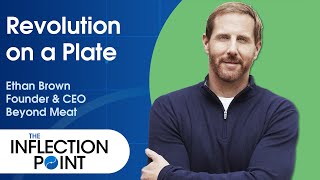
Interview (YouTube) with Ethan Brown, founder and CEO of Beyond Meat, about his motivation (concern about climate developed in grad school in the mid-1990s), childhood influences (hobby farm), and the company’s mission to use science and engineering to make plant-based meat that replicates the taste and structure of animal protein. Brown frames Beyond Meat as a long-term innovation (5–15 years outlook), targeting mainstream consumers ("flexitarians") and major channels (e.g., fast-food); he emphasizes taste, accessibility, and a philosophy he calls "hedonistic altruism."
Chapters
Foreign.
I'm in Los Angeles to sit down with Ethan Brown, the founder and CEO of Beyond Meat.
His big idea, to fight climate change.
Start a plant based meat business and a revolution on your plate.
Is it possible that a major solution for climate is actually right under our noses?
On your plate?
Exactly.
You are trying to disrupt millions of years of human behavior.
What I view this as is a chance to evolve and innovate to something that's better. So I'm very confident that with time we'll build a piece of meat that's indistinguishable from animal protein.
I'm Monica Langley and this is the inflection point.
Hi Ethan. So let's talk about your inflection point. Was there a moment when everything became clear to you that there's a. I know what I'm doing in my life?
Yes, I think there was. And for me, you know, like many young people, I was pretty restless as a, as a student. And I was in graduate school at the time at a school that my father had founded. And I was thinking about not enrolling for the next semester. I wanted to.
You were going to drop out?
I was going to drop out, yeah. And I went up to his office on the third floor and I was in there. I said, dad, I think I'm just going to take a break. And he didn't try to talk me out of it, which is his way. He's a PhD in philosophy and would approach things with asking questions and things like that. And the question he asked me was an important one, which was what did I think the biggest problem in the world was? And after a while kind of arrived at climate, that if we don't do something to stabilize the climate, all everything else that matters so much to us would be made more difficult and ultimately impossible if we don't have an ecosystem that we can live in.
And what did he say back?
Well, we talked about it and we talked about the best way to approach it. And so it really was to stay in school and to continue to learn about these issues. And then I went out into the world and began to focus on, at the time, clean energy.
What year was this, Ethan?
Oh, this was in the mid-90s.
Yeah.
Yeah.
You're kind of ahead of the game worrying about the climate.
Well, at the school that I was focused, where I was was focused on the intersection of economics and ecology and policy. Okay. So it was something that was on the radar.
But here we are today. You are the founder and the CEO of Beyond Meat. What got you here? Why beyond meat?
It comes from a childhood where I was very blessed to. I grew up in Washington, D.C. and in College Park, Maryland. But my father, having grown up in a rural environment, wanted that for his family. And so we had a hobby farm, which we still have today, that we would spend time on in the weekends and summer and things of that nature. And so I just really fell in love with animals. My mother is an editor and would really encourage us to read a lot. And so I spent a lot of time reading. And the books that I read, first series of books was James Herriot, All Creatures Great and Small. And that kind of stuck with me. In fact, I think Charlotte's Web is such a powerful book because at this.
Point, we all read Charlotte's Web and we also read it to our children.
Yes, E.B. white, Wilbur. Yeah, yeah, exactly. Which is a terrific point to start that discussion, because there's a question about how is this animal different from me, for example, or different from another one? And that's really the challenge I began to have as a child, and I began to think about that a lot. And I began to think about, is it possible that a major solution for climate is actually right under our noses? Right. And as we.
On your plate.
Exactly.
Okay, what is it about cows that make them an issue? Let's talk about that.
You know, and I want to be very careful about how I say this, because it's not. And we have at our farm that I just mentioned, we have people raising beef cattle on either side. And I really respect their way of life and farmers and 100%. And it's actually an incredibly important part of my life. But what I view this as is a possibility, is a chance to evolve and innovate to something that's better. And so it's not about attacking what exists, but it's rather just like, I have a mobile phone, I don't use my landline anymore. Can we evolve towards something that is better for us and better for the Earth? And so that's the way I think of it. But it was that moment of looking at that steak or meat at the center of the plate and saying, wait a minute, there's another solution here. If this is truly a global problem, climate, right. We have to spend like it is, and we have to get the best scientists from the best institutions and the best engineers, the best and brightest, bring them together, put them together, give them a clear goal, which is to build meat directly from plants, fund them, and kind of get out of their way.
There have been other not Just plant based products. But there have been other things like black bean burgers, veggie burgers, I mean, other things. But you came in and really changed the game. Was it a moral mission? Was it a business mission?
Really powerful things can happen when you start not only listening to this, but listening to this. Right. And I did start to do that. And doing that allowed me to take risk and to move forward in an environment of doubt or difficulty in a way that I probably wouldn't have been able to do had it just been an intellectual exercise. And I don't think about it in terms of, you know, just another innovation like making, as I mentioned earlier, the mobile phone versus the landline. I think there's an evolutionary nature to this, right. That if we can be the generation of people that separates meat from animals, we could contribute an enormous amount not only to our own species, but obviously other species as well as making sure that the earth can be inhabitable in the future. Right. So it doesn't mean to not eat meat. What it means is that we figured out a way to use science technology to take all the core parts of meat. The amino acids, the lipids, trace minerals, the vitamins, combine those with water in the architecture of animal protein and provide it to the consumer. If we can do that, that's meat to me.
That's fascinating though, that you're telling me that those same elements are in beyond meat that are in meat. You have found a way to do that.
Yes. So I'm very confident that with time we'll build a piece of meat that's indistinguishable from animal protein, so tastes just like it, healthier for you and cost you less. I think if we get in this.
Then you will have a big market surge.
It becomes an unusual consumer. You know, I'm still not gonna eat that. At that point we're like, okay, fine, we're not gonna win you over anyway.
Why did you come up with the name? What's the origin of beyond meat? Because you still have meat in the name.
Yeah, because I mean, I think meat is central to, to our who humans are. We evolved eating meat. So many of our traditions are centered around meat Thanksgiving. And I always think about the Thanksgiving football game where they're consuming turkey as they're talking. So I don't think it's something that we're going to move away from. But can we change the source of the meat? That's really what I'm about.
Ethan, here's the thing. You, you are trying to disrupt millions of Years of human behavior. Yeah, I mean, we all grew up eating meat. Our families did, our generations to generations. I mean, this is an enormous task.
I talk about this a lot, that you're not going to grow a business telling people not to do what they love. It's not a good idea.
Okay, you know what? I, southerner that I am, grew up eating sausage gravy and biscuits. So I went out before I came here and bought your spicy sausage patty. It was as good, if not better.
Thank you.
Than what I grew up eating.
Thank you. Thank you.
So I see you're making progress in this and people will pick it. So you're starting maybe a revolution on the plate. If you can't change the planet, you can change a plate at a time.
And that's what's so beautiful about this, is that in everyday activities you can go beyond yourself. You can help the health of yourself, your family, your community and the planet just by making the simple choice. Right? And we have to make it seamless. We have to make it something that's enjoyable. And so, you know, continue to focus on the taste is really important to us. And the better we make the product, the larger our circle of consumers become.
Some critics say is beyond meat that healthy because is it too processed or something? How do you answer that?
On one level, it's kind of absurd. They're doing a good job at that, saying it's processed. But if you really unpack that. Process is a neutral word. It's a series of steps to a desired outcome. That's actually the definition of process. And so if you look at our process, which is taking protein and, you know, fats and things directly from plants and running them through a system of heating, cooling and pressure, mixing and then forming. Right. That's a process. Then you have to compare it to industrial meat process. And I don't need to get into the details of that, but you can ask yourself, which do you want?
So let's talk about your ideal clientele. Who are you going after?
Right. So I think it's a group that been termed plexitarians. So it's people that are that are on maybe once a week or something taking animal protein out of their diet.
So ultimately, do you think you can convert some meat eaters?
It's never really been about vegans and vegetarians. Right. That's a smaller percentage of the population. It's really, for us, it's about how do we reach the mainstream. And so if you've noticed our strategy, I've never really fussed with really high end chefs or restaurants, you know, Marin and Martha's Vineyard, they're going to eat what they're going to eat. But it's change that can happen at McDonald's, at all these places that we're in that are mainstream. But then it's also a younger generation which is interested in climate and environmental issues and things of that nature. But what's so interesting is the health is also playing into those decisions for many younger people. And Chris Paul is a good example of this, as are many NBA players because they have to figure out ways to recover more quickly and to continue to be productive even as they get older. And he's a terrific example of that.
Then I saw has Snoop Dogging.
Snoop is. Yeah.
Did he invest too?
Yes.
I don't like necessarily associate him with health, but what do I know?
You do with plants though, don't you?
Uh huh. Okay. That kind of plant, yes.
Okay. Snoop, he's, you know, he's a great advocate for us. He's a very smart businessman, also cares a lot about his community and he knows about higher rates of heart disease and diabetes and cancer among African American populations. And so there's a lot of reasons to Snoop, some involved. And he's been great. He's been great.
And then I saw Leonardo DiCaprio for the climate issues. So you're like checking all these boxes with beyond me, Ethan. You're out there making waves, you're doing big things, and when I search you, two words come up. Hedonistic altruism.
Yeah.
What does that mean?
Yeah, that's a way that I think about what we're trying to accomplish. And the reason that I speak about that is we want to enable the consumer to do things that go beyond themselves, but they also feel really good when they're doing them right. And if we can accomplish that, I think we bring far more consumers in than if we're browbeating them in some way. And so I think a company that's done that really well is Tesla. You enjoy driving that car and at the same time you're reducing emissions and things of that nature. So it's a way of thinking about changing human behavior that people can aspire to.
I want to talk about beyond me and you as a business, a business person. Which has been more challenging to you, being a founder of an innovative startup or being a CEO of a publicly traded company?
I think the biggest challenge, honestly has been innovating as a public company. And here's why. What we're doing is something that looks at 5, 10, 15 years out. Right. And I didn't understand or appreciate this as much. I went to a school that emphasized Buffett and you know, all these long term investing of that nature. But I didn't capture the extent to which Wall street is truly focused on the short term. And when Covid hit, we got tested because we could have retracted way back. So we're not going to do Europe, we're not going to China. We're not going to keep investing in innovation. Same clip. We're not going to, you know, build this beautiful campus. I didn't want to do that. I wanted to keep investing. Because this is not about next year, it's not even about three years now. It's about five, 10 or 15 years. Can we create a incredible return for the, for the investor, for the shareholder that has stuck with us and said, you know, we think they can get a serious percentage of that $1.4 trillion market, but we're not going to do that being timid or by saying, you know what? I'm really worried about these quarterly results. We're going to do that by a long term focus. And we get criticized for doing it. For sure. The headlines and all that other stuff, you have to ignore them.
Well, that's sticking with your vision. But I mean, I thought as a founder it was tough because you gave you up your 401k, you mortgaged your house, I mean, you took some serious risk.
I did.
But now you're continuing to take risk as a public CEO. The fact is your business is not just your business, it's your passion. And I get the feeling sometimes that you would almost give your product away or I've heard you say that.
I think I would.
You can't do that, Ethan.
I can't do that because I think what I'm trying to convey with that is just the passion we feel for helping people live better lives and have a planet that again is inhabitable. But you always have to take a risk. And that's what you get paid for as a CEO, is to take risk and be right enough that you stick around.
You alone cannot change the climate, cannot change everyone's health, clearly cannot, you know, save the planet. So what is your definition of success as we sit here today?
It gets to science and it gets to technology. For so long, coming out of the enlightenment and that era, we use science to conquer nature, right? To put nature under our control and to make it subservient. Today we have the opportunity to use science to literally free nature and to bring nature back in a way that we desperately need to, and that's what this project is about.
What is your holy grail when you say we've made it at Beyond Meat?
So I get that. I'm a product person, and I think it gets back to a product. And I'm very interested in making whole muscle tissue like steak and bacon and things of that nature.
That would be great.
Yeah, we're very excited about that one. In fact, I can remember having some really good bacon in Tennessee. Yes. I have a vision for a commercial I want to do someday where you'll be able to meet the farmer. Let's say we make that steak out of lentils that grew the lentils, and then see the process by which we make steak from those lentils. And people get really comfortable with the idea, and they say, you know, it's steak. It's just steak that's been made from plants and that, like the mobile and the phone and the landline. It becomes just what we do.
I would love to see that commercial and taste that steak.
We're working on it.
Thank you so much, Ethan.
Thank you. I really appreciate it.









