How CEOs are Leading Companies in Times of Uncertainty | Leading Through Change | Salesforce
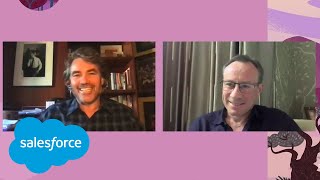
A live Salesforce "Leading Through Change" webinar (April 21, 2020) in which Gavin Patterson (Salesforce International) interviews Philip Jansen (CEO, BT Group) about leadership during the COVID-19 pandemic. Topics include Philip's personal COVID-19 experience (mild course), BT's emergency response principles ("stand by our customers, stand by our country, stand by our colleagues"), operational challenges (supporting 30 million customers, network demand, 30,000 field engineers, contact-center stress), employee protections (no redundancies for direct COVID impact; continued pay during illness/isolation; frontline pay uplift of 1.5%; £500 share grant costing ~£50M), communications cadence (daily exec crisis calls, weekly all-leaders video, Friday cascade), short- and medium-term planning scenarios (3- and 6-month lockdown assumptions with multiple recovery speeds), and emphasis on teamwork and mental well-being. The session closes with audience Q&A and a musical performance.
Questions this video answers
April 21, 2020
About 110,000 employees (around 80,000 in the UK)
About 30,000 engineers out on the roads every day
About 30 million customers
£500 worth of shares per staff member (approximate cost £50 million)
Chapters
Hello, I'm Linda Aiello. Welcome to another one of our live weekly conversations as part of our Leading Through Change series. This is a chance for you to hear tips from business leaders who, like all of us, are doing their best to get through this COVID 19 pandemic. Before I turn it over to today's host, president and CEO of Salesforce International, Gavin Patterson, I want to preview the next hour. Gavin will be interviewing Philip Janssen, the chief executive of BT Group. Not only has Philip been leading this company through this pandemic, but he came down with the virus himself last month. After that conversation, we'll be treated to a musical performance by Chrissy Hind. If you have any questions for Gavin or Philip, please submit them in the Q and A section of your screen and we'll try to get to as many possible later in the show. And if you're watching on Twitter, please use the hashtag LeadingThroughChange on Facebook and LinkedIn. You can add your questions to the social stream alongside the video. As always, we also want to support the World Central Kitchen, the nonprofit organization run by Jose Andres that helps provide food to people who need it most. In last month alone, World Central Kitchen has served more than 1 million meals and expanded to help people worldwide, including activating in seven cities in Spain. By going to HDTPS donate.wck.org salesforcecares you can donate to this great cause and help us reach our goal. In alignment with rally for restaurants, Salesforce will be matching donations of up to US$200,000 through June 1. Now to kick it off, I want to welcome Gavin Patterson. Hi Gavin, how are you?
Hi Linda. I'm very well, thank you.
So, having recently taken on the role of President and CEO of Salesforce International, the changes you have experienced have clearly been both on a professional and personal level. What observations in Europe and beyond have really stood out for you at this time?
Well, thanks, Linda. Well, it's clearly been an extraordinary time and a very interesting time to be starting a new job, I can say that. But ultimately this is a public health challenge and one that I think we should acknowledge. First off, the sterling work of health workers, key workers across the whole of the economy in every country who are keeping us safe, healthy and well fed. It's a remarkable effort and I'm sure I speak for everybody in thanking them. I think it's also an important opportunity for business. That business has taken a lot of criticism over the last few years. The trust and the relationship between business and its communities has been challenged. But I think this is a very timely opportunity to be able to demonstrate that business is key to having a successful economy and ensuring that everybody across the world is able to have full and healthy lives. So I think it's really, really important during this period that business steps up and is part of the solution. And that's very much part of the way we've been thinking about it at Salesforce. So clearly, as we go through this period, things will change. I'm optimistic. I think we will get through it. I think it will be a slow recovery, but we will get through it. But it's important that we don't just, just revert back to the way we were. We use this as an opportunity. I think it's very important to not just look back, but I think we need to look forward and create a new way of living, a new way of governing ourselves, of educating ourselves, and of course, a new way of doing business.
Thank you. And what does all this really mean for you as a leader at Salesforce?
Well, I think being new to Salesforce, it's been a very interesting time, as I say. But Salesforce has this within its DNA, within the original 1,1,1 model that mark has championed and has built into the culture and the DNA of the business. It means that this is a very natural motion for colleagues across Salesforce to respond too. Ultimately, our colleagues, I think my colleagues across the business are able to help in many different ways. That can be through philanthropy, where the company has been giving generously to causes across not just the US but around the world. It's been in the way we've been trying to work with healthcare organizations and other businesses to ensure that things like PPE are got to the most important places and that healthcare workers, for example, get the food they need as they're. As they're fighting to save people's lives. But I think ultimately we will be judged by the way we look after all our stakeholders as business leaders through this period. We believe that business is the best possible platform to drive change. And I think this will be a period when we judge not just on what we've done in the short term, but ultimately whether or not we've put in the right long term solutions for the economy. So thank you for the opportunity to say a few words. I now want to move on and talk to Philip and introduce him. So welcome, Philip. Philip Jansen, CEO of bt. A very good friend of mine, someone I've known for over 30 years and somebody I was delighted who decided to take on the role of CEO of BT after I left. So welcome, Philip, and very much looking forward to hearing what your thoughts are around the current crisis. I wanted to start with one, though, about you. You, of course, have tested positive for the coronavirus and I'd be very interested and I'm sure many of the people on the watching the webinar today will feel the same way. Want to find out how you are today and it would be helpful, I think, very interesting, to understand what it was like to contract it and what the thoughts that went through your mind were and how you would handle that with the business.
Yeah, well, hi, everyone. Thanks, Gavin, for the warm welcome and hello to all the Salesforce community. Yeah, you're right. I did contract coronavirus relatively early on in the UK's pandemic. So I think, look, what happened to me was I was feeling. I went away for a weekend, a big group of us, probably about 20 of us. I came back feeling slightly under the weather on a Sunday, and I went to work on Monday as normal, feeling just slightly under the weather, and talked with the chief medical officer at BET whether I should be at work or not. He said, no, you're fine. I went to. I did a personal trainer session that night, actually Monday night, boxing, the whole lot. So felt fine, you know, felt able to do that, no problem. But I had a number of meetings with government officials and various things at that stage. We were just starting. People were thinking about not doing handshakes and those things, but business was pretty much as usual apart from that. And in the end, the chief medical officer decided with some of the government colleagues I should be tested because I had various other things I was going to go and do. So it was a surprise to me for the test to come back positive, which it did on the Thursday. So Thursday I left the office and headed home for isolation. And again, my own experience with it at that stage was it was pretty mild. I mean, I felt I was very fortunate and I think I was particularly fortunate because by the time I got to Friday, I felt completely better. So Friday night I went to bed about midnight and I thought the whole thing had gone and I had no temperature, so I had no fever. All I had was a relatively mild cough and felt a little bit sort of under the weather, but then it sort of came back at me. So I woke up Saturday and didn't feel that well again, but again, still relatively mild, and the cough came back having gone. And then I had a few headaches and a few aches and pains and stuff. And then about probably Day nine, I guess I was very, very tired. Eight, nine, tired for two days. But again, it didn't, I was lucky. It didn't really affect me massively. I mean I was always working flat out. I didn't need to stay in bed, I didn't have trouble getting up and that kind of stuff. So I was very lucky. But I had, of the people I was away with, we think that probably at least half of the people had it and some of that group had it pretty badly, to be honest. And all of them gave it, had a similar sort of characterization. Those people who did have symptoms, had a wide range of symptoms typically and they also came back at them over the course of sort of a 10 day, sometimes a bit longer period of time. So it was a bit, it was a bit, a bit strange. But I was very fortunate.
I want to move on and talk about employees, if that's okay. And you've taken a very public stance on employees, employee success, ensuring that there'll be no redundancies through this period, you've maintained the stock grant that you've been making to everybody across bt. Tell us a little bit about your philosophy here and why this is important to you.
Yeah, well, once, once it became clear that, you know, we were in a full on crisis which, you know, again, it's not that long ago in the uk, obviously we had seen what was happening in other countries and as you well know, we've got operations in China, in Spain and Italy. So we began to see what was happening on this, on the lockdown. So we were, I wouldn't say we were really well prepared but we certainly had our heads up to the emerging problems and challenges. So from a very early stage, the executive committee took a sort of strong sort of statement of intent or sort of mantra almost, which was we are going to stand by our customers, stand by our country and stand by our colleagues. So those are sort of three principles by which we sort of made our decisions and obviously the first one is crucial because of the nature of what we do in terms of connectivity, not just in the uk, but also around the world. So we've got some really important customers, not to mention the nhs, for example, in the uk, but also the European Central bank, for example, and many customers you all know. So in the uk, the public sector relies on BT in a massive fashion. So we said that at the beginning we've got to keep our customers connected and of course we had major challenges in terms of capacity and excess demands or increased demands on the network. So in order for us to do that, we needed our staff to participate in a way which maybe some of them would be fearful about because they needed to come to work and they were nominated key workers very early on in the process. So we've got about 110,000 people, 80 odd thousand of those in the UK and probably half of them are key workers, probably a bit more, actually. So we have 30,000 engineers out on the roads every day who are keeping the network going and connections for our customers and we got 30 million customers. So inevitably the demands were immense, not just on the increased capacity requirements and performance. People wanted better connectivity and that needed visits and visits to the network and there were different pockets of activity that were under great pressure and actually we came through it really well. We could not have come through that without our colleagues and our employees standing up and delivering the kind of services they did in those very difficult circumstances, which were made even more difficult by the fact that very quickly people were told to self isolate if anyone in their household had symptoms. Obviously that was a 14 day isolation. So what that meant was, you know, we're suddenly staff, we got, call it, keep the numbers easy. 50,000 people are supposed to be at work, but you're down 20% so, you know, looking at 10,000 people down and you've got a spike in demand. So the call centers are going ballistic. We answer all the 999 calls, emergency calls in the UK and that was spiking very, very high to the normal levels you get on New Year's eve, but we're 20% down. So we retrain people very, very fast. People work unbelievably long hours, change their shift patterns, so we actually end up doing extremely well in the heart of the crisis for our customers. And again, you know, it's given me an enormous amount of pleasure to see the performance of our people delivering for our customers. And that's why you can't, you know, in the end we made those bold statements about our people to say we can't deliver for our customers and we can't stand by our customers, stand by the country if we don't stand by our colleagues. So we then made a few decisions that said, look, we're going to guarantee that everybody will have their job at BT and not have, lose their job as a result of direct coronavirus impact. We said we would pay people under all circumstances. So if they're ill or they need to isolate from a household perspective, or indeed personally, or indeed they need to look after a vulnerable person or someone who's in their loved one category that needs food or visiting or whatever else, we would cover them for that. And I have to say. And then we also, as you rightly say, we did give our frontline workers a pay increase. It was the, the annual review, so we gave one and a half percent, which is just in line with inflation, but we didn't give a pay increase for our managers. And we also, as you rightly suggest, we did reconfirm that we would honor our pledge to give all our staff £500 worth of shares, which sort of cost about 50 million quid. So I think that package of things for our colleagues, the response has been phenomenal. And they have maintained the performance and we are performing at an extremely high level. And as you know, Gavin, we monitor the hell out of every last inch of the network. And performance with our customers, the scores are exceptionally high. So I think that is so important for our customers, but without our people, we just could not have done that. And I really want to highlight the. Our colleagues who are key workers, those 30,000 engineers, and it's about 25,000 people who are in contact centers, answering calls, handling queries, dealing with questions and making sure that our customers have great connectivity. That's our. A summary of our philosophy.
And you talk about customers there, Phil, what are the biggest challenges you've faced? Meeting customers needs as many, many of your customers have moved their employees from offices to working from home, for example.
Yeah, I mean, it's been a massive challenge because many of different types of customers had different requirements. So on one level, the NHS wants us to connect the 18 new Nightingale hospitals as quickly as possible. We did that. You then got your large customers who will be big corporates who work all over the world, the unilevers, the Zurichs, the banks. And they want to typically, as you say, get some more remote working and delivering the ability for their employees to work from home. And of course, that's putting excess demands not just on capacity, but quality of connection. So you need security. And therefore, it's not just simple as spinning up a vpn, it's actually spinning up a network or a virtual network that is secure and can deal with the requirements of individual customers. So we pretty quickly bucket them in different parts, and some were more straightforward than others. But as you can imagine, if you look at the consumer base, suddenly everyone's at home and their requirements are much higher than they had before. And often, again, as you will know, some of the challenges of connectivity or performance are in the household, not on the connection. So we stepped up seriously the communication with our customers about how they can get the best out of their connection. Of course we had many people who want to have faster speeds, but also having the right wi fi setups in the home and the way in which they establish their own sort of mini network in the home has been really important. So we've allowed our people and encouraged our people to help out. Another great example was we got 600 stores, 5,000 people all went home. The number of people who volunteered, who wanted to help somehow to answer customer queries and help them in their homes was enormous because we treated them, I think so fairly. So they're now doing ongoing chat. It's been a real success.
I want to talk a little bit about the future now, Phil, and I'm interested to understand whether you've begun to think about what this will mean for the future of bt. And indeed, are there any changes you're going to make in your own personal life and the way you live on the back of this?
Yeah, I mean, look again, look. Clearly the way in which we are all living right now is so different to what we've experienced before. I think everybody is pausing for breath and thinking through what the implications are both personally and corporately. I'll give you my personal stuff first. I think personally I've tried and I've again articulated this to all our colleagues to say even how difficult and challenging is personally mental well being is so important and it's a real challenge now, as we all know. So we've done so much stuff to try and support our employees with getting through what is a very, very difficult challenge of being stuck in one place, isolated, not able to go outside for very long and not having the interactions that we are so used to and need as human individuals. So there's a. There's a massive stream of work that I personally have made sure that I've taken my own advice on that. So I'm out every single day, I exercise every single day and all the things you'd expect to make sure that I don't find myself sitting in a bunker all day nonstop doing these kind of video conferences. So that's personally. There will be some things that I will change, I think, as I move forward and I'm reflecting on some of those things. But from a corporate point of view, let me tell you our approach, we sort of. Things have calmed down a little bit now because the initial four week period was full on crisis. 7:30am Start for a crisis team meeting every morning. We are now seeing a More steady state. And therefore we are beginning to get our head up a little bit to think about what BT could do in the future and how it might change. So we have got lots of ideas. If I give you a quick summary, very big things on what we could do differently for our customers because their demands are going to change dramatically and what we're seeing right now will not go away. People's new demands will be built on what they're experiencing today. I think obviously what that means for our colleagues working from home and being more distributed and networking a different way, very important. But also what I'm going to do is the two other things I say to you is my aim is to invest more heavily on the back of this crisis. My aim is to look for opportunities for the company and think long term for all our stakeholders to see whether or not we can't grab new opportunities out of what has been a really, really difficult situation. Because as you said at the beginning, business has to help work our way out of what is a public health crisis. And therefore we need economic activity to grow as fast as we possibly can. So that's one of the things that I think is a responsibility of corporates, corporations, but also the individual leaders who are, who are at the helm of those companies.
And one last question, Phil, before I bring in Linda to get questions from the viewers. Is there one lesson that you've drawn from this experience that you'd like to sort of share with everybody?
I'm not so sure. Lesson, I guess I would say, I think, I mean, teamwork is something that has shone through for me, if I'm really honest. I think the things that I've learned are just things that I've always known, which is, you know, in really difficult times, stay calm, think carefully, focus, prioritize like fury and think. Make sure you're working out what's important, what's not important and don't waste time and then get the team to take responsibility. And that I have to say, my exec team, many of whom, you know, have performed, I mean, to the person in the exceptional category throughout this process. And I think they may say that about many of their people too. So what we have seen is extremely high performing teams. And therefore that's a lesson that is that obviously when people are up against it, you get this genuine unifying effect anyway, but it's extremely powerful. And so I want to make sure we make the most of that. But that lesson I've learned before, the power of people, the power of teams with a common Cause is amazing and BT Executive Group have delivered in spades on that front and I think it's laddered through the organization. So I will keep that as another great example of people make the difference.
That's a very powerful thought, Phil. So Linda, do you want to join the conversation and bring in some of the questions from the audience?
Sure. So I'll start off with a question from Matthew on Twitter for the both of you. This is as we navigate through the gambit of emotions during COVID 19 how do you and we get the balance right between day to day and planning for tomorrow and how long do you honestly think we have left?
You going to kick off on that, Phil?
Nice late one to start for you, Phil.
When we say how long have we got left? How long have we got left for what? Let me do that for how long we got left. Look, I think one of the real challenges for all businesses and all individuals, all of us facing this crisis is the massive uncertainty that we're all facing into. So no one knows where this will go and therefore you won't see any companies giving any sort of outlook statement in the next few weeks or months, I don't think, because it's just impossible. So what one has to do is one has to plan very, very thoughtfully and that's what we are doing at bt. So let me tell you what we're doing. We are, we've taken a number of assumptions and basically we've got a planning assumption which is a number one is a three month lockdown and number two is a six month lockdown. And then there are three variants of the recovery off the back of that lockdown. One is very quick, one's medium and one's slow and therefore you can just time frame those. So what you've got is two main options, a three month lockdown, a six month lockdown and I'm not suspecting we'll be in a six month lockdown, but you've got to have some planning assumption and then we've got three speeds for recovery. So that's our planning stuff in terms of how I balance the day to day versus the longer term, as I sort of imply with one of the other comments that I made earlier. We're just beginning to sort of see get our heads up a little bit. But one cannot afford to be complacent because no one knows what's around the corner here. So you know, we are dealing with as ever, when you have crises, new events happen and they always happen at the wrong time in multiple occasions so I'll give you another example. Would you believe it? Right now we've got a group of people who believe that coronavirus is caused by 5G. We have 40 incidents where people have attacked either physically or verbally, our staff, we've had people open engineers being driven at by people and swerving away at the last minute. We've even had one openreach engineer stabbed and put in hospital. So it's always the way when you're in a crisis, you get more and more things going wrong. So I can't afford to spend too much time trying to think through what's going to happen in six to nine months. I've just put a specific team on it and I said, you guys, I don't want you worrying about the day to day. I will lead that with my team. You put together a specific team to start listing out the opportunities and the list of things that we might consider. And when I'm ready, I'm going to come have a look at them, but I'm not quite ready yet.
All right, and then what about you, Gavin?
In this, I think Phil's put it very concisely. I think balancing the short term versus the long term. Clearly after a period of shock there, we've entered a period now of relative stability. Colleagues are having to find ways of continuing to work with customers, listen to customers, help customers while working remotely in most cases. But there will come a time later in the year and as Phil says, we don't know whether it's going to be the next few weeks or the next few months or indeed it might take till early next year. But there will be a time we come out of this and it is important that we are ready to help our customers as they transform their businesses on the back of this change. Nobody, as I said in my opening, nobody, I think, believes we're going to revert to the way we were. I think there will be opportunities and there'll be an imperative, I think, to really change your business fundamentally for the long term in a more sustainable way coming out of this, out of this situation. And it's important, I think, as business leaders that we're there to help our customers through that change and that they look to us for advice and sharing experiences in order to make sure that some good eventually comes out of this. Not just for business, but I think, for society as a whole.
Right. And another one for you, Gavin, from James. What is Salesforce doing to support employees through these unprecedented times?
Well, I touched on a couple of things. I think philanthropy is very important to colleagues across Salesforce. Being able to support public sector and volunteering organizations through free software, for example, is very important. But I think the other thing I would call out in terms of in fact I think Phil mentioned it as well. You know, we've learned through this process that communication with our colleagues on a daily basis, sometimes more than one times a day is critically important. You know, supporting colleagues, giving as much information as we can about what's going on and where we're going, what the issues are and how things will change has been critically important. And having an all hands call across the business once a week that goes on for 90 minutes where colleagues can put in questions to the leadership team. And Mark Benioff, the CEO has, has been I think extremely well received and has helped ensure that everybody sticks together and comes through this crisis as much as possible as a single team.
That's good. And then a question from Scott to Philip. I'm a department leader of a large organization, really impressed by all of the actions you have made to commit to your employees. But how have you been keeping communications strong across your widespread employee base? So really cascad off of what Gavin was just speaking about?
Well, yes, look, it's really, really important I tell what we've done. You know, we. And actually it's a bit like as Gavin said, we sort of learned almost not by accident but we realized that what we did had such a huge response. We ramped it up. So in summary, as I said my exec meeting, we meet every month, every morning at 7:30. I then get normally we have a once a week there'll be an actual and the exec also gets together at the end of the Friday. So that's our sort of every day, end of Friday. And like Gavin says we have every day there are series of videos going out but we do a once a week video for all the top 800 people and we whiz through everything that's happened in the business and they then cascade. So we don't do a. We have done some all employee videos. That's not said we haven't. We do one of those every sort of every three or four days from one of the exec team will send out a video to all employees. But what we have is the big event is on a Friday at 2 o' clock when we get our top 800 and they then take the key messages from that and it's a dialogue. It's not. We're not sending out loads of information. There is information but it's a dialogue a bit like where Gavin describes Salesforce. So we do that on a Friday and then Friday afternoon is spent distributing all the different messages and the communication across the whole company through lots of video is the interactive video like we're doing right now, is the vehicle of choice. That has worked really well for us and the response has been amazing from our colleagues.
Thank you so much, Phil. And before I hand it back to you, Gavin, just a quick note before you introduce our musical guest. Video is the mode of choice these days. We're having some slight video issues with our musical guest. The sound is great. You'll still be able to see them, don't worry. But just apologies in advance and welcome to the reality that we're all facing in certain moments. So, Gavin, back to you.
Thank you, Linda. I'd like to wrap up now and I'd like to wrap up by thanking Philip. Some truly inspiring thoughts there, Phil. I really appreciate it. I know you've got a lot going on and the personal level, I certainly appreciate you putting the time into today's conversation. And I wish you great luck. It's been very interesting hearing how you've been navigating this. Of course, I can think about it from a personal experience, but it's been truly very, very interesting and I'm sure it's going to get even better from here.
The pleasure and thanks, mate. Nice to see you.
Good to see you.
Thanks, Gavin. And thank you to all of you out there joining us today. You can find more content on leading through change stories@salesforce.com blog. And finally, one more reminder to donate to World Central Kitchen. The link again is donate.wck.org salesforcecares World Central Kitchen is helping so many people get through this crisis. And by donating even just a little bit, we can help them do even more. So we'll be back with you next Tuesday, April 28th. Until then, please take care of yourself and each other. Thank you.









