How CorePower Yoga’s CEO Turned Her Passion Into Her Profession | Ep. 17 | The Inflection Point
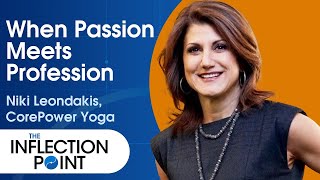
Interview (The Inflection Point) with Nikki Leandakis, CEO of CorePower Yoga, about her life and leadership. She recounts growing up in a Greek immigrant family, early hospitality career (worked at Marriott, then eight years at Ritz-Carlton), a formative moment choosing compassion over 'firing' which changed her leadership approach, and later personal tragedies (2017 wildfire destroyed her Sonoma home; her husband died a year later). Yoga and meditation helped her process grief and led her to pursue and accept the CEO role at CorePower. At CorePower she emphasizes community, belonging, people-first culture, growth after COVID (over 50% of new members are first-time practitioners), part-time teachers, CorePower University career/leadership training, and diversity efforts (1,200 BIPOC scholarships for 200-hour Yoga Alliance teacher training).
Chapters
Foreign.
Corepower Yoga headquarters in Denver. Corepower combines intensity and mindfulness. The same can be said of its CEO, Nikki Leandakis.
I found my way to the yoga mat, which helped me find my way to gratitude and presence for what I had.
She brings her Greek heritage and years in the hospitality industry to the helm of the largest yoga studio chain in the nation.
There's something magical for all of us as humans when we come together with others through a shared experience.
Welcome to the Inflection Point. I'm Monica Langley. Nikki, welcome to the Inflection Point, and thank you for letting us be in your world. Core Power. Now, you know the name of this show is the Inflection Point. So always my very first question is, what was that moment in your life when everything changed?
As a child of a Greek immigrant family, I grew up with a family that spoke a different language, ate different foods, had weird celebrations and big fat Greek weddings. Big fat Greek everything. And, you know, live animals being brought home from, you know, farms and slaughtered in the backyard for holidays, Easter, you know, and kids made fun of me at school, in the neighborhood. All of us. I was one of five. We were kind of ostracized for being Greek, and so I abandoned that heritage for a long time to try to fit in. And similarly, when I got into the business world as a woman leader, I oftentimes was the only one around the table in the meeting as a female. And at that time, whether it was in politics or in corporate America, there was a lot of question. And people were talking about whether women could really lead. And so I was always trying to prove that I was tough and I could do the tough things and make the tough decisions. There was a situation where someone, a chef I was working with, did something that was, you know, she shouldn't have done. It was a mistake. And, you know, I was being told by human resources that I had to let her go, fire her.
Yeah.
And I didn't think it was right. And I was struggling because I was sort of new in that job, and I needed to prove that I could make the tough calls. But I also didn't agree with it. So I was working for somebody. The person I reported to said to me, just. Just trust your instincts. Follow your natural instincts. Just trust who you are. And, you know, I settled into my own value system and what I thought was right. I talked to human resources and said, this is what I think we're gonna do. We're not gonna let this person go. And for the first time, I found I could be Me.
That's a fascinating inflection point because then that shaped the rest of your professional career.
But that inflection point really illustrated for me that equal equality doesn't mean sameness. And that was a big learning for me that I could add value and have a place at the table, but it didn't mean I had to be the same as them.
But that inflection point was when they told you, you need to fire this person. And in fact, early on, you were big on firing people and earned a nickname. Right.
What was your nickname? I did, because I was trying to prove I could make the tough calls. So I was called the Terminator.
That's pretty tough.
Yeah. I was working hard to show that I was tough.
So at first, was it a badge of honor? Hey, I'm the Terminator.
I don't think I was really proud of the nickname, but I was happy to be seen as tough.
What decade are we talking?
80S.
Yeah, so that was. I was just new on Wall street in the 80s. There were very few women. I agree. Now, let's switch for a second, because when you were in business, you started in the hospitality business, which also goes back to your background with your grandmother.
Yeah. So you know Greek diners on the East Coast? I mean, my grandmother, my grandparents owned a Greek diner in western Massachusetts called Charlie's Diner. And I grew up hanging out in that diner. And my grandfather died early, and so my grandma ran it by herself. And I watched her. I was just so impressed by how she ran that diner like clockwork. Such discipline, such authority and her perspective, precision in her expectations. But she also had a deep compassion for the workers and was so committed to them that it helped shape me.
And is that when you thought I could actually go into hospitality? Was she a role model?
Yes, she absolutely was a role model. And I ultimately worked my way through, you know, school in restaurants, high school and college because of that experience, so.
But then you wanted to, after your degree in college, you really wanted to work at some of the big name hotels.
Right.
And I read somewhere that you wanted to go to Marriott. Tell me what you did to go to Marriott.
Yeah, I wanted to go to Marriott because my, my dream was to own my own chain of restaurants. And I thought I'd go to work for Marriott because I'd learned from the best, the best training programs, the best systems.
And they were known for that.
Yeah, they were. And I went on the interviews in my senior year in college, and I did not get a job offer. And when I didn't get that job offer first. I went to the people I interviewed with and asked for feedback. What did I do wrong or what do I need to be better at? Or whatever. And I couldn't really get any answers, so I called Bill Marriott.
How did you get his phone number?
I don't even remember. I mean, this was. So you were pretty resourceful. I called his office at the headquarters and of course, and get a call back. I literally called like every day. And finally his assistant. We then said secretary, but she called back and you keep calling, Mr. Marriott, what is it you need?
You are a pest, Nikki.
I was a pest. And so I got, you know, she took my information and I got a call back from human resources and I'm sure they said, like, she's relentless. Like, what is this? You know, crazy woman? Like, she won't stop calling us. And, you know, I never really got answers to why the interview didn't go well, but I did get a job offer.
So your persistence paid off and you then continued to go up the hotel ladder with big name hotels?
Yeah, after three years with Marriott, I went to work for Ritz Carlton. So I spent eight years with Ritz Carlton. And that was very formative in my, in so much of my development as a leader. How to build culture, service, quality, hospitality, you know, just excellence.
So what were your key takeaways from being in the hospitality industry? Staying in the restaurants and the hotels.
My number one key takeaway is you are nothing without your people. So it's all about the people. It's all about the people who are on the front lines taking care of your customer. And so those housekeepers, those servers, those service attendants, then we called them bussers, they really matter. And not only do they matter, more information than most of us sitting in the boardroom, they know what's going on, they know why the customers are happy, they know why they're unhappy, they know what we need to do to fix it. That was my biggest takeaway from all those.
And if you tap into that, you can be so much of a better manager, right?
Absolutely.
Now let's talk about yoga. In your life, when did you get into yoga and what were you doing with yoga?
Yeah, I started with yoga because I was a runner since I was 15 years old. And I eventually took up yoga to become a better runner. And it did help my running, by the way, but it also helped me in life, it helped me focus. And so I really started doing yoga more and more and more and I wanted to learn as much as I could. About yoga. I ultimately went through yoga teacher training not to become a yoga teacher, but to really understand yoga at a deeper level. And so the philosophy of yoga, the lifestyle of yoga, the principles of yoga, all became a fascination for me. And a study and a self study as well. It helped me stay present and in the moment to stop future tripping, to stop worrying about future tripping. Oh, and worry about.
Okay, Love that. So you've been doing it for a long time. At some point, though, yoga became so much more to you.
In 2017, I was working in New York and got the phone call that my house, my husband, and my home in Sonoma burned down in the wildfires to the ground and we had built our dream home together. I verbalized my gratitude for life just being so good to me and that I would have the opportunity to create a dream home with my dream partner and have this dream life that was like in this place. It was my sanctuary.
So that was the manifestation of something so important to you and your partner.
Yeah.
And then it was gone.
Yeah. My husband and I both traveled extensively for work, so when we were there together, we were us. So when it burned to the ground, it wasn't just losing the home, it was losing the representation of where we were us. We entertained there. We were together there.
And yoga helped you?
Yeah, you know, I just kept my practice and it just helped me get grounded about, you know, it's just those were things. It's a thing. Things are replaceable and stay present. You know what I have and focus on gratitude for what I do have. Yoga helped me with that. Meditation helped me with that, which is a sister to yoga. And that was one of the most difficult times. A year later, even more lost. My husband died of a sudden heart attack exactly a year later from the house burning down. You know, my life disappeared as I knew it.
And you couldn't say that's just a thing that was your true love?
Yeah, it was my true love. And that knocked me off my feet. I really found myself not knowing where I fit in the world. We were not a couple. I didn't have that home anymore. I had left my job, so I wasn't working, so I felt like I lost my identity. So I found my way to the yoga mat, which helped me find my way to gratitude and presence for what I had. You know, you can't pretend you didn't have loss. You have to process grief. You can't just deny it. It helped me process it and helped me think about how I would rebuild my life. And what did I want out of life? New chapter.
So one new chapter Is Core Power, where we are today. What led you here? Would you suddenly smile when I bring up Core Power, which is like the largest chain of yoga studios in the country? Tell me about it.
What I can tell you is it was a calling and it was a phone call.
It was a calling and a call.
This one day I was sitting with my sister and we were just hanging out, having coffee and talking about what I wanted out of life. And she said, if you could have any job in the world, what would it be? And without blinking an eye, I said, I'd like to be CEO of Core Power Yoga. No, I kid you not. Core Power Yoga was one of the places I practiced yoga. So I was going to Core Power Yoga a lot. And I would think, okay, this is amazing. They do all these things so amazingly well. I love this, this, this and this. And if I was here, what would I do? I would do this too, and I would do that too. And I could see how it could grow and expand. And, you know, it was very exciting idea to me. So I said it. Long story short, 60 days later, a phone call came to me from a search firm for the CEO job of Core Power Yoga.
And so did you like, say, I want this job? Yes.
The reality of, like, life kicks in and the complexities and the timing and such. So I did have some other things going on that were a little bit complex that weren't allowing me to just say yes. Anyway, the long and short of it is I got a call a few weeks later and they said, would you please reconsider and talk to us again? And at that point I said, okay, that's a sign I'm supposed to be there. And I said, yes, I'll happily talk to you again. So here I am.
Okay, so Core Power, I first heard about it from my daughter, who's 23 and she loves it. She goes to your studios in New York City. And so I'm like, okay, I'm going to take a couple classes. They are tough workouts. But I have to tell you, when I left, I felt for the first time in a really long time, a connection between my mind and my body. Because often I feel discombobulated. I'm thinking a mile a minute, and I just, like, forget about my body.
Yes. That is the beauty of Core Power is that it combines that amazing physical workout and the mindfulness all in that 60 minute practice.
Core power is such a community when people go there. And I felt it myself. Is that something that attracts you, having come from your big Greek community?
Also, I'm sort of an inward, introverted person. And so that wasn't my attraction to yoga in general initially, but I found, just like I found the benefits of yoga, there's something magical for all of us as humans when we come together with others through a shared experience and a common love or appreciation. And I think that sense of belonging, I mean it goes right back to Maslow's hierarchy of needs. We have a need for water and shelter and food and then what's next? Belonging. I think whether people are conscious or not of that feeling when we're with others and we feel like we belong, there's something there.
So when Covid hit, the notion of wellness really took center stage, we realized we have to take care of ourselves in a much bigger, more important way.
We did see that in a recent survey of our membership, very recent, that over 50% of our new members that have joined Core Power Yoga are first time practitioners. They're new to yoga.
Do you find that now as people are focused more on the wellness industry, can people, yoga instructors, others in this industry make a living or is it not easy because there's either lack of job security, low pay? What do you think about that as a leader yourself in the industry?
For us, the majority of our yoga teachers are part time. They have a different career and they have a deep love and passion for yoga. So they teach two times a week average. The majority of our studio managers that run our studios, our area managers, our district managers, have started as yoga teachers. One of the things we launched was corepower University where we're teaching not just yoga, we've enhanced all the yoga teachings, but we now our goal is to teach more leadership development, more managerial skills to help people develop a career in yoga, but also develop skills for managing a business that they can transfer outside of Core Power to somewhere else in their career.
Do you find that most of your teachers are women? Is this part of your empowering women notion?
Most of our teachers are in fact women. But we have launched many initiatives to try to diversify our teacher base, not just to gender, but all diversity. We offer BIPOC scholarships. So far we have awarded 1200 BIPOC teacher training scholarships through what's a $3000 teacher training program, giving them a certification through Yoga Alliance, a 200 hour certification to become a yoga instructor anywhere. We've sponsored 1200 BIPOC people through that and we're continuing to do that. That's a program to Help diversify yoga in general, not just for core power.
Let's talk about empowering women, because you started in the 80s when you were like a unicorn. I mean, when I started in the 80s, I was one of few women myself. How important is that to you? And what are you doing for that?
There were so many learnings along the way for me that I just really wanted to help other women, and I continue to want to help other women navigate the different landscape and help give them the tools and the understanding and the perspective and the confidence to not have to get as many bumps and bruises as I did.
And do you think that it is changing enough today? Do you see that there are fewer differences between the female and male counterparts?
The statistics, the data, you know, doesn't show enough women in boardrooms and enough women, you know, in the C suite. However, it's. We're making a lot of progress. And one of the ways that I think we're making progress is that cultures, the cultures today that companies are aspiring to build are a reflection of diversity, of the diversity of thought, the diversity of leadership styles, and the importance of all of us at the table in bringing our strengths and complementing each other versus the desire for sameness and emulating each other.
Do you find among your peers other leaders that they have? Men and women have different expressions of success. Do you find that you've carved out a different way to view your success as a man would view his success?
My definition of success is multifaceted. Yes, career success, but success in my relationships, success in the things that I aspire to do, to be of service to my community and to others. My personal happiness in my life is part of my definition of success. That my hobbies and passions, that I'm able to fulfill them and make time for those. So my definition of success is many things. Research shows with men, it tends to.
Be.
More closely defined. With career success more singularly defined, it's a more single track definition.
So, Nikki, as we close today, when I came into Core Power headquarters, on the chalkboard, there's a big question, and it says, what is your intention? And I want to ask you, as we close, what, Nikki, is your intention for you? You've had a lot of growth and a lot of change and a lot of loss in your life. So today, as we sit here, what is your intention?
My intention is to make Core Power Yoga a place where our employees, our students, every stakeholder in Core Power Yoga is proud of Core Power Yoga and is feeling that they are better for their involvement and for you personally.
What's your intention?
I think there's nothing more important than giving back and leaving an imprint on the people you touch every day that makes their day a little bit better, their life a little bit better. It's really to help as many as I can.
Nikki, thank you so much for joining us today. It's been so fun and such a pleasure.
It's been a pleasure and my honor. I've loved it. Thank you so much, Sam.









