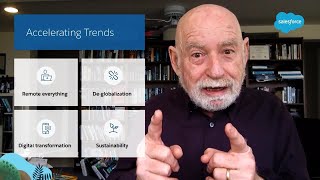
COVID-19 is reshaping how we work, shop, learn, and travel. Enterprise software and online retail are thriving while small businesses and hospitality collapse. The crisis is accelerating remote work, shorter supply chains, less consumption, and digital transformation across every sector.
Chapters
One of the things that we have seen that's really quite important is that different sectors of the society, of the economy are having very different experiences. There are some parts that are still growing reasonably well, frankly. Our business is much of enterprise, software is, but much of healthcare, you know, hospitals that had to put off elective surgeries suffered some, but they're getting back. And the truth is that more generally, healthcare is actually thriving and is likely to continue to grow. Online retail is obviously taken off in a big way. Government sector, we're having to shift more resources to the government, more happening there. At the opposite extreme is obviously small business. It's been catastrophic, right? It's a human crisis for every single small business person and the people that work with them. Whether it's the cleaners on the corner or the restaurant in the middle of the block or the bookstore down the street, all of them are suffering. The hospitality industry, obviously. Hotels, theme parks, rental cars, all that transportation, right? Not too many people flying these days. So what we're seeing is a high degree of variation in the middle. Some are doing okay, like financial services, lots of demand for telecom, manufacturing, depends where you are in manufacturing. So what we see is some industries like that turquoise line, green line at the top, doing just fine. Others have taken a dip but are coming back. Others are in a long term depression like say, hospitality. So what we're seeing is a high divergence in variation, not only by geography, but by industry. However, this is also a time to reimagine and reinvent. And indeed what we have seen is a number of trends that were true already before the pandemic have been dramatically accelerated by the pandemic. And obviously one of the most profound is remote everything. Right? I'm recording this from my study at home where I have been working for the last six months, as probably have all of you. So not only are we all working from home, we're buying from home, we're going to the doctor from home, we're learning from home, we're socializing with our friends on video from home. And so the technology of remote everything is going to expand. Look, all this technology was invented before the pandemic. And so we're using it for things it was never meant for. But it's going to get much better. All the tools of remote interaction, whether for medicine, for education, for retail, even for socializing, are going to radically improve. And this is an opportunity for innovation. The processes around it, how do you enable your customers, how do you interact with them, with your suppliers and so on in this remote world of remote everything that becomes a huge opportunity. The second was de globalization. Look, we already had a trade war and challenges to the US China relationship before. We had issues with Europe and the US and so on. Now people are, because of the pandemic, looking for much more resilient supply chains, things that will not be affected by pandemics. And so we're seeing a lot of realignment like that going on. And I think that presents a second set of opportunities. Third, sustainability. Look, sustainability has been an issue for a very long time, but the pandemic provides some unique opportunities. We're driving less, flying less, consuming less and so on. What does that tell us about what we really need to do? It'll be a long time before I get on an airplane to fly halfway around the world for a one hour meeting. You know, this isn't that bad. And I don't mind missing eight hours a week because commuting to work. And so we're learning a lot about what we're, how we could live to be much more sustainable. And then finally, all of these things require a digital transformation, moving almost everything into the digital realm. And so what we see, not only in our business, but nearly universally, is everybody is thinking through how to operate and live in a digital world. So all of those things together enable an enormous opportunity for reimagination and reinvention, to provide new products, new services, new ways of doing business, new ways of interacting, ways of doing it in a much more resilient and sustainable fashion. So I think those challenges and opportunities also should be in front of us, thinking about how we can build a better world out of all this, not simply have our heads down and write in light of the massive impacts of the pandemic. So I don't mean to minimize the consequences. This is a human and painful crisis for nearly all of us. But there is hope beyond the crisis and there's an opportunity to build something far better in the years beyond the pandemic. Thanks for being with me today and I hope you will all be well and be safe. Thank you.