How CRM + AI + Data + Trust is Making History | Salesforce World Tour Boston 2024
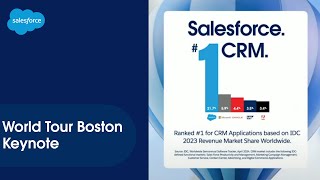
Salesforce leaders present a five-step framework for building an AI enterprise: unify data, collaborate with AI, discover insights, give AI new skills, and equip it to act. Customers like Air France KLM and Turtle Bay saw 40% revenue growth and 65-day faster processes using the stack.
Questions this video answers
Over 250 petabytes (noted as ~79 million hours).
On path to $38 billion in revenue this year.
2 months.
Over 1 trillion predictions.
40% increase in annual revenue growth for the resort.
Chapters
Artificial intelligence remains the talk of the town in 2024, after the boom in 23.
But in terms of how to use it in your everyday working life, I think a lot of people are still trying to figure that out. As the sun sets on all the hype and the reality of AI starts to crystallize, the question remains, how do.
We build the AI enterprise?
The customer is changing the way they want things served up to them. So we had to think differently than have one 360 view under one single.
Pane of glass so we can personalize every customer experience, creating long lasting relationships. Data is the fuel that powers AI. In fact, the quality of the input will absolutely determine the quality of the output. Now if I might be so bold, Unified data, that's as good as gold.
It is all about data.
Quite an important asset. At the same time is indeed a big challenge.
We've been able to unify our customer data across all parts of the business which were traditionally siloed. I needed a trusted source to secure my data and data cloud is that perfect product to take that journey with me.
I want to know what people are.
Doing with my data, don't you?
With Salesforce we can trust our AI.
Without risking our customer data.
Collaborative AI you can trust. Not nice to have. It's a must Slack helped my team team be more agile and productive by.
Enabling seamless communication between all of us at any given time.
What the Einstein One platform does is collaborate with the advisor, bringing the human touch to every interaction that we can with our customers.
It'll take their keywords and automatically give me service replies.
Over here on the right.
It's like a helping hand trapped.
Insights are now set free, unlocked with AI.
They are ours to see.
Tableau has been an incredible tool for us to be able to see. It allows us to surface insights in moments that matter. Tableau Pulsed has been a real game changer for us. That's really revolutionized how we think about.
A digital journey and as a result.
We'Ve seen a better experience for our customers.
Your own trusted AI a helpful copilot at your side.
Einstein Copilot helps the team go from.
Idea into execution really quickly.
We can now create meaningful automated recommendations.
For our customers faster than at scale. We were able to close student support pieces 65 days faster.
Hundreds of hours of manual work taken.
Out of our ecosystems across every part of the business.
We're exceeding the expectation of the customer. We're exceeding the expectation of profitability.
We gonna break a record.
The fun, the effects, the return.
3, 2, 1 magic has happened along the way.
Far greater than I ever thought.
Now that's how we ride into the.
Sunrise of the AI Enterprise.
Mm Giddy.
Please welcome CEO Slack, Denise Dresser.
Good morning, Boston. How is everybody feeling this morning? That's all you've got? That's all we've got. With the Celtics winning the NBA, let's hear it. I mean, this is. Okay, I can see where this is going. This is going to take a lot of hyping. So. So I'm going to be coming back at you for this. But first of all, good morning. Welcome to the world tour. Welcome to the AI Enterprise. This is a very special event for me personally. I'm back in my hometown. It is so good to be in Boston with all of you, the incredible energy and people. But I have to tell you, I had no idea I wanted to do this event. I've had it on my mind for pretty much 10 years or so. I did not know that I was going to be doing this the morning after the Celtics won the NBA tournament. So this is. This is really. This is a really special moment, and it's just great to be back home. There's nothing like coming home and being with all of you. So we are going to have a lot of fun. But when I was thinking about this AI event here in this incredible city of Boston, this innovation and hub for discovery, I thought it was sort of serendipitous. And I thought, okay, we're in this, this AI world. It is not a fad. It's not a trend. It is a full blown revolution. Are you feeling me with this? Like, this is not going away? Yes. Yes. Okay, stay with me. And then I thought, well, Boston, we know a thing or two about revolutions. Do we not? Do we not? So I think it is so appropriate to be talking about AI in this city that is a hub of innovation. It is the city where the mobile phone was developed, the microwave, whatever you think about microwaves, that came from here. The COVID 19 vaccine came from Boston. Fluffernutter came from Boston. Okay, so we have it all. So I feel this is gonna be a fun show. I feel like I'm in good hands with all of you because these are the smartest people in the best city in the world. Right? Hopefully you already feel like you're in good hands with me. It's gonna be fun. We're gonna learn a lot. We're gonna motivate you, we're gonna inspire you, and we're gonna educate you. But first, I do want to start out with a heartfelt thank you. Thank you to all of our customers, our partners, our community here in the city of Boston and Greater Massachusetts, our MVPs, our golden hoodies. I can't get all the way over there. Congratulations to our MVPs and to everybody watching online because it is you and your inspiration. That is why we do what we do. So thank you. And for those of you who've been with us for a long time, know that when we started 25 years ago in 1999, we set out to be a different kind of company. A company grounded in our values. Those values are trust, customer success, innovation, equality, and sustainability. And those are the values that are going to guide us, all of us, in this new era of AI. But everything in this new era of AI is about data. And therefore trust. Trust is paramount. Trust is the single most important thing. And I want you to hear from me that we believe deeply and always have that your data is not our product and it never will be. Now, the values also helped us achieve growth and it fueled our growth. And so we're proud to say that we're on path to be $38 billion in revenue this year.
That's great.
But what we really care about is that is the scorecard of the success that we've all had together. Because innovating for all of you, our customers, and working with our partners is again, why we do what we do. And 25 years later, we are steadfast, committed to those values of customer success, innovation, equality, and philanthropy. And we believe that business can truly be the greatest platform for change. Now, when we started, those values inspired a new philanthropic model. It's called the One One One model. We give 1% of our time, 1% of our profit and 1% of our product. Back to the world. Now, I was not in the room then, but I have heard that it was a pretty easy decision because there was no people, no product, no profit. Right? You guys have all heard this joke if you've been to an event of ours, but it really is pretty amazing because if you look at it now, that intention and that commitment has now led to over 700 million in grants given almost 9 million hours of employee volunteer time. I did the math. It's 112 years. Really kind of incredible how much time has been given back. And almost 60,000 nonprofit and higher ed institutions use Salesforce products for free. So shout out from an ngo. There's gotta be higher ed here. This is Boston, you know that. So we're really proud of that, and we will continue to have our values lead the way. When we started, we also started with a bold vision, and that was to help you connect with your customers in a whole new way. And that has never been more relevant than now, because in this AI revolution, everything is going to change. How you connect with your customers, how you build product, how you run your business. And this is what Salesforce has done since the very beginning, guiding our customers through these waves of technological evolution. If you can think about this, it started so long ago, going from on Prem to the cloud and then to mobile and then to social, and now with AI. And we did start our journey on AI 10 years ago when we released our Einstein product, which is predictive AI. It's machine learning. But now we've moved into generative AI. And I heard a stat recently that I think captures the point I want to make here, which is it took 2 months to get to 100 million ChatGPT users subscribers. 2 months. It took 15 years to get to 100 million users of the mobile phone. It took 4 years to get 100 million users on Facebook. My point in this to say is if you looked at this wave, the cycles are compressing and we are moving faster and faster through these cycles. But the key is, no matter where you are on this journey, it's clear that AI is going to transform every organization. It's going to unlock incredible potential. It's going to help all of us be better. It's going to augment our skills. I really believe that. I think we're all going to get better. We're going to drive more productivity in our organizations and for ourselves. That's going to lead to, obviously, improvements in the bottom line, but most importantly, better customer relationships. And that's what we're here to talk about. But as we've entered this world, it's become clear there's a couple of different types of AI. For example, consumer AI, it's probably the one we're most familiar with. And consumer AI has really three components to it. First, it needs to have a user interface to access the AI. We've probably all, at this point in time, use ChatGPT or any of the other products listed in the front. You need to have a user interface that's compelling to reach AI. Then you need to have a model, a really powerful model to execute the workflows. And some of these models are becoming so powerful, it almost feels like there's a human on the other side. It's almost moving into sentient, which is really really incredible how fast this has moved. And then you need lots and lots of data. And consumer AI is trained on lots and lots of public data. Now, that public data cannot help you understand or help your employees understand how to engage with your customer and what your customer preferences are. And that is why consumer AI is fundamentally different than enterprise AI, which is what we're going to be talking about. Enterprise AI is all about customer data, but it has to be grounded in your trusted customer data, grounded in the context of your business, your customers, purchasing behavior, service tickets, marketing interactions, so that we can trust it and it can be valuable. Now, the challenge is organizations also have lots and lots of data, but that data is not connected. It's not used in the flow of business, and it's hard to get insights out of that. So you end up with islands of trapped data, which is challenging in this world of enterprise AI. And I have the opportunity to meet with many CEOs, and they all get this. They all see the potential. They want to unlock this potential for their businesses, but they're concerned. They're not only concerned about this data challenge, they're concerned about security and privacy and toxicity and hallucinations. And we are not going to get to enterprise AI if we don't trust it. It's just not going to happen. And so when I think about that and I think about the ability to move forward, I feel really deeply that Salesforce was made for this moment because Salesforce AI is grounded in a trusted framework with processes to make sure that we are using data and developing AI responsibly. And that is all made possible from the Einstein One platform. The Einstein One platform is the trusted AI platform to help you to get to enterprise AI faster. It helps you unite all of your applications, bringing all of your data together in one place through data cloud, which is something only Salesforce can do. It has AI built right in. It's almost like you don't have to think about it. It's batteries included. And it starts with the customer 360. And the reason this matters is because, first of all, you have to have a single source of truth to understand your customer, to know your customer's preferences, to build a relationship, to grow your relationship. And I think about the customer360 as almost an operating system for growth in your business, can be used by anybody across your organization. Starting out with sales, I think about Spotify, who's driven 40% productivity with the AI sales cloud, really just being able to identify progress and close deals faster. Or how about EMPOWERING service agents to predict issues before they happen to resolve them proactively to build better loyalty and better customer engagement, which can happen through the AI service cloud. Now, nobody knows about loyalty better than marketers, right? Am I right? Are there marketers here in the room? So great marketing is all about having the right data, the right insights, reaching your customer where they are with the right campaign. And that's what St. Jude's did to raise $2 billion, $2 billion for children with cancer and terminal illness through the AI Marketing Cloud, which is just incredible. And every campaign is about inspiring someone to take action. And that's what the AI commerce cloud does. Meeting customers right where they are in that moment of inspiration, right in their shopping cart. And data isn't just about sales, service marketing, commerce. It's for your whole organization, especially in this age of AI. And Tableau is one of my favorite products because it allows you to see and visualize data so quickly to gain insights. You don't have to be a deep analyst. You can get those insights and I think it's incredibly powerful. And the Einstein One platform also powers all of our industry solutions. Our AI powered industry solutions, we have 14 of them. They're all about helping you build application or not build, excuse me, to actually get value faster. Because you don't have to build industry capabilities into the platform. We build them for you. And that's why today I'm really excited because we continue to innovate and we are going ga with our Life Sciences cloud, which is so exciting. And what Life Sciences cloud is going to help us do is help patients to be, to reach, enroll onboard and communicate during clinical trials. And it's going to help pharma and medical professionals to drive more personalized relationships through the clinical development all the way to commercialization. We're just getting started with Life Sciences Cloud but you can come back here at 3 o' clock and you'll hear the keynote to learn more about this product. Okay. I don't know why they put this last because you know it's my favorite, right? Of course, it's Slack. Last but not least is my favorite Slack. Slack is the AI powered command center for work. It is where your communication, your collaboration, your workflow, your documents, your videos, how you connect with your customers and your partners, all there in a conversational interface. But what I love is AI has now entered the conversation which is really powerful because Slack is your long term memory. And in fact, here's the proof. When I onboarded into the CEO role six months ago, I Use Slack AI. I use Slack AI in a couple of ways, and I hope this resonates for you to understand the power of this. So, of course, there's no surprise. Slack has been on Slack since before Slack was Slack. Okay, so there's no doubt about that. But I had to get up to speed on 10 years worth of work and understand all of the context. And as a CEO, you kind of need to know the history of all the decisions that were made. So I used Slack AI's search generative search capabilities to search 10 years of knowledge within Slack. About Slack. Why did we make certain architecture decisions? What is so special about the channel architecture? All the things that you need to know. And then when finding those answers, then it took me right into the channels so it could summarize. We have a product strategy channel that summarizes all the decisions we make. I was able to summarize 10 years of decisions in seconds. Do you know how powerful that is? And then starting my day with recaps, which is, I don't want to be in every channel. If you're a Slack user, you probably don't either, but you do need to know what's happening and you want to keep your finger on the pulse. So I start my day with coffee and Slack recaps. And those are just examples of how I've used that and how AI is coming into the flow of work. But work is getting even more powerful in Slack. Two weeks ago, we released Slack Lists. Slack Lists is simply put, the way that you take conversations and move them into work. How do you create lists, tasks and projects right where you're working, which is so important so everybody can collaborate on the work that is happening in real time. All right, so right now you might be like, wow, I feel like I just went around the world in about five minutes. I did cover a lot. But here's what I want to tell you. If you're thinking about where do I start, or I'm somewhere on the journey, but I don't know if I've thought of everything. We've got you. I said earlier, this is what we do. We've been guiding our customers through these types of transformations, and we're going to do this again with you in this AI era. So we've built a framework that gives you guidelines to understand what are the five steps that you need to be thinking about in leading your organization into enterprise AI. I'm going to introduce them now, and then we're going to spend the rest of the time going deep on these the first one, no surprise. Unifying your apps and data. Then once you unify your apps and data, how do you collaborate with AI? How do you discover AI insights? How do you put that data to work? But then every organization is different. And so how can you give AI new skills for your business? Very specifically. And how do you equip AI to act? Those are the steps. We're going to go through all of these in detail in a minute. I'm going to introduce my colleague Sarah to take us through the first one, which is unifying apps and data. But I want you to give a rowdy. Rowdy. We need to wake this up. I need to give you. You got to give a rowdy welcome to Sarah to get her excited on the first step in this journey into enterprise AI.
All right.
I need more energy. We need more energy. I'm not getting down until we get it. All right, all right. Take it away.
Awesome. I was promised energy, so I'm really glad to see it's here now. Thanks for that, Denise. We just heard how difficult it is to connect our data when it lives in different systems and silos. But when we don't connect our data to our CRM, we miss out on opportunities. Opportunities to transform, to connect the dots and to meet our customers expectation of a unified view of them across every touchpoint. We're experiencing a generational shift in data. Today, Salesforce hosts over 250 petabytes of data on behalf of our customers. To put that into context, that's 79 million hours. It's incredible. That makes Salesforce one of the world's largest repositories of front office enterprise data. And we host data about your business and about your customers so you can use it to ground your AI and deliver better outcomes. That's all possible because of Data Cloud. Data Cloud is Salesforce's hyperscale data engine. And it allows you to connect all of that data from any source and activate it in any application. And it's completely open. You can ingest data from your existing data lakes with zero data copy. But today we're excited to announce two new features powered by Data Cloud. First, you're able to identify relationships and compare them within Data Cloud. Now with the vector database live in Data Cloud. Second, your service teams can adjust asset data from any source and then they're able to use that to build better, smarter, proactive service experiences. And that's possible with proactive asset management. But you didn't think we were going to stop there, right? So today we're Excited to announce hundreds of new connectors in Data Cloud. It's amazing. So this includes Amazon Snowflake databricks, and these are natively built in. They also connect to your legacy systems, which historically would have required custom integrations, but with Mulesoft, that's all unified. So you're finally able to unlock all that value about those data points that you've been collecting over the years for your customers. That's why we built Data Cloud, so that you're able to unlock the value of that data, unify it together, and you can bring that data to life in any industry and drive better decision making with proactive analytics. All right, again, we're going through a lot, so why don't we break it all down about how this works? Big slide. We're going to step through it together. So on the left, Data Cloud harnesses the power of those natively integrated connectors in order to pull together all of that data. So that includes your unstructured data. Think knowledge articles, think emails. And that's why the vector database is so important, because you can identify those relationships and how that all connects in order to drive those actions. AI analytics, insights, workflows, in order to do that, we have to harmonize that data, which means we have to identify all those relationships and then unify it into one metadata model and create those unified customer profiles to drive the actions to drive the insights across our CRM. And this is something that only Salesforce can do. That's because Salesforce's data Cloud is built directly on that Einstein One platform, and it's integrated with the metadata model. I know that's a big word, but it's actually not that difficult. It's just context about your data. It describes how your data can be used. So let's take a look at that screen. A bunch of random characters, letters and numbers. Without context, we don't know what they are. They could be a password, could be a user id, they could be a zip code. Without context, we wouldn't know. And computers are the same. They need that context. We need to tell them, this is an account id. This is a zip code. Metadata simply takes raw data and then transforms it into context that can be used anywhere in the platform. And it's this data and metadata that brings business value to AI. Like Denise said, if you go ahead and ask ChatGPT about the performance of your recent campaign, I'll bet you it's not going to do a great job. And that's because it doesn't know about your data. It's trained on public data. So with Salesforce, you can securely inject your data into your prompts, and then you can give the AI hints again. This is why the vector database is so important. So you can retrieve that relevant information and then use it in order to provide better outcomes. And you know, with Salesforce, when you send that prompt across, that will ensure that that data isn't shared or retained by that model remains your data. All right, I hope we walked through that together in a way that made a ton of sense. But my favorite is always when we make this real with a demo. How about it? So we're going to look at Air France klm. They're a large multinational airline world renowned for their customer service. But as a merger of two airlines, they need to overcome the challenge of disparate data in order to put it to life in AI. So why don't we hop in and see how Einstein one platform is able to unify that data in order to provide more personalized experiences. Kristin, are you ready? All right. I hope this crowd gets excited by a demo. I do. This is my favorite part when I get to chat with customers about how this all really works. All right, here we are inside of our Salesforce instance for Air France, and we're looking at a contact record. So it's Sven. We can see he's based in Boston, so I hope you watched that game last night. I did. We have an email address, a phone number, basic contact information. And when we look below, we see that he's subscribed to a monthly newsletter. But it's pretty obvious looking across this record that we're missing a lot of information. I have no idea how Sven is engaging with Air France klm. And if I look in the center as a customer service representative, I have no idea what flights he's taken. I don't even know his home airport. So I don't feel like I'll do a great job when I work with him for whatever his issues are. For resolution, we need data. So let's see how AirFrance KLM can unlock all the value of that data they've been collecting in order to create more personalized experiences for Sven and customers like him. All right, here we are. And we're looking at data streams connected, the data cloud. And we just have the one. It is our Salesforce Org. So we gotta get a little bit more in there. Let's click new. All right, we see all these data streams at the top. We have the Salesforce one. We're gonna click marketing Cloud because we wanna bring in how we want to actually reach out the preferred channel for our customers. We scroll past that, we see all those other data sources that we talked about before, data lakes and data warehouses like Google Cloud and Snowflake. Past that, we see those mulesoft connectors that we talked about. This is how we're able to bring together all of this data from vast different sources. Think preferences for flights. Think the way again that we want to reach out. So we're going to go ahead and hit next and continue on integrating that data I selected earlier. Awesome. Here we are inside that harmonization step. So on the left here, we're looking at where that data resides and how it's mapping to internal in Salesforce, our data model. And we can see that it's going to map the right customer to the right data. Looks pretty good. So I'm going to go ahead and hit save. Remember that screen before that had just the one connector? Let's see what other data streams we have now. All right, this is value. We're able to bring together all of these different data streams here in order to create more value out of all that data that AirFrance KLM has been connecting. So let's see what that actually means in the context of Sven. All right, this is pretty empty still, so let's hit refresh. Boom. All right, that is a complete view of Sven. It's awesome. I know you'll get excited when you see that in addition to all this contact information, we have those calculated insights. It's really just a fancy way of saying that we're able to take that data and transform it into attributes about Sven. So, for example, as a service rep, I'll see that he's now a gold member, and that means they'll understand what his actual benefits are and be able to serve him better. And in addition, we have his preferred channel and his airlines. So we're sending the right message about the right brands. If I look across, there's that flight information and you can see that as customer service rep, I have a full view of all the flights that he's taking across our airlines. And on the right here, we're able to see that he's engaging across all different channels, sales, service and marketing. This is great. I do love this view. But let's talk about how to activate this data. This is what Salesforce does better than anyone else. So let's look at how Air France KLM can take all of this rich data and activate it with Salesforce Flow. All right. Here we are Inside Flow. It's Salesforce's workflow automation tool, and it lets you turn data into automated journeys. So in this case, it's a data cloud triggered flow. And so it's going to be activated when there's a change to the data. Specifically when someone reaches a new membership status, it'll then send a message to the preferred channel. Why don't we check out what that looks like for Svet? Great. So here we see that Sven is getting an email sent to him and it's personalized to him. Because Einstein personalization is driven by data cloud. We can see that he's getting an email about relevant offers and suggestions. For example, in this case, the summer deals for his gold membership level. I love this. This is what it means to unlock your data and bring it into life and action with Einstein one. All right, Denise, why don't we see what else we can do with all this data?
I love it, Sarah, thank you. I think what was incredible. Great job. Great job. What I think can get lost in that is that you weren't only just unifying apps and data, but you were showing how uniquely Data Cloud allows you to activate that data. And I think that is very critical. It's the last mile of bringing a single source of truth right in the flow of work. So you don't have these silos of trapped data that you can't activate. So I think it's incredibly powerful. Okay, step one, done. Everybody with me? Everybody see? Okay, we're all hanging in there. Okay, was everybody out late last night? Did people stay out late watching this game? All right, all right. So it's all right. I'll forgive you. So now we're going to go through steps two and three. Okay, Stick with me. Two and three, we're going to do together because they're related. So we've unified our apps and data. Now we're going to talk about collaborating with AI. So collaborating across your organization and discovering AI insights. And so to help us walk through that, I'm going to invite my colleague Krithika. Let's try this loud welcome again. Let's get this energy going. All right, Are you ready?
Yes, I am ready.
All right, let's do it.
Thank you, Denise. I am excited to be here in a city of champions, but also to talk to you about collaborating with AI. AI will elevate every part of your enterprise, your workflows, your web pages, everywhere work happens. That's why we're all feeling this urgency to implement AI. Luckily, we've already Figured this out. We've partnered together with predictive AI. Predictive AI is in all of our core apps, whether that's self service bots for service, personalizing your marketing offers for marketing and increasing forecasting accuracy for sales. I'm on the sales cloud team and I can tell you firsthand the impact that predictive AI has had for our customers across industries. Together with your partnership, we are delivering over 1 trillion predictions on our platform. So thank you. And building on this foundation, we are taking it to the next level with Einstein Copilot, your one conversational AI assistant. Einstein Copilot is grounded in your data and metadata. That's why Einstein is smart and it's relevant to your organization because it understands your products, your customers, your service cases and your deals. You can talk to Einstein like you would a coworker or colleague. And what'll Einstein do? He'll talk right back. He'll answer your questions, he'll generate summaries, he'll assist you with all of your tasks. This is high quality, trusted AI that only Salesforce can deliver. But most importantly, what I want you to remember is that this is one unified experience. Meaning there's one copilot across all your clouds. Sales, Service, marketing, commerce, tableau, you name it. All of these teams are working hard to give you purpose built actions and prompt templates so you can close deals faster, create relevant marketing content and increase commerce conversion rates. But I am thrilled to be able to announce that coming in September, you can talk to your CRM like you would a coworker or colleague with Copilot in Slack. Yes, bringing all of that customer context, all of that customer data right where you're interacting and moving work forward. But ladies and gentlemen, this is only the beginning. We have three other innovations that are also coming to you. Record channels. Bring all of your Salesforce record details into Slack and see your Slack conversations in Salesforce, removing the need to swivel chair between systems. And with Slack Elevate, you can track your deals and take action on your opportunities right in Slack. And finally, but certainly not least, you heard Denise talk about Slack lists where you can bring all of your project management capabilities once again into Slack. All right, so we just learned about how to collaborate with AI, but you can also collaborate with data and insights too. Which brings us to the third step of building an AI enterprise. Discovering AI insights. We just learned from Sarah how the AI enterprise is built on a foundation of trusted customer connected Data. And yet 94% of business leaders tell us that they need to get more value out of their data. In order to become an AI enterprise, you need to turn your data into relevant, actionable insights. And that's why Tableau has never been more important. Tableau transforms the way people see, understand and act on their data. Our latest two product innovations are going to make trusted insights accessible to everyone at your organization. Rather than opening up that visualization and spending all that time trying to connect all the dots, receive insight summaries in the flow of work with Tableau Pulse. I love Tableau Pulse. I get it in my email, Slack and mobile. It surfaces insights for all of my top metrics. But my favorite part, it often services insights for questions that I wouldn't have even thought to ask about my data. And with Einstein Copilot, your teams will now get a conversational AI assistant right within Tableau. So you can ask Copilot all of your data analysis questions. And Copilot will help you build visualizations and write calculations, all using natural language. These two innovations are going to help your teams go from data to insights to actions fast. All right, now that you've understood how Copilot works across all our apps, let's bring this to life with a live demo. And what better way to do that than through the eyes of our trailblazing customer? Turtle Bay. A premier resort in Oahu, Hawaii, Turtle Bay is creating guests for life by personalizing every part of their experience for their guests from pre booking to post day. And they're able to do this at scale with help from Einstein Copilot, quickly and efficiently. The best part, their teams are spending less time on repetitive tasks and more time where it matters. Building customer relationships. The outcome, you ask, 40% increase in annual revenue growth for the resort. All right, Kristen, Ashley, you ready to take this amazing crowd through a live demo? All right, let's do this. Here we have Tableau Pulse in Slack where I get a personalized AI generated digest of key insights for the metrics that I follow. I can quickly understand changes in my data, like this insight that occupancy rates are declining. That's not good. We gotta dig deeper. Let's do that in the Tableau Pulse mobile app. You see questions here that have already been generated for me to help me understand the why behind my data. The why behind your data is so important. And yet with traditional BI tools, it's time consuming and it's hard to get to that why. Thanks to Tableau Pulse, everyone at your organization will be a data expert. So even someone like me, who's a beginner at data, can Quickly see that the reason this decline is happening is because there's been a lack of corporate events. This is critical information. Let's send this to our marketing teams so they can start to build a campaign with this insight sent, let's head over to Slack to see how our marketing teams are collaborating on this campaign. Pretend I'm a marketer at Turtle Bay. I start my day in Slack. It's my AI powered platform for work. Instead of jumping from channel to channel to channel, to get caught up, I use Slack AI recap. It summarizes all of my important information. I see something that catches my eye, so let's click into the record channel where the conversation's happening. Now, on this conversation, you might see something familiar. This is the insight that we shared earlier. This is powerful. So I want to pause here for a moment. Not only are we uncovering insights quickly, but we're sharing them in the flow of work to drive collaboration and action. Speaking of action, let's continue to action on this campaign. In the record channel, which is a wealth of information. At the top, you see record details coming in straight from Salesforce. And below that, you see CRM data and tableau metrics to help the marketers at Turtle Bay, like me make better decisions. And in this record channel, we have lists so that your teams don't need to go to yet another app or website to track their deliverables. Everything they need is right here. My team at Salesforce uses lists and we love it. It's amazing to be able to have conversation on a project and immediately turn that conversation into tasks and assign owners so we can move projects forward. Let's continue to move this project forward. And we do that by conversing with our team. We're pulling in all the right people into the discussion, as you can see. But there's one teammate that's missing. Can anyone guess who it is? I heard it. I'm hearing it over here too. Einstein Copilot, your conversational AI assistant. I'm going to ask Copilot what resonates with this segment. And behind the scenes, Einstein is going to analyze all of that data that Sarah talked about in Data Cloud. He's going to analyze structured data like booking rates, and he's going to use vector databases to analyze unstructured data like survey results. And just like that, we have our answer. Now we know what resonates with this segment. So let's go ahead and send this insight out to the rest of our marketing teams. We have done a lot of work on this Marketing campaign. Let's fast forward and see if it brought in any leads for our sales teams. I'm going to put on a different hat now. I'm a sales rep at Turtle Bay. I start my day in seller home. It's my complete view of my business. It has my pipeline, my tasks, and my important to dos. And Einstein copilot is here too. I want to reiterate that this is the same copilot you saw the marketers working on in Slack. That's because with Salesforce, you get one copilot that's grounded in your customer data, regardless of the application. I could spin my wheels and focus on an opportunity that might not close. Or I could ask Einstein who I should focus on. And once again, Einstein is going to go and analyze that data from data cloud on our customers and he's going to surface an opportunity that has a high propensity to close based on the fact that this customer has had positive experiences with Turtle Bay and has zero open service cases. What's more, if I'm stuck on how to progress the deal, I'll ask for guidance. And Einstein's going to serve me a tailored close plan with key milestones and dates so that I know how to move this opportunity forward. And this close plan is grounded in opportunity data and previous interactions with the customer. So let's start actioning this close plan. Let's do that right from here. I could stare at the blinking cursor, think about what to say, go to another tab, find my calendar and my availability. Or I could ask Einstein to generate the email for me and you see an email here with scheduled meeting times based on my availability. This email's looking great, so let's go ahead and hit send. Wow, we just did so much in a matter of minutes. We collaborated with AI, we discovered insights, and we did all of that through one unified copilot. Imagine how productive your teams would be with this conversational AI assistant by their side. Back to you, Denise Krithika.
That was incredible. I mean, first of all, seeing the power of you've unified all of your data in applications, you have one single source of truth. And then bringing all of that structured and unstructured data together, which was never before possible, so that you can collaborate more and you can discover new insights. And this is an incredible unlock for every organization. I found it very inspiring, especially seeing it in Slack. It was great. Okay, so we brought the data together, we're starting to get more insights. We're discovering insights. But not every company is the same as I said before. So you want to be able to give your AI new skills. You want it to learn new things about your organization and maybe, just maybe, we're going to get into that autonomous world where we have agents working for. So this is the next two chapters we're going to cover. Chapter four and chapter five. I'm going to introduce Carlos to come up here and bring a whole bunch of energy. Carlos, let's see it. It's like you're ready, you're ready.
Thank you so much for having me.
I'm turning it over to you.
Thank you all for being here. Between the lobster, the cannolis and the game yesterday, I couldn't be more happy to be here in Boston for the first time. Thank you so much for having us and for having me. I'm excited because we are in a movement, in a no low code movement and it's scaling application development like we've never seen before. We're talking about hundreds of billions of transactions per month. We're talking about millions of custom apps built in point and click. It's wild. Think about it for a second. But it's getting even wilder because Genai is fundamentally changing the way we develop software and the way we interact with applications. We're going from click based UIs, user interfaces powered by code and transactional databases to Genai apps powered by the most accessible programming language of them all. Plain vanilla conversational natural language in English. I like to say that differently. If you think about traditional software development as a rigid decision tree with predefined if then do that type of path then you can think about Genai apps like a bush with no predefined paths where users can interact with the applications with many options in many touch points. Now the question is how do you build these next generation conversational gen AI apps? And the answer to that is Einstein One Studio. You can give AI new skills with Einstein One Studio as an admin, as a builder Persona create and craft beautiful gen AI responses trusted in your enterprise data with prompt builder all the way on the left here. Take advantage of foundational models or and bring your own with model builder. And finally where it all comes together where you can build the next generation of proactive conversational apps. Copilot Builder. When you give AI new skills, AI can do much more than just providing information than just answer your request. You can also equip AI to take action and you should. This will unlock the next levels of productivity and scale for any enterprise, for any brand. Think about this one for a second. We lose 41% of our day to repetitive work, to repetitive tasks. That's more than three hours a day. It's crazy. And that's what we can actually help you with. Einstein Copilot. Now, we all know that LLMs can generate content. We're all familiar to that. The beauty of Einstein Copilot is that we use LLMs to understand context and intent. We use LLM to create an action plan and we use LLMs to take action for you with Einstein Copilot on those repetitive tasks so that you can focus on high value customer relationships and work. Let's unpack this for a second. I want to show you how the brain works behind the scenes. So let's open the lid together and walk through these steps. The first thing is a trigger. This is a data change. Think about all of the CRM data changes that you may have. This could be a previously item that was sold out that pops up and is back on stock. Or for example, a lead that you are in discovery mode with that's back on your website researching for a product. These are all great signals to act upon to trigger Einstein Copilot. So let's unpack it even further. Let's walk through the brain step by step, going here from left to right. First thing that happens is that we send a copilot prompt to the LLM. Think of this as context. This is essentially a chunk of instructions that allow Einstein Copilot to start understanding what this data change this trigger is about and how it should go about resolving it. But before Einstein takes action, it will check in to see with you and clarify any intent just to make sure it's on the right track. At that point, it's going to generate an action plan and it will select the actions that are most relevant to deliver the job at hand. If at any moment it requires additional information, it will go ahead and ask for your input and it will do that autonomously, just like any coworker would do. That is how you can complete even multi steps tasks end to end with Einstein Copilot. And I'd love to show you this with an example. One of our customers, Aston Martin, that is becoming an AI enterprise. The iconic automotive brand that you know is becoming an AI enterprise. The challenge here that they had was fragmented data, fragmented vehicle data, fragmented customer data a little bit scattered all over the place with data cloud, they were able to unify this data and activate this data in order to provide personalized customer experience. And I want to show you an example of how Aston Martin and Any brand could deliver the next generation of Genai apps with Einstein One Studio. Okay, meet Luke. This is a notification from Aston Martin letting him know about his upcoming service appointment. It's completely tailor made for him as a customer and it was sent in his channel of choice, his preferred channel of choice. Now what's so special about this? Well, the beauty of this is that every single step leading to it was done autonomously. And that's what I want to show you today. So let's rewind and actually see together how we got here. Here I am as a service rep in Aston Martin's service cloud console. This is where I start my day in the homepage, allowing me to get key information to get started. Things like open cases by product or the temperature of my contact center bubbling up KPIs like average handle time or in this case, average resolution time. But today I would love for us to drive your attention here in the upper right side of the screen. I have a notification here where Einstein is proactively letting me know that one of my customers, Luke, has an issue. Not only was it able to actually understand what the problem is, it came up with a plan to fix it. But wait, not only did it do that, it actually took action autonomously on this very endeavors that we have given it access to these repetitive tasks like create a work order. Excuse me, find the parts of the vehicle, assign a field technician and actually send that outbound notification that we just saw. Think about that for a second. Think about all of the repetitive tasks that you have to deliver, you and I, every day at work. Think about the time that it will save to your employees. Now, how were we able to trigger proactively Einstein Copilot? And the answer to that question is this lightning flow. This is a trigger based lightning flow that's listening in on telemetry data. So a drop on the vehicle health score triggers this flow. And this flow in turn will invoke Einstein Copilot. And Einstein Copilot will come up with a plan and Einstein Copilot will cherry pick the actions that it needs to deliver to solve the job at hand. We can give copilot skills in the Einstein Copilot Builder. Buckle up. This is my favorite piece. I'm very proud to the team that is building this together with us. Welcome to the Einstein Copilot Builder. This is where you can customize your Einstein Copilot tailored to your business. And we're making this very easy for you on day one with standard copilot actions like to do things like Case summarization or draft and revise an email. But of course you can also leverage custom actions with automations that have previously are available in your org. Like for example, generate this work order and we're making it very easy for you to add an action and equip copilots with skills. Okay, fantastic. In this Copilot builder is where I am going to simulate how my end users will interact with it. So I'm going to go ahead and preview the service representative that was interacting with Einstein Copilot just a second ago. And I want to simulate the trigger that invoke the first turn for Einstein Copilot, that telemetry data flow trigger, remember? And we're gonna run it in the context of one of Aston Martin's customers. I will choose Luke here. Okay, let's actually give a little bit of space here. So on the right side is actually the preview the experience of my end user. And here in the center on the plan canvas, this is where the AI is reasoning. So on the right side, this is actually the experience of my service agent. But and as an admin, as a builder Persona on Copilot Builder AI no longer is a black box. I can see how Einstein Copilot is reasoning. I can see what is the plan that Einstein Copilot came up with to actually solve this endeavors. I can see the actions that it was able to stitch together. I can see what data is going through each action as well. That's the power and the beauty of the plan canvas here. And of course remember, this is a conversational interface. At any point, as a simulated user that I am actually doing here, I can interact with it and ask it things like, hey, when is this actually scheduled? Let's see if we can actually bring the appointment a little bit earlier in time because we know, and I know that my customer is going to want to harness his beautiful vehicle during the weekend. But what's actually happening here? How was Einstein Copilot able to find the engineering resources as well as understand this daytime's options? Well, because as we've been talking about, Einstein Copilot sits on top of your data and metadata and it is aware of the conversation that is happening. So it is able to understand that this week actually refers to the days before that very Monday. And this allows Einstein Copilot on day one to know your org. The fact that it sits on top of your data and your metadata and that is unique to Salesforce. Okay, there's another thing that is extremely interesting to see and to grasp here is that the usual service engineer for that very customer is not available. And Einstein autonomously pop up, pops up a disambiguation situation opportunity. For me, it's saying, hey, the engineer that we typically use for your customers, not available, but I have these other options. And he was able to do that autonomously. We did not predefine this logic. That is actually the power and the beauty of this realm. We're going to go ahead and choose James as one of our stellar service engineers. And this is the final dynamic plan. At every utterance, we're generating a dynamic plan, cherry picking the actions and executing them. And remember how I added the actions earlier? You hold the knob, you decide how many actions you add or not to Einstein copilot, you decide how much autonomy or not you give it to it. Okay, the last piece actually on this multi step plan is essentially generating this outbound notification. So let's see how we created the content and how we created this tailor made content. And to do that I'll move to Prompt Builder. This is the tool at your fingertips to craft beautifully, generate gen created content tailored to your business. This is where I'm going to basically provide AI instructions. Or if you want to get fancy, this is where we're going to do some prompt tuning and I have to actually do it in the context of my business. Right. This is where we're going to actually go here and pick up a retriever. Remember this retriever? We're picking up a retriever here. Remember the, what Sarah was doing earlier where she was building that unified profile? We're doing the exact same mechanism here. We're basically harnessing the customer data that I have already stitched up here, but I want to also bring in the vehicle data. So let's go, let's go back to Prompt Builder and actually add this retriever, this data graph with the unified profile. And finally we want to reference the flow that will take in the content and then it will be sent out to Luke. Fantastic. So let's go ahead and actually pick up this flow, the piece finale. We're getting there. I want to preview as a, as a builder Persona how my end customer is actually going to experience this content. Let's go ahead and actually choose one of the many customers that Aston Martin has. We'll check in here with Luke and we can preview that. Okay, so what's happening here on both of these screens is on the, on the left here we have what you call the hydrated prompt, essentially the instructions we send to AI with all of the data all of the cloud context it needs to do what? To give us a beautiful gen AI response here. Let's go back full circle and actually see how Luke will experience this community. Outbound communications. And here we go. This is essentially the WhatsApp that we were able to send on the customer's preferred channel, letting him know that a service appointment and a service engineer is will be on his way tomorrow to service for his vehicle. Thank you all. Thank you very much. That is how we bring Einstein One copilot to you.
All right, everybody, are you still with us? That was amazing.
I mean, hello, champions.
That was really, really incredible. Really incredible. So listen, we're in the home stretch. We're almost done here. So just to. Just to recap what we saw. Unifying apps, collaborating with AI, discovering new insights, giving AI new skills, and then moving all the way into autonomous AI, all on the Einstein One platform, grounded in your trusted data to help you get to enterprise AI safely and quickly. Okay, so this is just the beginning. We're going to wrap things up. But if you weren't already convinced to get started or you don't know where to start, we are also offering a couple of things to make it easy. A starter bundle which includes data cloud licenses and professional services. If you want to start out unifying your apps and data, you can also learn more about this on Trailhead. And we're offering 50% off the certification for data cloud if you want to do that. So we are really coming into the home stretch. This is it. This is my last slide. This is what I want to leave you with. First of all, this is just the beginning of the day and your journey for AI with 85 sessions, 25 demos. I mentioned the keynote for Life Science Cloud here in this room at 3 o'. Clock. I want to say thank you to our amazing sponsors and the last. Oh, by the way, don't miss the hands on workshops which are incredible and really bring this to life. But the last thing I want to leave you with is the AI event of the year is happening in San Francisco at Dreamforce on September 17th through 19th. Be there, learn and continue on your journey with Enterprise at Enterprise AI. Thank you everybody, have a wonderful day.









