How Developer Platforms Run The World at The Cloud 100 2020
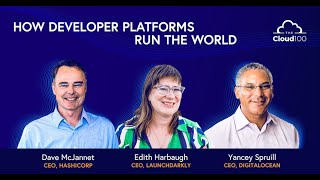
Dave McJanet, Edith Harbaugh, and Yancy Spruill discuss how developers now drive software purchasing decisions through cloud platforms and networked discovery. Developers have outsized influence because organizations increasingly buy productivity tools instead of building them. COVID-19 accelerated this shift as companies rushed to adopt cloud infrastructure.
Questions this video answers
Cloud100 panel, September 16, 2020 (YouTube video 'How Developer Platforms Run The World at The Cloud 100 2020').
Dave McJanet — CEO, HashiCorp; Edith Harbaugh — CEO & co-founder, LaunchDarkly; Yancy Spruill — CEO, DigitalOcean.
About 25 people dedicated to developer evangelism.
Edith stated "6.6 trillion (with a T) features every day."
Chapters
Hi, I'm Dave McJanet, CEO of HashiCorp.
I'm Edith Harbaugh, LaunchDarkly CEO and co founder.
My name is Yancy Spruill and I'm the CEO of DigitalOcean.
Thanks for joining us at Cloud100. Today we're going to talk about developer platforms. Just even the word developer platforms is something new. 10 to 20 years ago developers really didn't have much budget and weren't really purchasing software like they are now. So my question for both of you is why do you think that's changed? Why do developers suddenly have budget and the ability to purchase developer platforms?
I'll start with that. I think the impact of developers has been growing for the last 15, 20 years. And I think the difference in our view is that historically people didn't spend a lot of money on developer tooling. So developers were not an audience that people really paid that much attention to commercially. But I think what's happened is commercially developers have much more influence now in sort of bigger decisions that are being made around software purchases. I think it's actually the impact of both. The developer tooling market is a relatively small commercial market, but it's that they have an outsized influence in the decision making process. And I actually think I credit Microsoft for it, honestly. I think Microsoft mastered this with their developer and platform evangelism function years ago and invested in that. And I think it's borne fruit.
Yeah, I would say that the cloud has really enabled democratization of software across the enterprise. And so where historically you'd have centralized IT departments that controlled new applications being brought onto the on premise infrastructure and they had to manage security and all the program management, procurement rules and all the rest of it. I think, you know, as the software tools that people could use have become easier to, to manage and not be decoupled from these big software platforms, enterprise platforms, I just think it's made it easier and I think organizations got over the hump probably eight, nine years ago in allowing people who are closer to the applications to actually make the decisions. There's nothing more powerful than with software developers in the organization where they could choose the tools and then the organization still figure out all the other security and other things. But even that becomes less and less of an issue as the whole platform becomes cloud. That's really the power of what we all are enabling in the economy.
Maybe I'll make another angle on the question is that it's that developers are the ones that spend their time working in software and as the Internet more Broadly emerged, those people started to discover software. And I think that's the difference. No longer were they burdened by the legacy salesperson from Oracle to come and tell them about some new technology product, they could discover it for themselves. And by virtue of us all connecting on a common network, all that information is now accessible. So it shouldn't be surprising that the people driving the adoption of new software are those people that live and breathe and work in software every day. And whether that software is going to be deployed on PREM or on cloud is sort of a secondary concern. It's more that the decisions around which software is going to get used are now being driven by people that live in the world of software. I think that's very different than maybe a decade ago.
I know what we've seen in our own customers is that developer happiness is an important metric. You know that if people are using it every day and happy with it, they're going to be happy at your company as opposed to just taking whatever is given to them and maybe not being happy and then going to another company.
Yeah, I think the cool part about that is that it sort of removed this barrier of the hegemony of a few software vendors in the world controlling what we all use. Because now the sort of this common network connectivity tends to favor the best technology that people like to use. So it's a sort of you're not catering to the user need as opposed to the organizational need as the primary. And I think that's a huge inflection point and it's a very different way of building a business, candidly, because now we all understand the need to appeal to the user. And when those users move to the next company, they bring that tech with them, whether there's a PO in place or not. I think that's very, very different.
I think the rise of open source and myriad of software tools that are innovated outside of those narrow platforms that Dave referenced has also created this whole ecosystem and knowledge base around software tools that could be customized or more relevant for particular use cases. And depending upon the developer style, programming style desires the organization. They have way more flexibility trying to restrict that versus unleash it and the creativity that it enables. And I think that developer happiness scale or index is a good proxy for the people who are fueling growth, not just in tech companies, but most companies now need software as a key competency to enable innovation and productivity in their business.
A trend I've seen myself is is that just a willingness to pay for tools for developer productivity. You Know, when I started in software, our QA manager actually built our issue tracking system in Lotus Notes. And now anybody who's working in software is like, well, why don't you just buy Atlassian Jira and be done with it? It's like, well, Jira didn't exist back then. So I think there's a whole wave of it's okay to have the budget and like, let's have our developers focus on higher level activities than building an issue tracking system or DigitalOcean or HashiCorp. Are you seeing the same thing in your own customers or is there still resistance to build versus Buy?
Yeah, I think this comes to the nuances of business models a little bit too that I think we've learned to make our products freely available to everybody so that they aren't faced with that decision so early. And so I think as companies mature, we're building products that appeal to the developers and then the question always becomes, okay, at what point does that transition to being more of a commercial partnership so that they sort of make the build versus buy leap? We see, you know, our view is a little bit purist. Candidly, we, our true north is the user and we just trust that, you know, if we add value to that user over time, we can build a commercial partnership with them. And so I think it's that like that true north is always the user. So absolutely we come up against people in the build category all the time and that's totally okay.
Yeah. And I would say, you know, our whole mission is that we create a platform for people to build on and our customers are testing code, they're building a business, scaling a business on our platform. So they're fundamentally builders, entrepreneurs, developers, and we feed into that and I think, you know, tools like ours, you know, to Edith's point, you know, people don't have to manage their own it. Nobody thought that 10 or even 20 years ago for sure. And now no one thinks the difference of I'm going to outsource my infrastructure and then focus the efforts of my talent, the capital I raised, et cetera, on productizing in my relationship with the customer. And you know, we're facilitating our builders, you know, productivity through the platform and the tools that we built.
I briefly want to touch on that. Developers are also much more prevalent than I think than they were 10 or 20 years ago. Cloud used to just be constrained to high tech and now it's also in automotive, financial media, everywhere. It's no longer something that's on the side or on the end. It is actually your same business. Do you think that's leading to the power of developers?
Obviously, almost every business has a relationship through the web and, you know, having the tools and the powering behind that from a productization perspective, distribution, branding, etc. It's all tied to software. Whereas, you know, when I started my career, very little of it was software, it was emerging as hardware, but it was all sort of physical. And the increase in softwareization of the economy is just making all businesses software companies. They have to have a competency in software.
A developer can build something which massively increases the productivity of their entire company. They can build something that allows them to enter into a new market and just leapfrog others. And I think that is what we're in the midst of is this industrial revolution driven by digital. Whereas the previous industrial revolution is about, you know, manufacturing in a world where there really is no raw material other than an idea and some text typed into an editor. Your only constraint really is your imagination in terms of businesses you can build. And I think developers are the ones with that superpower.
We're seeing that with our own customers, like BMW, where it went from you shipped a car and then it just sat in your driveway and never changed. With software, they could continually update the car and give it more capabilities. So even stuff that we think of as static is now a lot more dynamic.
The commercial differentiator is no longer my ability to build the most sophisticated vehicle. I've actually provided a software delivery platform that allows me to leapfrog every month what other people are bringing to market. I think that's how these markets are being won by our users and your users is by expressing that superpower that they have. So they may not control the budget per se, but they're certainly in the bullseye of what their companies are trying to do.
And the world has really evolved as well to the notion of software is not a product. Customer experience has been conditioned across the planet to expect change in updates in the product, not on an annual or multiannual cycle like it used to be. And so it just has raised the prominence and expectation of all of us as customers or users of some product or service, that the software aspect of it is going to continually make the experience better. I believe we all do things differently in that regard. I think it'd be good to talk about how we approach selling to engaging, communicating with developers. And then the other is related is this whole area of developer evangelism. And how do we. How do each of us in our businesses sort of Approach that angle to conditioning and building brand and capability and reputation across the developer community.
I think that the key to success with developers is really recognizing that you have to make them happy and make them productive and then also make a product that the organization which they work for feels comfortable purchasing. And I think the key is to have them both. What we've seen over and over at LaunchDarkly, and we serve 6 billion flags now, feature flags worldwide, is that we'll have a developer that loves us, is very successful at a job and then they go to a new company and they want to take us with them. And there's no better feeling than getting that call at the second, third job where they say, hey, you helped me so much at my old job and I want to buy again. You know that you're seen as a trusted advisor where you're helping them do their job better. So that's a lot of our go to market activities right there. It's just making sure that we have these built in evangelists monitoring our. Net promoter score. The second motion then is being able to have a product that people can purchase for their company. If you're a huge enterprise, there's some table stakes in terms of GDPR compliance where it has to be basically enterprise ready. I think for a long time in the developer landscape it was seen as an either or that you were friendly developers and therefore not enterprise grade, or you're enterprise grade and therefore developers hated you. I think a really successful platform has both something developers love to use and that any company can purchase.
We think about it in a similar way, which is we try to step all the way back and go. We actually don't just serve developers. Developers is just one of the audiences we serve. We actually have ops people, security people, networking people and developers. So step number one is delineating your audience and saying, I want to authentically commit to making that person successful whether they turn into a customer or not. Because, you know, enterprise software at a certain degree is about trust. It's about trust for the tech decision maker, but it's also about trust with the practitioner that uses the tech. So we delineate the audiences, we identify the kind of the journeys that they're going to go on and then we cater to them authentically. So the practitioner has a journey, the tech decision maker has a similar journey that says, all right, I get that people inside my company like this tech, but I have a sort of different set of requirements. I need to be able to, you know, understand the why try buy kind of journey that they go through, I think. So the delineation of those two journeys out of the gate, that's really, really critical. And number two, it's being deeply committed to the authentic successful completion for both those participants is how this is done at scale. As an example, our, you know, we just give a sense, we probably have about 25 people purely in our developer evangelism organization. That's all they do. We ring fence that investment as a separate thing and their measurement is explicit. Is the developer is the ops security network person getting what they need from us, whether we have them as a customer or not. So I think it's that it's the decoupling of those Personas which is so key. Key, because I think you're right, developers don't necessarily have a budget to spend, but they're enormously impactful.
Yeah, I think our approach is similar on the evangelist side. We put a lot of effort, we call it community and we treat the global sort of entrepreneur developer community similarly in that we invest in them, we produce a lot of free content, we hold events, we invest in their learning development with the notion that, you know, we're not trying to monetize every instance of their engaging with our content. We're really trying to help them get lift off on the next idea. Because I think what Edith said is absolutely true. If you win the hearts and minds by helping people make a breakthrough in Opportunity one or Opportunity X as they go throughout their career, they're going to come back because they're going to remember that we invested, we partnered with them, frankly, we're part of that ecosystem. And I think that is a key aspect, you know, that's very different than the traditional model around selling software where it was very transactional, very terms and conditions, very much sales cycle. This is much more about a long term, you know, we view it as a long term commitment as a part of this broader community that we invest in. And it's really core to our essence. And I think it's why we've been successful and you know, have over 500,000 customers today, but many, many millions, maybe order of magnitude more than that of people who touch do in one way or another, whether it's reading tutorials, going to an event and learning about technical issues that matter to them.
For launchdarkly, we were really starting a new category of feature flagging and feature management. So a lot of our early evangelism was just that hey, there's a better way to build software. We did not invent the technique of Feature flagging. But I and my co founder really thought that this was just something that everybody should be using and that there should be a product out there that made it easier. So we've always had kind of a dual path of just feature flagging is a better way to build software. And even if you don't use LaunchDarkly, though, I sincerely hope you do. And thank you, Dave and Hashicorp for being our customers. Even if you're not using us, this is a great way to build software. And once you're happy with feature flagging, you should consider us. But it's a very genuine effort from us to just build better software.
You guys are a great example of how big these markets are. Think about the software development life cycle. Feature flagging is something all of us were doing for many years, but we're all doing it ourselves. And as this community's gotten bigger and bigger, what's popped is actually everybody's trying to struggle with the same stuff. And entirely new software categories are getting created within the developer ecosystem as people are realizing, wait a second, everybody's trying to provision infrastructure on multiple places, like, why am we all reinventing this? Everybody's trying to do feature flagging. And I think you're seeing some really large companies getting built on the back of what is really a TAM expansion, that none of us appreciated how big these tams were. And I mean, you shared the number. Is it 5 billion feature flags a month or some enormous number that none of us could ever have imagined that that would be the scale?
Yeah, Dave, just to clarify, this might surprise you, but it's actually6.6 trillion with a T features every day.
There you go. Six trillion features a day. Yeah, it's an amazing, amazing number. So we've been talking a bit about the go to market models around developers and sort of the notion of developers, but I don't think we talk enough about the impact of the developer platforms that we're all building. So maybe answer what's unique about your developer community that jumps out at you?
Well, I think what I'm struck by, every customer that I speak to, they're all over the place, 100 plus countries. And what we enable is the fact that 10, 20 years ago, for someone to chase an idea, to stand up their own IT and buy the hardware, the software, the cooling and the data center, the network connectivity, et cetera, the barriers to entry for any single idea were just too large, measured in tens of thousands, some cases maybe hundreds of thousands. Just for the core it. To me, that's the power of what we can enable is that the old models of really expensive, complex software riding on complexity just didn't enable people to be themselves and chase dreams. And that's the common idea, is that we are unleashing human potential at virtually no cost. And you're seeing why that's creating much larger TAMs, as Dave referenced earlier, and huge platforms are evolving out of it.
Ultimately, this is about people building net new things. That's what's happening in the world. People are building net new digital applications and they're building them on a different platform than they used to. I think they used to build. If I had to build a new mask extension application, I would have built it on prem in a very traditional way. And your developers would be doing things they've been doing for 20 years. And I think what's happening now is actually the new platform are places like DigitalOcean, their cloud platforms, where those applications are getting deployed. And that's exposing how completely horizontal these software markets are for all of us. Wait a second. It's not just the high tech companies that are building new applications on cloud. They figured out the blueprint for how to do it, but actually it's the Global 5000 that's now doing it. And so the platforms that we, you know, have built initially to meet the needs of a very specific set of users who were our peers here in Silicon Valley, wherever it might be, because we were the ones building that new applications on cloud, you know, those have become very horizontal platforms that actually in a sense surprised us at how big the TAMs are. We can't talk about what we're doing without just maybe referencing a little bit of what's going on in the macro.
Maybe.
Edith, just any comments on the impact of sort of the macro Covid piece, the shift to work from home and maybe how that's impacting your company in ways that you may or may not have expected.
Covid has definitely increased the trend we were already seeing towards digital transformation. It has accelerated many projects of a bank saying how do we get people to check their balance online to okay, everybody needs to check their balance online because we don't want them to come to the branch right now. So a lot of projects are getting just accelerated greatly because of need.
Obviously everyone's disrupted. The thing about this is every single human being knows about it. It's been impacted by it economic crises. There's lots of data historically that says that's a catalyst for a lot of entrepreneurism. In fact, a lot of cloud giants Today were formed in that 0708 time frame, the last crisis that we had. So we're definitely seeing that. And so that's, you know, that's good, that's accelerating and, you know, allowing our customers to thrive during this period and serve bigger market opportunities as the world changed.
It's curious, people keep talking about how this macro shock is accelerating trends. I mean, my parents now know how to use Zoom, and they probably wouldn't have happened for another few years previously, just as an example. And digital transformation is one of the huge things that is getting accelerated because people are saying, if I don't have a digital relationship with my customers, I'm gonna have a major issue. And paradoxically, our companies are actually, all of us are actually all built on the back of digital engagement with our customers, because that's just how you engage developers. I can't go to a thousand meetups and meet people. So our businesses are fundamentally using a digital distribution channel, which is digital relationship with our customers, to engage them. You couple that with the fact that it's accelerating the shift to cloud as the new place for building applications, and I think the market shift is, despite all the macro headwinds, there's some positivity embedded when you look at the math. Obviously, I think all of us are futurely convicted of the power of the developer, the importance of the developer, whether they are making the purchase decision or whether they are influencing it as it relates to building businesses. So thanks, Edith and Yancy for spending the time with me and talking through this. You know, we're certainly all very pleased to be recognized on the cloud 100 and excited to be back here next year.
So thank you, thank you. Really enjoyed the conversation and congratulations to you both for also being in Cloud 100.









