Countries that acted early on COVID-19 often grew complacent and saw outbreaks return, while late responders like Europe learned quickly and suppressed cases. The Northeast U.S. faced early failure but developed discipline, while developing nations with limited resources struggled as cases surged.
Chapters
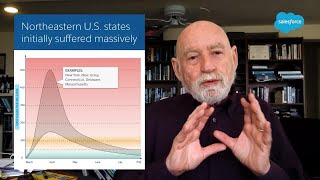
Europe was very late to react, but it learned very fast. And so places like France, Germany, Iceland, Ireland, Italy, uk, all had big takeoff very quickly. And most of them UK a little bit later, Italy a bit later, Germany, early, all reacted quickly and managed to get it under control and have pretty well kept it down in that green zone. Paris just has had a significant outbreak. They've required mask wearing all over the city. So the focused interventions still work for most of Europe. Some countries moved a little bit too fast. They opened, they had a big takeoff. Very quickly they suppressed the virus, they kept it down, but then they opened too soon. Like Spain, for example, which is now having a major outbreak. Same with Israel, Serbia, Ecuador. These are other countries that had these kinds of phenomena. In other words, early success led people to be complacent. And that complacency led to changes in behavior that led to new outbreaks and large scale outbreaks. And that's the kind of dynamics that we need to make sure we avoid. Some had such a terrible experience at the beginning that they learned, and that was the northeastern states of the United States, New York, extremely so, New Jersey, Connecticut, etc. They saw a massive increase of cases and frankly, deaths. And so everybody knew somebody who was sick or frankly had died. And so they have done very well at maintaining social discipline in containing the disease, in mask wearing, essentially all the social measures necessary to contain. And also obviously the cluster busting where needed. So what we saw is early failure led to later success. Other states, on the other hand, did very well at the beginning and then they got complacent. My own state of California, that was true. We were very pleased with the early success. And then people started going to the beaches, kids at university started to go to fraternity parties and so on. In fact, I drove across the campus of UC Berkeley yesterday and there was a big sign that said, don't go to parties. And walking by the sign were four young women without masks on their way to a party. Very dangerous, very hard to maintain. And so Arizona, California, Florida, Texas, South Carolina, early success, later failure. And we now have a serious problem. They ain't dancing very well. They probably have to do a fair amount of hammering to get it back down. And in the developing world, they are just seeing the takeoff. There are very few constraints. They're being hit very hard. They don't have the health resources, the communication and engagement resources. So places like Brazil, India, Mexico, South Africa are all experiencing huge outbreaks. And there the uncertainty is quite profound. So the point is simply this. We see very different dynamics in different parts of the world where early success leads to later failure, early failure led to later success, and those learnings and experience are shaping the future dynamics.