How Google’s CEO Hopes Tech Can Solve World Crises | Ep. 10 | The Inflection Point
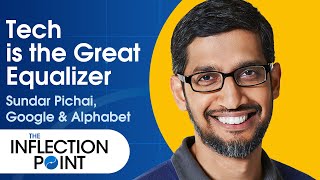
Sundar Pichai, Google's CEO, talks about his path from Chennai to leading products like Chrome and Android, and why he sees AI as transformative. He discusses the company's climate goals, including running on carbon-free energy by 2030, and addresses public criticism over antitrust and privacy.
Questions this video answers
2004.
2007.
2030.
About 10 people.
Approximately his father's annual salary.
Chapters
Welcome to the Inflection Point. I'm Monica Langley. Growing up in India, Sundar Pichai dreamed of a faraway place, Silicon Valley.
I wanted to be at the cutting edge of how computers were designed, made.
Today he sits atop of one of its most iconic companies.
But I've always carried with me the power of technology to improve people's lives.
A company so significant it has become a verb. Google. And now the man behind its most important products is front and center in guiding Google and its trillion dollar parent company Alphabet into the future.
Artificial intelligence is one of the most profound things we are working on. It's as profound as fire or electricity or anything or the Internet itself.
Sundar, it is a great pleasure to be here in Mountain View where where we are at this computer history museum not far from your Googleplex. And name of this show is called the Inflection point. So my very first question to you has to be what is that inflection point in your life? Is there a moment when everything changed for you and you realize my life is now on a different course?
That's a great question. Tough question, many moments. But given I'm at the Computer History museum and you know, I'd always wanted to do stuff with computers, but I had to wait a long time to get access to it. And it was really only when I came to the US to Stanford, I got a chance to spend real meaningful time with a computer. And that opened up my life to all the possibilities. And given the location, you know, I would probably pick that out amongst the many, many important moments in my life.
And then that became your life though, right? Technology, computers, the Internet, etceter that changed your life, right?
Absolutely.
I mean, look at you now. You are the head of probably the most important technology company in the world. So that was a pivotal moment.
It's been a fun journey and everything else is a side effect of having fun along the way.
Let's talk about your journey. We'll go back to Chennai in India where you grew up. What was that childhood like?
My dad was an engineer and we lived a good life, simple life, but we had to wait a lot for every piece of technology to come into our lives. So it's not that, you know, I waited five years, we were on a waiting list to get our phone, it was a rotary phone. But getting it really kind of opened up a lot of possibilities. People came to our house to make calls to their loved ones. And so I saw how quickly that one instrument changed lives around me. So it kind of left a lasting impression that's fascinating.
So when you got your rotary phone, did you or your family realize I have a knack for numbers? I'm really good at math. Could you memorize every number?
You know, I used to remember every number I had dialed. And so, you know, I was.
I was the opposite, which is why I went into journalism and all kinds of other things first.
That's funny. But, you know, my people used to treat me as a local phone book. And people would say somebody needed this doctor's phone number. They would ask me and I would tell it to them.
And you knew it because you had called it?
Once I dialed it once, I would remember the number. And to be clear, numbers are only seven digits, so it was a bit easier. And now I can, because the phones store everything.
So you don't have to test your memory.
Yeah, I don't have to test my memory.
When did you first start dreaming of technology? In Silicon Valley.
I was always fascinated with how things worked, be it the television or the phone, anything I could get my hands on. You know, I started reading about how the semiconductor was invented in Silicon Valley, and that story really resonated with me. And so I'd always wanted to be an engineer. My dad was an engineer. When he came back and talked about something in a shop floor or factory, I would soak it up. So was interested in math and physics. So in some ways, this was my dream, and I wanted to be at the cutting edge of how computers were designed, made, and so that was always in the back of my mind.
And you went to college at the India Institute for Technology?
That's right.
But then you went to Stanford and that's how you got to America.
You know, Stanford was kind enough to give a scholarship, and my dad took a loan to buy me a plane ticket and to give me some pocket money to make it to the States.
That loan equaled how much of his salary would you say back in that time?
Probably definitely his annual salary.
His annual salary?
Yeah.
Wow.
In my mind, I started understanding the level of sacrifices they were making and, you know, wanted to make sure I had a chance to give back. So it was deep within me.
You obviously did well at Stanford. You ultimately then went to an interview at Google. So that was the first day you went to your interview was when they were just coming up with Gmail, which now is pervasive. I use it, you use it, we all use it.
Well, it was April Fool's Day. I went for the interview. They had announced Gmail, but most people thought, including me, thought it was an April Fool's joke.
This was in 2004.
2004, okay. Except when I was in the interview, people asked me, what do you think about Gmail? It was an interview question people were asking me. And so I realized it wasn't an April Fool's joke, but the product was invite only, so I had obviously not seen it. It was only in my fourth interview, I think, or maybe the fifth, when someone said, have you seen Gmail? I said, no, I haven't. And he turned around at his laptop and showed it to me for 10 minutes.
What was your initial thought?
You know, there were two parts to it. One was, I hated organizing email. Gmail was the first. You looked at it and you realized you don't need to do it. You can search and find anything. And so that struck me. I was like, it was fast. But what turned out to be much more important, which is a bit technical, I realized the browser suddenly, instead of just showing content pages, can now run applications inside the browser, which was a paradigm shift. And so for me, that caught my attention, which would later come back when I built Chrome.
Exactly. Let's talk about that. You oversaw Google Maps, Google Drive, and then you invented one of their most successful products, Chrome. Tell me, how did you create Chrome?
I saw the browser was becoming something very, very powerful, and it could kind of help you do pretty much everything you wanted to do. And the browsers weren't really designed for it. So there was a set of people, not just me, a few people, a committed group of people who felt the browsers could be so much better and faster and so on. So we started a project. We had an early prototype. We were like, wow, this can be very, very good. Eric Schmidt, who was our CEO at the time, he had been involved in technology for a long time, and he said, to do a browser, well, takes teams of hundreds of engineers, which is all true, by the way. It is such a big effort. He said, there's no way. You really don't know what you're doing and you shouldn't do it. He said it out of the intention of making sure we understood how big an effort it is. In some ways, we were naive. You know, we were a team of 10 people, and we thought we could do it all. But, you know, it's good to be a bit irrational when you approach new things, but that's how we started.
But it is now the most widely used browser in the world. You did have to sell it internally, though, to your CEO and everyone there.
Were, you know, the Co founder on the project. The engineers were very good. That helps. So all we would tell people is come and see it. And you know, we had early versions of it running. It was so much faster than everything else out there. I think people instinctively felt it when they saw it.
Now, another major product of yours is Android. How did you make that such a success? So it is the most widely used cell phone in the world.
Android was already well underway when I started getting involved. I had always been interested in with the goal of getting computing to as many people as possible. Mobile phones, it was obvious to me were going to reach far more people than desktop computers ever did.
Yeah.
So we cared equally about cheaper, affordable smartphones as much as we cared about high end smartphones. So that really helps scale up Android in places like India, now Africa, Brazil, Indonesia, everywhere. And I think that greatly contributed to its success.
Like that rotary phone made such a difference in your life.
Yeah. I think part of what drew me to Google is I think giving people access to information and computing at their fingertips is one of the most empowering things you can do. And so it's been something which has motivated me ever since.
So it's clear one of your missions is for your products at Google to be universally available.
It's in our company mission. Larry and Sergey wrote it in our mission.
Oh, even before you.
Yeah. Which is what drew me to the company. That mission resonated with me.
So no matter who you are or where you are.
That's right.
You have the access.
That's how if you think about search, if you have access to a phone or a computer, you get the same search, same information at your fingertips. You could be a professor at Harvard or a kid in rural Indonesia. If you have a phone with connectivity, you have that Google search. And you know, and that's something which has always motivated me.
So you can learn the exact same stuff.
It gives people a platform on which harnesses their initiative of what they want to do in life. And so that's what technology does.
We are, some would say, at the precipice of a major technological revolution with quantum computing and artificial intelligence. At Google, you are at the forefront. What do you think of this? And do you think we are at the precipice of something great or something scary?
You know, artificial intelligence is one of the most profound things we are working on as humanity. I think the opportunities are incredible to really improve people's lives. Just like with any powerful technology, I think we have to harness it to make sure it's beneficial to society. It's true of everything humanity has ever worked on. And it's not just companies. You need academics, nonprofits, governments, everyone to play a role. But am I excited at the potential of artificial intelligence to radically improve many things? Yes.
What do you compare it to?
You know, it's as profound as fire or electricity or anything. Or the Internet itself.
As profound as fire?
Yes. Yeah. You know, because it gets to the essence of, you know, as humans, we are perceiving the world, making decisions, and, you know, we will have access to tools which are very good at all that. So you can literally imagine any sector, take health care, you know, how we detect diseases, what is the right drug for it. Every aspect of everything will be reshaped by AI over time. And so it's pretty profound.
One of Google's latest products is Lamda, which, by the way, is such a nerdy title. Why didn't you just come up with something like more conversational. It's about conversational dialogue, and then you call it lambda, which means what Language.
For multimodal dialogue applications.
Okay, well, that's crazy. Sundar.
It's a research project. You know, by the time when we launch it to consumers, you know, we'll have a friendlier name. We wanted people to understand it is a research. Research product. But, yeah, it's a. It's a breakthrough advance in. In conversational dialogue.
And you have already tried it out with your son, Is that right? What did y' all do to make sure it works?
Well, you know, there's a lot of machine learning which goes into making sure it works. But, you know, I played around with my son by talking to the planet Pluto, and Pluto talked back. Pluto talked back. And, you know, and Pluto can be witty, can sometimes be annoying. You know, that.
Darn Pluto.
Darn Pluto. I'm a fan of Pluto. That helped. But he, you know, it's wonderful because.
But Pluto's not even a planet anymore, is it? Did you ask Pluto, are you a planet? And what did Pluto say?
You know, I did ask. Ask about it, and, you know, I think it had a philosophical answer, saying it didn't care what we thought of it. It was pretty confident in its position in life.
Okay, let's talk about you as a leader. What qualities do you think are most important?
I think the most important thing is you find a way that is authentic to you. I think people respond to that. Things which I found help are being clear about what you stand for, what your values are. Very important. A lot of my job is also about helping others succeed. I think it takes a while. As leaders, you often try to do things yourself. But leadership is equally about enabling others to succeed. And I think that's important at the scale at which we operate. I do think empathy, thinking about people, caring about people, will increasingly be more important as a leadership quality.
Some people have said, well, that Sundar's just too nice, too nice of a guy.
I think you can accomplish what you're trying to do without changing who you are at the core. And I think I've never felt that gets in the way of being a good leader.
Exactly. I was raised in the south, as you attract more flies with honey than with vinegar. So I always think you should be nice anyway.
Well, a company's culture and values matter a lot. I think deep down in the company, you know, people are at all levels of the company, are. It's a problem solving company. It's an optimistic company.
Well, you're an optimist.
I am a technology optimist. You know, we have to be responsible when we build technology. But I've always carried with me the power of technology to improve people's lives. You know, I work hard to make sure we support innovation. We celebrate failure when we need to, because people we cherish. When people tackle what we call as moonshots internally, that you work on something so ambitious, it typically tends to attract the best people. The most difficult products, most difficult projects tend to attract the best people. And even if you fail, you will end up doing something along the way which is better than anything that exists.
You mentioned moonshot, and I was surprised to hear you once say your moonshot is still search, of course. And as you as the kind of creator of Chrome, it's fascinating that you still want to improve, improve, improve. But Google is so much more than a search engine company. So my question is, what is Google?
We want to be helpful to people in moments that matter. And the attributes we want to improve are knowledge, success, health, and happiness.
Wait, wait. Knowledge, success, health, and happiness. Those are your main categories now?
Yeah, that's what we focus on. And we want to use deep technology to make that possible. And it's the common theme you'll find across all the things we do.
Are you happy? Happiness is one of the four keys here. How are you happy?
Happiness is a state of mind and it's a quest. I get a lot of satisfaction from the work I do. It's a privilege to be doing something which can help a lot of people. It's a lot of responsibility as well, so I take it seriously. But it is like everyone else, you know, I have to make sure I learn to relax. And so it's a process.
As the head of a company that's all about staying connected and keeping us up on everything, how do you disconnect.
You know, through the pandemic, it kind of reinforced to me that it's the simple things that really help you do it. So me and my wife taking our dog out for a walk, you know, making pizza with my kids or in the sport. Sports fan. So simple things.
Sports fan or just a cricket fan? Cause I even see you tweet about cricket.
Yeah.
So you, like, are passionate about cricket and you played that in the street in India growing up?
Yes.
Do you play it here? Do you get a chance to play cricket here?
Yeah. I mean, casually. Not on the streets, but. Yeah, but in the backyard with my kids.
And they know how to play?
Yeah, a little bit.
Can you even go out anymore or are you, like, mobbed? I mean, everybody knows you.
I think, you know, we are not in Hollywood or something. We have.
You're not on the big screen.
No, we are in the tech industry. And so, I don't know, I go to Pete's and grab coffee and do the things. Yeah, I do the things I used to do before.
But given that Google is so big, your size and your stature also means you come with a big target. So there, you know, you know, it's no secret you have criticism from antitrust to data privacy to diversity issues. How do you, given your great amount of success, deal with all this? Sundar?
Well, you know, I step back and say all the stuff you mentioned are the right questions to ask and, you know, for society to ask and for us as a company to engage responsibly. Technology, you know, is profoundly shaping many industries.
Every industry, basically every industry.
So it makes sense to me that the workforce which is building technology is representative of how the world is. And technology, early on, we had very few rules. And as a society, we are all figuring out new rules of the road. Like every other sector.
Exactly.
I think those are important, making sure there is comprehensive privacy laws and frameworks and legislation. So I view this as actually a natural stage, a healthy stage, and there'll be a lot of debates, but that's how we figure out the next set of rules and frameworks. So I take it so it doesn't.
Get you all upset that, oh, I'm being slammed on antitrust. You're like, this is a process. We're going to address it. I mean, you have to Analyze it.
As a businessman, I know, you know, analyze it. But you know, I want us to be constructive. I want us to be there. And there will be through this process things we feel. The way we are approaching it is good and we will make a strong case for it. There are times we will take the feedback and say no, we may need to do something differently. And so that's how I think about it and how I approach it.
You're asked so many questions all the time. What is one question you wish people would ask you?
We are dealing with a lot of challenges as a society, including the role technology plays. But if I could say something to the younger generation, I would be very optimistic about technology. But maybe a question you haven't asked, which is climate change and sustainability. It is the biggest risk we face.
What does it mean to you personally and then to Google?
You know, from my personal experience, I grew up with severe water scarcity.
Exactly.
There was no running water most of my childhood. So we would fill buckets of water and manage it that way.
And did you sleep with a water bottle by your bedside because water was.
So scarce nowadays I still keep sleep with a bottle of water next to my bed because it gives me comfort to know that, you know, I have access to that clean water. Yeah. But the same place I grew up, Chennai, had a one in a hundred year flood a few years ago.
Wow.
Which had never happened before last year with the wildfires. Woke up one day to the orange skies.
I was living here. It was scary.
My kids, I could see the concern in them because it felt. Felt a bit apocalyptic.
Totally. That's what it felt like.
And anyway drove home more than ever before. And I've been following the science closely for a long time and I know whatever we need to do here we are already late in doing that and we have to have a very committed effort.
What are you doing at Google on climate change?
Google has long been a leader on climate. We were carbon neutral in 2007.
Wow. That was way before most.
And we invested in wind and solar very early on. And it was expensive to do so. But we saw the potential. The biggest moonshot we have taken is by 2030. We've committed to operating all our operations including our data centers 24, 7 on a carbon free basis.
Wow. That's not that far away. Sundar.
No, it's tough to do. But. But it's what excites me because it's attracting the best people. And anything we solve in this process we will share openly. So for example, we are using geothermal now for one of our data centers. So we are trying to push the boundaries. And I want to be clear, when we say 24. Seven, carbon free, we are not using offsets. I actually think it's an important moment because the only way we can solve climate change is by the world working together in some way. It is a bit like Covid, you know, Covid, many countries had to collaborate, but we have to do a lot more of that. So it's both the greatest challenge we face and it's one of the biggest opportunities for us to solve something big.
Now we're at the Computer History Museum, not far from Google, and there is an exhibit in there about Google, what will be in the museum here that is the contribution of Sundar Pichai.
You know, I want Google to work hard and make sure we develop AI responsibly in a way that profoundly impacts as many lives as possible. From a work standpoint, the thing that drives me is getting more people access to information and computing the same way I got access to and to create that point of inflection. And so hopefully that is the next chapter in that journey.
Wow. So we will see what ultimately ends up to be your contribution over time. But thank you so much for spending time with us here today.
Thanks, Vonika. Real pleasure.









