How Harley-Davidson is Paving a New Road While Embracing its Iconic Legacy | Ep. 23
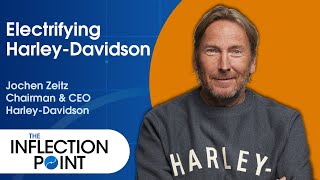
Jochen Seiz, Harley-Davidson's CEO, talks about leading the iconic 119-year-old brand through electrification. He launched LiveWire as a separate electric brand and is building a second model called Del Mar, while working to attract new riders without losing legacy customers.
Questions this video answers
May 11, 2022
119 years (noted as approaching its 120th anniversary).
Del Mar (part of the Speed series, second LiveWire bike).
18 years as CEO, plus two years in the holding company (almost 20 years total).
29 years old.
Chapters
Harley Davidson is an American icon. Its CEO Jochen Seiz is taking it down a new road.
We have a new brand that's called Livewire that is all electric. We want to lead the electrification of the sport. What is your goal when you get on a Harley? You live the Harley Davidson lifestyle. And that's something we want to cherish and take into the future.
Do you bring your adventuresome spirit to your role as the CEO of Harley Davidson?
Being a CEO is always an adventurous experience.
I'm Monica Langley and this is the inflection point. Thank you for joining us on the inflection point. When was that moment in your life when you got on a path that changed your world?
Well, I guess one has a lot of inflection points in life. But as a young businessman, it was when I was 29. I was working for Puma. I had just been promoted to vice president of marketing and sales and the company was taking over and it just, you know, was very unsuccessful. It had gone public in the 80s, had been losing money ever since. And the new shareholders tapped me to develop a plan and asked me to present it to them. They gave me three weeks time and I presented the plan. And after a grilling of two hours of Q and A, they said, this sounds like a great plan. Why don't you go and execute it? And I was 29, so it was quite, quite a surprise at the time.
Go execute it as the CEO.
Exactly.
Okay, so that's a big step up for a 29 year old.
It was. We actually waited a couple of months before we announced it so that I would turn 30 to make it look a little less challenging.
I guess that must have been daunting. Or were you just too young to realize I've got a big responsibility?
There were a lot of people that said, oh, he's going to crumble under the pressure. The leading papers, newspapers, magazines were never going to happen. You know, we had a Harvard CEO before and many others that tried. So why would a 29 or 30 year old make this a success story? And it really didn't bother me. I was just excited to be given the opportunity. You know, I often quoted because I was asked whether I could do the job not having the experience. And I was sort of quoting Tucholsky who said, you can do things wrong for 20 years and with all your experience, you still can't be successful. So from that point of view, I just felt that, screw experience. I think I know what I need to know and I know what needs to happen. Assemble A great team around me, and off we went.
How did it work out, Jochen?
Thankfully, it worked out really well. I mean, it was a company that was in turmoil. It was bankrupt on paper. So we had to first really turn around the company to make profit. And then after we made record years of profit, we decided to reposition the brand as a sport, lifestyle, and fashion brand and then became a huge, huge success. I mean, we grew from a little over 100 million to $4 billion in sales. And, yeah, it was a great journey, really.
And to top it off, the top luxury conglomerate in the world bought Puma Kering, which has Gucci, Yves Saint Laurent. I mean, that's damn good.
Yeah.
How long were you the CEO of Puma?
18 years, and then two years in the holding company. So almost 20.
Wow. So you literally could have ridden off in the sunset, but you took the job as CEO of Harley Davidson, an iconic American brand. Why?
Well, you just said it. It's an iconic American brand. And the company hadn't been doing well for several years. We had to let go of our CEO. And then the board turned to me and asked if I would step. Step in for.
Because you were a director.
I was on the board of Harley Davidson for a while, and the board asked me if I was willing to step in for a certain period of time as an interim CEO. It was just before we had to shut down our factory due to Covid. So it was a very critical situation, and we had to raise a few billion dollars right away to keep going because we didn't know how long our factories would be shut. I took the job, and I just saw a huge opportunity. So for me, a crisis, the bigger it gets, the bigger the opportunity. And that's why I'm doing what I love now to run Harley Davidson.
So you don't just like a challenge, you like a crisis?
I sure do. So I've heard quite often in my life this is never going to work. And it sometimes took many years for it to work, but it just never scared me. So I'm probably, in that sense, a little fearless. And I've realized that the things that are not the most obvious things can become your biggest success. You just have to believe in it, work at it, have a great team, and then eventually it'll work out. So I'm pretty confident.
So now that you are the CEO at Harley, what is your goal?
Well, this is an incredibly iconic brand. It's one of the most powerful brands in the world. We have a history of 119 years. We celebrate our 120th anniversary. And that is a great legacy to build your future on. And that's what we're going to do. I mean, we had to change a lot of things and I think this is sort of a gorilla that was punching below its weight for way too long. And we want to build on that legacy, but bring it into bright future. And we are also recognizing that while the US Is a huge and the most important market where we still have a lot of potential in the coming years, we also want to expand globally as a true global icon.
We're here today with this new, innovative bike. Give me the big reveal.
Well, the big reveal is that we have a new brand that's called Livewire that is all electric. We want to lead the electrification of the sport. This is the second bike of LiveWire. It's called Del Mar, part of the Speed series, built on a versatile speed platform or aero platform that can be utilized as a platform for new bikes that we will develop in the future. It's a very exciting motorcycle. It's the best electric motorcycle out there. It's a fantastic experience. And it's a different experience to a normal Harley Davidson motorcycle.
So how is it different? Tell me about that.
Well, it's all electric, first of all. It's a different.
So you don't have the same loud.
Noise, no clutch, no gears. It's non stop once you turn the throttle. So it's very fast, very agile. It's just a fantastic bike to ride. I mean, I love riding on my Harleys every day, but I also love switching to Livewire because it's just a very different experience that is worthwhile. And, you know, it's a different consumer that we're attracting. It's the innovator that wants to get into electric for the first time because there's just not much out there really that I think can compete with this motorcycle. But it's a very exciting experience. So I want everybody to ride a Livewire and also have a Harley Davidson in the. Okay, so we need both 100%.
Jochen, what is the risk of not innovating? Because clearly you're innovating here.
Well, I always think, what's next? Right? What do we have to do to succeed and to win? And the future will require a way where we engage with our planet without destroying it. And electrification is a given.
At the same time, is there a risk of innovating that you have such long time lovers of Harley Davidson that don't like a new direction?
You can never stand still Otherwise become a dinosaur. No brand, no company can stand still and just rely on one customer group. You have to bring in new riders, and that's what we're doing, and that's what innovation is all about. But that doesn't mean that you can't look after the riders that made you what you are today. I think that's very important.
Do you think that the future of Harley Davidson could one day become all electric? We're seeing so many legacy brands wanting to go all ev.
Well, electrification of motorcycles will happen. The question is when and how. Motorcycles, from a technological perspective, are a little bit harder to convert to electric than cars are because we don't have the space. There's only limited space. The battery can only have a certain size. You need to get to a certain range. The parameters are very much tighter than in a car. So it's going to. The electrification will take longer, but we want to lead that path with Livewire and give the opportunity, through the innovation of Livewire, to then also electrify Harley Davidson.
I ask you in particular, because you have been on the forefront of the issue of sustainability almost your entire professional life, and when you were at Puma, you talked about sustainability before any CEO anywhere was talking about it.
Well, I love nature. I love our planet. I sort of grew up spending weekends in the Black Forest, and I just realized that, you know, we cannot consume the way we have in the past, and we have to find ways to, you know, for prosperity for humans, but at the same time, preserving our planet. And I think it's not just the responsibility that we have, it's also an opportunity to really innovate as a business. And that's what I've been trying to do. I had been on the Harley Davidson board for over 10 years, and I came to the board because I felt that if you could influence an iconic brand to care more about people and the planet, then you could actually change a whole industry. I introduced the idea to go to innovate in the electric space over 10 years ago when nobody was thinking about it. But I said, look, one day, maybe the world will go electric. So let's think about that. I even had to say, I don't think you're taking this comment seriously, so maybe I need to leave the board. And the company did take it seriously. And thanks to that, we're here today and can talk about Livewire, an electric brand that is going public. And now I'm being given that opportunity to actually really make it happen.
So you've been pushing on this for many years.
For over a decade, yes, at Harley. But as a board member, there's only so much you can do.
So you carried your sustainability drive and philosophy much farther.
That's right. So that's one of the other reasons why I said, well, this is a great opportunity. All the things that I would have done and couldn't do because I was just a board member, I can now actually implement.
What does sustainability mean to Harley Davidson?
Well, there are really three aspects to sustainability. It's people, it's planet, and profit. As a company, you know, we talk about inclusive stakeholder management. Of course, we're a public company. We want to be successful for our shareholders. That's the profit side. But at the same time, you can't make profit at the expense of people and the planet. And that's where sustainability in terms of people and planet comes into play. One of the first decisions I took was to make everybody a shareholder in the company, whether you are at Harley, at Harley. So we issued a grant to employees and hourly workers. Everyone in the factory is now a shareholder in the company. Because I believe that everybody that is contributing should be winning. When we win as a business and using riding culture to bring people together, riding is a fantastic opportunity to get out. You get into nature, you experience nature, but you always want a buddy to come along with you. It's a big community, the riding community, and it's a very diverse community as well. So we're welcoming all. And I think, especially in a divisive world, that's a great opportunity for all of us to come together around one cause of riding and getting to know each other and experience different points of view. And that's what makes the Harley community so special, that once you're a rider, no matter who you are, where you come from, what you do doesn't really matter as long as you're a rider for Harley.
You've been riding Harleys for a long time. I presume that sounds like you're like a real adventuresome guy.
Well, I would say I probably ended up in the wrong century. I would have probably become a Shackleton and died in the Antarctic or so. But, yeah, I'm sort of an adventurer.
I mean, to me, you still look that way. You know, you're still like, you're not looking the corporate type to me.
But I've never worn a tie in my business. The first year as a CEO, I did because I was so young and I wanted to look a little older. But then I gave up the tie very early. So you know, still, corporate ties is not my thing.
Do you bring your adventuresome spirit to your role as the CEO of Harley Davidson?
I think being a CEO is always an adventurous experience. It never gets boring. And Harley Davidson is about adventure and freedom. So I live a dream in a way of being able to think about adventure and freedom every day. And what I do.
What is at stake for this iconic brand for Harley Davidson today as we sit here?
At stake? I don't think anything is at stake other than us wanting to be really taking the brand and taking the company to new heights. We are not just a product, we are a lifestyle, which is extraordinary. There's very few brands out there, and I can't even think of one that epitomizes the lifestyle of motorcycling more than Harley Davidson. That's a huge asset. So when you get on a Harley, you live the Harley Davidson lifestyle, and that's something we want to cherish and take into the future. You still see motorcycles from the early 1900s riding around the world, and I think 100 years from now, it will be the same. But we have to, obviously, as a company, like everybody in a fast transforming world, we have to innovate. We want to lead, we are the leader, and we want to continue to be the leader. And that's why we're changing a lot of things at the company.
What's at stake for you, Jochen?
I don't look at it that way. I just.
You don't even think like that.
No, I don't look at this as a job. I just love what I do. Otherwise I wouldn't be doing it. You know, I have an incredible passion for Harley Davidson, for my colleagues, for the team, the employees, for factory workers. And I just want to see it succeed and I want to be part of it. So I do what I love and I have a passion for, and I think that's the best recipe for success.
In a way, you've convinced me with your adventuresome spirit and your love of freedom that I want to join you. So can I wear a Harley Davidson T shirt? And will I feel that way?
I think that's the start. If you wear a Harley T shirt, and then we'll sign you up for Riding Academy and three days later you can ride a motorcycle. Why not? Absolutely.
Maybe I'll just get on the back of your motorcycle.
That's an option. Or into a sidecar.
Thank you so much for joining me.
Thank you.









