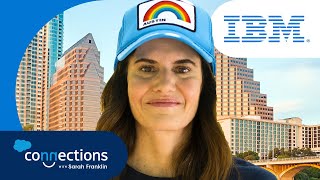
IBM's CMO Carla Pinero Sublett talks about modernizing the brand's marketing, from consolidating 40 marketing organizations into one to rolling out Salesforce for unified data. She's also pushing for creative ambition: her team wants to win an Oscar. Sublett credits her multicultural upbringing and a family sabbatical traveling the world with shaping how she leads.
Questions this video answers
A swim-lesson business called "Supafish" that paid for her first year of college.
A family travel blog/project called "Finding Ubuntu" during which they unenrolled their kids and traveled the world.
100 professional dates.
Meeting-free Wednesdays (encouraging team members to dump devices).
IBM has a 110-year history and its research team has won five Nobel prizes.
Chapters
I have a big vision, Sarah.
I'm excited. Spoiler alert.
Before it's all said and done, I would love for my team to win an Oscar. I want to bring these stories to life in a way that no B2B tech marketer ever has done it before.
Hey, I'm Sarah Franklin, and welcome to Connections, where we hear from some of the most innovative leaders in marketing. I. Carla. I'm here in Austin, Texas, speaking with Carla Pinero, Sublet, the CMO of IBM. How she got here might surprise you. It included, in her words, a midlife crisis and dragging her family to the ends of the earth in search of, you guessed it, Connection.
Welcome to Austin.
It is gorgeous. I love.
And I have a little something for you for our first 3D meeting.
I love it. Oh, my God. Gotta get ready. Welcome to Austin.
Right here. Yeah. You're looking good.
I look good? Yeah.
Totally suits you. You look fabulous. I got the flavor, I got the.
Let's start at the beginning. Where did you grow up?
I have to admit, I have a little bit of an identity crisis. So I was born in Montreal to Uruguayan parents, raised in Dallas. And Austin is the place I've lived the longest. So I'm a little bit French Canadian, a little bit South American, a lot Texan, but you got it all.
Where does your entrepreneurial spirit come from?
I was born from a family of entrepreneurs. My parents moved to the States to start a clothing line, and I was always surrounded by entrepreneurs. And When I was 14, 15 years old, my parents lost my college fund in the stock market crash.
Oh, my gosh.
And, you know, it became very apparent to me that I needed to help out, and I was lifeguarding at the time. And the pool where I was lifeguarding didn't have swim lessons. So I finally decided to start a swim lesson business, and it exploded. And I called it Supafish. And that. Supa fish. Supafish. And that actually paid for the first year of my college.
What have you not done? This is incredible. I have to tell you, I love your website. It's so inspiring. Finding Ubuntu.
Yeah, that's my midlife crisis. And I actually did not anticipate. You're 20.
There's no time in midlife.
When I left my prior job, I was feeling very disconnected from my kids and my husband and the people that I loved. And I had just been at a global seminar with the Aspen Institute, and we had been learning about Nelson Mandela and Desmond Tutu's A Philosophy Around Ubuntu, which basically Means you are me, I am you. We are connected humanity. And it was all about connection. And I was starved for connection. And I came home from that seminar with world leaders and said to my kids and my husband, we have got to do something differently. We've got to change landmines.
He and his safety. You're a safety inspector in the park too, right?
We've got to do something differently. And I said, I want to unenroll the kids from school and reconnect to you, my husband, and the kids, and travel the world. And to my husband's credit, he did it. And we did it, and we traveled the world. And the way we let people know that we were alive and okay was uploading to this blog once a week. And so that's finding Ubuntu. I saw massive personality changes in all of us. The other big takeaway was just being able to see my kids and my husband connect with people from completely different backgrounds. It was just really special to see that it completely changed my values. I think the other thing I realized, Sarah, is you don't have to make a big, bold move and unenroll your kids and travel all over the world to connect with people. You can throw your phone in a drawer for an afternoon and camp in the backyard whenever we're feeling disconnected. That's kind of my first move.
I love that. Just like, okay, phones, iPads.
I do it with my team too. So when I notice that the eyes are starting to glaze over and folks are starting to get burned out, we've moved to meeting free Wednesdays, and I've strongly encouraged them to dump devices so that they have time to think and do work without the distraction. And I've been guilty of it too. You know, I text you instead of actually picking up the phone and calling you and hearing your voice. You know, this is the first time we're meeting in person, which is really special to me. It requires being intentional.
I think it also requires some vulnerability. Do you think you need to be vulnerable when you're exploring connection?
Actually, that's such a good question, because that's actually the biggest key to establishing connection is vulnerability. It's actually a lot more fun to move through the world that way and have no pretense.
So it's been an adventure. What brought you to IBM?
So during my time off, I also was doing soul searching about my values and what was important to me. And part of how I figured that out is I went on 100 professional dates. That's a lot. It's a lot. I called it forking. I fake worked, and I basically would take every call, go on every meeting, every interview. And it was through that process that I actually met Arvind, our CEO, and he actually offered for me to come to IBM that year. But for whatever reason, I took another job. But it always kind of sat in the back of my mind, like, did I make a mistake? And I loved the other job, and I feel like I did exactly what I was intended to do there. And when that work was done, miraculously, my phone rang and it was Arvind and my predecessor Michelle, asking me if I'd come as the cmo. And so here I am, you know, getting to shepherd one of the most iconic brands in the world back to growth.
What's your vision for this iconic brand, IBM?
What we've done over the last 110 years is remarkable. Our research team has won five Nobel prizes. We've invented everything from the first personal computer to now we have an actual quantum computer. But I feel like the world doesn't quite get it. And I was talking to a friend of mine and she said, I mistakenly referred to us as a tech company. And she said, oh, Carla, you don't work for a tech company. You work for the founder of the industry. And that just gave me chills all over my body. And so for me, my vision is to really bring that to life in a very rich way. I have a big vision.
Sarah, spoiler alert.
Before it's all said and done, I would love for my team to win an Oscar. I want to bring these stories to life in a way that no B2B tech marketer ever has done it before. And I want to inspire the next generation of really creative innovators and engineers and developers around the globe.
I just got chills when you said that. That's such beginner's mind and such, like, innovative thinking, like, we're going to win an Oscar. But that's what you do as a visionary cmo and you have a history at IBM of doing incredible branding. And what's your thoughts on reinventing the brand?
One of the things I did not fully appreciate until I got to the company was the luminaries in design that we've worked with. I mean, Paul Rand and then our architecture, Eames Mies Mandreau, im Pei Saarinen. The company's heritage and design is really spectacular. So this isn't a rip and replace. There's a lot of goodness here to mine. But for me, it's about really modernizing this company and distilling down for the world what it is that we do, who we are, who we do it for, and bringing that to life in a way that's so compelling that people want to binge watch it.
How are you going to do that? You're going to, like, get movie crews? Like, what are you going to do?
I mean, that's. That's what I'm contemplating, but also in a way that has technical substance. So I envision that if somebody wants to learn about artificial intelligence, they could watch a whole series about it with episodes and go deep in the technology and really learn it. Our kids are showing us that people learn differently, too. I'm sure you've seen this, but my kids watch YouTube to figure out how to do something. So what if we just employed those same channels to actually teach people about technology?
At Salesforce, we pride ourselves on having a single source of truth. How do you connect with different departments within IBM and deal with different silos of data?
I was part of the team at Dell that helped roll out Salesforce to our sales organization, and now we are at IBM doing the same exact thing. And so that's one way that we can get one source of the truth and all get on the same page in terms of the tools that we're using. But the other thing that I observed when I came to IBM, and it's so common in big B2B tech organizations, is we have silos by line of business, and we basically have 40 marketing organizations at IBM, which I actually want to build into one marketing organization that works together to move the market. That's a big change that we're thinking about doing, and your tools actually underpin a big part of that.
I also know that you're an advocate for women in leadership, and I hear in Texas, you've been a big part of the conference here. Share that with us, please.
I've been chair of the board for the last several years. A lot of people elevated me along the way, and I love elevating others. And the conference is just a really remarkable way to do that at scale.
And when was the first time that you saw leaders that looked like you?
My mom. My mom was a working mom, Latina. She was a manager of a furniture showroom surrounded by men and five feet tall, and she held her own, so. So I think that's the very first time. I feel a very strong responsibility to pay that forward. I feel so fortunate as an immigrant. I feel like I won a lottery ticket being here.
Never miss an episode by subscribing and turning on your notifications. We'll see you next time.