How Jeff Gennette is Digitizing and Advancing Macy’s for the Future | Ep. 19 | The Inflection Point
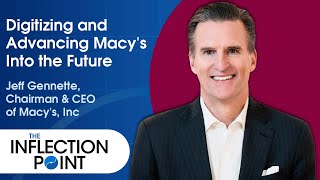
Jeff Gennette, CEO of Macy's, talks about his path from Stanford trainee to the top, coming out as gay during the AIDS crisis, and how he's pushing the company into digital retail. Stores still drive most sales, but Macy's is building resale partnerships and sustainability programs to reach younger shoppers.
Questions this video answers
February 2020
Over 60% of business
100% parity across gender or ethnicity for the same job type
21
Chapters
Foreign. I'm here at Macy's at its landmark store in the heart of New York City to chat with Jeff Gannett about its future and the future of retail. You're known as a trend spotter.
You know, I always think about being a merchant, like driving a car. And so you're looking out your windshield because you're always looking at what's next. You're looking in the rearview mirror because you've got to protect history. And you're looking in the side mirrors because you want to know what the heck's going on in your competition.
Did you always have your eye on the C suite?
You know, I didn't. Being openly gay and not seeing anybody at those levels, you know, back in 1983, I really took it out of consideration.
I'm Monica Langley, and this is the inflection point. This is, like the coolest place. I've been coming here for decades. And thank you for having us today.
Yeah, it's great to be with you.
When was that moment in your life when everything changed?
So it was my first year in my career, and it was 1983, and I came out in college, and I had to make a decision as I was entering Macy's. It was Macy's, California, at the beginning of the AIDS crisis in San Francisco. And I had to make a decision. Was I going to keep my personal life a secret or was I going to integrate it into my professional life? And, you know, at that time, gay people both inside and outside the workplace, they were facing big challenges. I didn't see gay people as role models within the company. And I thought, you know, is this gonna. Is this gonna, you know, hold back my career? But I made the decision to, you know, basically work out loud. And I've never looked back.
That's powerful. Even though today, I mean, gay rights and acceptance have come a long way. But take us back to 1983. A lot of people don't remember or were even born then that are watching our show to know what it was like back then. I mean, AIDS was only discovered in 1981 or something. Right?
So.
And then it was called the gay plague. I mean, it was a very discriminatory place back then.
It was.
So that was a very bold step for you to do that.
When I really kind of weighed the pros and cons of this, you know, I was always. I was raised to be very, very truthful and live your full self. And I don't think I could have separated it. You know, I wouldn't have been the person and executive that I became if I had separated it. So I really didn't have a choice.
So when you started at Macy's, how did you land there? I mean, you were at Stanford, right, as an English major. And I'm sure Stanford got every big time employer coming there from Goldman Sachs to who knows where. Okay. And the tech companies being in, in California. So what made you go to the Macy's to interview?
So this is a good story. Take you back to kind of the spring of 1983. And Stanford at that point gave all seniors a number of interview points. And we each got like 400 points. And then when the IBMS and the MBIS came to campus Xeroxes, all those were the companies at that point. It would take you 150, 200 points to be able to get into those interviews. The Macy's interview, you were giving up.
A lot of points.
Well, the Macy's interview was free.
What does that say about Macy's?
Well, you know, what it said was that you could practice your interview skills. You may not end up there, but you know, there was something about that. It was the idea about. It was the management experience that you could get at age 22. I thought I was gonna stay for a couple years. I thought I was gonna go to business school. And here I am 38 years later. And you know, I got the fever. I was running the young men's area. It was called the Tiger Shop. And in the Macy Stanford store, and I'll never forget this, there was a short sleeve woven program called the Kingston Trio that arrived one day and it was on the back wall. And about a third of it sold in the first day. Those were customers that found it. So I picked it all the way in the back, all the way in the back. I picked it up and put it on a fixture right by the register. I called the buyer, I said, send more. And that sku, that one shirt ended up being about 30% of the entire business. And we ended up going for in that store, in that store and for the company. That was the idea that a customer with the right content, at the right value, with the right service, you'd immediately see the results of that in your sales was just intoxicating.
You're known as a trend spotter. Tell me about that.
You know, I always think about being a merchant, like driving a car. And so you're looking out your windshield because you're always looking at what's next. You're looking for what are the signals in pop culture that are going to define where customers are thinking about what they want on their body, what they want in their home. You're looking in the rearview mirror because you got to protect history. You got to know what are those things that produce profit? And you're looking in the side mirrors because you want to know what the heck's going on in your competition. If you're not looking at your competition at all times, you know you're going to miss things.
Well, let's go back a little to your inflection point, which really, I think, made you the perfect CEO to focus on diversity and inclusion, which is so important always and especially today.
I think Macy's has been a frontrunner of this, but we're still, in many respects, in the early innings of this. And I would. I would talk about it in a couple of ways. The first one is that I think we were always pretty good with diversity. And the idea about getting all of the various, be it ethnicities or genders, into the tent, but getting them onto the playing field and getting them participating and figuring out a way to have them bring their authentic selves with their unique contributions to the fore, that's been the journey, and that's what we've really been focused on. You know, we do a good job with pay equity. When you look across gender or ethnicity, whatever the job type is, wherever it is, we have 100% parity. But we have a huge opportunity to make sure that from the front line all the way to the boardroom, that we have, you know, symmetry with the communities that we serve.
So would you say this has become one of your priorities as a CEO?
Absolutely.
What is another of your priorities as CEO?
Major priority is to grow profitably. And, you know, that's a good idea. So when you think about it, we have a. On the Macy's brand, we have and the Bloomingdales brand, we have a thing called the Polaris strategy, and that was launched right before the pandemic in February of 2020. And the good news is that it has proved quite durable. And we've just gotten our cost base dramatically down. We've sped up the metabolism of our team. We've reduced layers, we invested early into digital, and we now have the number two website in our categories in America. So this is something that has been.
A position of strength, given that Macy's was founded in, like, 1850 or something like that. You're so have such a storied history.
Yes.
I mean, all of us have heard of Macy's all of our lives. And in my Mind's eye. When I think of Macy's, first I think of this store. But now you say you're digitally led. Was this a big shift for you to think it's digitally LED and just the stores are part of that Omni Channel?
Yeah. What I'd say is that the customer has moved towards digital. So we always follow the customer. But customers love stores. You know, over 60% of our business remains in stores.
Did you always have your eye on the C suite? When you became a management trainee out of Stanford, did you think, one day I want to be the CEO of Macy's?
You know, I didn't. And I will tell you, it goes back to that inflection point. You know, being openly gay and not seeing anybody at those levels, you know, back in 1983, I really took it out of consideration. You know, it was a. But I love the work. I love the teams. I love the work that I did and the contributions that I could make. And that's what led me to this on this journey.
But you've had a pretty straight trajectory. Yeah, you have gone up, up and up. Now you are the chairman and CEO. Have there been setbacks for you, Jeff?
You know, there certainly has been setbacks. You know, I left the company a couple of times, and one of them was foolhardy. But what I tell you is that I had amazing mentors over the years that were always tapping me on the shoulder before I thought I was ready or probably before I was ready. You know, my predecessor, Terry Lundgren, who is a big mentor of mine, says he has this phrase says bloom where planted. And I think that is a great mantra for anybody in retail that has talent and has ambition, is if you're ready to go. Because the industry is so rich with opportunities, between marketing and merchandising and tech and data analytics, that you can go anywhere in there. And if you're ready to go into different cities or states, you're going to learn about new customers. It's just going to enrich your talent base, your experience level, to be a more effective executive.
The retail industry, as you're just describing it, with all the different divisions, is seriously complex in a way. And on the other hand, though, does retail get the respect as other industries?
Well, I would tell you it's definitely complex, and I don't think it gets the respect that it deserves.
So does it tick you off that retail doesn't get that respect when you see how good it's been in your life?
You know, what I say to people is that because it doesn't get the respect that it deserves. Retail, you can just do extremely well if you have talent and you have ambition and there's so much that's gonna keep you interested over the years.
Let's talk about you as a leader. What would you say is the one characteristic that you bring as the CEO that all your team would say? That's why I wanna follow Jeff Gannett.
Yeah, I would say that I'm pretty optimistic. You know, if you interviewed my mother, she would say I was born on the right side of the bed. You know, I wake up each day and I've got a pretty wellspring of energy and optimism. And I channel that. And I, and I, over the years have had a knack for bringing that out in others. You know, with this authenticity, the opportunity is, you know, if I'm going to be myself and I'm going to talk about my failures, you know, I've been open, very open about my noble failures and the things that I've just been train wrecks in my career and sharing of that, because there's other times in which I've swung for the fences and I've had some major hits and, you know, sharing of those stories, asking everybody to bring their full self to work has been. And doing it with an optimistic, you know, spirit. Because think about what we just went through for the last 18 months. It was harrowing. I mean, it was hard. Lots of obstacles. And yet if you keep your eye on a future, if you keep your eye on the consumer and you talk about those possibilities, you present a vision that is out there and you're honest about the things that aren't going right, people will follow. What I find is that by being vulnerable as an individual, as an executive, that breeds vulnerability in others. And that is a foundation that I think develops trust.
Jeff, you've mentioned authenticity a few times. Why is that so important?
So I know for myself and I know, have learned from others that when you can bring your full self to your workplace, it just unlocks so much potential. You're not checking, you know, yourself at the door. You're bringing all of your ideas, all of your thoughts, everything that you saw, everything that you feel into the workplace. And from that, it breeds creativity, it breeds, you know, trust. It breeds the opportunity for you to exercise that which you believe and are passionate about. And when you can do that, if you can unlock people's ambition and talent with the passion that they have, you're going to win.
Was that the key to your success?
You know, in Retrospect, I think it was. I didn't know it at the time, but in reflection, I believe it was.
Okay, let me ask you this. You go to stores?
I do.
Okay. Do you go as Jeff Gannett CEO or do you, like, slip in anonymously?
So it's 50. 50.
Okay.
So there is about 50% of my visits. They're scheduled. And it's like, you know, I'm going there to see my team in action, and the stores look great, but I'm meeting with colleagues. You know, my favorite thing to do is to really see and just get a sense of these amazing sales colleagues. And these are men and women that just are so passionate about their customers. And I learned so much from them. Half the time I go in unannounced, but within about five minutes, I'm recognized.
You are?
Yeah, yeah. Because I do a lot of video and. And so I am recognized. But it's. It's always good because I don't see the preparation. I see what the customer sees.
Do you go to competitors all the time. All the time?
All the time.
And they.
No, they don't recognize me.
Yeah. So they don't know who you are. So you're in their shopping. What if you're in a competitor?
Yeah.
And you see something that I want to wear this, can you buy it?
So what I do, because I live in Brooklyn, I support a lot of local retail around there and just being, you know, a good. A good citizen of, you know, my part of Brooklyn, which is Park Slope, and there's a lot of really struggling businesses. I've always done that in all the cities I've lived in. I've taken, you know, advantage of local businesses.
Okay, but those are probably local businesses.
Those are local businesses.
What about other big department stores that are Macy's competitors?
I don't buy from them.
Never.
I buy from Bloomingdale's and I buy from Macy's.
Okay, so what about your daughter? What is she. Does the same rule apply?
I'd love you to interview my daughter. My daughter doesn't buy anything at retail. She is simply secondhand. She goes into.
But she has you as her dad.
Doesn't matter. You know, she's got this sustainability bug in her head, and she's not going to do anything that is going to increase carbon footprint or any of the.
How old is your daughter?
She's 21.
Does that drive you crazy? Like, we've got beautiful stuff for you, honey.
It gives me a good window into, you know, her generation, which I find quite helpful.
If she won't buy anything new and she's only secondhand, how can you bring that mentality where your job is to sell new things?
Well, first off, she's not, thank goodness, representative of all of American youth, which I love. A lot of people buy things, actually. Her inspiration was, which led me, you know, with James Reinhardt, to do a collaboration with Thread up, which was an opportunity to basically bring, you know, used clothing into our stores to kind of have that virtuous loop of apparel consumption. So, but, you know, what I would say is that there is always needs that this younger consumer has. They might not buy apparel, but they're buying fragrance or they're buying jewelry or they're buying something for their home. She certainly is a consumer on that. Just not an apparel.
Let's talk about Macy's as its storied history. It's something we all have grown up with. Honestly, who hasn't heard of Macy's? So many children and adults in this country have grown up on Thanksgiving morning with the Macy's Day Parade. And it's a very multi generational store. My mother, when I told her I was interviewing the CEO of Macy's, she goes, my favorite store. And my daughter was born in New York City. And of course, Santa to her will always be the Macy's Santa.
Yes. So.
So I ask you, as the parent of a daughter, as I am, will your legacy, as you're thinking about it, how can you ensure that our daughters will one day, not anytime soon, but will one day bring their children to Macy's?
You know, making the brand relevant in the 21st century? And we're on our way. You know, we definitely have had some setbacks, but I think that with our strategies in our ambition, the brand is eternal. I really do believe that it's now our opportunity to execute our strategy because when we make happy customers, we make happy shareholders. And so that's our journey. We feel like we've got the right path. We now just need to continue to execute it.
Thank you so much for having us in Macy's today. Jeff, it's been a pleasure.
It's been a pleasure. Monica, great spending time with you.









