How Leadership at Deloitte Consulting Drives Customer Success | Leading Through Change | Salesforce
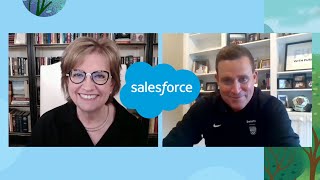
A Salesforce "Leading Through Change" session (Sep 17, 2020) featuring Monica Langley interviewing Dan Helfrich, CEO of Deloitte Consulting. Helfrich describes his leadership style ("lead like a captain," favoring transparency, short huddles, and cultural "everyday equations" such as "horseshoe > circle"), how Deloitte maintained purpose- and values-led leadership amid COVID (rapid shift to remote work), and the firm’s digital agenda. He highlights the Deloitte–Salesforce partnership (global CRM consolidation, Philanthropy Cloud for volunteer engagement, and the Pathfinder workforce-development program launched in Indianapolis and expanded to San Francisco and London). The session closes with a Salesforce Anywhere / Work.com demo showing collaboration, IT support, and workplace-wellness/contact-tracing capabilities.
Chapters
Sam.
Leadership, it's important all the time, but especially in the midst of a crisis. And now leadership is an entire industry of its own. I mean, there's leadership classes, leadership coaches, leadership behaviors, leadership blogs, leadership books. But let me tell you the secret sauce to great leadership. You listening? Being authentic. And our guest today has certainly stamped his own style on leading and devising an approach that isn't based just on his time in the boardroom or in the business world, but on his time. Get this, as the captain of his college soccer team. Good morning. I'm Leah McGowan here and welcome to another one of our live weekly conversations as part of our series Leading Through Change, a chance for you to hear from business leaders around the world who are doing their best to navigate these challenging times and support their community. Now, before we dive in, I want to preview. The next hour will bring to you a conversation between Monica Langley, Salesforce, EVP of Global Strategic affairs and co author with our CEO Marc Benioff of the best selling book the Power of Business as the greatest platform for change, and dan Helfridge, the CEO of Deloitte Consulting. Dan's team at Deloitte has over 50,000 employees, but has still managed to pivot quickly in the face of this pandemic. How has he done this? What technologies has he used? And how has Dan's leadership philosophy helped guide the team? All great questions inquiring minds want to know. Well, we'll hear that in the conversation. And after that, we're going to dive into a demo highlighting the power of Salesforce anywhere. And after that, we'll close with an amazing performance, a very special performance by John Fogarty. So for those of you watching on Twitter, you're going to want to head on over to Salesforce Live and join us there for that portion of the show. Now, as we do every week on Leading Through Change, we want to help those who need it the most. Millions of people rely on the United Nations World Food Program for food they need to survive. And COVID 19 is making these conditions even worse. This pandemic could double the amount of people suffering from severe hunger. Now, to help prevent this hunger pandemic, the World Food Program is scaling up to reach 138 million people across 83 countries with life savings. Now, if you want to be a part of this movement, please go to salesforce.com wfp now, up to September 30th, Salesforce will be matching donations of $150,000. So if you can, please join us in helping the world's most vulnerable manage through this very challenging time. And go to salesforce.com now with that, it is my pleasure to bring to you a really interesting conversation between Monica and Dan. The two of them sat down to talk about how Dan has led Deloitte Consulting through this difficult period, which, let's be real, no small feat, especially when you're talking about a company of 50,000 plus. How has he done it? Well, I'll give you a little bit of a spoiler alert. Partly the power of leveraging technology, partly a belief in digital transformation, partly a unique leadership philosophy. So here it is, Monica's conversation with Dan.
Let's welcome Dan Helfrich, the CEO of Deloitte Today. So hi, Dan. How are you?
Hey, Monica. It is a great day. Let's have some fun.
Okay. Let's start off with just what we can't avoid anymore. In March was one life. Today, six months later or more is another life. How have things changed for you and how you lead Deloitte Consulting?
Look, it's an interesting question in so many ways. The answer is it hasn't changed it at all. We have been values led, culture led, responsibility led. We were talking that way, thinking that way and leading that way in March, and we're talking that way, thinking that way and leading that way now in September. Now, the context of the environment in which we're leading, of course that's changed. We have a workforce that was 10% working from home. That's 99% working from home. We have clients and customers who are navigating the same things. We have our employees who are navigating the complexities of child care and other caregiving at home. And that changes the context of how we lead. But in my view, if you are a purpose led, a values led, a culture led organization, then actually you were very well prepared for a moment like this. And that's the way I look at it.
Wow, that's fascinating to hear because a lot of people started out for many months in paralysis before they could start making progress. But it sounds like you just kept on going. And I see the sign in the background that says fun with purpose. So you have stayed being a purpose driven company the same way we are at Salesforce. I think one of the most interesting things about you, Dan, is your sports background and the fact that you're a color commentator for Georgetown University men's soccer team, which was the national champion last year.
Indeed.
And I'm also, I'm also a Georgetown Hoya just because I went to law school. But I did no sports except hearing the heavy law books. But because you were a soccer player and you are the broadcaster for Georgetown, you bring this sports background to the way you lead Deloitte, I think, tell us a little bit about the mentality that you have, which I think is really unique to you.
Yeah. The thing I like to talk about is that I want to lead like a captain, not like a coach. And I was probably the one who was the captain of all the teams I was on from the age of 10 through college. But I wasn't always the best player. At times I was. At times, I was a captain while on the bench. And the reason I think about being a captain, not a coach, is that I lead to. To serve the rest of the team. And do I recognize the importance of the responsibility I have, Just like a captain recognizes that they have a special responsibility amongst their peers? I do. But I view them as my peers and that my job is to serve. And so I sometimes think that coaches lead through authority and title and hierarchy. And I always want to think that I'm part of the team. I have this special role for whatever period of time I'm in this CEO role. But I'll never forget I'm a captain because I'm a member of the team, not the owner of the team.
And this book, I don't know if you all can see it, the Captain Class by Sam Walker, my former colleague at the Wall Street Journal, wrote about. He did sports teams, unlike what you do in a corporate environment. But he said in sports teams, the captains are not always the best players, which is the point that you just made, which I found a fascinating thing. And the other thing, coaches also seem to keep the information more to themselves, don't they? And you don't like that approach to how you manage?
Yeah, for sure. The expression I use with our team and frankly that I use with executives that I advise is beware of information privilege. And what does information privilege look like? That looks like a leader or an executive or a group of executives who sort of get a feeling of power and responsibility by virtue of holding the information tight and maybe doling it out to people on the team on an incremental basis. And I think what that does is it perpetuates this mentality of there's a castle on the hill that the executives live in, and that's where all the information and all the action and all the recognition is. And then there's everyone else staring up at that hill just hoping to be doled out some information I think that's totally wrong. And we have to respect the adults that are on our teams that they can process information. That transparency and candor is fuel for good performance. And so I'm working hard within our team and working hard to push my client executives to be aware of and then break down some of that information privilege. Because I think when you do that, you unlock a level of trust and you enhance culture in a way that's extremely powerful.
At Salesforce, our number one value is trust. We have four core values. And I think that that's one of the things that we try to instill too. All of our executive. Our big executive meetings are broadcast to all employees. So it's a way to let everyone know the information so they feel part of the team. Although we don't have this captain mentality that's so unique to you, your philosoph philosophy, I think also extends in the way you run meetings. You prefer huddles over a meeting. So that to me says sports again.
Yeah. And I like to help people with visuals because I think they're a reminder of sort of what we're trying to accomplish. So when you envision a huddle, if you're like most people, you envision a group of people in a circle. They're really close knit. They're not socially distanced, they're really close knit and they are talking about what's going to happen next and they're really quick about it. And then they go execute a plan. A briefing or a meeting doesn't create that visual a briefing or meeting. There's someone at the head of the table. There's this degree of preparation and formality to it. There's more time spent in the briefing perhaps than trusting people to go execute. And so when I tell the team, look, let's have 15 minute huddles, not 30 minute briefings or meeting. It's to create this mentality that it's a team. It should be quick, it should be efficient, it should not be hierarchical. And that cue, I think, is important to the kind of culture we're trying to build.
So in that way, you don't have someone that's a real superior to the group. Because a huddle is everybody's together.
Yeah, I think that's right. And look, in a football huddle, is there a quarterback? Absolutely. And does that quarterback have a different role than the wide receiver or the running back? Of course. But the concept of hierarchy and superiority is broken down fundamentally by that. And look, I think the best organizations lead through influence and Collaboration and team orientation, not through fear and intimidation and intensity. And these little cues have been helpful to get everyone on the same page.
That's great. Now, another thing that you have done in your leadership is come up with something called everyday equations, where you have something is greater than something. One of the ones. And I guess maybe is this helping you more try to manage internally and externally to pivot during COVID or were you always doing everyday equations?
We were always doing everyday equations. But I would tell you, and to get back to your first question of how might things be different, the degree to which people are tuned in and paying attention to the messages and content coming from an enterprise leader like Mark, like me, that's gone way up. And so while we had this framework for everyday equations pre Covid, pre the racial justice that we're talking about much more as a society, they've mattered more because they've been more under the magnifying glass since. So take a step back. What's an everyday equation? It's a little reminder of the culture we're trying to create and the behaviors we want you to think about. No matter if you're a first year analyst who's three months into your career, you're an administrative assistant, you're a technologist, you're a philosopher, you're the most senior partner in the practice. What kind of choices should I be making? And so we have about 15 or 16 of them. And they're really helpful as sort of a checklist to say as a team. If I look at these everyday equations, are we living them? And if maybe we've gotten out of balance on one, then let's correct. That's been really helpful again, putting culture at the center of everything we're doing.
One of the everyday equations that I found interesting is you said a horseshoe is greater than a circle. Explain.
Okay, so, Monica, when you visualize a horseshoe versus a circle, I hope you see the most prominent distinction is a circle is closed and a horseshoe has an opening. And the reason, in the context of the culture we're trying to build, that horseshoes are greater than circles is because if you create too much of a circle, then what happens is cliques form. What happens is new people and new ideas can't get in, and people and ideas are trapped from getting out. And if you're trying to create an inclusive environment, then it is essential that the horseshoe exists so that new people are invited into the team, new ideas find their way in, and the best people and the best ideas are able to navigate out. So that they can cascade that impact more broadly in the organization. And that's probably the equation that is the least intuitive when you read it on a piece of paper, but perhaps has had the greatest impact as we talk about the equations within Deloitte.
So when you guys before COVID if you all came in and sat at a table, would you make sure there was nobody at the head of the table? Or if it's a round table, did you try to leave an empty chair? How did you do this effectively?
I've never thought of it that. I've never thought of it that way. The physical manifestation of an actual meeting. If I think about our team, it's interesting. There is no rhythm or pattern to where people sit. So in many ways, that's showing that we have adapted this in a pretty seamless way. And then, of course, in a world of video calls like the one you and I are having, that's a great equalizer relative to making sure that there's a horseshoe. The bigger question that I hope people are asking is not how are we situated around the table, but who's at the table? And if the answer to who's at the table is the same people who were at this table X number of months or years ago talking about the same thing, or the answer to who's at the table looks like a lot of people that are familiar to one another in both visible ways, like race and gender, or age, or in invisible ways in terms of personality type or skill set, then we're probably looking a lot like a circle and not a horseshoe. And we should challenge that.
Now, one of the things that we've talked about before is how innovation, you say, cannot help happen without inclusion. So I guess that also goes to what is the composition of the horseshoe? The people who are either now on the Brady Bunch screens or in the meetings.
It does. And I can't come up with a single instance in my career where a breakthrough idea was the domain of a single individual. Now, were the sparks of the best ideas from amazing individuals? Absolutely. But to go from a spark of an innovative idea to an idea that you can actually put into action, that's where inclusion matters. That's where testing and pushing and prodding the idea with a very diverse group of people is what generates the most impact. And in our team, that also means that innovation isn't the domain of the most senior, the most tenured, the most highly compensated people in our organization. To the contrary, often those sparks of ideas come from people early in their career. I think, as I Look at both our own organization, but with the customers that I consult with, boy do I see a lot of ideas that are underneath the surface that just aren't able to be unearthed because the culture is more of a top down culture around innovation.
Okay, I think we get that and it makes complete sense, but it's not, it's maybe it's just now starting to happen. In addition, let's go from your day job at Deloitte, which we've been talking to, to your other true love. I think you have, well, of course you have four kids and a wife, but we know that's the.
They are first, let's be clear.
Yes, okay, let me get that straigh.
Okay.
In addition to Deloitte, you're the broadcaster of Georgetown University men's soccer team. And what I found so fascinating is you have been doing this for 16 years and you've only missed three games in 16 years. Now how can you be this hot shot, you know, rising fast at Deloitte, now the CEO and only miss three games in 16 years?
The thing you have to do is have the confidence and courage to define priorities that matter to you and to trust that the organization you work for is going to value those priorities. And so yeah, 16 years ago when I started broadcasting, and by the way, my ambition as a teenager was to be a professional broadcaster. And I hope to do that more full time and in the next chapter of my career. And 16 years ago the opportunity came about to start broadcasting games at that time online now on TV some and on, you know, streaming on applications. I said oh my gosh, this would be great. And at that time my schedule was probably a little more flexible and I was able to do it without much fanfare. You know, fast forward a few years. I was loving what I was doing as a broadcaster. I was finding incredible value from the broadcasting into my life at Deloitte. But I was starting to have to miss Deloitte meetings on a Wednesday in October at 2:30pm, get to Georgetown University and broadcast a game. And I made a decision that in retrospect was an important decision, was that I wasn't going to hide this at all. I was going to make up excuses that I had a sick child or a client called and therefore I'm going to miss the meeting I was invited to, that I was going to be my authentic self. I was going to share this passion. And throughout the time, this is why I've only missed three games. My colleagues have appreciated that, they've respected it. And eventually, as I have, you know, taken on roles like the one I'm in now. I hope I've been a role model to others. That, and I'll put it in the frame of an equation again, because this is one of our equations, that your personal well being is greater than Deloitte's wellbeing. And that's an important equation. And that's been the case for me. And so I'm a better CEO because I get the outlet of broadcasting. I'm a better broadcaster because I get to be in real time moments that are unfolding every day and figure out how to be articulate and when to let the story and the meeting that's underway tell the story versus my words tell the story. And so it's been mutually reinforcing. And I will just close by saying, you know, Georgetown winning the national championship last year, its first national championship in soccer, was the thrill of a lifetime for both me and for my family. And, you know, those 16 years of effort and commitment certainly felt like they, they were rewarded.
Well, I think you're a great example to the Deloitte team. And I watched some snippets from when the Hoyas were winning last year and you are quite passionate on the broadcast. I was like, I've got to hold my ears. You went a little crazy there, Dan.
It happens occasionally that my pre adolescent cracking voice is evident at a big moment in the game.
But it was fun and I think it's great that your teammates see, your teammates at Deloitte see that it's okay to have such a strong passion and still be a, a player within the, within the consulting firm. Okay, now let's talk about Deloitte's relationship with Salesforce and our relationship with you. We go to market together and serve some mutual clients to help them transform their businesses with technology and consulting. And then we also are a client of Deloitte and you're also a customer of Salesforce. Now at Salesforce, because this is a Salesforce thing, we have a try to give our customers a 360 degree view of their customers and their businesses. Have we been doing that with Deloitte and what kind of technology are we empowering Deloitte with?
Yeah. So before I answer that question, let me add one snippet to the relationship between Salesforce and Deloitte that I think makes it unique and frankly, I think makes it more powerful. And it's not just that we go to market together. It's not just that you're a customer of ours and we're a customer of yours. But it's that we have shared community interests and we've done some really great things around social impact. That to Me have been 1 +1 equals 3 relative to the impact we can make in the impact we can make in in communities. And that's critical. So turning to has Salesforce played a role in our own digital journey and our own cloud journey as we try to run this global enterprise that exists in more than 100 countries and has a couple hundred thousand people? Absolutely. It's been critical. And there's different dimensions to it. The first one I'd mention is our global CRM system. We had a very disjointed, segregated approach to how we managed information about our customers across the globe. And it became an imperative that we needed more agility in how we updated and managed that information. We needed more consistency in the information. We needed to break down some of the data silos. And Salesforce was a tremendous partner and an enabler of that part of our digital transformation.
That's great. Now another, I mean, that's music to our ears. But another cool thing is that Salesforce has a philanthropy cloud. And I know, talking about our shared values, Deloitte had something called Impact Day, which I think is a service day that you guys have. And you had to cancel Impact Day because of COVID And were you able to use our to help you with that?
Indeed. And yeah, Impact Day has been an institution for Deloitte for more than 20 years. A day, typically in early June, where we serve the community, all in the United States, all 100,000 of us. And for obvious reasons, we weren't able to do that this year. And instead of sort of being depressed about it, we said this needs to be about impact every day and it needs to be about empowering our team members to connect with the volunteer and philanthropic opportunities that matter to them the most. Enter philanthropy Cloud, where suddenly we have this really empowering experience where we can better connect our employees and their disparate interests with a wide variety of nonprofits and other organizations who need either skill based or other types of services or resources. And we've seen an uptick in volunteer activity. We have better data to manage how that impact is playing out. And it's been a huge win. And while I hope that the notion of Impact Day returns in the future, I think we are now forever improved by having something like Philanthropy Cloud as an asset for our organization going forward.
That's so cool. And one thing that you When I first started talking about our collaboration as Two companies, you said is, we have strong values and social impact together. And I think the clearest example of that right now is the Pathfinder program. And can you talk a little bit about that? Because we've really joined that to make a big difference in workforce development. Yeah.
Pathfinder is my favorite. Now, we at Deloitte, we've identified a few priorities where we want to be a leader in the world. One of those is in workforce development. That's not workforce development for the benefit of Deloitte. That's workforce development for the benefit of society. Our teams working together. This stemmed from a speech Mark gave in Indianapolis. Salesforce was expanding in Indianapolis and wanted to open up more jobs to different opportunities. We combined and said, boy, wouldn't it be cool if we got the Salesforce technical acumen and the Deloitte business acumen together and we came up with a training certification program, and what if we targeted it towards veterans and community colleges and less advantaged groups in less advantaged communities? Could we develop a set of people that then, after getting the certification, we could launch into the Salesforce ecosystem of small businesses, big businesses, nonprofits, the Deloitte of the world, Salesforce itself. I bet we could do something. Sure enough, you put that together in Indianapolis. You have then hundreds of people that graduate or now have expanded to San Francisco. We've expanded to London. And to me, it's a great example of none of us have to do this alone. And if you have shared interests and shared values, then you combine forces. And the multiplier effect that we can have in the community is profound to me. This is an age and an era where responsible enterprises must do their part and will make the greatest impact on society. This is a case where I think two responsible enterprises got together and said, we can change the trajectory of a bunch of people's lives by virtue of doing this thing. I'm excited by the results to date, and I'm excited to see these kinds of collaborations happen more around the world.
As we are training the people in Pathfinder to be digitally savvy and for the jobs of the future. You also, as the CEO of Deloitte, are working with your clients for digital transformations, I presume. So what do you tell them about the need to go digital? Is it go all in? Is it just get in a little bit at a time? What's your philosophy right now on the need for a digital transform as you advise Deloitte's clients?
If you're not all in right now, you're behind the reality is that the opportunities that are unlocked by thoughtfully transforming digitally, by aggressively moving to the cloud, the opportunities that are unlocked are endless. And the first era of digital transformation in some ways tended to be focused on how do I digitally transform the way I run my business, hr, finance it, et cetera. And that's a critical part. But what we're most excited about are the transformation opportunities that are unlocked in the direct way that companies interact with their customers, that governments interact with their citizens. And that's the frontier we're in. And look in this moment. And when we emerge from a pandemic, we will see, and are already seeing industries and sectors fundamentally transformed. And it is those companies and organizations who've leaned into digital in an all encompassing way who are right now the winners and who will continue to be the winners going forward.
And Dan, you have experience with handling some big crisis to the system. After 9 11, you were the Deloitte person who really helped formulate or get off the ground the TSA in the government, which transformed the way we all travel. So now, as we look forward to how we're going to emerge from the pandemic, what do you see going forward?
Well, first of all, I was not the person. The beauty of the wake of 911 was how many people combined and joined forces to help reconstruct the country and help prepare for a next generation. That was the beauty of what happened at TSA and at the Department of Homeland Security. In the early days. You had executives from companies around the world. You had government employees and executives from other parts of the government coming in. It was a title free. It was a borderless environment where everybody was rallying to create the environment for change that people knew was required. As I translate that to what I hope happens in the future, it is that same mentality. It is about the unique ability to knit together the forces of multiple parts of the private sector, to knit together academia and the public sector and the nonprofit sector together to create the kind of solutions to the kinds of societal challenges that frankly, have been vexing for generations and in many ways have been multiplied by some of the things that have occurred in the last six months. I, for one, as a leader with a platform, as a leader with privilege, view it as my responsibility. We, as a firm, view it as our responsibility. And I hope that others with platforms feel the similar responsibility, because if we do that, the degree of positive change that will result can be profound.
Well, it's really inspiring, Dan, to hear how you and Deloitte are using your platform for good. And we Believe in that at Salesforce. And I'm so happy and honored to have you give your wisdom to us today. So thank you for joining us, Dan.
It's been really fun to get together. Monica.
Okay, thank you. And back to you, Leah.
Thank you so much. Monica and Dan, I mean we had talked about digital transformation, philanthropy, commemorator. Just awesome conversation. And I have to say what I love, Dan's statement of if you're not in on digital transformation, now you're behind. So that really kind of stuck with me too. Great conversation. And now I'm excited to hand it off to my colleague Wade Wagner for a demo on Salesforce Anywhere that can help you and your business succeed. Take it away, Wade.
Whatever your job or industry, Salesforce Anywhere is here to help you to be successful. Let's see a demo. Take Monica. She's a sales rep working from her home. In fact, her whole team is now working from their homes. Monica is here in Salesforce working on an opportunity. When she updates the status, she doesn't have to ping all of her teammates or schedule a meeting because her team is subscribed to alerts. Down to the field and topic level. Collaboration is natural and everyone can bring others into the conversation. They can even start a chat to discuss this in real time. This experience transfers seamlessly from mobile to desktop. Team members can continue to chat and collaborate directly on the opportunity in Salesforce. Also notice some other innovations for modern collaboration at the top. Presence shows who's working on the record and even allows you to follow teammates to other records. Comments allow you to have contextual threaded conversations at the field level. You don't have to sit next to your teammates to see what they're doing. You are virtually working side by side. And when you want to have face to face engagement, you can easily move the conversation to video directly within Salesforce. Not only can you include your teammates, you can also securely invite customers into the conversation. And just like that, you can start this virtual face to face, all in the context of the opportunity. And when you're done, everything is tracked, logged and transcribed for you. Wow. Now that's an incredible way to collaborate from anywhere. Now in this all digital work from anywhere world, the employee experience is more important than ever. Employees use technology from laptops to phones and other devices and you need to connect to your company network over your Internet or cellular service. It's never been more important to keep all of the technology working, updated, patched, compliant and secure. Let's say Monica has a connection issue in real time. Just like she would text a friend. She can chat with an IT chatbot on her phone. This is an intelligent bot powered by Einstein and Flow that can help troubleshoot most common cases. It can even open a case for an IT agent to follow up with her. Let's take a look here at this case. Here IT agents can use the same collaboration features we saw earlier to work together. Presence shows an IT agent collaborating with others. They can chat or start a video call. And using service Cloud voice, an IT agent can call up Monica to get more details about her issue through Tanium. The agent can see all of the hardware and software assets associated with Monica and can see that her computer is running an older version of the VPN client. The agent is able to securely push the update to Monica's laptop. But wait, there's a notification indicating that other users are also impacted by this issue. Not a problem. An IT agent can securely push the update to all of these users at scale Boom. So not only have we been able to solve Monica's connectivity issue, but we just proactively solved it for a lot of other people. And using Tableau, IT agents can visualize the health of the network and confirm the status of company devices. This is exactly how you support employees to work productively from anywhere. Now remember what I said in the beginning. We're in a new normal. It's important for leaders from HR to operations to have the tools and the data they need to manage their workforce and ensure their well being. Now in the work.com command center, we can keep tabs on employee wellness and understand if our colleagues will be working from the office, from a store, factory, school or anywhere. Shift management tools help provide the data required to manage this safely. We can drill down to the employee profile fully integrated with workday through Mulesoft to see more information about the employee. And on the employee profile, we can also see the new skills the employee is learning on trailhead. Contact tracing is one of the new realities for all companies. Here we see contact tracers working on an employee record and they can use the same collaboration features to work together with other contact users, including presence, chat, video calls, field level comments and more. Now we have just scratched the surface. Salesforce, Anywhere empowers, CRM, commerce, collaboration, work development. All the things from anywhere and for everyone and for you developers, Admins, partners and ISVs out there. What's so exciting and empowering about building on the Salesforce platform is that your applications and your solutions also benefit from this incredible ability to collaborate.









