How New Technologies Can Help Us Reopen | Leading Through Change | Salesforce
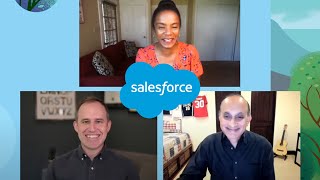
Brett Taylor interviews VMware's Sanjay Poonan on remote work infrastructure and reskilling during COVID-19. Meredith Flynn Ripley demos Work.com's tools for reopening: wellness surveys, shift scheduling, QR check-ins, and contact tracing. Salesforce matches donations to the UN World Food Programme up to $150,000.
Questions this video answers
Salesforce will match donations up to $150,000 through September 30, 2020.
Chapters
Every week I run a speed test to make sure I have enough bandwidth to come on this show and connect with you wonderful people. The Internet speeds, the cameras, the lights, really this has all been part of my own digital transformation here at home. And for many of us, technology and a solid digital infrastructure are are key in keeping us connected. Now this pandemic is not only making individuals stay agile in upgrading their technology at home, but also making businesses fast track their digital transformation and embrace a new way of working. In the end, we don't want to just adapt to this new norm. We want to build back better. Good morning, I'm Leah McGowan Hare and welcome to another one of our live weekly conversations as part of our Leading through Change series, a chance for you to hear from leaders around the world on how they are navigating these challenging times. Now, I want to preview the next hour. We are so pleased to be joined by today's host, Salesforce Chief Operating Officer Brett Taylor, who will be interviewing Chief Operating officer Sanjay Poonin. Now, if you have any questions for Sanjay or Brett, please submit them in the Q and A section on your screen and we'll try to get to as many as possible later in the show. If you're watching on Twitter, please use the hashtag Leading through Change. Now after that, we'll have a special presentation from my colleague Meredith. We're going to who will bring the conversation to Life with a Work.com demo showcasing what Salesforce has built to help companies build resiliency and get back to work safely. Finally, we will conclude with a special performance that will sweep us away to the island by the one and only LT Smooth. Now, as we do every week at Leading through Change, we want to help those who need it the most. Millions of people already rely on the United Nations World Food Program for the food they need to survive. And COVID 19 is making conditions even worse. This pandemic could double double the number of people suffering from severe hunger by the end of the year. To help prevent a hunger pandemic, the world food program is scaling to reach 100 million people across 86 countries with life saving support. Now if you can, please go to salesforce.com wfp and join us in ensuring the world's most vulnerable people have enough to eat during this critical time. Now, through September 30, 2020, Salesforce will be matching up to $150,000 on donations. Again, that's salesforce.com WFP now with that, it is my pleasure to welcome our host for today, Brett Taylor.
Thank you, Leah. And thank you to all of you for joining us today. I hope all of you are healthy. And these are really difficult times. Honestly. We're going through multiple crises at the same time. We're in the midst of a global pandemic. We're in the midst of an economic crisis, and there's an equality crisis happening at the same time. But one thing I just love about Leading Through Change, I love about this program that Leah has been leading us through every single week, is we're all navigating this together. This is my first pandemic. I know it's Leah's first pandemic, but through conversations like these, we can navigate this and we can get to the other side. We can come out stronger than before. And I think it's really inspiring. And some of these conversations have been the highlight of my week. Now right now, we're sometimes awkwardly trying to reopen, and technology is playing such a key role in that. So I couldn't be more excited to welcome a fellow Chief Operating officer, Sanjay Poonan from VMware. Sanjay, thank you for joining us today on Leading Through Change.
Brett, thank you very much. Pleasure to be with you. Been a deep admirer of Salesforce, and as I've gotten to know you also, and the recent few years and months, congratulations on your recent promotion and all that Salesforce is doing to help customers and the community.
Well, thank you, Sanjay. And, you know, it's really interesting to have you on. I mean, not just because of technology's role in reopening, but also our company has very similar heritage. We were just talking about the fact that our companies were founded in the same year during the dot com boom, which feels like decades ago now. I think it actually was decades ago. The world has changed so much since then and yet is still so incredibly relevant. You look at sort of the DNA of our companies. What has VMware's focus been during this pandemic? I mean, you know, really the first for both of our companies. Our technology is more relevant before. What's your focus right now?
Yeah, Brett, I think our companies both have had very similar cultures, obviously founded around the same time, around the start of the year 2000. And I think at the core of it, There are these two DNAs that are very similar. So when I say this, you could almost take the same thing that I'm saying about VMware and apply them to Salesforce. Innovation is at the core of what we is our first engine of what drives us. And you know, Diane Green and Her husband and the founders, just like Benioff, they've been really focused on innovation. And the second is customer obsession. These are sort of like those two jets of a, of a plane. And you get both those working together, you get some incredible, incredible power where you could take that. And that's what's happened to Salesforce. That's really what's happened to VMO the last 20 years. Now in comes the pandemic, which we didn't expect, I think. You and I were at World Economic Forum in Davos earlier this year with the rest of the Salesforce team. In January, we're all together and then of course, this whole thing sort of happens in the February, March timeframe. And what we sought to do was first off, I think like you turn our attention first to our employees. The health and safety of our employees. 30,000 plus at VMware are super important. We have not lost anybody to Covid in death. We had cases, but we were able to keep them in control. And then I told our employees and we told our employees, if you are healthy, we don't think this is going to be a six month or a six year vacation. Let's turn our attention to our customers and in that, take care of your employees first and then turn our attention to customer. We found a tremendous amount of motivation in some senses. I found the best of VMware coming out in that spirit in ways that would never have anticipated. Brett. And it's super exciting to see that inspired by other companies like yourselves who've been doing a lot about that. And then of course, we developed a number of practices over the course of the last six, seven months. I'm sure that we'll talk about during this session.
I love that story of resilience. It is really interesting how much every employee at every single one of our customers has really inspired us. As hard as this is, we're sort of proving to ourselves that we can do the impossible, right? Who would have thought that we could run on operate a business like this over zoom? Who would have thought? But we're doing it, which is pretty amazing. My next question is related to that. We talk a lot about this all, all digital work anywhere world that has awkwardly been sort of imposed on all of us. But it does feel like part of this is going to endure. We've all had to try to find ways to work from anywhere, right? How to sell from anywhere, how to run customer service from anywhere, how to market from anywhere. How have you been personally trying to address that challenge? It's been A real awkward transition for a lot of us.
Yeah, I mean, I'll talk both professionally and personally. Listen, we are very fortunate to run on a lot of your technology in the front office. We run on the sales cloud. We run the service cloud. So having a SaaS mindset to a lot of our applications, especially yours in the front office, helps us. We use analytical tools like tableau too. So we had been thinking for a long time about our professional work life becoming digital driven, especially sort of SaaS apps. We were one of the earliest customers to use Zoom. Love what Eric is doing. He's a good friend. And they are also a mutual customer, just like both of us are mutual customers. So this notion of a digital workflow workspace became something that we could play very prominently in. And VMware's role is to provide the infrastructure and the digital workplace technology that allow you to use these apps in a very seamless fashion. We began seven years ago to talk about working at the speed of light, well before all of this pandemic and our workspace. One offering, which you folks at Salesforce use internally, has allowed the facilitations of tens of millions of end users to work in their professional life just like they work in their personal life. I always kind of talk to customers and tell them when you work in your consumer life, you don't lug around,000 CDs and 2000 DVDs. It's all streamed to you. And unfortunately, our enterprise life with laptops and tablets and phones over the years have been so cumbersome VPN technologies and agents, and it's incumbent on us infrastructure players to simplify. That's the professional side. On the personal side. Brett, we were talking about this in the green room prior to this, right? It's changed. I mean, it used to take me 30 minutes to get to work. It now takes 30 seconds. And we have to all build out the appropriate work life balances so that we aren't burning ourselves out. Because it's very easy, whatever time you start. I tend to be a late night owl as opposed to an early morning bird. So I start my morning a little earlier than my boss, whose CEO starts much earlier than me. But I think we have to all build, especially those of us who have families and children, the appropriate places by which we build that work life balance. And I start to do that personally in a couple of ways. You know, every year I ask my kids what can I do to be a better parent, Ask my wife what I can do to be a better husband and a Year ago, my kids told me something that's always sort of sat in my head. Dad, would you mind when you come back home, put the phone away. Okay. We want your attention for that period of time, whatever it is, six to nine. And, you know, it's amazing. Now, for me personally, Brett, I've developed a few habits with my kids that I wouldn't have done when I was traveling 40% of the time to various parts of the world. One of them is biking. And every evening now in the summer months, we get our bikes out. We'll go for, you know, three, four miles, ten miles round trip. It's easy to do that for hour and a half with the kids. And I tell people, develop an activity, you know, on your own. And if you have a family with your family that you will keep after the crisis. For us and our family, it's been these bike rides. If you follow me on Twitter, you've seen some of those photos. And sometimes we'll go visit some people and say hello to them. Just social distance from their window, so to speak. But it keeps the. Especially the kids who are for this is an unprecedented time for them in a way of keeping things different and moving. Those are a few examples of what we've tried to do.
Brett, I love that. Sanjay, I think you just said you get performance reviews from your kids every year. That's pretty awesome. Bring in the work process. I love that story. I mean, it is really interesting. There was a funny joke on Twitter the other day. It's like, am I working from home or am I living at work? And it is interesting. In this new normal, we're working from anywhere, you really have to establish those boundaries, be a little bit more intentional. I love that theme of intentionality. With your business, with your home life, we really had to really think about what's the life we want to live, which is really different. It's interesting you talked a little bit on your early part of your answer. Just the way technology is facilitating all of us working, this new normal, this all digital work from anywhere world, how is VMware using technology? You mentioned a little bit, but I'd love to hear a little bit more about that, because I think a lot of people who are watching right now are thinking about, what is this new normal? What's the shape of my company? What's the shape of my family? But how can technology facilitate that? How is VMware using technology to facilitate it?
Yeah. First off, if you think about the various different functions that we all run, whether it's the finance, the operations, the front office, customer facing or the back office operations or engineering. We've taken an approach to move digitally first to as many of cloud SaaS, infrastructure related things that are just easier to manage. The cloud just makes it easier for all of these things. So we run our front office, a lot of it in your technology, the HR solutions on workday, our core financials is SAP, but even that we're running it on a private cloud that's highly optimized. So we were the first and then many of these apps, probably a total of 500 apps internally. We've chosen technologies that are often best of breed with a very strong integration and analytics engine that we can run the business on on a real time basis on my phone, which is I think for us able to run any kind of business anywhere. Then then from the standpoint of VMware's proposition, obviously everyone knows us in the data center as extremely powerful. There's 70 million virtual machines, a half a million customers who are standardized on virtualization. We began seven years ago to really modernize the workplace technology with a set of management, virtualization and security technologies. We acquired a company that was the leader in mobile security called Airwatch. And that's become now the de facto standard for managing endpoints of any kind, laptop, tablets, phones. Because the phone world was not a Microsoft device, it was an Apple or a Google device. In the past you may have managed that whole world with a Microsoft technology for a Windows laptop. We also began to see a proliferation of Macintosh and Chromebooks. The diversity on the endpoints of laptop, tablets and phones we began to detect over the last seven years. We became now that sort of leader in a workplace technology we call Digital Workspace or Workspace 1. And at the core of it, Brett, it provides the management security layer for any of those endpoints, laptop, tablets and phones. And in certain cases even technologies like virtual desktops. Now enter Covid the last six, seven months and these customers started to explode in their use at home of these technologies. And all of a sudden we began to see a surge in of these in tens of thousands. One of our large banks went from 10,000 customers to 200,000, sorry, 10,000 users to 200,000 users immediately. And we began to see story after story of hospitals, of banks, public sector governments starting to surge in their usage from home. And then we began to build alongside that a couple of other technologies also that could accompany that laptop or phone that went home. One was clearly Workspace one, the other was security. We acquired a company, carbon black that's the next gen Endpoint security capability to protect you from antivirus and threats. The third was network acceleration so that your network experience into the home could be fast and secure. That combination of Workspace one, carbon black and network solutions called NSX really began to see a surge in demand. And we packaged that into a future ready work from home suite, so to speak. Brett, and that's really done well to help our customers in the last six, seven months.
What I love about that story is, you know, it's a mix of kind of pivoting your value proposition, but also saying of all these amazing technologies that VMware has in the portfolio, how do you actually package it for this new normal? You know, and I think it's interesting because a lot of business leaders on, you know, on this stream right now thinking about how do you make our value proposition most relevant in this time where there's so much consumer change, business change, you know, if there's any. That's why the title of this show is Leading Through Change. Right. That's the only constant right now. You know, implicit in this though, you're talking about how you took all these value propositions on the network on Endpoint Security and you really took advantage of this opportunity afforded by everyone working from home in that is culture, though, right? Which is this culture, to kind of embrace change, right? To say, okay, you know, rather than look at this as a disruption, how do you look at it as an opportunity? You know, I'd love to talk a little bit about that. And when you look over in the future, and Honestly, the next 12 months, I have to assume we're going to see almost as much change as we've seen in the last six months. You know, just as we hopefully get a vaccine and we, you know, reopen the economy, reopen our businesses, reopen our schools, it's not going to be a slow, it's not going to be a fast process, right. It's going to be ever coming change. How do you plan to stay ahead of the curve and how does culture play into that and how are you thinking about that for your employees and your customers as you're navigating this?
Brett's a super important question, I would say. Listen, we've been very inspired by what you've been doing at Salesforce. This Leading Through a Change series. I've got to watch a few episodes. So we learn from each other. And remember, this is, I mean, this is a village that it takes. The more that we can help each other from a cultural perspective, we set certain things that we felt were important. Much of this won't be new. Many of you are probably already doing this. But to communicate, communicate, communicate. On the get go, you folks, I think have been doing. When I've heard from some of my friends at Salesforce weekly type of events that internally communicate, we felt it was very important. In informal town halls. I began a practice of just doing in country town halls for my teams. I run all the front office operations, about 17,000 people, 60, 70% of the organization reporting to me. I've started to kind of really focus in on the top countries and do in their time zone starting six months ago, once a month or so, just a half an hour. I mean the shorter. One of the things that's super important is everyone's right now. Zoom fatigue. I mean, you know, you kind of have to do things that are short, sweet and you know, start it on time and finish it a few minutes early too because you know, people are always running from one place. You need to allow a bathroom break or a bio break in between those. But even those 25, 27 minutes, let's just say with our team in Japan in, you know, late evening, my time, morning, their time, the format was, listen, you know, five or 10 minutes of my sharing what I'm seeing across the world and then 15, 20 minutes of interactive Q and A with the few hundred people or a thousand people in a particular country. Then you go to the next country, but do it in their time zone. All of this just really began to set a communication paradigm where me as CEO of the company was communicating directly with our team on a more intimate basis. We replicated this at company town halls. Pat, myself and others. We found this to be a really good way to stay in touch with. I found myself much more in touch now with everybody all the way from top and quite frankly, what I care about the most are the individual contributors. That person who is the engineer or the sales rep we have, that's the place where all the action is happening us up the hierarchy. We're bureaucracy. But to the extent that we can get that engineer and sales rep working well together from a cultural perspective. When we also talked about turning our attention to our customers, I began to think about ways in which I could role model this. I'm a big believer in servant leadership, which is, listen, if you want to lead, you exemplify that through being a servant leader to your team. We're getting ramping up in a significant way into the security space because we see a big opportunity there. I set myself a goal, a personal goal this year before COVID started to try and meet a thousand CISOs. Now, typically I talk to CIOs and from my past at SAP, talk to CFOs. So I have a fairly large Rolodex among the IT leaders and the finance leaders in the industry. But, you know, it's been 15 years since I left Symantec, so I don't, don't stay in touch with the CISOs. I figured if I was going to talk to security professionals like Jamalkov at your company and others, I ought to start meeting with them and getting to talk to them. I figured I'd go to conferences like RSA and Blackout meet 100 a time. And then Covid hit. I'm actually finding, Brett, that it's actually easier for me to schedule some of these 25 minute calls. I've reached out with my staff to 7, 800 of them. I've done 3, 400 already. And it's incredible the learning insight I'm doing having from these. And it's exemplifying to my team that at the top of the company, their leader is willing to talk to a customer. Often it's just a cold call. It's 25 minutes of what we're trying to get done, hearing their objectives, doing a first early pitch. I think when we as leaders exemplify that we're willing to get into the trenches with our teams at this time, it motivates them even further.
Yeah, you know, it's interesting. There are a couple interesting things there that I just want to highlight. First is things are different now. You need this plan to go to an RSA conference and instead you're asking for zoom meetings. And what's interesting though is I've observed the same thing. It's actually pretty easy to take a zoom meeting, right? You don't have to fly anywhere. You don't have to coordinate. It's just clicking a link, right? And it's really interesting. I love that idea of turning lemons into lemonade and saying, okay, what's, what's actually easier in my business now, that was really hard before and I do think that that ability to connect, it was interesting. On our earnings call last quarter, Parker made a comment that's really stuck with me too. He said, as impersonal as it is to be working through these panes of glass and not being able to shake hands or give a hug or have that hallway conversation, we're also looking into each other's homes. I could see those Jerseys behind you. And I'm learning about you, learning about you, probably in ways I wouldn't have in a world where we were meeting in a conference room on the VMware campus or within Salesforce Tower. And I, I love the idea that, you know, we are, I love the idea that you're sort of. Some things are different and different in a better way. And you know, what of this can we retain when we come out the other side? Yeah. One last question. I want to make sure we also leave time for folks online to ask us questions. But it was interesting. I was on the phone with a CIO the other day and she made an interesting comment to me, which is, we had a digital transformation project before this and now I have a digital transformation imperative. And it's because every single interaction is digital now. Why do you think it's so important to focus on digital right now? You know, like what, what will endure from this, you know, mass digitization of the economy that's happened over the past, past 30 days?
Great, great question. Just a call out to my son who's got their jerseys at the back. Those are my kids basketball jerseys. And one of the things that I'm trying to do, as an aside, I play the piano and I played the guitar not so well. So my guitar is on the other side as I'm trying to use this pandemic as a time to learn a new musical instrument. But coming to the digital imperative, I think you're right, Brad. We are the most interesting time. If you look at The S&P 500, the top five companies years ago were oil and gas companies maybe 50, 100 years ago. XMO, they're all respected companies. But now the top five companies, Apple, Amazon, Microsoft, Google, Facebook, occupy 25% of the market cap of S&P 500. That's never happened in the history of them. And they're all growing and doing reasonably well even through the pandemic. So we are at the cusp of an incredible revolution where even the most mundane industries, if you think of them as agriculture, agrarian cultures, are all becoming tech industries because they're being revolutionized through cloud or IoT or mobile or whatever have you. And I think it's the best time, if you are a millennial, entering the workforce in your 20s to get involved in technology. Because irrespective, whether you stay in the tech industry or you go to one of these other industries that stem knowledge and learning from both high school to college and into the workforce is going to be super important. And I think Some of these technologies, like for example, video collaboration, who would have thought? I mean, I applaud Eric Yuan. I mean, he's a WebEx engineering leader. That understanding that if he could build a technology that was optimized for this device, it would take off. I remember when we went through this type of crisis, not as bad as this one. In 2008 during the financial crisis, I was at SAP and we were all hunkered around very expensive telepresence machines. These were big, important gear from Cisco. And now it's so much easier because this video encryption technology and all that's happened to allow this to happen has gone mainstream. And whether Zoom or Teams or hangouts, these are now technologies that are going to change the world, not just for business, but for education, healthcare, telemedicine. We just saw this huge merger of Teladocs and Livongo. I mean, it is going to change fundamentally everything. And our job as infrastructure players is to support those apps and be the digital first responder to those first responders in this time. Because ultimately infrastructure like our serves those applications, whether it's Salesforce or medical records or any other apps. And that's the way in which we're thinking about the future. I think it's a very exciting time for digital transformation.
I love that phrase, digital first responder. That's like every IT professional on the line right now. They're digital first responders, right? You know, getting us all working successfully from our homes. So with that, I would love to open up to questions from the audience. And Leah, I'm going to turn it back to you to see what questions we have online. And I think you're on mute in the spirit of working from anywhere. How many times have you said that in the past month?
And I've learned to not apologize for it because it is what it is. All right, thank you so much. That was a great conversation. And we do have some Q and A here. So from hard deep on chat for both Brett and Sanjay, how do you see the job market recovering both within the Salesforce SaaS and VMware Cloud Space?
Sanjay, you want me to take this first?
Yeah. All right, Please go first.
You know, I've had this perspective before the pandemic. It's something that Leah and I have talked a lot about too, which is the importance of reskilling. You know, I think there was a world that I think ended more than a decade ago where you learn skills in high school, university, and those are the skills that you needed for your whole career. You know, Nowadays, if you're a marketeer, the skills you need look as much like a data scientist as they do a marketer. You know, if you are a sales rep, the skills you need to operate successfully in a digital world are completely different than the skills you needed previously. And, you know, what I would say is the job market will evolve, but that doesn't need to exclude anyone. And I think if we have a mindset of constant reskilling, where even at the company level and the personal level, we don't view skills as something that we learned in our early life, but something that we're constantly honing through our whole career, we can really, you know, essentially evolve into the jobs that will be the most important jobs in this, you know, brand new, all digital work anywhere economy. And obviously, I think that involves a lot of digital skills. So, you know, one of the things I think a lot of folks who are watching this broadcast have heard of is trailhead. This is Salesforce's free learning platform. This is a place where you can, for free, learn about all these modern new technology platforms. And not just Salesforce's platforms. Amazon Web Services, Apple, GitHub, all these technologies that I think are more relevant than ever before in this all digital work from anywhere world. So what I would say is I think it will impact the job market. You know, there's no way a pandemic doesn't hurt the economy. Right. On the other hand, I am an optimist and I believe all of our businesses are going to find a way to navigate through it. But the tough reality is it's not going to look the same on the other side. Right. The sky, the skills we need to be successful tomorrow are not necessarily the skills we have today. So that learning mindset, I think, is the most important thing as you're looking at the jobs in the future.
Yeah. And I would just briefly add it endorse everything Brett said. First, my heart goes out to every one of you who may be affected from a job displacement situation. There are tens of millions I know have been affected in the United States and other parts of the world. This too shall pass. And I do think that we'll get back. This is not going to last as long as World War II. The last time we had something of this kind lasted six. And just to underline a few things of what Brett said, I think if you. The pandemic is the best time to ask yourself, what are the skills you need? I think back to 2008, 2009, and one of the best things I Personally did. I'm a product guy at heart. I'm an engineering person. Most of my life, I was writing code and managing teams that did that. My boss at the time was Bill McDermott at SAP. He encouraged me to move into sales and run some sales teams. And it was completely out of my comfort zone to do that because I'd never done that before. And everything I learned about the front office, I learned during those three, four years. Just diving into the deep end of the pool. I could have failed, but it was for me, a tremendous learning opportunity. It's prepared me for what I'm doing in my current job at VMware. So I'd encourage you to pick up those new functional skills. The best time to do it is when you'll be in companies where they want people to lean in and do new things. We are also like Salesforce, providing a lot of tools. We're seeing in our core virtualization capabilities. A lot of move into containers, and we're offering Kubernetes Academy. We acquired the company of all the founders of Kubernetes who left Google and started Heptio. It's a company based in Seattle. We're encouraging a lot of the core people who know VMware well to learn containers. This is the best time to upgrade your skills from not just virtual machines to this whole world of Kubernetes and containers, and it's going to help you in the future. And we've got a lot of free tools like Kube Academy and so on to help our core community. You know, there could be other areas like security that are also going through. So we will, like Salesforce, continue to help you with a lot of tools that we'll make for free.
And I would add in there, this is a time I've heard others talk about using this time to reskill so that when we come through this come out on the other side, you're not playing catch up, right? When you come hit the ground running like, I've got these new skills, I'm ready to run. You are ready to go. And not necessarily playing catch up for what's new. And to add onto what Brett's saying, we also have on trailhead soft skills, learning how to business write, learning speaking skills, even how to virtually present. So please check it out and. And let's take advantage of the free reskilling access that's out there now. All right, my next question is for Brett. What's the one enduring change from COVID that you see lasting even after there's a vaccine and we're in the new norm.
You know, I'll give a professional and personal I like Sanjay's structure to one of our previous questions. So professionally I have to imagine it will impact business travel. You know, it's interesting. I think that before every time I met with a customer I tried to do it in person and I still honestly I'm missing that Leo. I'm looking forward to actually shaking, you know, customers hands again. But I do think a lot of those meetings could be over zoom, you know, they could be over, you know, video. And I do think that will be an enduring change and I think that will, you know, when this is optional, when we're not, you know, when this work from anywhere old is not imposed from us, I think we're going to retain some of the in person business interactions being digital in an enduring way and even events like these. You know, I love this Leading Through Change series. Why don't we have it before? It's a good question. I think it's going to be more of an and than an or. I don't think we're going to snap back to the way things were. And then for me personally, I have more reliably had family dinners with my family every single night for the reason Sanjay said my 30 minute commute is now 30 seconds. And that's something that I know my family and I are going to retain coming out of this.
Sanjay, I would like to extend that question to you.
Yeah, I think listen, we're very grateful. I mean some of the things that innovations you're going to I think even show later. Work.com, we've been thinking about how our workspace one efforts around proximity and campus could connect with work.com so I think there's going to be some good innovation that comes out including between VMware and Salesforce about return to work that I'm very excited about and our teams have been talking about that. I'm looking forward to that. Continuing seeing the demo and what you're doing@work.com and its connection to Workspace One will be fascinating. I do think that as I mentioned earlier as we kind of come out of this, maintain, like I said, maintain a habit that you want to keep at the end of this. I hope I told my since I have the front office teams I hope our travel reduces by if I was traveling 40%, maybe I get down to 10% because quite frankly it's as efficient and many of those customers now will be willing to do something 24, 7 and then develop some activity with your community. One of the things I've encouraged people to do, I do think you get a tremendous amount of satisfaction out of giving. We've been looking for ways by which we can give back to the community. If you have disposable income, I'm not putting this as a pressure out to people who, who are out of jobs, but if you have disposable income, find ways which you can help your local community. I took our. In the early days of the pandemic, I took our kids to the local deli and I said, let's buy a bunch of lunch gift certificates, you know how many number of them and take them to the local hospital. It's just a practical way in which I could teach my kids that's more blessed to give than to receive. And when you do that to you're blessing two people. One is the local deli. That's business is down 90% and of course, taking it to the hospital, you're helping the people who are working there on the front lines. Or you could do the same thing with a homeless shelter. When this is done, I hope that sort of mindset of giving back continues. You've had that culture very prominently at Salesforce, I know for sure, in the 111 and so on and so forth. But this crisis is teaching us to look outside of our four walls too, even while we're socially distant, to help our community. I hope that will continue to last even through at the end of the pandemic because this, you know, virus has had no distinction of culture, race, or color of skin. It's affected every country and I think it's bringing us closer together as humanity.
I really do love that. I love that coming together as humanity because we've had to deal with some really tough. We still are dealing with some very tough issues that need us to bring the humanity to the forefront and really come together and see each other, see the humanity in each other and bring the compassion and the empathy to so we can move through this. But even more importantly, we come out through this better. Better people, better world, better community. With that, I want to thank you both. Thank you, Sanjay. Thank you, Brett. It was great hearing from you. I look forward to seeing all the great things coming out of VMware and I'm very grateful that you took the time to talk today. Thank you.
Thank you, Leah. Thank you, Brett, for having me.
Yeah. Thank you, Sandra. Thank you, Leah.
So many great learnings from sanjay about navigating COVID 19 and the shift to this new norm. And now we have a special presentation from Meredith Flynn Ripley Salesforce VP of Digital Engagement, who will bring our conversation to life with work dot com. Welcome, Meredith.
Thank you, Leah. Now let's look and see how the work.com solution is building resiliency for today and for what tomorrow brings. This is the command center, that single pane of glass that allows companies to make data driven decisions combining their internal data, employee and office information combined with external data like pandemic related health stats powered by Tableau, as well as the extensive state, county and country guidelines which are changing on a regular basis. It's such a dynamic environment right now it makes it even more important to have the power of the customer. 360 Platform and apps that let companies take action on a very targeted geographic basis. So what we're seeing right now is a tech facilities manager who's tasked with bringing a new team into the Bangalore, India office as they continue to bring more and more employees back in their reopening strategy. Bringing employees back starts with our wellness survey, a daily health attestation that can go out across a variety of different channels. The survey can be sent out manually, it can be automated, and all of our sensitive data rules apply, which means data can be masked at storage. Now let's see what the employee experience is like. This is Priya. She's getting her health survey for the day, filling out the series of questions that let the company know that she is healthy and willing to come back to the office. She's choosing her preferred channel of communications with the company, which is WhatsApp. And she's choosing the days that she's interested in coming back. Many companies are involving employees in how and when they'll return to the office. This is the new reality of flexibility and scheduling. Now let's look at the building capacity side of things. This isn't just about organizing neighborhoods or spaces. This is also about getting employees safely in and out of the building. Thinking about things like elevator capacity with our shift management app, powered by the world's leading scheduling and optimization technology. All of those statistics and policies and building specific information is taken into consideration and with the click of a button, shifts are generated. Now let's look at the console side of the view. You're seeing at the bottom of the screen the existing team that's been coming in on a regular basis to Bangalore already. And now at the top, you're seeing Priya's team. The other important thing is that when employees return back to the office, they're going to Come in these collaborative pods, people and teams coming together with a purpose. So it's even more important to have the right people entering the building and entering it at the same time with staggered arrivals. And that's done with the click of a button. So let's see Priya's notification. This is an alert in her Salesforce mobile app. It's letting her know a 30 minute window to arrive and the days that she's to arrive based on her preferences and a QR code to scan. The work.com platform integrates with a variety of smart building systems. So when a wellness survey isn't filled out, a badging could be blocked. Now let's see what happens when Priya is scanning out at the end of the day and her temperature shows an elevated number. That event from the connected device is sent to the Salesforce platform and a series of actions take place. Priya is put into quarantine. The team that was set to be coming into the building shortly is now asked to stay at home. Extra cleaning protocols are now going to take over and happen within the building. And Priya's teammates are now being notified on their preferred channels that they should be staying at home for the next 14 days because they may have been exposed to someone. Here's Ganesh, a teammate. He's also on a preferred channel of WhatsApp. It's super popular around the world. And he's not only told to work from home, but he's offered a daily bot temperature check, something that we learned from working with the States that was very popular. He subscribes to that. He's putting in his temperatures and on several days in he does show an elevated temperature. The bot, which is something that he's opted into as well. He could be talking to an employee for help. It's entirely at their option. Immediately sets him up with a nurse telemedicine appointment. And the bot can also schedule a COVID test kit to be delivered to his doorstep. He does that and is now taking his temperature. After about a week, he does notify the company that the test came back positive. You see that the outbreak is now flagged in the command center. More actions can be taken and entirely at Ganesh's option. This is all employee opt in. Manual contact tracing can start. You'll see his contact graph here where we can automatically populate it with the teammates and even the customers that Ganesh has been in contact with. And this is really where employers are helping their employees in a critical time of need with support and isolation services like food and medicine delivery and also prioritizing the entire health of the workforce. So that was just a very quick snapshot of how the work.com platform powered by the Customer360 platform is enabling businesses to assess and plan their operational readiness to let them take action very quickly to maintain the wellness of their employees and most importantly, build long term resiliency. For more information please visit work.com and now back to you, Leah.
Thank you Meredith. That was awesome. Now before we bring in our next guest, LT smooth for performance. Those of you on Twitter, you don't want to miss this so you need to switch on over to Salesforce live and we'll be waiting here for you. The link is salesforce.com live again salesforce.com live. Come on over. You don't want to miss this. We'll be waiting for you. What was that? Why do I have a flower? Well, we are about to be transported to the island. Grab your mocktail and sunglasses and get ready to be serenaded by the beautiful smooth sounds of LT Smooth. You'll love his music. Let's check it out.
I was standing all alone against the world outside you were searching for a place to hide lost and lonely now you've given me the will to survive when we're home with love will kiss the light don't you worry sometimes you just gotta let it ride the world is changing right before you ride now I found you there's no more emptiness inside when we're hungry love will keep us alive I will die for you climb the highest mountain baby there's nothing I wouldn't do now I found you there's no moment in this aside.
When.
We'Re hungry love will keep us alive I will die for you climb the high this mountain baby there's nothing I wouldn't do most and lonely now you've given me the will to survive.
When.
We'Re hungry love will keep us alive We've worked hungry love will keep us alive when we're hungry love will keep us alive. Sam. It. It. Yes. Of me. Let your spirit follow me. Let him dwell within your sacrifice your life for him and he'll pick you up and you fall.
Who?
Wow.
That was so amazing. And I think it's just so important that throughout the day you create moments of joy, whatever that is for you. That's part of your self care regimen. So if it's listening to the smooth sounds of LT smooth and I'm dreaming that I'm in an island somewhere, that's self care for me. My daughter thought my flower I was doing too much and I said honey like Luther Vandross said it's never too much when it comes to self care. LT thank you for that beautiful beautiful songs and just allowing us to be transported to another place or even another room but just giving us that space to create. Love it. And thank you all for joining us today and I hope you walked away with some great gems of wisdom and and I look forward to seeing you again. You can find more of these amazing Leading through change stories@salesforce.com blog now before we wrap up, one more reminder to join us in making sure millions of people worldwide do not go hungry during this crisis. If you can, please go to salesforce.com wfp and joining us in helping this organization once again. Through September 30th, Salesforce will be matching up to $150,000 in donations. Now again, that's salesforce.com WFP now we'll be back with our next Leading Through Change next Tuesday at 10am Pacific and join us for our upcoming Salesforce Live, your roadmap to recovery and growth. Wednesday, August 12 at 11am Pacific Register at salesforce.com events. You won't want to miss this one. Until then, please take care of yourself and each other.
Sa.
It.









