How Nextdoor's CEO is Creating a Different Kind of Social Network | Ep. 25 | The Inflection Point
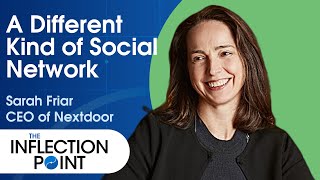
Sarah Fryer, CEO of Nextdoor, grew up during the Troubles in Northern Ireland and built a social network focused on trusted local information and neighbor-to-neighbor help. The company uses volunteer moderators and kindness reminders to shape behavior, went public under the ticker KIND, and aims to be a global community platform by 2032.
Questions this video answers
1996.
29% of US neighbors knew only one other neighbor and 27% knew zero.
2018.
Over 230,000 neighborhood team members.
Six weeks.
Chapters
Do any of us know our neighbors anymore? Sarah Fryer, the CEO of nextdoor, is trying to change that.
When you talk to people about what their neighborhood was like when they grew up, they all say something very similar. It was great. We knew all my neighbors. I played, you know, in and out of other people's homes. And yet today all of that has been taken from us.
It's a different kind of social network, bringing people together instead of driving them apart.
Unlike other social media platforms where you don't have an expectation of seeing that person in real life, nextdoor is all about real life. And I think that in real life piece is actually the magic of nextdoor.
I'm Monica Langley and this is the inflection point. Hi, Sarah. Thanks for joining me today.
It's great to be here, Monica. Thank you.
My first question to you is when was that moment in your life that turned out to be a real inflection point.
My inflection point was moving to South Africa right at that point where that country was going through massive societal change. It became the rainbow nation. But it taught me so much about business, about leadership, but also being a human in society.
That's a big amount of stuff put into that one moment. Let's unpack it. So it was, what year did you go and paint us that picture?
Yeah, someone. In 1996, I was fresh out of university. I joined McKinsey. And so they sent me down there to work with a lot of mining companies and so on.
And in 96, that was just two years after apartheid ended in South Africa.
Exactly.
Nelson Mandela had just been elected. And so there was a lot of tumult in that country.
There was, there was tumult, but also just incredible optimism and joy.
So how did that change you as a human being?
There are kind of two moments. One personal, one business. I'll start with the business one. We were working on a mine that was trying to figure out how to become viable. On top of that, the government was saying we have to start seeing black people at the top of these organizations. So we were trying to bring people through the organization speedily. And we had post it notes, sticky notes all over this big wall. And I remember I was tracking this one guy. I'd met him, I was so taken with him. He was such an up and comer. He deserved to be right at the top of this company. And one day I came in and his post it note had disappeared. And I was kind of. Did I just fall off the board? I'm looking around the floor and I said, where did Daniel's post it note go? And they said, oh, he was diagnosed HIV positive. And in that moment, I realized we could do everything we wanted as business people, but if we didn't think about the society and what was impacting the societal outcomes, the business was for, not, in that case, getting control of the HIV epidemic. As an example, the personal one was going, believe it or not, to a Michael Jackson concert in South Africa. In South Africa. And he sang black or white, it doesn't matter if you're black or white. And the whole audience, I remember just looking around and then holding hands with all of the people of all different colors and shapes. And it was an amazing personal moment. It still gives me goosebumps, still makes me a little tearful, and just realizing, you know, again, humanity is awesome when we do the right thing. And, you know, it's a lot of what keeps me optimistic in what I do today.
Let's talk about also your life and having seen people work together but also have so much strife that is your own childhood.
Yeah. I mean, I grew up in a little village right on the border in Northern Ireland between North and south, right during the Troubles. And I think today people start to understand a little bit more that that was a war. But it was not well known for many, many decades almost. But we had gotten to a point where religion divided everyone and we were willing to kill each other. My parents are today, we'd call them community activists, but they didn't have fancy names like that. So my mom is the local nurse. She's the midwife. A lot of people are still giving birth at home. My dad is the personnel manager of the local mill. And every night there's people, us at our house. Like, whatever problem you had, if you needed health, you had a health issue. If you needed a job, if, you know they were at your house, they were knocking on our back door. And my mom and dad would get up from the dinner table and they would go into the kitchen and there'd be two chairs and they would have a chat. And that was kids. We saw that over and over again. So you have this wonderful community thing going on, but at the same time, there are bombs going off, there are people getting shot around you. I think as a parent, I look back now and I'm like, how did my parents deal with that? Because it's kind of all sorts of crazy in hindsight.
And you live through these very pivotal moments in history in Northern Ireland, and then when you were working in South Africa, has that really Informed your leadership?
It has. If I think about why I'm so excited about Nextdoor and why it speaks to me, it's all about community and about this belief that when you aggregate people like humans coming together around something they care about and local is something everyone cares about because it's where you live. Right. It's where your family is. It is the most potent thing on earth. But I think that's what those arcs have brought me to.
Which brings us to nextdoor. Millions of people are on Nextdoor, as am I.
Thank you.
I checked it this morning. My home is in South Carolina, so I wanted to see what's happening at home. Yep. And there was a beautiful rainbow this morning, according to Nextdoor.
That's cool.
And there also is an alligator on the loose.
That's a good Nextdoor story.
Yes. So what is the origin of nextdoor?
So our founders got together and read this wonderful Pew Institute survey that said 29% of US neighbors only knew one other neighbor and 27% knew zero. So half of the United States said they only knew one person in their neighborhood or no one at all. So they said, we are going to try to solve that problem.
First of all, that's a shocking number. But second of all, you can kind of see it because we all go inside and stay on our social media anymore and do that kind of thing. So there is a real need for a next door.
It's really needed because of what you just said. When you talk to people about what their neighborhood was like when they grew up, they all say something very similar. It was great. We knew all of my neighbors, I played in and out of other people's homes. And yet today all of that has been taken from us. And so what's that leading to? It's leading to social isolation. Loneliness. It's an epidemic. We've done research that shows knowing six neighbors or more, but just six, has a statistically significant impact on your feelings of well being. And if you are willing to do one little act of kindness every week, and we did it over a six week study, that has a huge impact on your actual physiological as well as mental well being. So if you think about loneliness as being the equivalent of smoking a pack of cigarettes per day, then next door must be the equivalent of, I don't know, running and eating your greens every day.
And it's so much easier and it's much more fun.
Exactly.
Tell us what it is. For those who don't yet know what.
Nextdoor is, to me, nextdoor is first of all the place you go when you need trusted information. So I always say Kathy down the street is my neighbor, but she's the font of all knowledge. So when I needed a babysitter or I needed to know like an emergency plumber, I'd call Kathy. And to me, next door is just Kathy on steroids. Right. It's big time word of mouth, trusted information. It's also the place you give and get help, like help me find my lost dog, help me get together in a group. Right. There's lots of way help happens. The final reason we think actually the most important is people come to Nextdoor to create connection. So unlike other social media platforms where you don't have an expectation of seeing that person in real life, Nextdoor is all about real life. And I think that in real life piece is actually the magic of Nextdoor because that's where great communities are created.
You became CEO of Nextdoor in 2018 and you took the company public this past year. Fall. Yes. So why did you decide to take the company public?
A couple of reasons. Number one, to raise money. So we want to be huge. Right. Next door should be global. There is not a person in the world that's not a neighbor. I actually love that thought.
Right.
Queen Elizabeth is a neighbor to someone. Second, we were ready. And I think it's a credentializing moment. It kind of says we are serious and you should take us seriously, particularly think about our customers, advertisers, for example. It's just another way of continuing to put Nextdoor on the map of the up and coming platform where you want, want to come advertise.
And your stock soared on the day of your ipo?
I did.
Yeah. I saw that. Now why did you pick your ticker symbol?
Tinker. Yes.
Kind. It was interesting.
Kind.
Kind. K I n D. K I n.
D. It was kind of a throwdown moment of we are building. Our purpose is to cultivate a kinder world where everyone has a neighborhood to rely on. We believe that in this case a platform can be used for good, for really pro social behaviors. And the word kind for us is not just about nice stuff. Right. There's a lot of kindness that is super nice, but there's a lot of kindness that I think edges into toughness. As a leader, I actually think giving kind and candid feedback can be a tough moment. But it means I care about you and I want you to develop. Because if I don't give you that tough feedback, I'm actually being unkind because how are you ever Going to get better. And growing up in Northern Ireland, I think one of the things I learned is if you didn't get the opposing sides around a table, how are you ever going to create peace? And so kind for me is also that it's being willing to have our toughest conversations, but in a constructive way. And that's what we're building with Nextdoor.
You talk about that because one of the models of Nextdoor is civil disagreement.
We have constructive conversations. Civil disagreement. Yeah.
Yeah. So it's interesting because you do read people disagreeing out there.
Absolutely. It's healthy, by the way. I think that's supremely healthy. Those are the debates that should happen in neighborhoods.
So we all know communities, kind of like families, can be messy. So what do you think about now? That when some of these people on nextdoor have their megaphone moment and they can go off.
So a couple of things there. Number one, remember, Nextdoor is founded on trust. So it's real people at a real address. I'm going to meet you. I can be a jerk online, but I'm probably going to bump into you on the side of the kids soccer pitch. Second, we have pioneered community moderation, and this is very different from every other platform. We have over 230,000 neighborhood team members, we call it, all over the world, and they are the people who do moderation in their community. They welcome a new neighbor. And we felt that was important because it brings local context. So if you think about my dad's neighborhood in Northern Ireland, someone sitting here on the west coast of the United States has no idea how to moderate that neighborhood. Right. What's a joke? Right. We're a little bit more sarcastic in Northern Ireland. Probably wouldn't go down as well here on the West Coast. So you need that kind of tone, that cultural piece.
Is there a point when it has to rise to your level as the CEO, Sarah, where you've had to jump in and they're like, this is not working here. And you're like, okay, I gotta make a call.
Me jumping in on a topic or a person is a really unscalable model. Yes. So being willing to make this trade off between engagement and growth. Now, I do think this is a CEO decision because in the end, it's about the size your company becomes. We have decided to take the path of slowing people down. So we've worked with literally some of the best in the world. So Dr. Jennifer Eberhardt out of Stanford, she is wowing. She just won a huge prize for this work, which Is all about how do you slow people down. So we have something called kindness reminder. So if I were writing back to you and was gonna say, you know, Monica, you moron, for example, use a better word, you get a little pop up, that slows you down.
That's fascinating. But it goes to what we have told as moms to our children sometimes, or my daughter even sometimes tells me, take a breath.
Yeah, we know over a third of people are willing to edit. They still post, which is important because you want the conversation to keep going. But a third of people edit and we're continuing to do more there. So we're willing to slow you down. That balance of engagement and growth.
Do you find that this is particularly helpful now that we know with social networks there's a lot of divisiveness, misinformation as well as, you know, racial profiling or xenophobia. Do you find that your employing that in those areas because that's what people are critical of.
Absolutely.
Of all social networks. I'm not singling out my social network.
In fact, we would like other social networks. This is an example where I'm like, copy our IP because we've led the way, but please do this. And we do it for all sorts. Like kindness is one. We do one for misinformation, we do one for discrimination where it has just a slightly different design element, but the science behind it.
Have you called Mark Zuckerberg at Facebook?
We have shown it to a lot of people in these different companies.
Another thing that fascinates me about you is when I look at you as a CEO, you are not scared to take on hot button issues. Some CEOs say absolutely not. Why do I want to attract attention? For the good or the bad? Because I know I'll anger some people and other people will love me.
I mean, it comes back to the inflection point, right? It was that moment where I realized you cannot just live in your bubble and say, I run a business and it's just about dollars and cents. Right? It's the old Milton Freeman, right. That you. Shareholder value, stakeholder value is where the world is going. And I think more and more CEOs are being asked to step in. I think you have to be careful of if you stand for everything, you stand for nothing. So you have to pick your entree points. And I think they should be aligned to your purpose as a company. So if something has a local element to it, then I think nextdoor has to have a point of view.
Let's talk about ladies who Launch. I love this, and I like it so much better than the ladies who lunch.
Yes, we launch things. We don't lunch a lot. In fact, we barely eat because we're usually working so hard. I remember so clearly a friend who left. She had this great ad job at Conde Nast and she laughed and was doing her own business. And she's sitting at her kitchen table and I called in for a quick cocktail on the way home from work, and she said, you know, had a really miserable day. Now I run my own business. Nobody shows up for me. And it kind of really resonated. Right? Nobody shows up for you. And I'm like, you know what? I am going to show up for you, and we're going to build an organization that shows up for you and people like you.
When I started at the Wall Street Journal decades ago, before I joined Salesforce, I was one of the few women on Wall street. And it was daunting because I was really looked at hard and it was a little lonely. Have you felt heading a tech company is either?
Well, I think it's definitely, you have to be better. There is no room.
And your daughter gave you a bracelet that says badass, so she knows you gotta be a badass to do this.
Yeah. I mean, there is no room for mistakes when you are the only in the room or the only few in the room. And that's been true. Right. I was an engineer in college. I joined a consulting firm where there are not a lot of women. I went to South Africa. There are no women. I joined banking. There was no women. I went to tech. There really weren't a lot of women. And so I think you have to be better. There's no room for mediocre women. I will not say what the other side of that statement is, but is it lonely?
Well, why say it. Why?
Well, I think there's a lot of room for mediocre men.
Yeah.
And it's because the network supports them. I think it's getting better on the other side. I think it's getting better, but not fast enough. And that frustrates me for my daughter.
Okay. It's 2032, a decade from now. Where is Nextdoor?
Nextdoor is global number one. Everyone's a neighbor. We are gonna be everywhere in the world.
Okay.
We are going to be known as that platform that helped communities really come together, but also an amazing platform for social commerce.
And where are you, Sarah Fryer, in a decade?
That is a hard question. I hope I'm at the helm of Nextdoor. And if I'm not, it's because I'm side by side with someone amazing that I've GRE that's come up and that we share a common vision. I hope I'm still as intellectually crazily curious as I am today. I don't think that will ever leave me. And of course, a decade in technology, it's kind of wild to think what the opportunities will be for someone like me to keep partaking and building up this crazy tech driven world.
We look forward to seeing it. Thank you so much.
Thank you.









