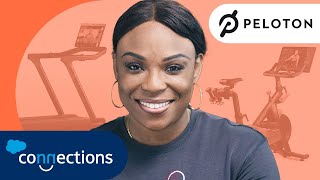
This is a transcript of a Connections (Salesforce) interview between host Sarah Franklin and Dara Tresidder (Peloton CMO). It covers Tresidder's personal background (born/raised in Nigeria, Harvard education, role models like Ursula Burns), her reasons for joining Peloton (member experience, Peloton's anti-racist commitment), and Peloton's positioning as an app, technology and media/content company. Major themes: instructor authenticity and vulnerability as the basis for member trust, the importance of micro-communities (e.g., Peloton moms, vets, Black Girl Magic) in creating belonging, marketing as deepening brand–customer relationships, and a forward-looking interest in "precision marketing." The tone is conversational, inspirational, and brand-enthusiastic.
Chapters
What is marketing? At the end of the day, marketing is about deepening the relationship between a brand and a customer. That's essentially what we are. It's the art and science of doing that. And I think that when there's passion and there's joy, we are. It sort of unlocks creativity.
Hey, I'm Sarah Franklin and welcome to Connections, where we hear from some of the most innovative leaders in marketing. When we started the show, one of the first people I wanted to talk to was Dara Tresidder of Peloton. Peloton has skyrocketed to become the world's largest interactive fitness platform. And Dara has been instrumental in building the brand and driving that growth. And we caught up at Fortune's most powerful women's summit here in Washington, D.C. to talk about it and maybe get a quick workout in too. You grew up in Nigeria and your mother was one of your biggest inspirations. Tell us about that.
When I was growing up, my mom would always tell me, you know, Dara, ambition with contentment. And I didn't know what it meant. You know, I was that kid, that forward kid that always was dreaming big, was always thinking about, you know, how I was gonna make an impact in the world. And I'm so grateful to my mom. My mom encouraged me to be bossy. She encouraged me to own it. She encouraged me to take up space. And I appreciate that so much. But those words she used to say to me, ambition with contentment, it's really become the North Star for my life, for it's about what we accomplish and how I am lifting up my community and how I'm making sure that my ambition is not unchecked and it's not self centered, but it's focused on impact. Those simple three words have made a huge difference in my life and my career.
Speaking of ambition, you came here to the US to go to Harvard, where you graduated with honors and started your career. Take us back to that exciting moment in your life.
Something about the American dream and something about this country was so appealing to me. When I told my mom, I was like, I want to go to university in America. She was like, no way, because if you go, you won't come back. She wasn't wrong about that. So they said to me, well, if you get into Harvard, you can go.
Oh, that was the. That was the deal.
That was the deal. And I worked really hard and that was kind of my goal because I knew if I wanted to go to college in America, I kind of had to get into Harvard. Harvard. I focused on history, specifically African American history. Because one of the things that just was so clear to me when I got there was there was so much I didn't know about what it meant to be black in America. But here I was in my chosen home and I wanted to make sure that I had a deep understanding of the fullness and the richness of the African American experience. So I actually changed my concentration from economics to African American studies. My parents were sort of like, okay, what's going to happen? And I remember actually my then boyfriend, the only good thing he ever did for me was get on a phone call with my parents and say, dara, let her do whatever she wants to do. Like, she's gonna crush whatever she does and she's gonna be fine.
So tell me we don't have enough representation in leadership. When was the first time you saw inspiring leadership that looked like you?
Ursula Burns. I knew her name right when I was a child. And she was the only black woman who was a CEO of a Fortune 500 company. And I was inspired by her. I was like, I wanna beat Ursula Burns. When I grow up to look and say, okay, there are all these companies, why is there only one? Now I know, I think there's three. But that' here we are in 2021 when I'm raising my daughter, there's three. You can't be what you can't see. So seeing that representation, you know, knowing that it is possible, I think was really something that opened my mind.
And what drew you to Peloton then?
Oh, my God. All the things I love. Peloton I can see.
I can see right here.
I knew the value of Peloton as a member. So when I had the opportunity, I was like, to motivate millions of people to be active, centered and connected. Sign me up as a member. I company take a stand and say, hey, we are going to work to become an anti racist company. I like to say 2020 gave all of us 2020 vision. You know, it caused all of us to pause for a minute right as we were all taken away from the hustle and bustle and just look at our country and say, wow, okay, we've come, you know, we've made some progress, but there's a lot that still needs to be done. And I was proud to join a company that just went that step further and said, hey, what can we do within our sphere of influence? We can become anti racist. How do we work to do, to do that? And ob not saying Peloton's perfect. But I'm really proud of the commitment that the company has made to being an anti racist organization. That really spoke to me as a black woman.
A lot of it is creating content that is for the audience, that's empowering them, motivating them. What's it like to create that content, which is putting that audience and putting that trust at the center.
It's about creating content that allows people to escape everything else that's going on and just really enjoy the workout. And I think that's what's so unique about peloton and our world class instructors. They're unscripted, so they're bringing themselves. Like if you take a Cody Rigsby ride, who's on Dancing with the Stars right now, Strength, baby. This is something I'm passionate about, something I do on the daily or you take an Ali love ride, they're different.
This is not just a ride. It is a movement. A movement that is thought provoking, that is a celebration of life, but most importantly, that is spiritually grounded.
The authenticity and the vulnerability that our instructors bring to the bike, the tread, the floor, you know, they bring such a, I think, such a unique vantage point that really allows you as a member to connect with it.
I love Krista McGee and her yoga. Oh, my gosh.
She's talking about her experience of what it's like as a mother.
I would say what I've learned this.
Year is that family is everything.
But I do love because their content, it speaks to you. It's so personal and it builds trust. And I can say that from personal experience. Like, I trust the instructors. How important is that to build that trusted relationship with your community?
Our members deeply trust our instructors, you know, and I think the reason that they do that is because they know our instructors are allowed to be themselves. And that's, I think, a tough thing to do as brand. We're not trying to put our instructors in a box. They're unscripted. And when they can be themselves, our members can connect with them authentically. And that relationship is strong. And guess what? As they connect with the instructors, they're connecting with each other. And they're also connecting with the brand, which I think is just. It's a beautiful trifecta.
I agree. And I love how you have the instructors and you're creating that community. Like, I'm in the, like, moms over 40 community or something like that.
Peloton moms. Go girl. Yeah.
Peloton moms. How important is that sense of community that you're creating with with your customers.
That's a beautiful thing about our communities. Everybody understands that, hey, we belong, and we're in this together. But even within this community, our micro communities, right? Whether it's Peloton moms or, for me, black girl magic, or. My husband's a veteran, a marine corps veteran, and he's part of the Peloton vets group. Having people that you can work out with, you can sweat together, you can bond together with shared interests. It's so nice, right? Because even though you're working out in the comfort of your home, you're not alone.
Do you see Peloton as much more than an app and a piece of equipment? Do you see it as becoming like a media company?
We are an app. We are a technology company. We are a content and media company. Every day, we are broadcasting live content from our Peloton studios in. Whether it's in New York or London. So we are all of those things. And it's that vertical integration are what make it such a. Such a magical experience.
So it seems like you're having fun as doing all the marketing for Peloton.
Oh, my God. I'm having so much fun. It's like, is this even my job? Is this life? Oh, my God. It's amazing.
How important is it to have fun when you're doing marketing?
I think it's critical. I think that you need to enjoy and be passionate about the stories that you're telling, because what is marketing? At the end of the day, marketing is about deepening the relationship between a brand and a customer. That's essentially what we are. It's the art and science of doing that. And I think that when there's passion and there's joy, we are. It sort of unlocks creativity, and that allows us to think about what are new and interesting ways we can establish and deepen that relationship. And so I think that if there isn't really passion or. Or joy, I think it's hard to unlock that creativity.
So we usually do a walk and talk here at Connections, but today, just for you, we have a special surprise in the other room.
Oh, my God. I'm so excited.
Come with us. You're gonna love this. It's gonna be so fun.
I'm like, oh, my goodness.
Look at this.
New palettes on Tread Girl. You shouldn't have. This is amazing.
I love it. We are gonna have fun on these.
These are some beautiful girls. Let's go.
Peloton's just become a household name. What's it been like to grow this community and brand.
I mean, it's been amazing because I think one of the things that we're focused on at peloton is like, how can we improve the well being of the world? And that starts with the well being of every individual. Right. If each of us invests in our physical health and our mental health, then we are better for society. We can give more to society. And so I've been really inspired by our members, actually, and their stories of transformation, how they are making the time to invest in themselves.
You said whether it's B2B or B2C, the goal is to create relationships. Tell us about that approach.
I've been in jobs where I've been the CMO of a B2B company or a B2C company, and at least for now, the robots haven't taken over yet. It's a human you're trying to talk to. And so I think at the end of the day, you always need to be thinking about what's important for your customers and putting your customers at the center of it all. From a marketing standpoint, you don't want to be an interruption. You want to be having a conversation.
Business Insider called you one of the most innovative CMOs in the world. What innovations do you see on the horizon for marketing?
I think what's going to be so interesting is what I like to call precision marketing, which is ensuring that you're delivering the message to your customer when they need it, where they need it, in a way they want to consume it. And I think that innovation, how you bring media and creative together in a way that's much more synergistic, that's what I'm super excited about.
Thanks for tuning in. Never miss an episode by subscribing and turning on your notifications. We'll see you next time. All right, turn these off.