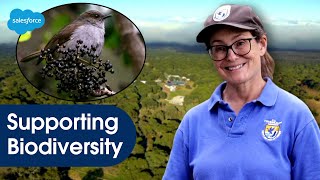
Salesforce and American Forests are helping restore native forests on Mauna Kea in Hawaii, where avian malaria threatens endemic birds. The project has planted over 580,000 trees to create habitat corridors and protect the watershed across 416,000 acres of partnership land.
Chapters
This area that we're in is called the Wa Akua, the realm of the gods. The eastern part of Mauna KEA catches about 388 million gallons of water per day. Our native forest is ideal for catching that water. But a big part of that system is not just about the water. For us, it's about native forest health. You're seeing the apapane and this amakihi, and that includes some of the rarest plants. And we've also got the rarest birds in all of Hawaii. This tree probably in the area of maybe 5 or 600 years old. We are the Mauna Kea Watershed Alliance. We're part of the Hawaii association of Watershed Partnerships. We appreciate you all coming today to volunteer to help plant some trees. There's about 416,000 acres of partnership lands. Let's get everything loaded up. We've got a lot of work to finish today. The main thing that we're doing right now is we are planting native trees for native birds. And there is a sense of urgency. Because of habitat loss and avian disease, the ecology of Mauna Kea has changed drastically in the last 200 years. We've had to deal with the introduction of non native species, both plant and animal. Probably the main threat to native birds is disease carried by mosquitoes. And those mosquitoes are causing a lot of problems through the transmission of avian malaria. So the way we get around that is we are planting native trees to make the Kanaka Leonui bird corridor so the birds can get away from the mosquitoes that are carrying that disease. With climate change, we with avian malaria moving up the mountain in elevation as temperatures increase, it is even more urgent to continue that reforestation effort. Hi, Mama. See you. We've done a lot of reforestation in these areas, so we'll just continue to plant trees. We're very thankful for the support of American Forest and Salesforce for funding the work that we do. Put the Hakalau greenhouse. The greenhouse has been really the heart of getting this restoration work accomplished. Here's the Hakalaf forest sign commemorating the work that was done in the 1990s with American forests. The first big effort, really at the National Wildlife Refuge was an American Forest effort that started that reforestation process. And since that time, it's grown to over 580,000 trees planted. These were planted, I think, maybe something like seven years ago. So we're trying to bring back the functionality and the forest to what its former state would have been. Here we have Akala Sahoyan, Raspberry iliahi sandalwood, also known as awa. I'm just so thankful for all of the work that's done to grow our koa trees, to grow our ohia, to grow our pilo, to grow all of these trees that provide the drinking water that we drink. You know, we're really stewarding a landscape that the future inherits. Hey, dad, what kind of fern is this? Oh, yeah, this one is actually called. We really want to make sure that we're protecting and restoring these resources for our children and our children's children. These are all the things that make us who we are and define who we are as. As Hawaii.