How Salesforce Research Is Using AI to Generate Proteins | Blazing Trails | Salesforce
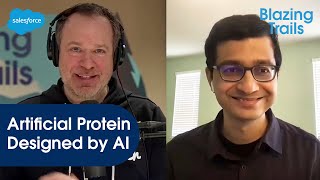
Nikhil Naik, director of AI research at Salesforce, discusses Progen, a generative AI system trained on protein sequences to design novel proteins. Early tests synthesized about 100 generated proteins in the lab, with many functioning despite being 60-70% different from anything found in nature. Salesforce open-sourced the project to accelerate drug discovery and enzyme development.
Questions this video answers
February 15, 2023.
About three years before the interview ("started a project in our team about three years ago").
Tierra Biosciences (synthesis/printer) and UCSF (laboratory validation).
About 100 proteins.
Designs were reported as up to ~60–70% dissimilar to anything seen in nature.
Chapters
Welcome to Blazing Trails. I'm Michael Revo. Today we're talking about something a little unexpected from Salesforce. I bet you didn't know that Salesforce has a research team that's being recognized for successfully creating an AI program that could build a protein to treat diseases like multiple sclerosis and arthritis. Through a partnership between Salesforce and ucsf, we took the code off the screen and brought it to the lab bench to prove that an AI program could, in fact, build a protein, something that hasn't been done before. So let's go behind the scenes with the lead researcher from Salesforce Research, Nikhil Naik, to learn about this transformative discovery and the impact that will have in the medical world, as well as how AI research is being applied across industries. Welcome, Nikhil.
Hi, Michael. It's great to be here.
Well, this is really exciting, and as I said, it's a little unexpected from Salesforce. We don't really hear about Salesforce research that much. In fact, I'm kind of learning about it with everybody else. So can we get started and maybe give me a little overview of the Salesforce research team? What you do, what the mission is. Tell me about it.
Sure. Salesforce Research is the main AI research lab of Salesforce. So we are a group of researchers mostly with PhDs in machine learning and AI, and our team's focus is to do both basic and applied research in artificial intelligence. And so we cover a lot of areas of artificial intelligence, including natural language processing, computer vision, reinforcement learning. And we also apply these research areas both for applications at CRM and also for applications for broader society. So part of our goal of doing AI research is also to apply AI for problems which can have an impact on society. And as part of that goal, we have worked on a variety of projects using AI. Some examples include AI Economist. In AI Economist, we are applying AI to developing better economic policy, which hopefully can help society build a more equitable and a better society. We are also applying computer vision AI to the problem of counting and tracking sharks in the Pacific Ocean. And this is helping us understand climate change and also the behavior of sharks. In fact, we have also done research in medical AI, where we have worked with universities to develop an AI that can help tell breast cancer patients an optimal path to treatment. Of course, we have worked on AI for protein design, which I think I'll go into more detail later in the podcast.
Yeah, absolutely. I mean, but just backing up a little bit. AI is having such a moment right now with ChatGPT and sort of entering everybody's consciousness thinking about this new sort of generative AI. I think in the past, people have thought about it much more in a pure machine learning kind of context, where it's not coming up with something new, it's how can we do a further analysis? But this new generative AI is really revolutionary. And I'm curious how we think about that at Salesforce with the sort of ethical concerns and with this, what this is opening up right now. And when you talk about AI for Society as part of the mission of Salesforce Research, tell me a little bit more about that framework and how you think about that.
Sure, those are excellent questions. So, as you rightly said, generative AI is really having a moment right now, and it's really amazing what we can create using AI and the types of data we can generate in all different kinds of domains. And as you say, applying this technology in a very ethical manner is extremely important. And at Salesforce Research, we work with our Ethical AI Council and Office of Ethics under Paula Goldman to make sure that all the AI that we build and deploy, both at Salesforce and outside, undergoes ethical reviews, and that we make sure that we are following guidelines that help us deploy AI in a careful manner. And so in our team, we have a program where almost every research is involved, where we are always thinking about how we can apply the AI we are developing for applications for society. And we essentially try to identify AI techniques that we are very good at that we can apply, typically in collaboration with universities or nonprofits, and where we can identify problems where the AI could be applied for an application, where we can have direct impact on society. And so that's kind of our broader goal under the AI for Society program. And we have been working on various projects under this umbrella in the past four to five years.
Well, I see how that opens up so many opportunities to use the technology that we're building here at Salesforce. So let's get into this latest research, which is really exciting at Salesforce. It's Progen. And again, this is a little outside of my, my area, so I'll try to ask good questions about this. But tell me a little bit about how Progen came about and, and what the project's all about.
Right. So Progen, or AI for Protein Design, was started a project in our team about three years ago. And the goal was that to apply generative AI and especially large language models, the problem of protein design. The project started because we realized that the powerful language modeling technology that we were developing at Salesforce Research can be directly applicable to problem of designing novel proteins. And if you are able to do so, it could open up a lot of applications for protein design in medicine and for applications of sustainability and others. That's how the project really came about, where we decided to explore the use of large language models for designing proteins. And we started working with academic collaborators to actually prove that technology works.
I mean, so tell me a little bit about developing this generative AI using these language models. Again, how are you approaching that from a perspective of, okay, we're trying to create a protein. Walk me through what that process is like. How does that work?
Sure. So maybe to give the audience a bit of understanding of how large language models work. Large language models are these AI algorithms that can generate language. And very simply speaking, the way they work is that they ingest a large amount of text and they learn to predict the next word that might come after a given word. And just by training, using this pretty simple method, you can train an AI algorithm to generate very realistic language about any topic that you might be interested in. And what we realize is that the same technology can be applied to generating proteins. So proteins are biological molecules, and the way proteins are represented in biology are using an Alphabet of amino acids. So there are 20 plus amino acids that constitute any protein. And just the way the Alphabet of English used to represent any English word, any protein can be represented using these amino acids. And so the same way you can train a large language model to predict the next word and to generate sentences in English, you can train a large language model using lots and lots of protein sequences to be then able to generate novel proteins. And that was kind of at very high level, the. The inspiration and the method behind creating language models for proteins.
And, I mean, it seems like this is working pretty well in relatively closed sets of information. Like you're saying with these amino acids, where, okay, you know, within these boundaries, we can create new sequences. How do you see this growing as it gets more and more sophisticated and the ability for these systems to be able to take on larger sets of information and come up with more novel ideas.
Right. So what's really cool about the way proteins are represented with amino acids is that any protein is essentially made up of amino acids. So. So everything from a simple protein that's an enzyme that can kill some bacteria to a very complex protein or chains of proteins that can help you cure cancer, they all can be represented using amino acids. So where we see this research growing is by exposing the models to those kinds of data of, say, drugs or of industrial enzymes. That can be useful for say, degrading plastic. You can now create new designs of proteins for these problems. And these proteins hopefully can be as effective or more effective than what we can design manually as scientists. And hopefully the AI can also work together with scientists to kind of coordinate co create novel proteins. And this process can be much more faster and efficient than kind of the manual design process which happens right now. And as a result, we can accelerate the discovery of novel drugs and useful industrial chemicals.
And is this process how people are going about this right now? Are you seeing a revolution in the space of basically everybody's using this AI technology and these models to start to build all kinds of new things? I'd love to hear about what are some of the problems people are trying to tackle, and particularly with Progen. But even just generally out there, what's happening as we start to accelerate this type of work?
Right. So specifically in the field of protein design, this is just the beginning for the use of AI. Both university researchers and industry research groups are just starting to use AI to understand if it can help in the process of drug discovery, for example. So our work was one of the very first in the world to show the promise of AI for designing useful proteins. And since then there have been other researchers who have built on our work to show its applications in a variety of domains. And I think in the near future we are going to see an explosion of research and commercial activity in this space to use AI to accelerate these processes like drug discovery. So I think we are just at the beginning of this revolution, so to speak.
Yeah, it's super exciting. So tell me a little bit about. And this seems to be what's happening in AI generally right now is taking it from the theoretical and making it real. Now you can say to ChatGPT, you know, write me a wedding speech or whatever it is you need to do. And people are starting to take more advantage. This is trickling down now to everyday folks being able to use the technology. It's a little different in moving this from the theoretical work you're doing to actually developing proteins with ucsf. But tell me a little bit about the partnership and how that worked and how we making this real.
Right. So when we first developed this AI model in house at Salesforce, we could use the model to generate new protein sequences. You know, in a computer you could just see a string of letters come out of the model. But really the important question there is that is this real? Right? If you actually went and created this protein in a test tube, would this work. And that's really the gold standard test for technology like this. In a natural language model, you can just read an English sentence and say, yeah, this makes sense, it's sensible. But for a protein language model, no one can just look at a string of letters and tell you if this protein will work. So that's why we started this partnership both with UCSF and with a biotech startup called Tierra Biosciences. So you can think of Tira as a printer for proteins. You can send them a string of proteins and they can synthesize it, creating a test tube and test it. So first we worked with Tierra to test about 100 proteins generated by Salesforce. And that process itself took a few months. But what that showed us is that there was promise in our technology that it seemed like most of the protein sequences that we generated were working now. So it was time to then actually do a much deeper dive into these proteins and carefully test them in a test tube. And that's when our collaboration with UCSF came in.
And these are, these are new proteins, these are biological proteins that have not existed before that were created through this process, is that right?
That is correct. Scientists maintain really large online databases of all the proteins seen in nature. So when we create a protein, we are able to compare this protein against this large database and evaluate how similar is it to anything seen in the nature in the past. What we're able to show is that we can design proteins that are even 60, 70% dissimilar to anything ever seen in nature, but that still is functioning protein. And that was very, that was an important scientific milestone.
And how do you think about the distribution of it? I know, you know, there's a sort of an open source history, you know, of, of using tools like this to, to be open for folks to be able to do that. And it really increases development, creates community, all the thing that happens there. How do we think about who can access these tools both from a Salesforce perspective and then generally industry wide? How are we thinking about this right now?
Right. So Salesforce research is typically, you know, typically open source is an easiest technology that it develops in house. And our goals are just as you said, to allow for transparency, to enable other people to build on our work, to also for them to understand our work better. And we feel that's really useful and important part of research because I think any technology can be replicated and reused if there's interest in technology. So hiding it can only kind of keep it under the lock only for some time. But if it's open, it's out there, it actually enables us to understand it better because more people can use it, more people can interact with it and that actually helps us probably create better safeguards around it. I think it's definitely a question of debate around as AI becomes more and more powerful, if some AI should be more closed versus open and so on. And I think it's an important discussion to have. But at this point it seems that having open technology is beneficial to advanced fields.
Yeah, I think as I've been thinking about it more, it's a tool just like many of the tools that have been developed. If you go back to mainframe computers, all the way up through mobile, et cetera, these tools continue to get faster and smarter, et cetera. But it's still the ideas behind it and the human ingenuity of how you're going to use it that's really going to have a big impact. And yeah, so I'm curious, you're in this space, you're creating and working with these AI models. Models. How much Are you using any AI tools as part of your work right now? Are you co creating with AI?
Yes. So I have been using AI tools like the GitHub Copilot to write code. I use the language modeling tools, ChatGPT to help write better and I've been enjoying working in the that working with them and I feel like they have made me more productive in my own work as well.
What are the outcomes from Progen? What are you seeing? What kind of diseases is this going to help? Where is it going?
So we have two goals for Progen. So one is to obviously make this technology available to other researchers. So we have open sourced and released the code and technology behind it and a lot of people are building on it to do their own research into a variety of applications and I think concretely speaking, it can help develop protein based drugs. So really it's a tool that can help you accelerate drug discovery in a variety of domains where protein based drugs will be useful.
Wonderful. Okay, well this is super exciting research and I learned a lot today that I didn't know about Salesforce Research. So Nikhil, thank you so much for joining us.
Thanks for having me, Michael. I enjoyed our conversation as well.
That was Nikhil Knight, director of AI research at Salesforce. And for more information about Salesforce Research, head over to salesforceai research.com so you like this episode? Be sure to subscribe to Blazing Trails wherever you get your your podcast or on the Salesforce YouTube channel. Blazing trails is a production of Salesforce Studios, produced by Courtney Eltinge, edited by Cynthia Chavez, with original music from Andrew Duncan. I'm Michael Revo. Thanks for being with us. See you next time.









