How Siemens Is Innovating To Find New Ways Of Working | Leading Through Change | Salesforce
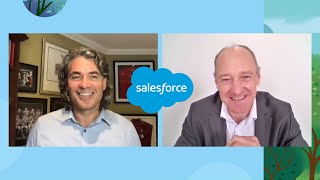
This is a transcript of a Salesforce "Leading Through Change" live conversation (published Sept 10, 2020) featuring Gavin Patterson interviewing Roland Bush, incoming CEO of Siemens, about leading with values (collaboration, openness, empowerment), managing COVID-19 impacts, accelerating digital/automation use, reskilling, and a Siemens–Salesforce partnership to deliver a Safe Workplace solution. The demo portion walks through employee and facilities workflows (wellness checks, scheduling, desk reservations, command center actions) and describes a planned rollout for Siemens and customers.
Questions this video answers
~380,000 employees.
€85 billion in revenue (stated as '85 billion').
October 1 (referred to as 'the 1st of October').
Rolling out on 600 locations covering 440,000 people.
$500 million (described as 'we are spending 500 million to train and educate our own people').
Chapters
Two, three.
If you know Salesforce, you know we love to celebrate our trailblazers here. Our guest today might be the original Trailblazer. Way back in the 19th century, Siemens invented a new telegraph. It was like the Internet of its time. And since then they've never stopped innovating and re innovating. Now Siemens has over, get this, 380,000 employees and 85 billion in revenue. And now amidst a global pandemic and a recession, they are still looking for new ways to work to drive future success. Now, there's a lot we can learn from this ot original trailblazer. Good morning, I'm Leah McGowan Hare and welcome to another one of our live conversations as part of our Leading through Change series, a chance for you to hear from leaders around the world on how they're navigating these challenging times and supporting their communities. Now before I hand it over to today's amazing host, Salesforce President and Chief Chief Revenue Officer Gavin Patterson. I wanna preview the next hour. Gavin will be interviewing incoming Siemens CEO Ronald Bush. Roland Bush, excuse me. On how he's leading his company by focusing on empowerment and trust, finding new ways of working and fostering a culture of innovation. Now we'll then dive into a live demo highlighting how Siemens and Work.com are providing tools to help companies usher in their future of work and the future of workplaces. After that, we will close with a special performance from Andra Day. So for those of you watching on Twitter, you're going to want to join us on Salesforce Live because you don't want to miss that. Now as we do every week on Leading through change, we we wanna help those who need it the most. Millions of people already rely on United Nations World Food Program for food they need to survive. And let's be real, COVID 19 is making these conditions even worse. The pandemic can double the number of people suffering from severe hunger by the end of this year. Now to prevent a hunger pandemic, the World Food Program is scaling up to reach 138 million people across 83 countries with life saving support. Now if you can please go to salesforce.com wfp and join us in ensuring that the world's most vulnerable people are supported. Now Salesforce will be matching donations up to $150,000 through September 30th. Again, that's salesforce.com WFP with that, it is my pleasure to welcome our host for today, Gavin.
Thank you so much, Leah. And thank you all for joining us today. So those of you who haven't watched leading through change before. Let me tell you what it's all about. First of all, it's about how we can learn from each other and learn from the best practitioners across businesses and organizations around the world. And it's about specifically how they're leading through challenging times. Now, the best leaders don't just lead through these times. They adapt, they innovate and they find new ways not only to survive, but to thrive in situations like this. Our guest today leads a company that for decades has never stopped innovating and reinventing. And even now, in the midst of the pandemic, they're still finding new ways to innovate and be successful. So please welcome today deputy Siemens CEO who will take over as CEO next month, Roland Bush. Welcome, Roland, thank you so much for joining us today.
Hi Gavin. And welcome from my side.
How are you?
Great, great.
Difficult times, but challenging and interesting, I think.
Yeah, I think nobody expected this kind of impact from a little virus which we all experience over the last six months or more. And I have to say, as you normally say, critical times are times where you have to, on the one side solve problems, but you see opportunities too. And I guess that's what we are looking for.
That's very good. I want to start and talk about values. Salesforce and Siemens share a commitment to leading with values and being values led businesses. So as you start as CEO, I'm intrigued to understand what your personal values are and how you're using those and applying those as you take over the reins as CEO at Siemens on October.
The one, the three values which I really put into focus are collaboration, openness and empowerment. And I give you an idea what's behind it. Collaboration is for me important in a world which is more and more built out of partnership and ecosystems. We recognize that there are so many new technologies which are coming to the market where you cannot really invest in all of them on your own. You really have to rely on strong partners. And in this ecosystem, I would also count customers as partners and counter our ecosystem. And we will later on, I guess also talk about our application, which Salesforce and Siemens jointly brings to the market, which is another example. So collaboration is important. Openness is a very important element, in particular for a company like Siemens. We are here since more than 170 years and we innovate all the time. However, if you're not open for a fast changing world, digitalization is changing so fast, so the cycle time is shortening. So if you're not open, if you're not Ready to learn and relearn, then you really have a danger to lose track. So be open for new solutions is one thing. And here comes the most powerful one, which is empowerment. My experience is that if you have the right people, if you tell them what you want, give them the strategy, the background, and then empower them, give them trust and let them do their job. This is the most powerful element. You will see the teams, they are excelling and really contributing to more than 100% what they normally can do. It is sometimes very tough for managers because you have to take your hands off and let people do. But at the end of the day, for me, this is the most powerful element which you can have as a leader.
I want to move on and talk about the pandemic, the global pandemic we face today. It's not the only crisis, indeed, that we're facing at the moment. I'm sure everybody watching today would be really interested in understanding how Siemens are approaching managing through this, these difficult times.
Yeah, so it called all of us literally by surprise. And as Leah said Before, we have 380,000 employees all around the world. We are sitting in 200 countries in the world. So this is a challenge on its own to manage what we did. Of course, we created a corporate crisis team where we are coming together with the regions, the core functions, where we meet sometimes on every second day, every other day later on, a little bit less frequent. And the key element in this was that we knew from the very beginning, you cannot manage that centrally. You can give guidance, maybe we can organize masks and distribute them because we have a central purchasing department. But at the end of the day, we gave guidance to our regions and then again, we empowered them and took our hands off. And here is something what I really learned. We have such a strong regional organization with a strong regional management, and they really did a great job in terms of, number one, is looking that our people are safe and healthy, secondly, to really keep the support for our customers even in difficult times. So we kept up having our deliveries and also deploying new technologies, automation technologies, so virtual commissioning, for example. We still kept our things running and the critical infrastructure running. And so this way of working in a huge environment have empowered people and they did an excellent job, is for me, astonishing and a great learning at the same time.
Many industries are using the impact of COVID to change, and many are changing for good. So as you work with your customers and you look at the industries that Siemens operates in, what impact is it having and how does it differ by Industry and what does it mean in terms of digital transformation? Where is it accelerating and where is it decelerating?
I think I can go on for an hour to answer your question. I tried to make it short. So it's a mixed bag. I mean talk about aerospace and automotive. I mean this industry really got a real hard stop even. I mean the declines are not comparable to any other crisis before. So this was really tough. On the other side, if you have the other industries like food and beverage, critical infrastructure, I mean we are running grids, we are running trains and whatever. So they are. They were still up and running. So at the same time we really have to. And food and beverages are market which are still on and growing logistics market. So therefore it's a really mixed bag. Therefore we had to gear our resources accordingly, number one. Number two is we experienced that our technologies. I talked about virtual commissioning. We have customers who came to us in order to really get a release on the products. Now we do it virtually. We have buildings where we have people in the site and they operate remotely, our building automation system. So we saw that technology can really make a difference. This is actually what we are looking into now that we say what can we do on top in really giving our technologies, digital technologies, automation technologies to our customer in order to improve the way how they work? Last point. We also recognize that the supply chain is really not really resilient. So therefore in some cases OEM customers, automotive customers, they bought stuff from one region and one supplier. And if the supplier doesn't supply, they can even not ramp up their manufacturing line anymore. So we found out that we now have also a kind of a reshoring and redistribution of value added which requires low lot size manufacturing with low cost. Again, technology comes into play and this is something where we hopefully can take advantage and also support our customers in really reshaping the value added how they see it today and really bring it to the next higher resilience level because you cannot predict whether Covid 20 comes again or a second wave. So we have to be prepared.
Absolutely. I want to move on and talk a little bit more about the partnership we announced back in June. I think it was. It feels like a lifetime moves so quickly in this new world, this new paradigm. I guess. So it was a partnership around work, helping people come back to work safely, but also thinking about what the future of work looks like. So can you tell us a little bit more about the partnership and why from your perspective, it was important to come together?
Yeah. So what I'm talking about now is also triggered by our own need because we figured out during the crisis there's also some positive in it if you don't have people coming to work and working virtually works quite nice in many many cases. Still we have to have this personal touch. So we decided for Siemens during the crisis, but also thereafter to have two to three days of people in work or off in the mobile work. But that gives a particular challenge to the way how you number one bring people back during crisis but also how you manage it later. So and we know that Salesforce with Workplace.com has a technology which is used now also to see how you can get people back at work and support it. Siemens we bought two companies, startups and lighttips. They provide sensors so you know exactly what's happening in a building. And Comfy, which is an application which manage the building space. But these different functionalities which workforce workplaces, workplace.com is providing and Comfy and Light. Our Siemens solution combined makes really an outstanding solution for customers to number one bring people back at work with all the information they need making a scheduling. And the scheduling really respects social distancing. Actually the application which we, which we provide is normally doing exactly the reverse. They're trying to increase space productivity. Now we just reverse it. But it's brilliant to do that. And you have also the way how that you're sending for example cleaning stuff if an office was used and you really put it to the spot. So the whole way how you change the way of work, how you basically also distribute people can be managed with applications. And the joining the forces between Salesforce and Siemens is really the ideal product to do that. We are starting rolling that out on 600 locations for 440,000 people. And I know that Salesforce is deploying it too. And I hope that we find a lot of customers who can take advantage out of this Great solution.
Yeah, me too. The next thing I wanted to talk about is I think how you're beginning, you know, get your thoughts on how you're beginning to talk about the future of work. And I think you've described it as the new normal. And one of the things that sort of struck me is it seems have been really progressive and early out of the blocks at thinking about what that might look like. So the new normal I understand is employees get the chance to choose two to three days a week that they will work remotely. And that's built into the new way of working. So this sort of work from anywhere revolution, if you like your thinking is clearly more developed than many companies. And we'd love to hear more about how you've been thinking about that and where you think the opportunities and challenges.
So it started when I, when I on my own was working from home and I recognized well, there are good elements in it. I mean, for example, also talking to customers, I could talk to customers with a much, much higher frequency because it was very simple to connect with for half an hour virtual meeting. And so I said, I mean if you want to preserve this good element in it, we really have to do something now. Because if Covid is over and my prediction was within three or four months, we are back in the good old days and work the same way. So as we were studying it, we were asking 8,000 people in our organization how they would like to work in the future. And most of them said we want to preserve part of it. However, we need the human touch too. So it's not about either or, it's a blend. So this brought us back to the point that we say two to three days home or mobile work and two to three days in the office would be the right blend, number one. Number two is we also said it is voluntarily so you cannot force people. Number three is it is locally different, different countries have different regulations, so you have to respect this too. So again, you have to empower organization and execute locally. But at the end of the day, the real motivation is we do believe that people can be more productive if they choose the place where they can work. You have to again blend it so that you still have this high touch element of work where you bring people together but plan it really so they can take advantage out of that time. And there's a third element in it which is maybe the most powerful one is we believe that future management should really lead outcome oriented and not how much time do you spend in the office. This is meaningless. So it requires also change in the management down to the lowest level where people are managing teams to really think about how is the future of work also in terms of output oriented measurement of your team and the freedom to choose the right place so you can be as productive as you can be. We believe also this provides more attractive jobs in the future and so we get the better talents.
And I have one last question. The pandemic in many ways has exacerbated existing inequalities that have existed within society and within, within the workforce. One of the things that Siemens I think are right at the forefront of in relation to addressing that is reskilling and giving people new skills so they can move through life and continue to work as the needs of companies and society in general change. Can you tell us more about how you are approaching that? Because in many ways it's more important now than it's ever been.
Yeah, if you ask me. And this goes back to our social engagement program at Siemens, which was part of our sustainability program I'm responsible for. And it was a couple of years ago where I thought, well, I'm not sure whether. And we spent money here and there. I was not sure whether this is the right way to do. And so what I did is I was writing an email to our 100 country managers and asked them, what is it? What would you do? What would you spend money on in your local society in order to really get contribution? And it was amazing. It was really a lot of feedback, different feedback as you can imagine. But there was one common denominator, regardless whether this is what a feedback from our CEO from the United States, from India, Pakistan or China. And it was about education, training, education of people. This is the common denominator, what money can do most and best in order to really help societies. And this is the time when we said we have to gear more for that. Not only that we are spending 500 million to train and educate our own people, our own employees, but also how we can support our local societies. We're working in giving back and we believe that training, education is a good one. On top of that we have this vocational training. It's a 100 year old history in Germany, how we really can combine the work and the training on the shop also for workers and alike. And this is something which we really can also transforming this kind of method to other countries. So it's a multi layer project. We bring the expertise and of course we train on our technologies too. This is where we are good at. So we believe this is a huge impact which you can make. It is not only for our company and our employees, but also for their societies and we can give back and that helps also hopefully people standing up from the lower classes and having a better life because once you are more educated, you have a chance to get a good job.
Well, that's all we have time for today. Roland, thank you so much. That was absolutely fascinating and best of luck for the 1st of October. It sounds as though you've got a very exciting vision for the company and I for one are looking forward to Salesforce playing a small role in helping you achieve that. So with that, thank you very much Roland. And back to you, Leah.
Thank you. Thanks Leah.
Thank you so much Roland. Thank you Gavin. I love the conversation. What really resonated with me too was being outcome oriented from a management standpoint. Measuring. Measuring how the team gets there, letting them get there on their own. But outcome oriented really like that. Now I'm excited to hand it off to my colleague Julie for a demo on how Siemens and Work.com are providing tools to help customers companies usher in future of work and the future of workplaces. Take it away Julie.
Thanks Leah. As we just heard from Gavin and Roland, we're all having to find new ways to work and that's especially true when it comes to our physical office spaces. That's why Siemens and Salesforce are teaming up together to create the Safe Workplace Solution, a set of capabilities that help companies and employees to prioritize health and productivity in the office. So let's dive into a demo and see how one company is using this solution to help their employees return to their reopened offices. Let's follow the journey of David from Pacifica Technologies. Now David has some offices reopening in his area and there's a whole new procedure for how he's actually going to re enter the office, keeping his and his coworkers health top of mind to get him familiar with the new safety and health procedures now in place. Pacifica Technology sends David custom built learning content on my trailhead so he can better understand his new office environment and and make sure he's taking the proper precautions before coming into work. These trails are easy for Pacifica Technologies to create and launch fast thanks to my trailhead content kits where Salesforce has curated relevant content that admins can use as a starting point to customize and publish. With just a few clicks, David is finishing up the last module in this trail, learning all about how business as usual has changed. He takes the quiz, earns his new badge and can take the next step towards returning to the office. For David, this means taking a wellness Check survey. Pacifica Technology is using these surveys to ensure their employees are healthy and well enough to return to work. This survey is modeled from CDC guidelines to make sure they are capturing the appropriate information to understand if an employee is well enough to return to work while respecting employee privacy. Once David submits the survey, the information gets updated in the command center where the operations leads can confirm qualifications. And when he's cleared to return to the office, he receives a notification from the Salesforce mobile app prompting him to choose what days he can come into the office. He can see the available shifts and simply tap to identify the days he's available to work during this week. Given that he's still caring for children at home due to school closures, David selects the days that work for him and when he submits. The shift management Optimization and scheduling engine works in the background, using his availability and matching it to the available time slots for shifts. And with his shifts scheduled, David can also use Comfy to preserve a desk in his office ahead of time. Certain desks are blocked off to maintain social distancing, but David can still find a spot for the day near his teammates and select it right from the app. The desks and shifts available are all based on input from all of the employees and by matching their role and function to ensure proper coverage and that critical projects are prioritized. This has been a seamless and simple experience for David and for all of the Pacifica Technologies employees who are getting ready to come back to the office Now. Let's look at this experience from the perspective of a facilities manager at Pacifica Tech. In front of her, Andrea has the workplace command center. This is her single place where she can see data from all across the organization like open shifts, facility occupancy, employee wellness check status, and the latest from public health organizations. And she can use all of it to make informed decisions about how best to keep the offices humming while keeping health and safety top of mind. And Andrea just got notified that the local government has updated their COVID 19 guidelines regarding office spaces due to a spike in cases. They're lowering the office capacity starting tomorrow and they recommend companies clean their most highly trafficked areas. Andrea can immediately take action to abide by these regulations right from the command center. First, she can see real time anonymized location data based on occupancy from enlightened sensors as well as room usage and desk reservations from comfy. To get a better understanding of where employees have been in the office. She identifies key areas that should be cleaned per the regulation, like certain conference rooms, kitchen areas and hallways, and she dispatches crews to clean those areas at times when occupancy is the lowest so as not to disrupt the usual flow of the office. Then what does she do next? She checks out the shift management console and looks at the shift scheduled for next week and sees that they're over the new capacity guidelines. She can ensure the office is in compliance with the new guidelines by using the reschedule shifts action. This cancels excess shifts based on the roles that support remote work and issues alerts to those affected with an explanation about why they can no longer come into the office. Those employees can also be invited to schedule a shift later in the week. This is how work.com and Siemens are coming together to to embrace the future of work by helping companies to orchestrate the people, process and things that create the future proof workplace safe, efficient and productive. Now back to you Leah.
Thank you so much Julie. That was amazing. Now I know you all are intrigued too and you want to get hands on. Head on over to Trailhead and check out this trail. You can get it at SF S F O R C E Co backtobusiness.









