How Takeda Uses Agentic AI to Transform Customer Engagement and Help Improve Patient Outcomes
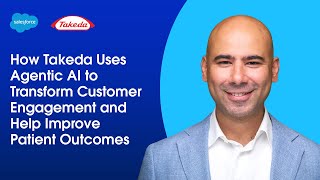
Jeff Amen from Salesforce talks with Samir Insari, head of commercial innovation at Takeda Pharmaceuticals, about how the company uses agentic AI to improve customer engagement and patient outcomes. They cover Takeda's digital transformation, AI's role in research and development, and how AI integrates into commercial strategy.
Questions this video answers
About 244 years.
About $30 billion annually.
>50,000 people in more than 80 countries.
Oncology; gastrointestinal (GI); neuroscience; plasma-derived therapies; vaccines; and some rare diseases.
More than 7,000 patients registered.
Chapters
I'm sure when Takeda was founded, nobody could have ever imagined that there was a data digital and technology team at Takeda. Hello, I'm Jeff Amen from Salesforce. And today we're going to be discussing the role of AI agents in the life sciences industry with a focus on how these agents can deliver better commercial engagement. And I'm joined now by Samir Insari, head of commercial innovation and external experience at Takeda Pharmaceuticals, one of the most important pharmaceutical companies in the world world. Sameer, you're an awesome guy. Thank you so much for being here today.
Thank you for having me.
It's a privilege. So, Samir, maybe we can get started by helping our viewers understand a little bit more about Takeda and especially how you're demonstrating thought leadership in the industry in terms of improving efficiency in go to market models.
Of course. Well, Takeda, you know, our purpose is really to create better health for people. And we've been around for more than 244 years and it's really valued and create sustained outcomes for patients and for society. The revenue that we have is about 30 billion annually. We have more than 50,000 people and we're in more than 80 countries around the world. And the therapeutic areas that we operate in is oncology, GI neuroscience, plasma derived therapies, vaccines, and also some rare diseases that are very near and dear to us. And what you'll see is that it's a company that is very diverse in terms of its footprint, its therapeutic areas and also we're very anchored around the values and creating those outcomes for our patients and for the communities around the world. Data digital technology is a function that really is at the center of this AI transformation at Takeda. And what we're doing is we're really looking at the value chain starting all the way from research development, commercialization, medical components, the market access aspects, and then really manufacturing and then having the quality rigor around our processes as well. So AI is embedded in the whole value chain of the company. It's not one use case or one win. It's the entire value chain on how the company operates. And data digital technology is really the enabling factor that is bringing that transformation. Working with the business hand in hand to make that sustained outcome for patients and stakeholders.
Wow, Sameer. 244 years, that's incredible. I'm sure when Takeda was founded nobody could have ever imagined that there was a data digital and technology team at Takeda. And so, but here it is. And so maybe you can give us a little bit more of a sense of what DD and T is doing and of course maybe a few examples of how it's having significant enterprise wide impact on, especially in research and development.
When it comes to R and D. Really, you know, bringing that transformative medicine again to patients and doing it fast is critical because there's such a high unmet need out there. And what we picked as a priority last year from a DDT perspective, which is data digital and technology perspective, is how do we accelerate the enrollment of patients in clinical trials. And we introduced this platform called WEConnect, which is really a patient registry website. And what we've seen is a staggering result where more than 7,000 patients have already registered on the site. And also we've had more than a million visitors, which is far exceeding the goal that we had. So connecting the patients with the right trials so the patients have the awareness of what sort of trials are happening, where is fundamental. And it really helps us enrolling the patients quicker so we can bring the medicine to our patients faster.
Sameer, that's a lot of innovation and obviously we're now living in an agentic world. And so I'm really curious, I know that you're embracing AI for commercial engagement and I'd love to know more about how you're approaching this topic and how you're helping to meet the needs of your customers. And of course you're full of great examples, so if you can share any in this regard, it'd be great.
Well, of course, you know, with AI and agentic now taking mainstream attention in all the industries, of course life sciences and pharma is also looking in itself and transforming and improving this. This is truly an inflection point where we have to look at our capabilities across the board, across the value chain and reinvent and transform. That's what Takeda is also doing. And I think what's very evident is that the human experience expectation has exceeded, has elevated and our customers are also humans, just like you and me. And the experience across the day to day, life through apps, through other experiences is just so much more simplified. And I don't think pharma has an excuse or life science is an excuse not to offer that sort of an experience, human centered experience anymore, despite us being a heavily regulated industry. And that's where I think, you know, really blurring the line between how we operate within this industry with the other industries, but still being focused to our patient needs, tailored to our local needs, and meeting all the regulatory compliance and ethical requirements that we have from a responsibility perspective, One thing I would focus on is the framework of decision making that we have within Takeda Pharmaceuticals. We're centered around patient trust, reputation, and then business, in that order. So let me explain that for a second, right, which is, you know, we look, everything that we do, we look at it from a perspective. What does this mean from a patient perspective? What does this mean from a trust in society perspective? Is this going to accelerate trust in society? And is this really benefiting the trust of the reputation of Takeda? And then also is this making us sustainable as a business so then we can deliver the outcomes for our patients and our customers? So I think in that order, that framework really helps us ground everything we do. And agentic and AI is no exception. It is grounded in that value framework for us as well. From an example perspective, I think what we're seeing already the results of AI because we're not starting the journey now. We've been doing this for a while, but particularly in commercial engagement, we're seeing that the interactions are truly going up. And even in markets like Europe, it's upwards of 30%. Even in a market like us, it's more than 10% increase in engagement rates that we see by applying innovative methodologies of AI and agentic across channels to bring that customer centric experience to our customers.
So, Samir, you talked about one of my favorite things, which is trust. It's one of the most important elements of business and frankly the world. And when you're implementing advanced technologies, there's always a lot of challenges in trying to balance the advancement with trust, especially the things that drive trust, like good governance, good change management, and ensuring continuity of operations within the organization. I know you've learned a lot on this journey. Can you share some of those learnings with our audience, especially those who might be trying to embark on a similar journey?
What we're seeing is that you need to have clarity around framework. So I think there's five things that I just mentioned here are, you know, to me, even in that order, that are important to have very clear and fundamentally deployed as part of this transformation. Number one, you gotta know your customer or your patient, whoever your audience is, you gotta know your audience and focused on their needs, how they would like to be engaged through with channels, but also a series of processes that really enable that experience for your audience. So that's number one, a lot of people just go with digital transformation or AI without understanding the business or their customers. So first is that. Second, I would ground it on change management. We have about 50,000 people in the company, which is a massive organization, there's lots of buzzwords, there's a lot complex language that we have as well, and there's lots of initiatives, but you really have very, you got to have clear, simple initiatives tied to metrics that are easy to understand, clear enough to measure, and people can relate to what's in it for me and what's in it for patients and customers. I think that clarity in change management embedded in their workflows and processes is so fundamentally critical. Technology is the easy part. It's really creating that adaption, that awareness and that buy in, that sense of skin in game sort of sentiment is so important to really get that teams around the world across all organizations moving in the same directions with this change of AI. The third thing I'll mention is it's not a buzzword that gets a lot of excitement going, but it is necessary and that's around governance because of the volume of investment going in AI, you gotta make sure that it's focused on the right areas across the value chain for the right outcomes with the right guardrails around ethics compliance and the legal framework to make sure that we really are grounding this in the values and we're doing it with the how in mind, not just the what. Then I'd just focus on impact measures. You gotta, you gotta know how you measure success and then also do it continuously in a very clear way and communicate the impact measurement that's important. And then linked to that is agile mindset. Right? You gotta have an agile mindset that you're looking at the data, you're looking at the impact measures, what's working, what's not working, where's the adoption, what's the feedback from your employees and then continuously change as your employees as part of change management, as your customers and patients as your audience list. Take all that data, that feedback, be very agile, be bold to move and pivot along the way that truly creates the impact overall that we would like looking ahead.
I'm curious what role you see AI and agents playing in shaping the future of commercial engagement over the next, say three to five years.
I think this is where, you know, it goes back to what are we trying to do? I think, you know, there's always been this conversation about, you know, keeping human in the loop and AI as an augmentation to what the workflows are, the processes are. I think with AgentIQ now coming forward, which is the new trend, we saw the AI wave, then the Genai wave and now the agentic wave. What's really interesting is that the ability to create sense of data in a very meaningful, practical way in day to day processes is becoming so real and so quick. That's where the opportunity is fundamental. We're just making sure that it's truly embedded in the workflows and the processes keep. Especially like you said, you went there, right? Which is also my favorite word around trust. Humans are going to be critical in creating that trusted, authentic, genuine relationship with their stakeholders, customers and patients. That AI is not going to change or take away quickly. And that's where we got to make sure that our people are focused on that and truly bringing value and meaningful medicine and treatments to our patients and customers. However, taking the burden off a lot of processes and operations and insights, taking that away. And that's where AI and agentic can play a lot of role.
I know that you think a lot about how agents and humans interact. It's really about augmenting human capabilities, not replacing them. And so I'd really love for you to share with us how you think about that balance and especially how do you see the agents supporting the humans in the organization of the future.
You really got to understand what your customer is going through. Is it a nurse in an IV center given oncology treatment? Is it a doctor who's also an academic or the investigator for a clinical trial going on? Or it's a Kol in an academic center that's traveling around the world at different congresses. Treatment is different than the cancer treatment and the vaccine is a whole different domain area as well. So we really have to tailor it to who the audience is. And now looking at it, it's just too overwhelming. It's just too much of an expectation for a human alone to be exactly precise, concise, crisp, with the right content through the right channel in a very meaningful way. We've been trying to do that, but I think now at this inflection point with agent, the speed to insights converted into actions is going to become so real and so easy, which is truly the exciting opportunity. So we want our people to truly focus on the research transformative medicines, getting them to our patients and really building that genuine trusted relationship with our stakeholders. And then let us use the AI and agents to take over when it comes to insights and actions or recommendations to our people so they can deliver that to our customers and our stakeholders.
So Samir, you mentioned content and I know that Takeda is making some very big bets in generative AI in areas like content. And so I'm hoping you can share more about what you see as the biggest opportunities in the content lifecycle, you.
Know, building on the personalized needs that we talked about. What's very evident is the cost of building content is not sustainable from a business perspective, and it's not even the content isn't even as personalized as we would want it to be. So we really have to think of a very different way to create a lot more content that is personalized to our needs or stakeholders at a fraction of a cost. That is a huge opportunity from an AI perspective, especially Genai and now agents coming forward, but for us, not only that, we need to create a lot more content. Being a regulated industry with the sense of trust and responsibility because we're dealing with patients lives here, we really have to make sure that we find innovative ways to get it approved through our approval process, to make sure it's medical, legal, regulatory, approved and compliant before it gets communicated externally. So we're looking at AI to really get embedded in the flow of the process, in the workflow, and really find methodologies and acceleration opportunities to improve the speed at which the content gets approved. So it's not only generating content, but also content approval. And combined is really what will unlock the opportunity for content to get personalized and then get delivered to our stakeholders quickly.
Sameer, maybe we can switch gears just a little bit here, because I know you're also extremely innovative in digital health and I'd love to know how you see that space evolving. And since you've been so full of amazing examples, perhaps you can share a few examples of success in this area.
This is an area where I'm very passionate because the innovation is very rapid and we talked about AI energetics quite a lot. But also you see that the patient experience is very complex because the ecosystem is very complex. We've got lots of wearables, we've got lots of patient portals. The EHR systems are pretty complex. But while also the patient is trying to manage the disease, the treatment, the appointments and so on and so forth, right? So I think this is where, wherever we can make an impact, it's important. What we've prioritized is a key capability to make sure that not only the medicine, but with the medicine, what is the right companion digital strategy or the wrapper? The digital wrapper, as we call it, that is going along with the medicine to really bring that fulfilled experience for the patients. The right digital wrapper and companion is very critical. I'll give you a couple of examples. For ADHD, we see that 5% of the human population is roughly going through that condition and it's a neuropsychiatric condition and therefore there's a multi language app that we have, it's live in Nordics, it's going to UK and Spain and it's going to go to other countries as well where we really make sure that the patients have the right education and also appointment reminders. There's a set of features that we're introducing because it's a very tailored treatment because the condition is very nuanced and specific. So therefore having not just only taking the medicine but also having the right digital wrapper, which is very intuitive, very simplified and meeting the patient needs is critical. I'll give you another example. It's for IBD patients. What we're seeing is that it is such a complicated disease to manage because the symptoms could be unpredictable and could be overbearing. So what we have is we've launched an app, it's live in 18 countries including US, where the patients can track their symptoms. They have features like toilet finder, but also there's a disk feature in there that can really connect that data with their sleep and energy levels data sets as well. And we're also sharing the data in a compliant way with the proper consents with their healthcare providers. All in the promise of really bringing the quality healthcare for our patients and really building that trust in the community that we so passionately care about.
Well, Samir, thank you for grounding us in patients and health and the well being of our communities. Because at the end of the day, that's why we all do what we do, especially you and your incredible colleagues at Takeda. And thank you for your time today and an incredible discussion.
Thank you for having me and thank.
You all for joining us and we appreciate your time and please be sure to check out all the incredible links in the description below for more information about Takeda, about Salesforce and about the life sciences industry and what we're doing together to transform it. Thank you so much.









