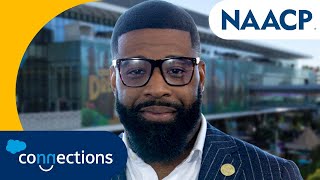
This is a transcript of a Salesforce Connections interview (episode featuring Sarah Franklin and Trevon Williams, NAACP SVP of Marketing & Communications). Williams describes his upbringing (raised by strong women), education at Hampton University, and early NAACP involvement. He explains transforming NAACP marketing by combining technology and data (email heat-mapping, geotargeting, concise messaging) and a narrative-first approach. He defines the "bold, blunt, brief" playbook and discusses digital advocacy accelerated by the pandemic, the "We Are Done Dying" campaign (addressing COVID disparities, police violence, wealth/education gaps), and a high‑engagement Jan 6 tweet that received over 1 million likes. The piece highlights member-driven priorities (NAACP ~2 million members) and using emotion-driven storytelling to convert attention into action.
Questions this video answers
SVP of Marketing & Communications at the NAACP.
About 2 million members.
Over 1 million likes.
Chapters
Looking back on your time at the naacp, what are you most proud of?
The future of it. These new generation is future. They're not just interested in hearing history. They want to make history. And I'm excited about what that could mean for the future of our organization.
Hey, I'm Sarah Franklin, and welcome to Connections, where we hear from some of the most innovative leaders in marketing. The NAACP was founded more than 100 years ago, and since then, its mission has never changed. Advocating for civil justice and social justice for black communities. That vision remains the same. What has changed is how it delivers on that vision. Moving to a marketing playbook that is more bold, brief, and blunt. And joining me today to talk about it is NAACP's SVP of Marketing and communications, Trevon William. I want to learn a little bit more about your upbringing. Who taught you what integrity looks like?
Integrity looks like Esther Williams, my mother. A single mother, raising two children, doing a fantastic job. I grew up in a house with my mom, my grandmother, and my aunt and my sisters. I had all women around me. So, as we say, trust the black woman, because they got all the right answers over there.
And what was the biggest learning that you have today from your mother?
One of the major things that my mother always taught me is just to be humble and to treat everybody the same. I don't care if you are, you know, janitor or the CEO, you're gonna get the same respect and treatment for me. And I think that that's how the world should really work.
I love that. That is so beautiful. More people need to learn those lessons.
Absolutely. Absolutely. Absolutely.
I don't know if you know this. I grew up in Virginia. Oh, and you went to college in Virginia?
I did.
And so tell me about what it was like to go to Hampton University.
Northern Virginia is a very, very diverse area. I went to a very, very diverse high school. But just going to a diverse high school doesn't tell. And so going to an hbcu, experiencing the culture associated with understanding who I was and really using that as a launching point for furthering my culture. I learned all that at Hampton University. I'm so proud that I had the opportunity to do so.
So you also learned about the NAACP at Hampton University.
The funny story is Harvey Library is the Hampton University library. And I was following a girl. I was following a girl.
It always starts with a girl, right?
It always starts with a girl. I was following a girl from a. And she said she was going to an NAACP interest meeting. And I went there just out of curiosity. And before I Knew it. There were students who were only maybe a year or two older than I was, who was talking about redistricting and voter registration and all these different things that I had read about in history books. But now I'm seeing it play out in front of me. And so from that quick 30, 45 minute conversation, listening to the interest meeting, I signed up to be a part of the naacp. And it was foundationally one of the most important things that I did while I was there. First time I voted was in college through the naep, naacp. It really helped foundationally build who I was as an individual and understanding that it goes beyond just getting the degree. I can be important to our community by going out into our community and NAACP taught me all that.
When you started there, what was their marketing like?
I came from a large technology background. Most of my experience in marketing came from either cyber security or technology. Working with rocket scientists and different things of that sort, very different pace. And so because of that, I had to reset my expectations around what marketing looked like at the beginning. But understanding that there was a long term vision for where we wanted to progress the organization, we wanted to be faster and we wanted to use technology more effectively so that we could not just have the arts aspect of marketing, but the data analytics aspect so we could couple those things together and be as impactful as possible.
And so how did you do that? How did you transform this organization into using these modern marketing tactics, failing fast?
We tried some stuff, we got the data from it, we figured out what made sense, what didn't make sense, and then we were able to bring that information back to our leadership appropriately. Heat mapping for email communications. Learning that we don't need to send emails that are stories, messages, a lot of words, a lot of dialogue, but maybe, you know, two or three really tight paragraphs gets the job done and gets people to the call to action. And then implementing things like, you know, geotargeting for specific locations that we're interested in. It's been such a growth for the organization. Holistically, we're excited about where we're going.
One of the things that interests me so much about you is the value you place on narrative and storytelling. Tell me why that's so important to you.
I think if you could tell a great story, your communities will become your ambassadors for that story. Right? We do our job effectively as communicators. We should be able to take our community on this journey with us. It's their story. And so they become the greatest evangelists for what it is that the association is doing in respects, if we do it well, if we message properly, if we position things appropriately, when we have these milestone moments as a community, they tell the story for us.
So speaking of storytelling, you've shifted your marketing playbook to reach new supporters. Talk to me about what bold blunt brief means.
I think that in today's society, we need to cut through a lot of frivolous words in some respects and just get to the meat and potatoes. Bold blunt brief is our. Is our commitment to cutting through the noise. Let's get right to what it is that we actually need our audience to do. We have 2 million members across the country. They're getting emails and communications constantly. We want to get to the point of what it is that we want them to do or we want them to pay attention to so that we know that we're not wasting their time.
You said that you see your job as getting our attention. Tell me how you persuade people to pay attention and what do you do once you get it?
More than anything else, I think it's important for us to hone in on the emotions of our community. If our community can feel the authenticity of what we're saying to them, I've got their attention. Whether that's signing a petition, volunteering, donating, all of these things are at their disposal. And then turning that emotion into actionable, positive things for our community, that's what we've been rewarded.
How did the pandemic pave a way towards this era of digital advocacy?
You know, that's a great question, Sarah. NAACP has over 2 million members across the country. The most important thing that we can do is boots on the ground. We can march, protest. We can do things in our local community. The pandemic made us have to think differently. And so digital advocacy became one of the most powerful things that we. We could do. Getting positions signed, getting donations signed, having pass through calls, calling local legislators around issues. We could do that and put that into the palm of your hand.
Tell me about the we are Done Dying campaign.
We were very much in the throes of the start of the pandemic at the time facts and figures came out that African American communities were being disproportionately impacted by COVID 19 for a number of different reasons. And so we are Done Dying originally started out as a campaign to talk about the disproportionate impacts on the black community. Right on the heels of that, we saw a lot of unfortunate events take place with regards to Ahmaud Arbery, George Floyd, and we couldn't allow it to just be one thing. It was one of those bold, blunt, brief components that you were mentioning and saying, we're sick of this. We're tired of our communities being targeted. We're tired of these being framed as isolated incidents and we want to deal with this on a macro level. So weird than dying became our campaign around sharing the facts and figures of what's taking place within our community. Not just from a pandemic standpoint, but police reform, talking about wealth gaps, talking about educational gaps. This is our cry to our community saying not only are we not going to stand for this anymore, but there's actionable change that we can see take place within our communities. And I think we were successful in doing so.
How does that make you feel that your marketing makes such a big impact on society?
I couldn't be happier. We, we are a bottom up organization. Our members dictate what's going to happen within the association. So what they say the agenda is is what the agenda is. When we see them utilizing our messaging or pushing out something that we've done, I feel that much more honored about what we're doing because it means we didn't miss it.
The NAACP posted a tweet during the January 6th coup, which earned something like a million likes. Walk me through that moment.
We basically created a virtual war room because everyone was home and we were making things happen in real time. And one of the most important things for us from a communication standpoint was our ability to take advantage of the aspect of. I'm going to let my community know I hear them and I'm going to use my platform to speak to what it is that they're feeling. Our new community knew that at that moment there wasn't a tremendous amount that anybody could do. But they need to know somebody was there with them.
And you spoke and we spoke.
We had one tweet, one little tweet.
I think it was a huge tweet.
It was a huge tweet. It is two tweets.
One of the biggest tweets ever.
It was one of the biggest tweets ever. We had over 1 million likes of the tweet itself. And it was really just a tweet in regards to stating that we thought taking a knee was bad. A small gesture brought the nation to its knees in a moment, right?
Yeah.
And now we're sitting here watching individuals terrorizing our nation's capital. It's an emotional experience for a lot of people, but we wanted to make sure the frustration that our audience felt was received, and they rewarded us with the engagement itself.
How do you find the courage to be bold, to be blunt, to be brief?
I've lost enough battles being quiet. If something's gonna go awry, it's gonna go awry with my voice being attached to it. The association is very strong in that respect, in that we're gonna do the right things because it's the right thing to do. And you don't win every battle. But we're gonna win the long. The long battle. The long victory is making sure that our communities are improved, protect and change. I think it to have a why not mentality when it comes to these things. Why wouldn't you do the right thing when it's an opportunity? We're showing up for those who are being marginalized as much as possible and using our platform effectively in that respect.
How proud is your mother of you?
Almost too proud. She wants to know whatever I'm doing, whenever I'm doing something, because she wants to tell everybody. I'm thrilled that I can make my family so proud and that the long conversation, the hard work that she mustered over the period of time where she was working and trying to keep us on the right track and putting two kids through college. I'm rewarding her now. You know, she made a good investment. She sowed good seeds. She did a good bearing fruit, Mom. So thank you, Mom. I appreciate you.
Thanks for tuning in. Never miss an episode by subscribing and turning on your notifications. We'll see you next time.