How to Build Trust for Tech Solutions and Reopen Safely | Leading Through Change | Salesforce
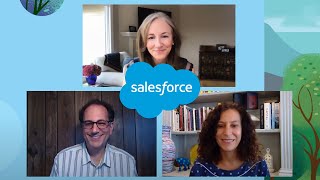
Jules Polonetsky, Victoria Espinel, and Amy Weaver discuss how tech companies can rebuild trust while reopening during COVID-19. They cover contact tracing, AI bias in UK exams, and the tension between privacy and public health. Salesforce demonstrates Data Mask, a tool for protecting sensitive information.
Chapters
Sa.
Reopening is not like flipping a switch. It's a process. And technology can help with that process, but it needs to be trusted. Today, we're going to explore the opportunity for keeping privacy and ethics at the forefront of the technologies that society is using to recover from the pandemic. Good morning. My name is Leah McGowan Hare and thank you for joining another one of our live weekly conversations as part of our Leading Through Change series, A chance for you to hear tips from business leaders around the world who are doing their best to navigate these challenging times. Now I want to preview the next hour. We are so pleased to be joined by today's host, Salesforce President and Chief Legal Officer Amy Weaver and our guest, Jules Polinetzky, CEO Future of Privacy Forum and Victoria Espinel, President and CEO, BSA the Software Alliance. Now after that, we'll have a special presentation from my colleague Rahul who will share with us how platform data mask an amazing product can help your teams manage sensitive customer data, which is top of mind for all of us. And finally, we will conclude with a very special performance from LT Smooth. Now, as we do every week on Leading Through Change, we want to help those who need it the most. And millions of people rely on the United World Food Program for their food to survive. And COVID 19 is making these conditions even worse. The pandemic could double the amount of people suffering from severe hunger by the end of the year. Now to help prevent a hunger pandemic, the World Food Program is scaling up to reach 138 million people across 1883 countries. With life saving support. If you can, please go to salesforce.com wfp and join us in ensuring the world's most vulnerable people have enough to eat during this very critical time. Now, through September 30th, Salesforce will be matching donations up to $150,000. Again, that's salesforce.com WFP. Now with that, it is my pleasure and honor to welcome our host, Amy Weaver.
Great.
Thanks, Leah. And thank you to everyone for joining us today during this unique and certainly challenging time. Since the first shelter in place, orders were issued, people have looked to ways that technology could help lead us out of this crisis. To keep us safe, to help us work, to help us learn from home, to rebuild our communities and to help regain some sense of normalcy. But just as quickly as the idea of these tools caught our imagination, it became clear that even in the midst of an unprecedented health crisis, trust matters. Because no matter how good a tool is, people won't use it unless they trust it. This debate between privacy and safety, between convenience and potential bias, is playing out in real time around the world. From certain countries using geolocation services to track people exposed to the disease, to the controversial use of algorithms to help create a level test score results in the United Kingdom this past week. These issues are no longer just lofty and somewhat esoteric legal concepts. The privacy and civil rights questions that are being raised are novel, cutting edge, and most of all, they are deeply, deeply personal. And they present an incredible opportunity. An opportunity to show that this does not need to be a zero sum game, that it's possible to build and maintain trust while exploring new technologies to fight the pandemic. To dive in today on these issues, I am thrilled to be here with two of the leading minds who grapple with responsible and ethical use of technology every day, Jules Polanetsky and Victoria Espinal. As Leah mentioned, Jules is the CEO of the Future of Privacy Forum, a nonprofit that focuses on privacy leadership and scholarship. Jules has seen these issues from every angle. He has a long background in this area, having served as the Chief Privacy Officer Officer at AOL and DoubleClick, and also as an elected New York State legislator and congressional staffer. Victoria is the President and CEO of bsa, the Software alliance, and she is one of the most respected authorities I know on the intersection of technology, innovation, global markets, and public policy. Before joining bsa, Victoria served for a decade in the White House for both Republican and Democratic administrations, including as President Obama's advisor on Intellectual property, and before that as the first ever chief US Trade negotiator for intellectual Property and Innovation at the ustr. So welcome to both of you here. I'm thrilled to have you and I'm thrilled to dive in on this topic this morning. So let's get started. As I talked about, privacy is at the top of everyone's minds as we look to technological solutions to this crisis. And there seems to be a tension between individual privacy rights and public health and safety interests. So, Jules, let's start with you. Is this tension real? And what is the opportunity in this case to build trust while respecting privacy and reducing bias?
You know, privacy is about context. We all share information or we expose ourselves in different ways. You might go to the beach and, you know, wear something skimpy. It might be appropriate. It wouldn't be appropriate. You'd feel embarrassed or exposed if it was in the workplace or if it was a place where that didn't make sense. We're constantly revealing, sharing, and then Recognizing that we sometimes don't want to reveal and share. Here we are, for most of us, encountering a very new and different situation. The context is a bit different. If I have had the virus, we expect that private information, that otherwise it might not be anyone's business, but it is the business of people in my home, people in my workplace, people in broad society, to know that somebody was near them and they need to take steps to quarantine. If we do it in a way that is proportionate, that's necessary, and I'm using terms that actually end up in some of the smarter, more articulated data protection laws. If we do it in a nuanced way that respects limits and boundaries, in a way that doesn't leave you hungry, doesn't leave you discriminated against, that recognizes that there is a balance, we can get it right. If we do it wrong and we don't recognize that this could be harmful and we do it in a blunt way, then of course we end up having that clash. But we can do it in a careful, nuanced, balanced way. It just takes careful thinking and appreciation for the particular context.
Great, thank you. Jules and Victoria, how do we use this as an opportunity to actually gain trust, not lose it during this time?
So I think that's a great question and I think there is a real opportunity here. I'm going to start with an example that's going to seem very far afield, but I think there's commonality in how you build trust anywhere. So, Amy, as you mentioned, I was a chief trade negotiator for the United States at an earlier point in my career, and I probably negotiated with 80 countries around the world. And one of the things I realized in doing that is that you really have to build trust, perhaps even more as a representative of the United States, because of the economic heft that we bring. Building trust with other countries is really important to be able to successfully negotiate. And so I've thought a lot about that, and I think it often comes down to three things. First is being straightforward and transparent about how and why decisions are made doesn't necessarily mean everyone's going to be happy with every decision, but they should understand how and why you got there. I think the second is listening to concerns, really listening to them, really trying to understand them, and if you can address them. And I think the third is to stick to what you say. And I think the same dynamics apply here for privacy generally, and perhaps even more so in this time of COVID People need to know that their data is going to be protected and kept safe. That's why BSA and Salesforce both put out privacy principles that are very specific to this time of COVID And some of those are really common sense, straightforward things like try not to collect personal identifying information, be thoughtful about how you minimize the amount of data that you collect, put time limits on how long you keep it. But a big part of that is transparency. And that means telling people that their data is being collected, telling them why it's being collected and how it's going to be used, and then just stick to what you say. I mean, the guiding principle for all of this has to be no surprises. And I think there is, because Covid has had such an impact on our lives. I think this is a real opportunity to talk about, to talk about privacy in a way that people will really understand this very immediate, very significant impact that it's having on our ability to try to address this pandemic. But in doing that, I think there's a real opportunity to build trust on how you can use data in a way that really is thoughtful and protective of people's rights.
Victoria, that was great. I love how you led this off. You want to be straightforward, you want to be transparent, and you want to understand what the other person's concerns are, the other countries. And frankly, that's advice we could use for any situation, but it's never been more important than it is right now. You also mentioned the guidelines. I should point that out. Our Chief Privacy Officer and Chief Ethical Use Officer came together and developed a great set of guidelines at Salesforce, which really talks about how we try to make these issues top of mind. These are publicly available, so if people are looking for them, they can go to salesforce.com privacy and they're all in our resources section. Victoria, you talked about talking to countries around to 80 countries around the world. One of the biggest issues and the most electrifying, I think, has been the use of geolocation or Bluetooth tracing for contact tracing. So, Jules, let me go back to you. What are you seeing in terms of an international response and different ways that different countries might be considering these issues and how it works with privacy?
I think we saw some people maybe plunging in very quickly, thinking that tech would solve the problem. Right. Silicon Valley was going to invent solutions, and it wasn't surprising to see a little bit of a backlash. Wait a second. This isn't about technology. This is about communicating with the public. This is about understanding what do the public health authorities need, what do epidemiologists need. I think now that we've had a little bit more experience, you're starting to see a more careful, nuanced process. The leading platforms are supporting apps that don't require location. Do I really need your location? I just need to know that you, someone who got a diagnosis, was near other people by using cryptography, by using Bluetooth to detect other devices. I think we've settled in large part on a system where people who download these apps can be comfortable that they're going to get an alert and they'll know that they were in proximity to somebody else. But I think it took a little bit of while to get there and there's some lessons from some of the snafus. We saw apps that were collecting location and maybe didn't really need that location. The principle of do you really need this? Because if you collect it and you don't need it, we're going to get worried. We see college students being asked to sign up for apps that will monitor where they are. Are they going off campus? And you think to yourself, that's a little bit heavy handed. None of us want to be surveilled. We want to understand what's going on. We want to understand that if data's being collected, it is indeed the minimum and most important. We want to recognize that it's not going to be used in a way that's adverse to us. We want to understand that we are in control and that we, the community, the school, is bought in to the way the data is being used.
Jules, that's terrific. I have to say, as the mother of two sons in college, tracking where they are doesn't sound like the worst thing in the entire world to me. And do not tell them I said that.
It's all context.
It's all context.
Yes.
So when we look at this one, debate is around privacy, but equally important is equality. And this year has brought equality issues into such sharp relief. And I think it's always important to step back and look at whether technology is helping or whether it is hurting. One of the biggest issues that we're seeing right now is simply the availability of technology. It doesn't matter if you have, if they're able to help you through an app, if you don't have a smartphone. Even more critically, if we are sending our students home for online learning, that has to start with owning some sort of device where you can actually do this and then an ability to get on and have wi fi. So, Victoria, what do you see in terms of the changing priorities in the technology world, and how can we use some of these to increase equality?
So that's a great question. I mean, I think it's. I think it's been a responsibility of the technology industry to be thinking about having how the tools that it creates are used responsibly for many, many years. But in so many areas, this pandemic has thrown that into even more sharp focus. You raised one of the ones that is most on my mind, which is the future of education in our country and in other countries around the world, and how to try to address children that are at risk of being left behind because they don't have access to the technology that we all need right now in order for children to be going to school. And as you said, part of that is broadband. I'm cautiously optimistic that this is such a concrete example of why lack of broadband access, whether you're in an urban area or rural area, is important, that it will lead to congressional action to actually be able to move forward and increase broadband access across the United States. There are a host of other issues beyond that, including the ability, as you said, to be able to have devices. And I know there are many school districts that are trying to address that. But this seems to to me like an area where the governments and industries could partner together to try to help local communities and local governments that don't have the resources to be able to address that. So I think there's a big opportunity here for a real partnership. I think it's this interesting moment where it demonstrates, in a way, how critical software and technology are to being able to make sure that students can go to school or that some workers that are able to are able to do their job remotely, that companies can be reading the consumers, but also that if you don't have the ability to have access, that divide is just exacerbated. And I can't imagine that it won't be a significant focus for any government, whether it's federal government or local government, to try to address that gap. But I think the software enterprise industry has a huge role to play in partnering with governments in all kinds of ways, both from the very practical of donations, and a lot of our companies have been doing that, but also trying to make sure that digital skills and literacy are being upgraded. And while the governments can do that, they really need the partnership with the industry to make it effective.
That is great. When we talk about this and we're looking at equality, one of the areas that probably has some of the greatest potential in technology is artificial intelligence. It's also an area that can really be fraught. It's one of these areas where when we talk about using privacy and ethical use concerns, putting them top of mind, building from day one with those in mind, it could not be more critical than in that area. This week, the newspapers were flooded with articles about the use of artificial intelligence in the United Kingdom for the A levels, and it didn't go exactly the way that they were hoping. Jules, could you talk a little bit about this? What consideration should we take, be taking into account when we're looking at artificial intelligence and talk a little bit about what could have been done better in the United Kingdom?
Yeah, you kind of wonder how they didn't anticipate that this sort of thing would create a giant backlash. Look, the reality is we are automating in large and small decisions all over the place. Our vehicles, our airplanes, our testing, everything we do is being optimized, sometimes very significantly. You're getting a grade different than what you expected, and sometimes in minimal ways that we barely appreciate. And I think the challenge is, as Victoria said at the outset, making sure that what you do is transparent, that when it's an automated decision, that actually has a significant effect, a legal effect, that you not only provide transparency about why and how this is happening, but that people get a way to challenge it, that you understand the underlying logic. You know, when this was being proposed in legislation around the world, the instant reaction from some was, there's trade secrets, it's complicated. And that's all true. But at the end of the day, none of us are going to trust key decisions that could be life or death or change our future unless we trust that they're being made in a way that's been vetted, that's being analyzed, that's being pressed, and that is, I think, hopefully we'll see some of those elements showing up in laws in the US and it really means sitting down and actually recognizing the impact that these decisions are going to have on people's lives and understanding that they come with bias. No matter what we do, even if we don't intend to be discriminatory, simply deciding who you collect the data from and not including certain people or over including others or the way you categorize or the people who are doing the categorization, we need to really interrogate what we do in a way that is much more aggressive. Understanding that good intentions and just not being biased or not being discriminatory doesn't just happen. It actually takes an intentional effort because we're dealing With a society that's imperfect.
And just a level set for people who may not have followed this as closely as all of the privacy lawyers were. What happened in the United Kingdom is that students were not able to sit for their A level exams, which are the really critical exams given up every spring that are similar in the United States to almost like the sat. Very, very determinative of where you may get into university. This year, because students were not able to take it, an algorithm was developed that was going to help predict and award the scores. At least in part. The algorithm took a lot of things into consideration, including what the teachers thought the students would get. It also took into consideration things like the high school itself, how people have done traditionally. So the issue came up and at the end of this, 40% of students wound up receiving a score that was lower than what their teachers had recommended. And there was real concern about whether using on high schools was disadvantaging very bright students who maybe came from a school that was in a disadvantaged area. And it's led to an incredible uproar. But it's also been fascinating, fascinating insight into well meaning uses of artificial intelligence that led to problems that could have been avoided if there had been more thought right at the beginning. So as we look around the world and to different priorities. Victoria, I know that you are on the front lines of dealing with legislators and legislatures all over the world on behalf of some of the largest software companies. When you were putting out your I saw your priority list last fall for what you were going to accomplish in 2020, you did not have a global pandemic on it. How has your list of priorities changed for this year and what do you see as the top issues for software now?
Well, 2020 has definitely been. It has been a different year than we were expecting. So I would say in three ways. So first, just as the head of an organization, one of my priorities has been to try to make sure that my own people have what they need in order to be able to work remotely, in order to be able to be safe, in order to the extent we can try to minimize stresses in the workplaces or find ways that we can still get together virtually. And so that's been. My employees are always a big priority, but in a different way this year, thinking about a different set of issues this year. The second thing I would say is giving governments advice on how the policy issues that we've worked on for many years, like artificial intelligence and privacy and the risk of cybersecurity, how those are being impacted by Covid specifically, we've already talked on this call about two of those, AI and privacy. And the fundamental underlying issues may not be significantly different, but the concrete examples and the practical applications and the really real life demonstrations of how things can go wrong has accelerated those conversations. And so I think giving governments advice on how those issues are impacted by Covid has been a second big priority. And the third that I would say is one of the things we've also seen in a very direct way is how old infrastructure that the governments have sort of legacy IT and outdated systems have been a real barrier to their ability to have first responders communicate effectively or process the loans that companies need desperately in order to keep going. And so talking to governments about how they can use technology so they can deliver the citizen services that they want to as well as they can has been a big priority and something that governments are really focused on because they want to make sure that they are doing the best that they can for their citizens. And part of that is trying to make sure that in some cases, some incredibly old systems are being updated and used effectively.
Victory, are there things that really fell off your list this year that you feel like are important to the software industry but just people are not able to focus on them with everything going on in 2020?
You know, not really. To be honest, it's been kind of incredible and kudos to my amazing team. I feel like our entire agenda stayed live and in fact in some cases even more active and then sort of layered on top of that was the COVID response and recovery agenda where we've been working with governments really actively. So no, and I have to say I'm a little surprised by that. But the policy agenda has remained as active or more active. It's what, August 20, Washington D.C. is generally a little bit quiet. That is in no way true. And so I think the short answer to that is no.
I think a lot of people are finding that rather than everything going out the window and a new set of priorities, we just have double the opportunity, dive in and get to work.
I'd say there's been a.
In your forum.
Yeah, I'd say there's been a digital acceleration. Right. Businesses all over the world or governments over the world that had digital projects, that had data projects, those are all moving faster and quicker. If you're going to automate, if you were worried about self driving cars, if you were worried about we work with city leaders around the world. If you were looking to reorganize your public transportation, you're Doing it now because you can build bike lanes and you're thinking about where does self driving fit in. And so as much as it might have been nice to have a little bit of breathing time, let's just deal with the COVID issues. Every other pressing tech and data issue started moving faster and jumping in to try to help put good thinking and policy and law and complaints around those has been a challenge. The other big priority is one that I think is critical, and Covid has only made this point more clear. You know, we know we go to the doctor that health information is protected because we have a health privacy law, but we don't have protection for that information if the same data about my health is provided, maybe to an employer or maybe to somewhere else. We're one of the only democracies in the world, and we will soon maybe be the only major economy in the world that doesn't have a comprehensive privacy law. And if we want data moving, and we need data moving, if we worry about bias, we need to know who's being affected. If we want to know, are some kids missing out? We need to understand who are they? Are they immigrants? What's their background? What's the area? So more than ever, we need data moving. We need it moving around the world, because if we're going to have clinical trials and we want to make sure vaccines work, we need to understand that it works for different kinds of populations. So we've become more dependent than ever because of the acceleration, because of COVID and we end up having this gap of some laws cover some data, other laws cover other data. So I'm hoping that we'll see Congress, despite everything else that's going on, prioritize putting in place a comprehensive privacy law so people can know that if they share data, companies, governments, organizations are bound not only by good policies and good practices, but there's a law backing it up. It'll actually accelerate trust, frankly, if we can promise people that they're protected by law.
Jules, I'm so happy you brought up the lack of the federal privacy law. One of our biggest concerns has been that we are going to wind up with a different privacy law based on everyone's zip code. And we are going to be dealing with not just 50 states, but every county on doing this. And I think one thing that the pandemic and so much work from home behavior has made utterly clear is that zip codes should be irrelevant. There are no boundaries on this. And within the United States, we've got to come together and get a federal Privacy law passed to protect all of our citizens. Victoria, what are the odds of this? How do we get this through, and when is this going to happen?
Well, I think the odds of anything happening this fall are slim, for obvious reasons. But I think just to underscore what Jill said, I actually think, as in so many other ways, the pandemic has made people realize how necessary data is in order to solve major societal challenges. In this case, trying to address COVID 19, trying to find a cure or a vaccine for the disease itself, but also trying to ameliorate all the negative economic impacts of COVID 19. We can't do that without data. That data has to be protected. It makes no sense to have a system of data protection in the United States where the level of protection is completely dependent upon where in the country you happen to be located. And so I think it is entirely possible that this will help underscore the importance of, to Congress of why it is necessary for the United States to have a comprehensive, high standard enforceable so a really high standard privacy law across the United States. And I think in the year 2021, I think as the new Congress starts, I'm optimistic that we'll be able to make the case for that.
That is terrific. And just as you said that it's so clear how important data is. But really, every company, every university now has a digital imperative. I was speaking to a university president, and he said that for the last 10 years, people have been telling universities that they needed to have an online teaching option for people who couldn't come to campuses. And almost always the answer was, it's too complicated, is too difficult. Well, last spring, within three days, virtually every single university in the country did it and had to. There was no choice. It's the same for companies. Suddenly, there's an absolute digital imperative where everyone has to have something that's available online. It's a lot easier if you started earlier, but if you're jumping in now, you've got to do it. So, Jules, for companies that are now really focusing on this online experience, focusing on their own digital imperative, what advice would you give them? What should they be keeping top of mind?
We talked a little bit about the privacy compliance and the ethical rules and the transparency, but let me put all of that aside just for a second, because, frankly, you can do all of that, right, and still find yourself the brunt of a lot of criticism and backlash. I think the challenge is understanding that around the world, and I think increasingly in the US you've heard this from CEOs from Salesforce to other companies, that privacy and data is a human right. And a human right doesn't simply mean, you know, you can clear your cookies or, you know, make sure you've opted in before you send somebody email. Right. Human right means that this is really something about yourself and your dignity and your ability to, you know, be a free person. And I'm not sure a couple years ago that was fully, you know, accepted in a lot of the business world. I'm just marketing. Come on. What are you talking about? Human right? But I think today, who can open their eyes and see that? Whether it's who gets surveilled and facial recognition and AI and do I get to go to work? And how is Covid and tracking treating me? This really is about everyone's right as a human right, number one. Number two, this is also about power. Power. The school system deciding what schools you get into, the government deciding how you get treated. Do you get through immigration or customs? How do you get judged? And so all of us who have data, whether we're a company and we're just managing our website or whether we're providing major services, you need to recognize, and Victoria said this very well, when you're the US and you want to be trusted and you have a lot of economic heft, you understand you might need to go the extra mile. And so, yes, there's details, there are privacy impact assessments, there are boxes to check and laws to follow. But we also need to sit back and recognize that when you're in a position of power and you want to have a trusting relationship, there are steps you need to take. You need to understand who you're going to impact. You know, we don't even do a good job sometimes of taking into account that women may have a smaller hand and so maybe need, you know, a certain size item or that might have health needs that are different and women aren't a tiny sort of minority that we might forget. We're really bad at actually sitting back and saying, I'm going to make decisions and I'm going to decide what data to collect and how to describe it. And that actually gives me lots of power. So having that humility to say, I'm exercising power, how do I show that I'm truly listening, hearing how what I do affects, and I actually have your buy in, because I hear and I shape what I do based on some goal of helping the entire community. So that's the key. So do the nuts and bolts. The lawyers have to be involved, the Chief privacy officers, but recognize that it's very often about power and if you have it, you're not going to be trusted unless you go that extra length to actually have buy in of the stakeholders.
Jules, I love everything that you said there. The one word that really jumped out at me though, was dignity. And ultimately treating your customers, your consumers, your employees, your students, your citizens with dignity is what so much of this really boils down to. Victoria, what advice would you give to companies? What are the opportunities and the pitfalls that they should be looking out for?
Well, here's an opportunity. I don't know if this is advice to companies, but I guess I'll frame it as advice to companies. This is an opportunity I am really excited about. I think, as you said, Amy, this has demonstrated the ability of at least some people in some professions to be able to work remotely in a way that many people did not think was possible a short six months ago. And I think there is an enormous opportunity, therefore, for us to be able to broaden the economic opportunity and the jobs that are available to people across the United States. I think right now there still are some areas where technology jobs in particular and other types of jobs are concentrated. And that doesn't have to be the case. And I think this is demonstrated that that doesn't have to be the case. And we can take this opportunity again, the industry and government partnering together really seize that opportunity to have the impact and the opportunity and the availability of these great jobs spread out across, across the United States. I think for our country as a whole, that will be such an enormous benefit. It will have ramifications for decades from now. And so I'm really hopeful that's an opportunity that we all collectively seize and run with.
Victoria, I think that's fantastic. And I think we really are seeing that where the entire tech industry and the opportunities have been opened up really across the country and worldwide. So thank you both, Jules. Thank you, Jules. Thank you, Victoria. It was great to hear from both of you. And what I'm really taking away from all of this is that while there are valid concerns about privacy, civil liberties, bias raised by technologies that have been developed and are being developed, this is also an unprecedented time for organizations to earn the trust of their stakeholders to create with human rights and privacy at top of mind and as Jules so beautifully put it, to treat people with dignity. Thank you so much for this conversation. Now we have another very special presentation coming up from Rahul on our platform, data masking. Welcome, Rahul. And over to you.
Hi everyone. I'm Rahul Owesti, senior director of product marketing here at Salesforce. So excited to talk to you today about Data Mask. Now, the Salesforce platform is an amazing place where thousands of customers build thousands of apps every day. It takes a team of developers, admins, and partners to build these apps. But guess what else it takes data. Lots of data. So our customers can really do a rigorous test of the apps are building. Now, we make sure all the testing that we do is done in sandboxes. And sandboxes, as the name suggests, it's just a mirror of the production data and it's a playground. You get to test and play. But sometimes the data that is in the sandboxes, that's copied from production is sensitive, and not everyone should have access to it. While production environments are controlled and only the core team has access to it, sandboxes often have extended teams collaborating in that area. And potentially not everyone outside of the core team should have access to the sensitive data. But they need it for testing purposes. And that brings us to the main challenge. How do we get realistic data in sandboxes and maintain data privacy? Well, that's exactly where Data Mask comes in. As you can see, it's a mask, and it does something. All masks do conceal your identity. Well, some masks also protect you from viruses, but they make it hard to see your face and obfuscate your full identity. With data masks, you do the same, and you do it with choices, because teams can pick different masking techniques for different fields. For example, you can pick a pseudonym. So instead of, let's say, first name Kelsey, it would become Amber. You can completely anonymize the name, where a first name Kelsey just becomes a bunch of characters. Or you can just delete it and even pick a pattern of your choice to match. Think of it as just masks in different colors. Someday you want to wear blue, someday you want to wear black. Now, Data Mask is a fully native, 100% on the platform solution. And that means all your customer data never leaves the platform. It stays on the trusted Salesforce platform. And that's important because that means teams don't have to copy that data, move it elsewhere, anonymize it, and then bring it back. That means teams can meet those security and compliance needs while staying agile and maintaining high productivity. So this is all great, but let's see it in action. Right? Let's do a demo. Now, what you're looking at in this demo is a very common view in Salesforce. Here we're looking at Sales Dashboard with a View in the contacts you can see name, phone, email and this is exactly what a user might see in this case. If you look at the first row says Bob Hodges. That's his name, the account name, the phone number, the email and the title. Now let's see how a sandbox admin will can mask this data. Our admin Dylan is logged into the sandbox and right here we can see our data mask configuration. He's going to edit an existing mask and apply it to the data in the sandbox. And you can see it's really simple. He picks the contact field as we talked about. You know you can four different options. You can replace from a library, you can delete the field, you can jumble it up, all different ways to configure it and that's great. You just make your selections simple few clicks and then you save it and you run this mask. Now while this mask is running it takes some time. Let's see what the data actually looked like before for comparison. Remember that initial field where we had Bob Hodges? You could see his name, his company name, his phone number. Well this is the data we want to mask. So we run the mask and boom, look at what it looks like now. Well, no more Bob Hodges. It's Cynthia Squarepants. And the name of the company has changed. The phone number is just gone. You don't have access, the email is fake and the title is just a bunch of jumbled characters. Now this is why data mask is easy and helpful. For more information about data Mask please go to our website salesforce.com data mask here you can see all the great demos. You can even find trails and data sheets with that. Thank you for watching. And back to you Mia.
Thank you Rahul. That was great. Now it is my pleasure and honor to bring in our very next guest. Someone whose music always brightens my day and transports me to my happy place. The islands with that welcome LT smooth.
Thank you for having me Salesforce. I will fly away to the end of time. Fly away. You I search the world for you. I will climb those mountains for you. I will sail the seas Just to be. Just to be with you. Fly away with me. Fire. Way to the end of time. Fly away. I'm changed because of you. You're the wind that carries me through. You have changed. Giving me hope when I needed it most. And yet you still love me. Fly away with me. Fly away. I will fly away to the end of time. Fire doing. Fly away from me. I will fly away to the end of time. Fly away with me I will fly away to the end of time Fly away you how fly the way to the end of time Fly your way. My grandfather he was a kind man he lived on home Sometimes it seems me the songs he wrote when he was just a young man.
And he.
Played me a real old style. And he played Mary old style My. My auntie they love to dance the families love to sing I sing with them when I get the chance.
Sing.
The song they sung to me. Old style. About these folks they were young no more they will pass away and I know that I remember them the songs they used to play. And they gave. Sam. But. Sacred. He.
Always so wonderful to have LT Smooth transport us to a new happy place thank you LT and thank you all for joining us today. You can find more of our Leading through change stories@salesforce.com blog. Now before we wrap up, one more reminder to join us in making sure that millions of people worldwide do not go hungry during this crisis. If you can, please go to salesforce.com WFP and join us in helping this organization. Through September 30, 2020, Salesforce will be matching donations up to 150,000 once again that salesforce.com.
Now.
We'll be back next week with Leading Through Change next Tuesday at 10am Pacific. Join us for our upcoming Salesforce Live Maximize your return on Digital Wednesday, August 26th at 11:00am you can register at salesforce.com events. You won't want to miss that one now. Until then, please take care of yourself and each other.
Tableau allows companies to visualize their data clearly and make informed decisions to drive their business forward. Managers have access to dashboards where they can see a 360 degree view of their business and detailed categorized metrics to understand the health of their day to day operations. Live customer data is pulled from multiple sources across company departments and platforms. Using autofilters, managers can get a deeper look into their data including all the customers in their pipeline from prospects to loyal customers. When interacting with this data, managers can see the different interests and engagement between new and existing customers. Let's focus on a loyal existing customer taking a closer look at customer metrics. We can view changes in campaign engagement over time and by location and by simply dragging and dropping the customer's transition score onto color. Managers get deeper analytics into the performance of each each region and engage new and existing customers on additional incentives programs without the need to code. Managers can now quickly and easily get a 360 degree view of the current and future needs of their customers gain valuable insights into data and empower your organization to drive deeper conversations with your customers. With Tableau and Salesforce SA.
Sam. It.









