How to Make AI Inclusive w/ DeepMind COO | Blazing Trails | Salesforce
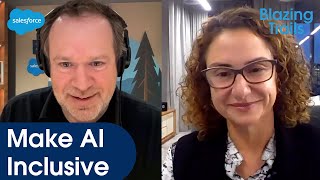
Lila Ibrahim, COO of DeepMind, discusses how the company pairs AI research with responsibility and governance. She covers AlphaFold's impact on life sciences, practical advice for leaders operationalizing AI, and her perspective on diversity and mentorship.
Chapters
Welcome back to Blazing Trails. I'm Michael Revo. Today we're talking about how to operationalize AI with none other than Lila Ibrahim, Chief operating officer of DeepMind. She's had a front row seat to technology innovation as a senior leader at Coursera VC firm Kleiner Perkins and as Chief of Staff to Intel CEO and chairman Craig Barrett. Welcome to the show, Lila.
Thank you, Michael. I'm really honored and excited to have this conversation with you today.
Awesome. Well, I am honored and we are on blazing trails here to have you here. So let's just start at a high level and tell me about DeepMind's mission. What are you guys all about?
Yes. Well, first let me say that I am joining you from London today.
Yes.
And I moved from the San Francisco bay area about five years ago to join this company, DeepMind, which at the time had heard very little about. So I too was quite curious about the mission, which sounded quite, quite, quite ambitious. And it is, and rightfully so. So our mission is solve intelligence to advance science and benefit humanity.
Okay, that is a big. Yeah, that is a big mission. And as I was prepping for this, I heard that, read that statement and I just wanted to ask, can you break that down a little bit for me and what that means? What does that mean?
Yes, as I mentioned, we're headquartered here in London and you can think of us as an advanced artificial intelligence research organization. The idea of starting DeepMind was really, if you can understand intelligence, you can use this advanced artificial intelligence systems or advanced AI systems to enable breakthroughs that haven't happened or been understood in the past. If you can do that, things that maybe could help solve address diseases, could help power cities, what that could mean for humanity and for society, that's really what we're working towards. That's quite different than a lot of companies who might be using AI to focus on product enhancements, user experience, increase sales, or from that perspective. So we're really, our product is knowledge, our product is research that then gets applied into solving some of these longer term problems that humanity is facing.
Yeah, I think a little later we're going to talk about the evolution and implementation of some of the ideas that the group is working on right now. But there was a phrase that I heard you say about power pioneering responsibly and using that idea because it is a pioneering mission for sure, but doing that responsibly. So tell me what that means, that phrase.
So my first week at DeepMind, the company really codified its values and the values are really interesting. So it's mission driven, pioneering, responsible collaboration and kind of really fantastic, very descriptive of the organization. But I got stopped in the hall in my first week and people would say, I don't understand, how can we be pioneering and responsible? And so we really went, even though we had been talking about both of these and advocating, it's like getting to the point in the research where we had to think about how do we actually operationalize this and build this into the ethos. Everyone who joins DeepMind is kind of bias towards being responsible, yet how do we actually hold ourselves accountable in the development and the advancement of this work? To me, having the experience I have from the tech sector of the past 30 years have a lot of experience of bringing new technologies into new markets. I remember back in the 90s when we were taking computers and building out Internet infrastructure in countries that maybe didn't have, didn't have all of this established and we were going to displace teachers and schools and farmers and entrepreneurs. And yet when we deployed this technology in a responsible way in collaboration with communities, we were really able to empower and engage a new type of users with new opportunities that they could bring to their communities and into their lives. And so having that experience from the past, to me, pioneering and responsible naturally fit together. And when I started, it was a lot about bringing people to this table together from diverse perspectives. And in fact I used to hold this meeting that I refused to give it a name because I didn't want to over index and stress folks out. And it was really how do we build a culture of having some of these very open conversations and very deliberative discussions and being able to ask questions.
Tell me how you implement that and how leaders can think about that maybe in their own organizations of the value of bringing these different voices to the table and being open to that.
That's a great question and you'll find in a lot of my answers I'll probably tap into. I have a pretty diverse background and I think that's actually helped me enter the field of artificial intelligence with a different perspective and actually bring some of this into an organization where there is a lot of expertise. So for example, earlier in my career I spent some time at intel where I worked very closely with ethnographers and anthropologists and we were doing user centered design before that was more commonplace. And so I had an idea of what this could look like. And so to me it feels very natural actually to bring in those different voices. And perhaps this is also a bit of my own background. Of being a woman in tech person have a lot of different experiences again that we can talk about, but it's really just saying, okay, who actually is one passionate about this topic is interested in being engaged or who might have the expertise. And what we found is when you put people around the table and you're saying, okay, these are two of our values, they can seem in contradiction and yet we absolutely need them to work together. So how do we think about that? And like just being able to be as an executive to invite people to the conversation, to create the space, it was absolutely okay for me not to have the answers. It was good for me to ask questions, to provide recognition of people spending the time and energy to have these conversations, to role model what it might look like to create a safe environment. So I think there's actually a lot we can do as leaders. We don't necessarily have to be the experts in the room. And sometimes that humility of and being the non expert and just asking, well, tell me why you think that or how might you approach this or who do you think is missing from this conversation? Oh, well, so and so from the policy team, well, let's invite them to our next conversation. So I think it really, it almost it became very much of a community. And even now when we have these conversations in our much more formal governance structures, we still carry a lot of those early startup, you know, the intrapreneurial side into those meetings. And it's been the reality is we're doing a lot of things that nobody's ever done before.
Right?
Undoubtedly something's not going to go as we planned. We have to be able to make a decision to move forward with imperfect data for that to be okay for us to revisit and then also to kind of critique our decision making, look back and say, what did we learn? How can we have this growth mindset? How can we have the continuous improvement? You know, it's only a mistake if we haven't necessarily had the robust conversations and hold ourselves accountable for what we, you know, what did we learn and how we put it into practice.
I was thinking earlier when you were talking about being at intel and rolling out sort of the earlier, you know, early web and the Internet and the infrastructure to do that. Again, that's a cutting edge, that's being on the edge of this, of a technology revolution. And you are again now in this AI space, what, what are some lessons learned in maybe how that was approached that's affecting how you're thinking about this next wave of technology that we're going into.
Yeah, I'm thinking a lot about these, these days. Maybe it's after being in the tech sector for 30 years, I've been on a couple of these rounds. So very early in my career, in my 20s, I moved to Japan to work on a technology that everyone, no one understood at the time. And I remember my boss sitting me down saying I was throwing away my career because why would you go work on this thing? What is it? Dvd? Like this is a movie on a computer. And it was really working on the standards that were underlying access to DVDs on computers. So I think there's this element of how do you give space to people to imagine things that might seem unimaginable? And maybe it doesn't make sense to a lot of folks, but there's still, you can imagine a purpose for it or how it could be used. I think there's another lesson which is no one organization can do this on their own. How do you think about what's the ecosystem, who needs to be involved? Everything from whether it's policy folks or if you're providing a technology ingredient, how is it going to be used? And so bringing those voices in very early is critical. But perhaps maybe back to the pioneering one, maybe the best lesson I learned was maybe a leadership one around. I was chief of staff at intel and my boss at the time, Intel CEO and chairman Craig Barrett. I went into this cubicle one day and I'm like, oh, Craig, I can't believe this. This other executive is on my case about this topic. And actually it was around some of the work in emerging economies about how do we build out technology for social and economic advancement. And he's like, lila, listen, pioneers end up with more arrows in their back than in their front because you're always paving a new path. So you're going to get arrows in the back. Just know that. He said, but promise me this, just stop occasionally. Let me pull the arrows out so you can run further, faster. And so my job as a leader, because I felt that was so empowering that I actually really believe that. And so I feel like my job as a leader is like, go find the people that I can pull the arrows out or take it for them so that they can go explore what they uniquely can go explore for the all in service of the mission.
That's a great story. And I mean, at a macro level, do you think right now the general environment for innovation is as strong as it has been? I mean, because you hear that critique, things aren't moving as fast. What was the quote about? They promised us flying cars and we got 128 characters, that kind of idea. I know some of what DeepMind is doing, but I'd love to get a view of what that future is going to look like and a little bit more coming out of the research and into the implementation of AI and where we're going to see that and what that might look like.
Yes. And D mind takes, as I mentioned, a slightly different view on artificial intelligence based on the type of advanced AI that we do. So it is really focused on what are the, we call them the root node breakthroughs. So think of, we call it the tree of knowledge. And like, what are the key aspects in physics and chemistry and biology which humans haven't, with all of our knowledge, cumulative knowledge, we haven't quite understood. Is there a way that DeepMind can help advance, unlock some of that knowledge for a field to accelerate and develop? One of the areas that we've been looking at in this space is around the life sciences and protein folding. I'm not sure if you're aware of the work around an advanced AI system called AlphaFold.
Yes. But can you tell us a little bit about alphafold?
Alphafold is a protein prediction system. From a string of amino acids, we are able to predict the 3D structure of a protein, of how it might fold into a protein. This is interesting because proteins are the building block of all living things. What makes it even more interesting is that it's also a grand challenge that has stumped the biology community for 50 plus years.
Right? A 50 year challenge.
Yeah, 50 year challenge, right, yeah. We worked with the biology community to try to understand this challenge and see how our approach, DeepMind's unique approach to advanced AI, could be beneficial. We were able to solve the problem, the grand challenge then we did a lot of work to improve the quality and accuracy and the speed of that system. We published the folded proteins into a database in partnership with the European microbiology labs and made that database almost like a search. You can go in and search and there you go. Is your folded, your predicted protein folded? And what's interesting now is that biologists who may have spent, you know, an entire dissertation on one protein or needed a wet lab to, to spend years trying to understand this and may or may not have succeeded now have immediate access to this. So it's shifting the work that the biology community can do now to actually how do they, now that they understand the protein a bit better, what might they be able to do? With it.
And so how do you see that impacting medicine? And what do you see as the breakthroughs that are going to come from that?
Well, and that's been the exciting thing actually is okay, the grand challenge was amazing. But what the community is doing is breathtaking. A few that I'm particularly excited about are we are working with the university here in the UK in Portsmouth, around the center for enzyme Innovation, something that used to take days and weeks to try to understand. Some of the enzymes are now happening almost instantaneously, which is really making their work go faster. And what is their work think about plastic eating enzymes. There's work happening in malaria and diseases. Another one I'm particularly interested in is some work we felt from an equity perspective that perhaps who can make use of these proteins in a way that we want to make sure people aren't left behind. So we identified an organization working on neglected diseases, predominantly in the global south. And they're making some really great progress around two parasitic understanding two parasitic diseases and then can do the work that needs to happen to get the right cures in place. And this is important because it's not necessarily an area that the pharmaceutical companies can. Even though it hits many humans, from a business perspective it might not make sense. So we're quite excited to be able to close the gap on some of these areas that seemed at one point too long, too difficult, didn't have a business model to go with it, et cetera. And now the technology is really advancing and shifting how the biology community can think about the problems that they're trying to solve. And I suspect over the coming years you're just going to see more and more of these really fascinating and exciting and life changing solutions come into the market and decline has done this again. It's like it was our as our mission, it was a non commercial donation in collaboration with this European lab to really try to advance humanity.
It makes me think about how we should all be thinking about AI that might be interwoven into systems that we're not even aware of. How do we maintain awareness and understand how it might be affecting decisions and data that we're seeing and operating. So with DeepMind, it's operating at the cutting edge of it and what is this technology going to really bring to the future? And thinking about that from an ethical perspective. But I think we need to think about that every day and what we're seeing. So how should we be thinking about that?
Michael? That's a great question. When I talk with a lot of business leaders I can see they're still in the very early stages of data science, especially for well established organizations where they might have data living in many different systems. And what they're actually trying to do is pull all that infrastructure together so that they can see the data that they've acquired over years and then understand the trends. So I think every organization is on a different journey and therefore every leader is on a different journey. So there is a lot of that. The first groundwork that needs to be done of really trying to understand what data assets you have, what can you do with this? Do you have the right skills around the table, do you have the right culture, do you have the right infrastructure in place? Those are not easy tasks and I know a lot of my colleagues in other organizations are managing through that right now. I think as an executive and as a leader, the things that you can ask are when you do get some of this data, like understanding what data is there, what's not there, as we talked about earlier, the voices that may not have been heard or had and have had access to this, I think understanding privacy is very much a hot topic around a lot of this. And then is the data itself. To me, it helps to ask the right questions rather than follow it blindly.
Which is so tempting to do. I mean, it's, you know, well, the machine says this, you know, great. It just, you know, there's an element of taking that responsibility out, but who knows if that data is accurate, where it's coming from, et cetera. So how do you, what are some questions you should ask to apply that critical thinking to working generally with, with data systems?
I think the ones even that you just rattled off are great ones. So rewind and listen to those. Yeah, and I think it's like, where is this data coming from? Who has access to this? How can we uniquely apply this to what questions should we be asking from this data? I think if we, I think questions like that are helpful again, giving the team the space to answer some of that. I also think there's a question of how much do you want to be rooted in what you have versus where you're going. A lot of organizations might be tempted to just try to apply AI or machine learning to what they have. Again, maybe missing core chunks of data, that would be really critical. And so I think that's also kind of gets back to the ensuring there's where you're being inclusive and what you might be missing out on. And so sometimes asking the people who may not be as. So asking the people who are close to it, I think are important, but think about who else to ask. So, for example, asking someone in another group, well, if we had this, what would you think? What questions would you have? And giving them a voice even to help inform your decisions, I think or your interrogation of the data is quite useful. I think right now, especially given the global situation around diversity, equity and inclusion, it's a great opportunity to think about who in your organization might be able to provide that diverse perspective or the unique way of thinking about the problems that you're trying to solve. I also think it's, you know, can be quite intimidating. So I have eight. I had 18 years of intel experience, followed by venture capital, followed by a startup coursera. When I took this job, I still kept saying, okay, well, I'm not the AI expert, but sometimes not being the AI expert is exactly what the organization needs. Right. Can you ask your team the. The questions which you know, which you can bring to the table? And so it doesn't. So I think there's an element of what do you need to learn? And you can always. I've never met an employee when you said, hey, I need help understanding something. Can you sit down and give me some mentoring? Everybody loves those opportunities and sometimes we just have to get comfortable and on our own skin that it's absolutely okay and in fact, fantastic when we can ask our team members to share their knowledge. So I think one is like, embrace the learning opportunity. Bring people along on this mission and this journey together because it'll help drive the cultural change that probably needs to happen.
Yeah. And hearing that overview of your career, I'd love to circle back a little bit. You mentioned earlier being a woman from the early days in tech and what that journey is like and really probably having a different perspective in the room often. Tell me a little bit about that from the, from the early days in your history in the industry.
Yeah, So I have an electrical engineering background. And so I think it started from long, long ago. But even if you go before that, when I was in high school in 1986, I went from Indiana to the countryside of Japan in a city of 40,000 where I was the only foreigner. So I think I got very used at a very young age of being the oddball. And so I felt like I was well prepared when I went into university. But actually what I found is with the right mentoring and support and sponsors, oftentimes men, because that's who are around providing me the space and encouragement to ask the questions to give me the stretch opportunities to succeed, to fail, to learn from my failures or learn from my successes. I think that's really gave me the confidence to just give things a go. And so when you look back at my career, that pioneering aspect of working on video, on computers, before when everyone thought it was a weird thing to do, or working in Asia, I worked from Japan to Hong Kong when the technology sector was just ramping up there, building a computer lab at the orphanage. My father was raised in Lebanon at a time when power was going out all the time. I learned at an early age that what other people might see as risk and challenges to me are an opportunity to make a difference.
Well, Lila, I think that's a great place to end our conversation. Thank you so much for joining us on Blazing Trails today.
Thank you, Michael, and thanks to everyone who joined us today.
That was Lila Ibrahim, the chief operating officer of DeepMind. A big thank you to Lila for joining us today. Like this episode, be sure to subscribe to Blazing Trails podcast wherever you get your podcasts or on our YouTube channel. Blazing trails is a production of Salesforce Studios, produced by Rachel Levin, edited by Cynthia Chavez, with original music from Andrew Duncan. I'm Michael Rivo. Thanks for joining us.









