How to Run an Effective Meeting w/ Reddit COO | Blazing Trails | Salesforce
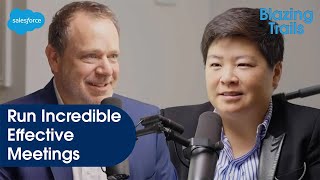
Jen Wong, Reddit's COO, talks with Michael Revo about running effective meetings, leadership styles, and mentorship. Wong shares how Reddit builds community and what productivity actually looks like at scale.
Chapters
Welcome back to Blazing Trails. I'm Michael Revo and today we're featuring our interview with Jen Wong, the chief operating officer of Reddit. This was an awesome conversation, so stay tuned for some great leadership tips on how to lead as an introvert, how to run incredibly effective meetings, and how to grow killer vegetables with help from her friends on Reddit. And we would love to hear from you. So add a comment below and let's get the conversation going here on the Salesforce YouTube channel. I kicked off my conversation with Jen by asking about leading as an introvert.
I think everybody has to find something that works for them. And what's worked for me is I think I'm really good at one on one conversations because they're controlled and less risky. I guess that's how they feel.
Yeah.
Look, I still get stressed about standing on stage in front of people. It's not comfortable for me. I do it, I've gotten better at it, but it's not my natural disposition. An enjoyable moment for me, I'd say. The good news is I think that there's like a lot of different leadership styles now.
Yeah.
So you can lead from behind and let your team be the stars. And that's a, that's something that I think people enjoy in terms of a leadership role. There are people who lead from the front and like to get on stage and rally. You know, I think some leaders, you know, we have both kinds in, in our company, both, I think, work. So that's what's great is I think there's a much more diverse set of, of leadership ideas for, you know, what might be called an introvert, an extrovert. Whether you want to be out in front or lead from behind and let your team be the stars.
Yeah, it does seem like that's changing a little bit. Where it's not necessarily kind of a rah rah thing that you have to do. Yeah, I think there are. People are recognizing the different styles. Really? That's right for that. So you're talking about your team. I'd love to ask this question, which is how do you run meetings? The dreaded meetings.
The dreaded meetings. A couple things. One, we use documents. I believe documents are a really great equalizer. You have all the thoughts prepared beforehand, people pre read. I like people to write their thoughts ahead of time so you can be clear, you know, where different people's perspectives are and it's chronicled. And I find that that's a helpful way to make sure everybody gets a voice. It reduces the amount of Talking time. Some people talk more than others to work out things, and that can be unequal in terms of the discussion. But writing tends to be a little bit more of a balance, balancing act on that front.
And break that down for me. So we've got a meeting next week on XYZ Topic. What are the steps that help you?
So if you're responsible for the meeting or you called the meeting, you write down a point of view. So my requirement is you write the facts.
Okay.
You write the point of view.
Okay.
Usually.
And what's the point of view?
Point of view should be the answer, what the recommendation is. I usually like to get to a yes. No.
Okay.
What you should be looking for me is not for me to decide, but for me to say yes or no to what you have decided.
Okay.
That's what I. That's my ideal statement.
Write this pov. And what does that. What does that look like, that document?
Here's the context. Why are we here? Can we reverse it here? The three things you should know. Why I decided X.
Okay.
Why I would recommend X. Yeah. And then. Then there's a section for discussion where people write their perspectives.
And is that a share? I mean, I know this is detailed. That's an open. That's a shared.
That's an open document to everybody who participated in theory, I guess. Well, yeah, to anybody who was involved in the decision.
Right. And that's prior to the meeting.
Correct.
So there's conversation that's happening in the.
Document asynchronously in the document. Yeah.
Okay.
Then there is a meeting which could be quick because it could be that it coalesced into a decision.
Yeah.
And there doesn't need to be a meeting.
Right.
Or not. Which would have a live discussion to ask questions and go through more detail. Then we make a decision. And often I try to push that decision to not be me. So I really, really want our teams to take ownership of their decisions.
Yeah.
So I try hard to push decisions to other people and then once that decision is made, it's written in the document and the other people sign off. The reason why is because that prevents people forgetting.
Right.
Details or revising later. You've all agreed on this. It's documented and it's done. Other people can read it.
Right. That becomes a public document.
If. If it's helpful to other people, you can share the document and say, here's the context for the decision.
Yeah. Is this something you developed or sort of learned?
We did as a company. Yeah. Yeah, yeah, yeah. It's something That, I mean, I wholeheartedly believe in.
Yeah.
I've probably been the biggest advocate of pushing people to recommendation. Yes. No.
Yeah.
That is something that. Because I think that just. It teaches other people to decide. It's very easy for decisions to move up.
Right, right. And for people to defer and not take responsibility. But I think it's less than.
Or to learn to learn to take the responsibility. Yeah.
It's not not taking responsibility. I think it's a cultural thing, which is. Well, I've given the information and now.
Yeah, it could be. Or I don't feel like I'm the right person to make the decision. I'm uncomfortable taking the responsibility to make this decision. Or I'm not sure that it's me who has the right to make this decision. All those things. So having clarity on who gets to make the decision and being as clear as possible that it doesn't have to be me, that you actually. I trust you to make the decision.
Right. And that has to be something that's verbalized as the leader. That's really the job. Which is to clearly define.
Yes.
Who's going to make that decision.
That's right. Yeah, yeah, yeah.
Well, who knew there was so much information about meetings. I love it. I love that segment on meetings. When we were having that conversation, I was thinking, this is the way to run a meeting. This is pretty awesome. But what do you think? Would her method work for you, for your company? Any tips on how you run a meeting? We want to hear from you, so drop a comment below and let's get the conversation going here on the Salesforce YouTube channel. Now let's get back to the conversation with Jen, and I ask her about mentorship and the role that it's played in her career.
I find talking to almost anybody valuable. Both people who have more experience than I do, less, you know, years of experience, but a different vantage point. All of it's valuable.
Yeah.
So. And I tell people that all the time, like, you'll get great advice from all angles and you'll surprise you sometime. It's not. Not the, you know, the. The former CEO, but it's not always, you know, they're not always the most valuable, you know, know, most insightful person. It comes from all angles.
Yeah.
So the most important thing is to have conversations and always be learning that mindset.
Yeah. We talk about that at Salesforce a little bit as this sort of idea of a beginner's mind and really. And being open to that. I mean, it can be challenging when you're trying to do your day to day work and you've got, you know, other concerns. Is there how, how do you reach that moment where you feel like I really should be reaching out or doing this, but I'm not. Or how, you know, how do you, how do you kind of force yourself?
I do.
Yourself doing.
And then I have to course correct. Yeah, I do. And then I have to course correct or I have to figure out how to do it in a shorter amount of time.
Yeah.
So that's the other thing that I've spent a lot of time thinking about just in terms of my personal productivity.
Right.
Is how do I. How do I basically create more hours.
Right. I mean, we all have the same number of hours of the day. You look at what some people can accomplish versus others. So what are some hacks?
Or how's use a lot of. I use a lot of verbal dictation now. Verbal notes. It's much faster than writing.
Yeah.
Because it reduces my cognitive load. Because if you have things that you're carrying in your head and you haven't let them out, they sit there and they make you slower. So I found getting them out makes me faster.
Well, it's amazing, the return on some work versus others.
Yeah. And I do it in the morning, which is my best time. So I also have optimized for my. My best thinking time's in the morning. I'm okay doing meetings in the afternoon. So I scheduled the day based on sort of my thinking biorhythm.
Right, right. And I think this speaks to what we were talking about with meetings too, which is if, you know, if you're responsible for this and you have to write that document, that's gonna build in the writing time, the thinking time. So having that sort of forcing function.
Yeah. The thing that's on my mind all the time is I could be reactive 100% of the day because I could respond to emails and phone calls. And those are things that I consider to be urgent but not important. But I could spend no time on things that are important but not urgent. And often the important things, the thinking, the strategy, et cetera, it's never urgent, but it's really important.
Right, Right. So carving at that time is so important. Those are some awesome productivity hacks. I love being able to do dictation and I generally like to get a good night's sleep. In addition, I would love to hear from you and from our community here on the Salesforce YouTube channel. What do you do to amp up your productivity? So drop a Comment below and let's start up the conversation. Next, Jen dives into how brands should build communities on Reddit.
Well, Reddit's a really special place because it's the largest network of communities that there is on the Internet. So it covers every single topic. And these communities are incredibly passionate about everything, you know, productivity, tools to how to deal with their accounting, to news, politics, gardening, you name the topic.
It's such a, it's just such a huge spread of stuff out there. Yeah.
And all the users there are there to learn. They come with a really, really open mindset. They're high intent. And so if you're a marketer and you're trying to grow your business, your customer is probably on Reddit and deeply engaged and in something that's related to what you care about.
Right.
And that's, that's what's amazing. It's a place where people can come to find new customers that are really, really high intent, high engagement, and high value.
And how do you show up there with authenticity? I mean, that's such a big part of Reddit that it's, you know, if you show up there with a brand message that's, that doesn't resonate, you're going to find out about it. So how should you approach it?
Well, think of it as similar to human life. Right. So in real life, what do you do to show up? Well, number one, you listen. So most of our partners, they listen and learn about how communities talk, what they're interested in. Two, they are, you know, sometimes they show up and ask questions. Right. They actually want to learn and hear from other people. That's actually what they do as part of their engagement campaigns. Yeah. Sometimes they bring something of value to the community, like they'll do an ask me anything with one of their experts, where the community gets to engage with them. Um, but for the most part. And they mimic the creative on Reddit Red, it's funny, got a lot of memes, it's got a lot of jargon.
Yeah.
And we help our clients navigate that. Right. We help them find the insights, we help them figure out, okay, what's the right way creatively to show up in this community. But again, it's just like real life. You follow social cues and social rules, and that's what helps you show up.
Well, yeah, and I mean, it's interesting the, the relationship between Reddit and the communities sort of, you know, the business side versus the community that's really running the platform in a lot of ways. So how do you think about Sort of decision making and prioritization from the, you know, host, I guess, you know, perspective. And if that's right, if that's how you think about yourself, what does that look like?
Our responsibility is to provide, I think, a basic set of tools that empowers users in the communities and also a basic set of sort of rules and governance. And they will build more governance and more rules and enforcement on top of that. That's kind of how we share the responsibility for the health and safety of the platform. Yeah. All of us are guided by a set of values that I think took us some time to articulate, but we, I think it more and more, it's clear we have these values of keep Reddit real. Remember the human empower communities. Privacy is a right. Believe in the good. These are things that our community upholds and we uphold. So privacy is a right, is you're always going to have the right to be anonymous, have control over your data. We're never going to force you to de. Anonymize yourself to get access to information. We believe in the open web. That is a core principle.
And that's really from the beginning.
From the beginning, Yeah.
I mean, and so how do you, you said it's a process to get to these values. Tell me about that process a little bit. How do you do that?
Yeah, I think that they weren't a cornerstone day one. You couldn't just articulate them. In fact, I think Reddit itself was sort of an evolution over time. But when we reflected on the platform over the last five years, you could crystallize these values because we all sort of operate them as informal mores. Right. So we know that our community really cares about privacy and that they want these controls. And you could tell from the dialogue. And so we just sort of codified that. Same with something like, you know, keep Reddit real. What that really is about is Reddit can be. It's very wide in its idea set and some of them are fringe. And that's okay. It's okay to be part of a small community that's really obsessed with toy cameras. Yeah, totally fine. And that keeps it real because that's the amazing thing about humans. Like, it's real that people are into toy cameras. Yeah. Remember the human. I mean, that's something that is about the empathy we about almost 20% of Reddit is support on very private things. Ailing parent, a sick child, you know, a tough thing that you're going through at work or with family addiction, etc. So that is that's about keeping it real. Right. We want to make sure that we always have those spaces for all parts.
Of the human experience as the CEO of the company and, you know, looking to grow and to, you know, to build the business as well as the platform. How do you balance that need for growth and then maintaining the values of the community?
The value. Values are our non negotiable foundation.
Yeah.
And when we built the first business, our first business is in advertising. It's the most significant revenue stream.
Yeah.
We built a business that's in harmony with our values. So privacy and anonymity still built in fundamental value, but we have a performant ad platform for our partners that respects that value. So those have been built in harmony together and we'll continue to do that. Everything we do starts with those values. Now the other part is, you know, you think about our growth. Right. Reddit is about quality content. It's really about content you can't get anywhere else. The questions, the very, very detail questions and the realness of what really is the best product, what really is your experience. Right.
Yeah.
That is everything for us. And that's a core value, that authenticity.
Right.
We would not trade that for growth. And we're, I think we're very thoughtful about that.
Okay, quickly, the last question I want to talk about is. You mentioned gardening before.
Okay, so tell me trials and tribulations.
I had a tough gardening season.
But you had, you did. What did you grow?
I was growing tomatoes. Nothing that special. I was growing tomatoes and cucumber and so, you know, pepper friendly. Yeah. But I, I had some, I think some invasive animals and stuff didn't work out as well. Mint, man, you can grow everywhere. You can grow mint really easily. So plant a little mint and you're guaranteed to get something.
Sunflowers are the same. Yeah. Gardening was a kind of picked up, really picked up during the pandemic for me and I've gone very, I've expanded my ambitions every year from a small two by four to now like an eight by eight garden. Yeah. So. But I have failed at anything below ground. So carrots, beets, even potatoes I have struggled with. This year I was getting help from Reddit on my carrots because they came out very stumpy and white, which was.
Really like a big.
Yeah, the top part was like flourishing. Yeah. I just expected a beautiful orange carrot to come out a stumpy white, you know, one inch carrot. So I have to try again next year. Apparently my soil was too packed with not the right minerals that they told me.
Well, It's a, it's a, that's a lifelong journey for sure.
It is. It is.
Okay, well, wonderful. Jen, thank you so much for joining us today.
Yeah, thanks for having me.
Well, that was Jen Wong, the chief operating officer of Reddit. If you want to hear more trailblazing interviews, be sure to subscribe to Blazing Trails wherever you get your podcasts. And now you can subscribe to us on our YouTube channel. Blazing trails is video and audio. Did you know that YouTube is now the biggest podcast platform in the world? And we want to be there and we want to bring you great information. So be sure to subscribe on our YouTube channel. Search us, look it up, get in touch with us, make comments. We want to hear from you. So we're so glad that you're here today and hope to see you again. I'm Michael Revo.









